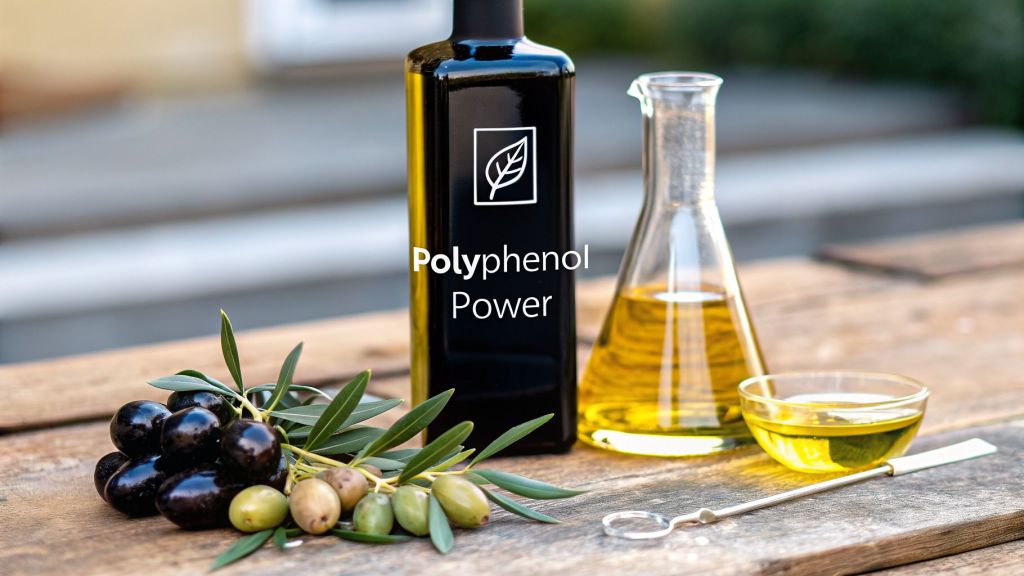
If you're hunting for the extra virgin olive oil with highest polyphenol content, you’re after something very specific. You need an oil made from certain olives, picked defiantly early while still green, and rushed to the mill within a few short hours. This isn't just a cooking ingredient—it’s a functional food, a true health tonic prized for its astonishing antioxidant and anti-inflammatory power.
Searching for Liquid Gold: Why Polyphenols Matter

Imagine an oil that doesn't just flavor your food, but actively wages war against inflammation and aging inside your body. That's the promise—and the reality—of a true high-polyphenol Extra Virgin Olive Oil (EVOO). This is nothing like the bland, lifeless oil gathering dust on your supermarket shelf; this is a functional food, closer to a natural pharmacy than a simple kitchen staple.
The secret that elevates olive oil from a common fat into a potent health elixir isn't a secret at all. But it’s a truth most commercial producers would rather you didn't know. The key to unlocking those profound anti-inflammatory and antioxidant effects boils down to a single, measurable element.
What Makes an Olive Oil Truly Exceptional
The critical difference between an ordinary oil and a therapeutic one lies in its concentration of polyphenols. Think of these natural compounds as the olive's private army of bodyguards, shielding it from the harsh sun and oxidative stress. The miracle is this: when we consume an oil rich in them, they perform that exact same protective duty inside our bodies.
And we're not talking about vague, feel-good health concepts. A higher concentration of these compounds is directly linked to greater wellness potential, a fact supported by a mountain of scientific research. For a deeper look, you can learn more about the benefits of polyphenol-rich olive oil in our detailed guide.
The most potent oils almost always come from olives harvested before they’re fully ripe. This is what gives them a more bitter and peppery flavor—a direct, unmistakable signal of their high polyphenol activity.
Understanding Polyphenol Levels
To make a truly smart choice, you must understand what the numbers mean. The concentration of polyphenols, measured in milligrams per kilogram (mg/kg), is the ultimate yardstick of an oil's potency. It's the number that tells you how to use it in your daily life for maximum effect.
To help you decode the labels, this table breaks down what the different polyphenol counts mean, so you can arm yourself with the right oil for your health goals.
A Quick Guide to EVOO Polyphenol Levels
| Polyphenol Level (mg/kg) | Classification | What It Means | Best Use |
|---|---|---|---|
| Below 250 | Standard EVOO | Fine for cooking, but offers minimal therapeutic benefits. | Everyday cooking and sautéing. |
| 250 – 500 | High-Phenolic EVOO | Delivers tangible antioxidant and anti-inflammatory effects. | Finishing oil, dressings, daily health. |
| 500 – 1000 | Ultra-High-Phenolic | A potent dose of compounds like Oleocanthal; strong peppery taste. | Health supplement, drizzling. |
| 1000+ | Therapeutic Grade | The highest concentration available, used for targeted health support. | Taken like a supplement by the spoonful. |
Consider this guide your first step to finding an extra virgin olive oil with highest polyphenol content that genuinely lives up to its ancient, almost mythical, reputation for wellness.
What Are Polyphenols? The Unseen Heroes in Your Olive Oil
Imagine polyphenols as the olive's personal security detail. Hanging on the tree, these potent natural compounds are what protect the fruit from the blistering sun, pests, and the relentless attack of oxidation. And here's the beautiful secret: when you consume a high-quality olive oil, they do the exact same protective job for you.
But let's be more specific. When people go hunting for an extra virgin olive oil with the highest polyphenol content, they're really searching for a handful of key compounds you can actually taste and feel. These sensory cues aren't just quirks of flavor; they are the direct signature of the oil's protective power.
Meet the Power Players in Your Bottle
That unique, robust taste of a world-class olive oil is no accident. It’s the handiwork of specific phenolic compounds, each bringing its own signature flavor and life-enhancing benefits to the table. Getting to know them is the first step toward understanding what makes an oil truly extraordinary.
Here are the main heroes you'll find:
-
Oleocanthal: This is the compound that delivers that peppery "sting" at the back of your throat. It's the hallmark of fresh, high-quality oil and a direct sign of its potent anti-inflammatory properties. In fact, many researchers have drawn a stunning parallel between its effects and a small, natural dose of ibuprofen.
-
Oleuropein: This is where that pleasant, palate-cleansing bitterness comes from, especially in robust, early-harvest olive oils. As a powerful antioxidant, Oleuropein is one of the most abundant polyphenols in green olives, playing a crucial role in the oil's stability and health-giving potential.
-
Hydroxytyrosol & Tyrosol: These are antioxidant dynamos, famous for their ability to help shield your body's cells from oxidative damage. They are among the most researched compounds in olive oil, especially for their role in supporting cardiovascular health.
When you taste that bitterness on your tongue or feel a peppery sensation in your throat, you're having a direct sensory experience with polyphenols. These aren't defects—they are undeniable proof of the oil's vitality and potency.
Why Flavor Is Proof of Function
It's a common and costly misconception that the "best" olive oil should be mild and buttery. But if you're after maximum health benefits, the opposite is often true. That robust, pungent, and even slightly bitter profile is the calling card of an oil that's packed to the brim with protective compounds.
The taste is a message, telling you the oil's natural bodyguards are on duty. While some producers chase sky-high numbers, a truly great artisan oil finds a masterful balance—delivering a high polyphenol count without overwhelming the palate. You get a powerful, healthy oil that is also a genuine pleasure to eat.
This link between taste and function is everything. The bitterness from Oleuropein and the peppery pungency from Oleocanthal aren't just flavor notes; they are the very reason we call this stuff "liquid gold." Learning to appreciate these intense characteristics is like training your palate to spot quality at its most fundamental level. For a much deeper dive, our guide to the key phenolic compounds in olive oil breaks it down even further.
Ultimately, getting to know these unseen heroes changes your entire relationship with olive oil. It's no longer just another bottle on the shelf—it becomes a conscious choice for flavor, health, and vitality. A choice you can taste with every single peppery, life-affirming spoonful.
The Blueprint for Crafting a High-Polyphenol Oil
An elite olive oil, the kind teeming with powerful health benefits, doesn’t just happen. It’s the result of an intense, almost fanatical dedication to the craft. Forget the romanticized images of lazy, sun-drenched groves; producing an extra virgin olive oil with the highest polyphenol content is a high-stakes race against time where every single decision counts.
This journey from grove to bottle is part precise science, part demanding art form, and it all rests on four foundational pillars. When producers master this blueprint, they create an oil that’s not just food, but a potent force for wellness. When they cut corners, those precious polyphenols vanish, leaving behind little more than a generic cooking fat.
The Genetic Foundation of Potency
Everything starts with the olive itself—its genetic code. Just as a thoroughbred is bred for speed, certain olive cultivars are naturally wired to produce staggering levels of polyphenols. Varieties like Coratina from Italy, Kalamon from Cyprus, and Picual from Spain are legendary for their robust, antioxidant-rich profiles.
Mass-market producers often prioritize yield over potency, choosing olives that grow fast and produce a lot of oil. But artisans chasing the highest polyphenol content make a different trade-off. They cultivate these specific, often lower-yield varieties, knowing the real treasure isn’t the quantity of oil, but the quality of the compounds locked inside each fruit.
The Critical Moment of Harvest
Once you have the right olive, the next pillar is timing. And timing is everything. Polyphenols are at their absolute peak when the olive is young, hard, and green. This is the moment just before the fruit begins to ripen and soften—a fleeting window that might only last a few weeks.
This early harvest is a major sacrifice. Green olives contain far less oil than their mature, black counterparts, which means the producer gets a much smaller yield for their efforts. It’s a costly decision, but it's non-negotiable for achieving that peppery, pungent character that signals a truly high-phenolic oil. The resulting oil is often a vibrant, electric green, a visual cue of its vitality.
The infographic below shows how just one of these polyphenols, Oleocanthal, gets from the olive to your body to do its job.

As you can see, that peppery sensation in your throat isn’t just flavor—it's the direct action of Oleocanthal, a powerful anti-inflammatory compound, hard at work.
A Race Against Oxidation
From the moment an olive is picked, the clock starts ticking. Oxygen, light, and heat are its sworn enemies, working relentlessly to break down the fragile polyphenols. This is where the third pillar—speed and technique—comes into play. The world’s best producers have turned this into a masterclass in efficiency.
The gold standard is to have the olives pressed within 2 to 4 hours of being harvested. This immediate milling crushes the fruit and extracts the oil before oxidation can even begin to take hold, effectively trapping the polyphenols in their most potent state.
Contrast that with industrial operations where olives might sit in piles for days, slowly fermenting and losing their vitality. The difference is night and day. Premium extraction also requires a modern "cold-press" method, keeping temperatures strictly below 27°C (80.6°F) to protect every last beneficial compound. For a deeper dive on this crucial step, you can explore the nuances of modern olive oil extraction in our dedicated guide.
The Final Guardian: Terroir
Finally, we have "terroir"—that unique combination of soil, climate, and geography. Just like with fine wine, the land imparts a distinct character to the olive. Olives grown in well-drained, rocky soil under intense sun often have to fight harder to survive. This struggle triggers a natural defense mechanism in the fruit, causing it to produce more polyphenols as a form of self-protection.
This is why certain regions are famous for producing oils with unmatched intensity. It’s not just the cultivar or the harvest method; it's the land itself contributing to the final product. Understanding these four pillars—genetics, timing, technique, and terroir—gives you a profound appreciation for what’s in your bottle. It's the reason a true high-polyphenol EVOO costs more, and why its benefits are worth every penny.
How to Decode Polyphenol Counts on the Label
Numbers on a bottle can feel a bit abstract, but when it comes to olive oil, they tell a powerful story about its potential to protect your health. In fact, the polyphenol count is the single most important metric separating a true functional food from a simple cooking fat.
Learning to read these numbers is your key to looking past flashy marketing and finding a genuinely superior, health-promoting oil. So, what exactly is a "good" polyphenol count? It all depends on your goals. The number you'll see on a label is typically in mg/kg, which means milligrams of polyphenols per kilogram of oil. This simple figure is your window into the oil's antioxidant and anti-inflammatory power.
Establishing Your Baseline for Quality
The range of polyphenols in olive oil is astonishingly wide. Your average commercial extra virgin olive oil often hovers between 100-250 mg/kg. While perfectly fine for cooking, oils in this category offer minimal therapeutic benefits—they just don't have the concentration of active compounds to make a real difference.
If you're seeking tangible wellness benefits, the magic really begins once you cross the 250 mg/kg threshold. This is your entry point into the world of high-phenolic olive oil, where the concentration is potent enough to start delivering noticeable antioxidant and anti-inflammatory effects.
Think of it like this: an oil below 250 mg/kg is like a gentle daily vitamin, while one above 500 mg/kg is more like a targeted, high-dose supplement. Both have their place, but their jobs are entirely different.
The difference in health impact between an oil with 150 mg/kg and one boasting over 500 mg/kg isn't subtle; it's night and day. If you’re serious about finding an extra virgin olive oil with highest polyphenol content, you need to aim higher.
Translating Numbers into Health Ambitions
Once you get the hang of the basics, you can start matching the numbers on the label to your specific health ambitions. This is where you gain real power as a consumer. If you need help navigating the often confusing terminology on olive oil bottles, our guide to understanding olive oil labels is an invaluable resource.
Here’s a simple framework to guide you:
-
For Daily Wellness (250-500 mg/kg): This is the sweet spot for general health maintenance. An oil in this range provides a robust daily dose of antioxidants, perfect for drizzling over salads and vegetables to support overall vitality.
-
For Targeted Support (500-1000 mg/kg): Welcome to the ultra-high-phenolic category. These potent oils are prized by those seeking serious anti-inflammatory support. You’ll definitely notice a much more intense, peppery, and bitter taste—that’s direct evidence of compounds like Oleocanthal hard at work.
-
For Therapeutic Use (1000+ mg/kg): This is the absolute pinnacle of potency. These oils are typically taken by the spoonful like a natural medicine, often for specific health protocols under professional guidance. Their flavor is extremely intense and not really intended for culinary use.
The polyphenol content in extra virgin olive oil varies dramatically depending on the production methods and olive varieties. While the international average is around 330 mg/kg, some regions produce oils that blow that number away. For instance, early-harvest Halkidiki olive oils from Greece can reach an average of 495 mg/kg—nearly 50% higher than the global norm. You can discover more insights about polyphenol benchmarks on mcevoyranch.com.
By learning to decode these numbers, you transform from a passive buyer into an empowered advocate for your own health.
Separating Fact from Fiction: How to Verify a Claim
In an industry filled with bold claims and beautiful bottles, how do you find the truth? Any producer can boast about a high polyphenol count, but without evidence, those numbers are just marketing noise. This is your defense against the hype, and it all boils down to one simple rule: demand proof.
Think of yourself as a detective. Your mission is to cut through the beautiful labels and charming stories to find the hard data. The good news is, the best producers of extra virgin olive oil with the highest polyphenol content make this easy for you. They’re proud of their work and happily provide the evidence you need to trust their product.
Your Best Evidence: The Certificate of Analysis
The single most powerful tool you have is the Certificate of Analysis (COA), often just called a third-party lab report. For any brand making serious health claims about its olive oil, this document is non-negotiable. It’s the impartial, scientific proof that what’s on the label is actually inside the bottle.
When you find a COA—often on the producer’s website or linked via a QR code on the bottle—here’s what to look for:
- Total Polyphenol Count: Find the specific number, usually measured in mg/kg. This is the main figure that verifies the oil's potency.
- Harvest Date: This is absolutely crucial. Polyphenols degrade over time, so you need to know when the oil was produced. A lab test from three years ago tells you nothing about the bottle you're holding today.
- Specific Phenolic Compounds: A really detailed report might even break down the levels of key players like Oleocanthal and Oleuropein, giving you deeper insight into the oil's unique profile.
A brand that readily provides a current, detailed lab analysis is showing transparency and confidence in its product. If a company hides or avoids sharing this data, consider it an immediate red flag.
Beyond the Lab Report: Reading the Clues
While the COA is your primary piece of evidence, other clues on the bottle and website support a brand’s claims. These details show a producer's deep commitment to preserving the precious compounds they worked so hard to create.
Learning to spot these signals helps you avoid common pitfalls. For example, many people don't realize how quickly quality can degrade, which is why it's so important to know how to spot fake or low-quality olive oil on the shelf.
Keep an eye out for these essential signs of authenticity:
- A Prominent Harvest Date: Don't confuse this with a "best by" date. The harvest date tells you exactly when the olives were picked and pressed, giving you a true measure of freshness. Always choose the most recent harvest available.
- Dark, Protective Glass (or Tin): Light is a primary enemy of polyphenols. A producer selling a high-potency oil in a clear glass bottle simply doesn’t understand the science of preservation, or worse, they don't care. Opaque glass or a metal tin is a must.
- Specific Olive Cultivar Information: Reputable producers are proud of their olives. They'll tell you if the oil is made from Coratina, Picual, Kalamon, or another high-phenolic variety.
This level of detail is a clear sign of a producer who is deeply invested in their craft. They want you to know the full story behind their oil, from the specific olive genetics to the exact month of its creation.
The industry is also seeing producers push the boundaries of what's possible, achieving truly astonishing results. For example, the Cyprus-based producer Oleaphen recently verified a polyphenol concentration of 2,236 mg/kg for their 2025-2026 harvest—the highest independently verified level in the world. This is a monumental figure, and their commitment to third-party verification is setting a new standard for transparency in an industry where claims often go unproven. You can read more about this milestone achievement at highphenolic.com.
By arming yourself with this knowledge, you can move beyond the marketing and choose an oil based on verifiable facts.
Taste and Store It Like the Liquid Gold It Is

After all the research and label-reading, the real proof is in the tasting. Believe it or not, your own palate is one of the best tools for spotting an extra virgin olive oil with highest polyphenol content. The very things that signal potency—a sharp bitterness and a peppery sting—are impossible to miss once you know what you're looking for.
A truly robust, polyphenol-rich oil will greet your tongue with a distinct bitterness, especially along the sides. That’s not a defect; it's the calling card of powerful compounds like Oleuropein. Right after, you should feel a peppery "kick" in the back of your throat that might even make you cough. That's the Oleocanthal, and the more intense that kick, the more of that anti-inflammatory superstar you've got.
Guarding Your Investment
Once you've brought home a truly superior oil, your job is to protect it. Those fragile, potent polyphenols you paid a premium for have three sworn enemies: heat, light, and oxygen. Proper storage isn't just a friendly suggestion; it's absolutely critical to preserving the oil's health benefits and vibrant taste.
Think of it like a fine vintage that needs a good cellar. Just as with premium spirits, understanding proper storage techniques is key to protecting its quality.
Your pantry is your best friend here. A cool, dark spot far from the stove is perfect. Never, ever leave your olive oil on a sunny countertop or next to the oven—heat and light will tear through those precious polyphenols in no time.
Follow these simple rules to keep your liquid gold safe:
- Keep it Cool: The sweet spot is a stable temperature around 14-18°C (57-65°F). Don't put it in the fridge, though, as condensation can spoil the oil.
- Keep it Dark: Always store the bottle inside a cupboard or pantry, away from any light.
- Keep it Sealed: Oxygen is the enemy. Make sure you twist that cap on tight after every single use to keep the air out.
Using Your Oil for Maximum Impact
To really get the full health benefit from your purchase, you need to change how you think about using it. This is not your everyday frying oil. High heat will destroy the very compounds you bought the oil for, turning your therapeutic elixir back into plain old cooking fat.
Instead, treat it as a finishing oil. It’s that final, powerful touch that boosts the flavor and nutritional value of your meal. Drizzle it generously over salads, steamed vegetables, soups, and grilled fish after cooking is done. This ensures the polyphenols get to you intact and in their most powerful form.
This simple change transforms every meal into a chance to invest in your well-being. It also honors the incredible craft behind the bottle. Some producers, like Atsas in Cyprus, have reached mind-boggling levels, with one batch of their Kalamon variety oil hitting 4,947 mg/kg—one of the highest ever recorded.
Your High-Polyphenol EVOO Questions, Answered
Stepping into the world of high-potency olive oil can feel a little intimidating, but it doesn't have to be. Let's clear up some of the most common questions so you can enjoy every last drop with confidence.
Can I Cook with High-Polyphenol Olive Oil?
You can, but I wouldn't recommend it. Think of this oil as a finishing touch, not a cooking fat. High heat is the mortal enemy of those delicate polyphenols and the complex, vibrant flavors you paid a premium for. Heat breaks them down, fast.
To get every bit of the health-boosting power from an extra virgin olive oil with the highest polyphenol content, it's best enjoyed raw. Drizzle it over your food right after it's been cooked. For high-heat jobs like searing or frying, a good quality, standard EVOO is a much smarter and more economical choice.
How Much Should I Take Daily for Health Benefits?
Most of the landmark studies that put olive oil on the health map used a daily dose of one to two tablespoons, which is about 15-30ml. When you're using a potent, high-polyphenol oil, that's enough to deliver a serious therapeutic punch of antioxidants.
I like to think of it as a daily supplement for whole-body wellness. Starting with one tablespoon a day is a fantastic habit to build. Of course, it's always a good idea to chat with your doctor or a healthcare professional to get advice that's tailored specifically for you.
It's a common misconception that deep green olive oil is higher in polyphenols. In reality, the color comes from chlorophyll and has nothing to do with antioxidant levels. A peppery kick in the back of your throat is a much better sign, but only a lab report can tell you the true number.
How Long Do Polyphenols Last in a Bottle?
Polyphenols are sensitive little compounds. They degrade over time, and their biggest enemies are heat, light, and air. A freshly pressed, top-tier EVOO will hold onto most of its power for about 18-24 months from the harvest date—but only if you store it properly.
To make sure you're getting what you paid for, always look for the harvest date on the bottle and grab the freshest one you can. Once you've opened it, try to use it up within a few months. That's when you'll get the peak flavor and the full health benefits.
Ready to experience the best? Learn Olive Oil is your ultimate guide to discovering premium extra virgin olive oils from around the world. Start your journey and find your perfect bottle today at https://learnoliveoil.com.
 Learn Olive Oil
Leave a comment