Picture this: you bite into a plump, sun-ripened olive, plucked straight from the branch. There's a burst of green, a peppery kick, a flavor so alive it almost vibrates. That exact sensation—that soul of the olive, captured in a bottle—is the promise behind two simple words: Extra Virgin.
Forget everything you think you know about the bland, lifeless oils gathering dust on supermarket shelves. "Extra virgin" isn't a clever marketing slogan. It's a blood oath. A legally binding contract between a dedicated producer and you, promising absolute purity and a standard of excellence that separates the liquid gold from the merely ordinary.
What's the Real Secret Behind "Extra Virgin"?
Here's the truth most people never discover: extra virgin olive oil (EVOO) isn't really oil at all. It's fresh, unadulterated fruit juice. It represents the pinnacle of the craft, a testament to an unblemished, raw state that perfectly preserves the olive’s true character. This isn't just a label; it's a hard-won badge of honor.
At its very heart, the title "extra virgin" stakes its reputation on two non-negotiable promises:
- An Unbroken Chain of Purity: The oil was coaxed from the olive using only mechanical means. No harsh chemical solvents. No destructive high heat. Just the ancient, honest method of pressing to release the precious liquid within.
- A Flawless Sensory Profile: The final product has survived a grueling trial by fire, passing both a battery of strict chemical tests and a professional human tasting panel, proving it has zero defects in taste or aroma.
This table reveals the stark, unvarnished truth, showing you exactly what separates the champion from the contenders.
Extra Virgin vs Other Olive Oils At a Glance
| Attribute | Extra Virgin Olive Oil (EVOO) | Virgin Olive Oil | Regular/Light Olive Oil |
|---|---|---|---|
| Extraction Method | Mechanical "cold press" only; no heat or chemicals. | Mechanical only, but may have minor defects. | Refined with heat, solvents; blended with a little virgin oil. |
| Acidity Level | Below 0.8%. Top-tier oils are often under 0.3%. | Between 0.8% and 2.0%. | Acidity is chemically altered; not a quality indicator. |
| Taste & Aroma | Fruity, peppery, grassy, complex. No sensory defects. | Good flavor, but has noticeable sensory defects. | Neutral, bland, or oily taste. Lacks aroma and character. |
| Health Benefits | Highest in polyphenols and antioxidants. | Some beneficial compounds remain, but fewer than EVOO. | Most beneficial compounds are stripped out during refining. |
As you can see, the chasm between them is vast. EVOO stands in a class of its own, built on an unwavering commitment to preserving the soul of the olive.
The Pristine Power of the First Press
Have you ever wondered why genuine extra virgin olive oil carries a higher price tag? It's simple. You're paying for honesty. For an uncompromised production process that refuses to cut corners. The method relies solely on cold mechanical extraction from the very first pressing of the olives.
This technique has one mission above all others: to safeguard the delicate natural flavors, vibrant aromas, and potent antioxidants that heat and chemicals would utterly annihilate. This fierce dedication to purity means the oil retains the full spectrum of its personality, from whispers of green grass and almond to that tell-tale peppery fire that catches in the back of your throat. This, my friend, is the flavor of a living fruit, bottled.
The Unforgiving Gauntlet of Quality
A gentle process is only the opening act. To officially claim the "extra virgin" crown, an oil must pass a series of specific, measurable trials.
The most famous is its free fatty acidity level, which must fall below 0.8%. This isn't about how acidic the oil tastes. It's a chemical fingerprint that exposes the health of the olives and the speed of the milling process. Damaged, overripe, or bruised fruit will always produce a higher acidity oil.
While the legal limit is 0.8%, you'll find that world-class, award-winning EVOOs don't just clear that bar—they soar over it. Their acidity is often below 0.3%. A low number is an irrefutable sign of superior farming and milling.
This scientific rigor is your guarantee. It ensures the integrity of the olive has been fiercely protected every step of the way. To peer deeper into the science behind this critical number, you may find this piece on understanding olive oil acidity fascinating.
The Unseen Journey from Grove to Bottle
The soul of an extra virgin olive oil isn't forged in a factory. It's born in sun-drenched groves, long before a bottle graces your table. Its destiny is decided by the hands that tend the trees and an iron-willed commitment to a process that is as much art as it is agriculture.
This is where the story of "extra virgin" truly begins. Not by treating olives as a bulk commodity, but as the precious fruit they are. The path to perfection is a breathless sprint against the clock, where every second is the difference between glory and mediocrity.
A Desperate Race Against Time
From the very instant an olive is severed from its branch, a countdown begins. The enemy is oxidation—a relentless natural force that degrades the fruit, raises its acidity, and spawns foul, musty flavors. To stop this invisible thief, producers must move with the speed and precision of a strike team.
The finest olives are harvested with painstaking care, often by hand, to prevent the bruising that instantly poisons their potential. A bruised olive is a wounded olive; it will bleed its quality away. Once picked, the fruit is whisked to the mill, ideally within a few short hours. This mad dash is the only way to lock in that vibrant, fresh-from-the-tree character.
Think of it this way: an olive left to sit for a single day begins to ferment and decay. The chasm between a harvest-to-mill time of four hours versus twenty-four can be the difference between an award-winning EVOO and a batch destined for the refinery.
This obsessive urgency is what separates the true artisans from the industrial producers. They know that a single day’s delay can nullify a year’s worth of devotion in the grove.
The Gentle Art of Cold Extraction
Once the olives reach the sanctuary of the mill, the next vital act unfolds: extraction. This is where the term "cold extraction" (or "cold press") becomes paramount. But what does it truly mean?
Imagine you’re trying to get juice from a delicate raspberry. You could blast it with high heat and crush it with brutal force. You'd get a lot of juice, but it would taste cooked, flat, and lifeless. Or, you could gently press it in a cool room. You’d get less juice, but every single drop would explode with fresh, complex flavor.
Cold extraction is the olive's version of that gentle press. The entire process must be kept below a cool 80.6°F (27°C). This temperature ceiling is non-negotiable for two critical reasons:
- Flavor Preservation: Heat is the mortal enemy of aroma. It vaporizes the delicate compounds that give EVOO its signature notes of grass, fruit, and spice. Keeping things cool ensures these fragile flavors are safely transferred from the olive into the oil.
- Nutrient Protection: Those powerful antioxidants and polyphenols—the source of EVOO’s legendary health benefits—are incredibly sensitive to heat. Cold extraction shields these compounds, guaranteeing the final oil is as nourishing as it is delicious.
This gentle, low-temperature method is inefficient by design. It yields far less oil than industrial methods that use heat and solvents, which is a key reason authentic EVOO costs more. The producer is deliberately sacrificing quantity on the altar of uncompromising quality. To see this remarkable process in more detail, you can explore our guide by learning more about making olive oil.
Ultimately, this entire journey is a saga of passion and precision. It’s proof that true quality can never be rushed or faked. It is earned through reverence for the fruit, a race against time, and a gentle touch that captures the vibrant life of the olive in every last drop.
Passing the Test: The Science Behind the Label
After the arduous journey from grove to mill, an oil is still just a candidate for the title of extra virgin. Before any bottle can wear that crown, it must survive a series of merciless scientific examinations. This is where the integrity of the entire process is laid bare under the unblinking eye of lab analysis.
Think of this scientific gauntlet as a lie detector test for olive oil. It is a set of strict, non-negotiable chemical benchmarks that separate the genuine article from the impostors, ensuring what you see on the label is a verifiable truth, not just a marketer's fantasy.
The Freshness Score: Free Fatty Acidity
The first and most famous test is for Free Fatty Acidity (FFA). You can think of FFA as a "freshness score." It measures the degree of breakdown in the fat molecules—a direct indictment of damaged or overripe olives, or a fatal delay in milling. The lower this number, the healthier the fruit was and the faster it was transformed into oil.
To legally be called extra virgin, an oil's FFA must be less than 0.8%. This isn't a friendly suggestion; it's an ironclad rule.
But the world's truly great EVOOs don't just meet this standard—they shatter it. It's not uncommon for elite, award-winning oils to register an acidity level below 0.3%. A low FFA is the first chemical signature of a producer who has mastered their craft.
This single number tells a powerful story about the care and speed that went into making the oil.
The Chemical Detectives: Peroxide and UV Absorption
Beyond acidity, other tests act like detectives, uncovering hidden evidence of problems you can't see or taste. Two of the most important are the Peroxide Value and UV Absorption tests.
The Peroxide Value measures the initial signs of oxidation. High peroxide levels are a red flag that the oil has already begun to go rancid, likely from poor handling, overexposure to air, or simply being old. To qualify as extra virgin, an oil must have a peroxide value of less than 20 milliequivalents per kilogram.
The UV Absorption tests (known technically as K232, K270, and Delta K) are even more sophisticated. They use ultraviolet light to spot signs of aging, oxidation, or even illegal refining processes. It's like a background check that reveals the oil's entire history, exposing any quality issues that may have occurred along the way.
Here’s a look at the journey an olive must take just to get to this point.
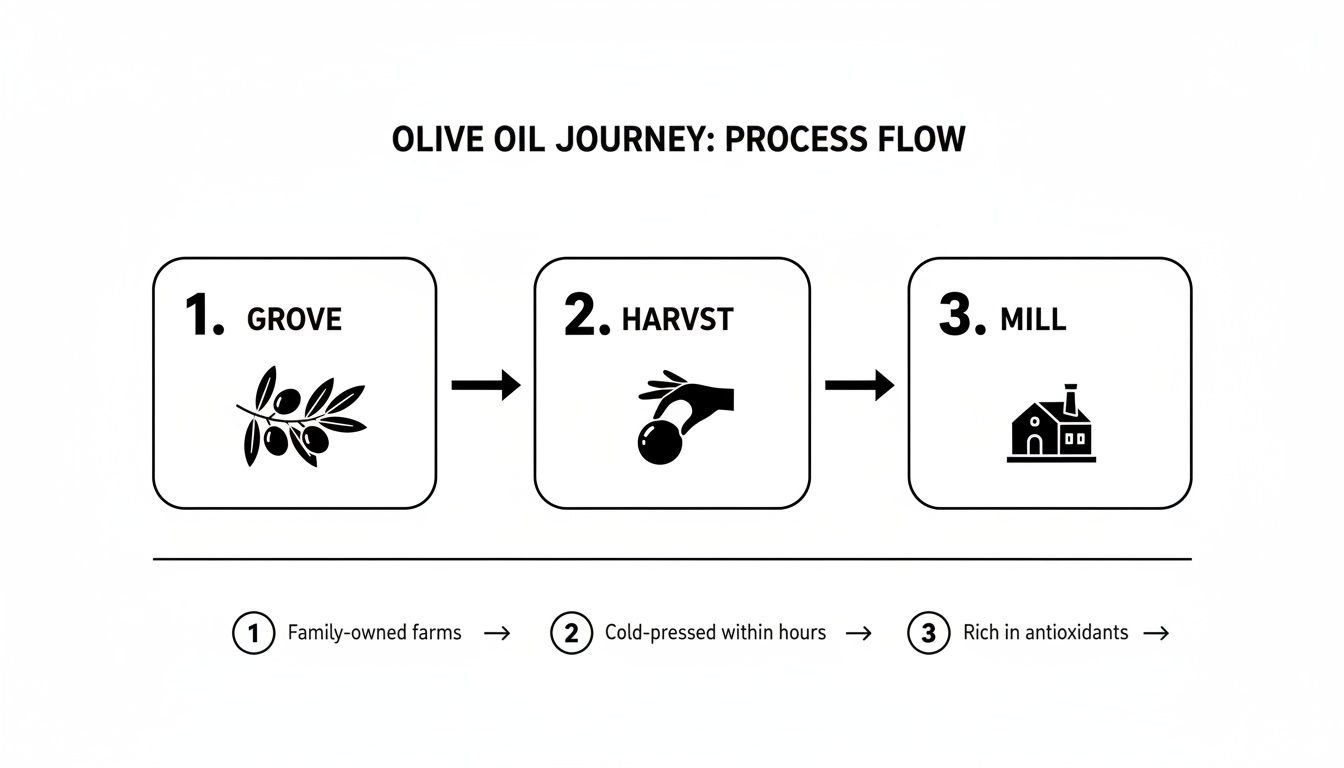
This process shows that quality is built in at every single stage, long before any lab analysis can even begin.
Passing these chemical hurdles is non-negotiable. The 'extra virgin' label isn't just marketing fluff; it's a testament to superior quality backed by hard science. An acidity below 0.8% and low peroxides define it, separating it from refined olive oils that are processed in a way that strips away their natural character and antioxidants.
Ultimately, these standards provide a powerful layer of protection for you, the consumer. They transform the term "extra virgin" from a vague phrase into a measurable, verifiable promise of purity and quality. It’s this rigorous, science-backed system that empowers you to look past a pretty label and know you're buying the real thing. For a deeper dive into the official seals that confirm these results, you can learn more about extra virgin olive oil certification.
The Human Element: The Art of Professional Tasting
Even after surviving the cold, mechanical extraction process and passing a battery of intense lab tests, an oil isn't guaranteed the title of extra virgin. The final gatekeepers aren't machines or complex algorithms; they're highly trained human beings.
This is where the cold, hard science of chemistry gives way to the nuanced, beautiful art of sensory analysis. An oil can have a perfect acidity score and pass every UV test with flying colors, but if it fails on the palate of a professional taster, it’s instantly disqualified. It's the ultimate test, ensuring that what's in the bottle delivers the complex, delightful experience that science alone simply cannot measure.
The Symphony of Positive Attributes
A professional tasting panel isn’t just looking for a "good" flavor. They are meticulously trained to identify and score three specific positive attributes that form the foundation of any great extra virgin olive oil. Think of them as the notes that compose the symphony of a truly exceptional oil.
- Fruitiness (Frutado): This is the aroma of fresh, healthy olives, whether they were picked green or ripe. It might remind you of green apples, almonds, tomato vines, or even fresh-cut grass.
- Bitterness (Amaro): A distinct, often pleasant bitter taste right on the tongue. Far from being a flaw, this is a clear sign of fresh olives and is caused by healthy compounds like oleuropein.
- Pungency (Piccante): That peppery sensation or "kick" you feel in the back of your throat. This is the tell-tale sign of oleocanthal, a potent anti-inflammatory antioxidant.
To even be considered, an oil must have some level of fruitiness. It's the interplay between these three characteristics that gives an EVOO its unique personality—from a delicate, buttery oil perfect for fish to a robust, peppery one that completely transforms a simple steak.
The goal isn't just to taste the oil but to understand its story. Is it bold and grassy from early-harvest green olives, or is it mellow and almond-like from riper fruit? A taster deciphers this story with every sip.
The Hunt for Zero Defects
While identifying those positive notes is important, the panel's most critical task is hunting for defects. A defect is any off-flavor or aroma that signals something went wrong somewhere on the journey from grove to bottle.
The presence of even a single defect means automatic failure. Here are some of the most common disqualifying flaws tasters are trained to spot:
- Rancid: The most common defect by far. It smells and tastes like old nuts or stale crayons and happens when the oil has been exposed to too much oxygen.
- Musty/Fusty: This flavor comes from olives that were piled up and allowed to ferment for too long before being milled.
- Winey/Vinegary: A sour or sharp taste that results from aerobic fermentation, similar to what happens when wine turns into vinegar.
- Muddy Sediment: This unpleasant "pond water" sensation comes from oil being left in contact with its natural sediment for too long.
To officially earn the extra virgin designation, an oil must be judged to have zero defects and a noticeable level of fruitiness. This human touch is the final, non-negotiable step that ensures the oil in your bottle is clean, fresh, and expressive.
You can even begin to train your own palate by following some basic principles of professional evaluation. For an introductory guide, check out our article on how to taste olive oil properly. It's this human element that guarantees the product is not just chemically pure, but also a genuine pleasure to experience.
How to Decode the Bottle and Shop Smarter
Let's be honest: the olive oil aisle is designed to be confusing. Between the beautiful labels, poetic descriptions, and conflicting claims, it's easy to feel overwhelmed. But separating true quality from clever marketing isn't as hard as it seems.
The secret is to ignore the marketing fluff on the front and become a bit of a detective. All the crucial clues you need are hidden on the back of the label, telling the real story of the oil’s quality, freshness, and authenticity.
Your Label-Reading Checklist
When you pick up a bottle, flip it over. You're looking for three key details that are far more important than buzzwords like "gourmet" or "first press."
- Harvest Date: This is the single most important piece of information. Olive oil is essentially a fresh fruit juice; its quality goes downhill over time. Always look for the most recent harvest date you can find, ideally within the last year.
- Country of Origin: Look for specifics. A vague "Product of Italy" could mean olives from anywhere were simply bottled there. A high-quality oil will proudly name a specific region or even a single estate.
- Protective Packaging: Light is olive oil’s sworn enemy. A producer who cares will bottle their oil in dark glass (green or brown) or an opaque tin to shield it from light damage. Clear glass is a major red flag.
A "Best By" date is a marketing tool, not a guarantee of freshness. It's often set two years after bottling, but who knows how long the oil sat in a tank before that? Always prioritize the harvest date—it's the oil's true birthday.
If a bottle is missing a harvest date, just put it back. It’s a sign the producer is hiding something, and you can bet it isn’t freshness.
Look for Seals of Authenticity
Beyond the basics, official certifications offer powerful, third-party proof of quality. These seals aren't easy to get, which means they are a reliable shortcut to finding the real deal. They verify that the oil has met incredibly strict standards for both geography and production.
Two of the most respected seals to keep an eye out for are:
- PDO (Protected Designation of Origin): This seal guarantees the oil was produced, processed, and prepared entirely within a specific geographical area using traditional methods. It's an assurance of authentic local character.
- PGI (Protected Geographical Indication): This is similar to PDO but requires that at least one stage of the production process happened in the designated region.
These seals take the guesswork out of the equation. They’re your assurance that what’s in the bottle is exactly what it claims to be. For a more complete overview, you can explore our guide on how to read an olive oil label like an expert. Think of it as your field guide to avoiding marketing traps and bringing home truly extra virgin olive oil every single time.
Why Extra Virgin Matters in Your Kitchen
So, what’s the big deal? We’ve gone from the olive grove to the lab, but the real question is why you should bother with true extra virgin olive oil at home. It’s in your kitchen where all that hard work finally pays off, transforming your cooking and even your health.
Choosing genuine EVOO isn't just about buying a fancier cooking oil. Think of it as an investment in two things that really matter: incredible flavor and real health benefits. This is where the meticulous harvesting and cold-pressing process connects directly to the powerful compounds locked inside every golden drop.
A Powerhouse of Health and Wellness
Real extra virgin olive oil is so much more than a simple fat. It’s a functional food, packed with bioactive compounds that you just won't find in cheap, refined oils.
At the top of the list are its polyphenols. These are powerful antioxidants that help protect your body's cells from damage. One of the most famous is oleocanthal, the very compound that gives high-quality oil that peppery sensation in the back of your throat. It turns out that oleocanthal has impressive anti-inflammatory properties, working in a way that’s surprisingly similar to ibuprofen.
With every drizzle, you’re not just adding flavor. You’re adding a dose of natural, food-based anti-inflammatory power that helps fight the chronic inflammation linked to so many modern health issues.
The Magic of Flavor Transformation
Beyond the health perks, the reason chefs and home cooks alike swear by extra virgin olive oil is its amazing ability to make food taste better. A great EVOO isn't just an ingredient you cook with; it's a finishing touch, a condiment that can completely change a dish for the better.
The flavor profile of the oil you choose can make all the difference:
- Robust & Peppery: Drizzle a bold, grassy EVOO over a grilled steak or a hearty bowl of soup. It adds a complex, pungent bite that beautifully cuts through the richness.
- Delicate & Buttery: A smoother, milder oil with nutty or almond notes is perfect for a light vinaigrette, baking, or gently coating a piece of fish without overpowering its subtle flavor.
This is why having a couple of different EVOOs on hand is such a pro move. It gives you a palette of flavors to play with, turning a simple weeknight meal into something truly special. And while some people worry about cooking with it, understanding concepts like an oil's smoke point helps bust those myths and shows just how versatile it is.
Ultimately, this is what it all comes down to. Extra virgin is the only grade of olive oil that delivers on both fronts: the full, vibrant taste of the fresh olive and the complete spectrum of its health-giving properties, all in one bottle.
A Few Lingering Questions About Extra Virgin Olive Oil
Even after you've got the basics down, a few common questions and stubborn myths about extra virgin olive oil always seem to surface. Let's tackle them head-on, cutting through the noise so you can get the most out of every bottle.
Can I Actually Cook with Extra Virgin Olive Oil?
Yes, you absolutely can. This might be the single biggest myth in the entire culinary world. A good-quality extra virgin olive oil has a smoke point anywhere from 375°F to over 410°F (that’s 190-210°C), which is more than high enough for nearly all your everyday cooking.
That range is perfectly suited for sautéing vegetables, pan-frying a piece of fish, or even roasting chicken. The secret to EVOO's stability is its high concentration of monounsaturated fats and a boatload of powerful antioxidants. These compounds make it surprisingly resistant to breaking down under heat—often more so than many common seed oils.
So, while you might want to save that super-premium, peppery finishing oil for drizzling, don't hesitate to use a solid, everyday EVOO for your daily cooking. It's not just safe; it's delicious.
Does the Color of the Oil Tell Me Anything About its Quality?
Surprisingly, no. The color of olive oil tells you absolutely nothing about its quality, grade, or even its flavor. The hue, which can range from a deep, grassy green to a pale, shimmering gold, is simply a reflection of two things: the specific olive variety and how ripe it was at harvest.
You might be interested to know that professional olive oil tasters use special cobalt blue glasses. This is done on purpose to hide the oil's color, forcing them to rely only on aroma and taste, free from any visual bias.
A greener oil often comes from olives picked early, which might give it a more assertive, peppery kick. A more golden oil, on the other hand, likely comes from riper fruit, leading to a softer, more buttery profile. Instead of judging by color, your attention should be on the harvest date and any official certifications on the label.
What's the Right Way to Store My Olive Oil?
The best way to think about storage is to protect your oil from its three mortal enemies: oxygen, light, and heat. These are the culprits that will quickly ruin the oil’s flavor and strip away its health benefits.
Just follow these simple rules to keep your oil fresh:
- Keep it in the dark. Your bottle belongs in a cool, dark place like a pantry or cupboard, never sitting on the counter in direct sunlight.
- Keep it cool. Avoid stashing it right next to the stove or another heat source. Heat speeds up oxidation, causing the oil to go rancid much faster.
- Keep it sealed. After you pour some out, make sure you screw that cap back on tightly. This minimizes its exposure to oxygen, which is public enemy number one for freshness.
Once you open a bottle, it's really best to use it within a few months. A great olive oil is a fresh olive oil, period.
Is "First Cold Press" the Same as "Extra Virgin"?
This is a fantastic question that gets right to the heart of a lot of confusing marketing jargon. The term "first cold press" is largely a throwback to an older way of making olive oil with hydraulic presses. These days, nearly all high-quality oil is extracted using a modern centrifuge that spins the oil from the olive paste.
This modern method is, by its very nature, a "cold" process that only happens once. So, slapping "first cold press" on a label is mostly redundant. While it certainly sounds impressive, it isn't an official or legally binding guarantee of anything.
The one designation that truly matters—the one backed by rigorous chemical analysis and sensory testing—is "Extra Virgin." That's your only real assurance that the oil in the bottle has met every strict standard required to earn its place at the top.
At Learn Olive Oil, we believe that understanding the story behind your food makes every meal better. We're dedicated to helping you discover the world of premium olive oil, from decoding labels to tasting like a pro.
 Learn Olive Oil
Leave a comment