The rancidity of olive oil isn't just about a bad taste. It's the heartbreaking, irreversible breakdown of the very magic that makes it so special. When people try to describe a rancid oil, they often land on words like old crayons or stale nuts—a universe away from the vibrant, peppery notes that sing in a fresh oil.
This tragic decay begins the moment the oil encounters its three mortal enemies: oxygen, light, and heat. These villains launch a relentless assault that degrades the oil's quality, methodically stripping it of both its glorious flavor and its potent health benefits.
What Happens When Good Olive Oil Goes Bad
Think back to the last time you tasted a truly exceptional extra virgin olive oil. Remember that bright, fruity aroma? That satisfying peppery kick at the back of your throat? That's the electrifying signature of freshness and high-quality polyphenols hard at work.
Now, imagine the polar opposite: a greasy, waxy, or musty flavor. That unpleasant transformation is the tell-tale sign of rancidity.
It’s a common mistake to think of rancidity like bacterial spoilage. It's not. It's a quiet, chemical betrayal—a slow, silent decay. It’s like leaving a beautiful, crisp apple on the counter for weeks. It doesn't get moldy right away, but it slowly becomes soft, brown, and utterly lifeless. The same tragic fate befalls olive oil. The wonderful compounds that make it "liquid gold" for your kitchen simply break down and vanish.
The Two Paths to Decay
The breakdown of olive oil isn't a single event. It follows one of two sinister chemical pathways. Understanding the difference reveals why proper processing and smart storage are not mere suggestions—they are the sacred duties of anyone who loves great food.
- Oxidative Rancidity: This is the common thief that sneaks into your kitchen. It’s a chain reaction triggered by exposure to oxygen. Every time you uncap your bottle, a little more air gets in, and the oxidation process marches forward, slowly murdering the healthy fats and antioxidants.
- Hydrolytic Rancidity: This form of decay is triggered by water. It usually points to a fatal flaw that occurred long before the oil reached you—a sin committed at the mill, like using damaged olives or failing to properly separate water from the oil.
This diagram helps visualize how these two different enemies—air and water—start the oil on its tragic path to ruin.
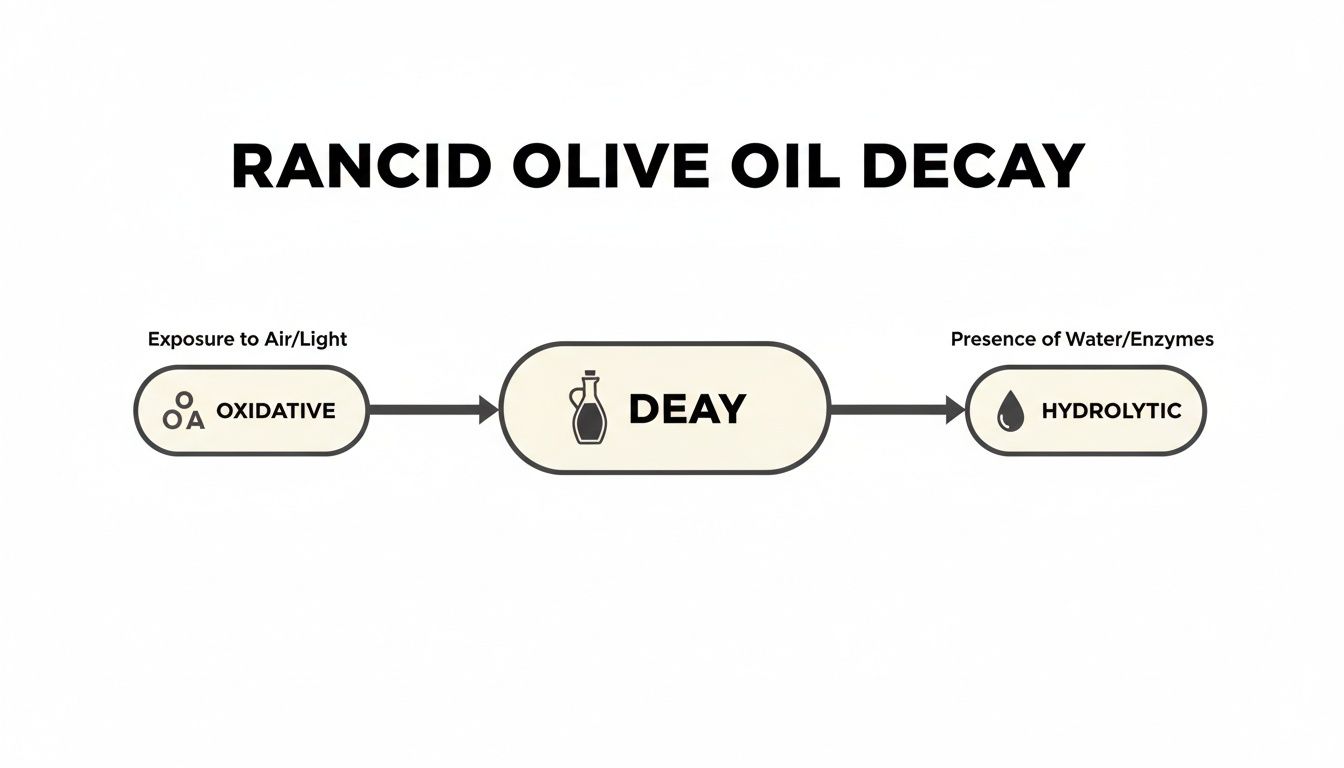
As you can see, both paths lead to the same unhappy ending: spoiled oil. It’s why appreciating what olive oil is made of helps drive home just how precious and delicate this incredible product really is.
Two Paths to Rancidity At a Glance
To make it even clearer, here's a quick side-by-side look at the two types of rancidity. This table breaks down what's happening behind the scenes.
| Characteristic | Oxidative Rancidity | Hydrolytic Rancidity |
|---|---|---|
| Primary Cause | Exposure to oxygen (air) | Presence of water and enzymes |
| Where it Occurs | Primarily during storage, especially after the bottle is opened | Mostly during processing (poor milling) or from using damaged, low-quality fruit |
| Flavor Impact | Creates classic "rancid" notes: stale nuts, putty, old crayons, waxy, or greasy | Can create soapy or fermented off-flavors, but mainly increases free fatty acidity |
| Chemical Change | Unsaturated fatty acids are attacked by oxygen, creating peroxides and aldehydes | Triglycerides are broken down into free fatty acids and glycerol by water |
| Key Takeaway | The enemy of freshness in your pantry | A sign of poor quality from the start |
Ultimately, both paths lead to a product that has lost its culinary and nutritional magic. Once an oil has turned, you can't bring it back.
Rancidity is a one-way street. There's no way to reverse the process or restore the oil's flavor and health benefits. The vibrant, healthy compounds are gone, replaced by off-flavors that can easily ruin a perfectly good meal.
This is exactly why that forgotten bottle of olive oil from a year ago might be doing more harm than good to your cooking. Protecting it from its enemies is the only way to preserve the quality you paid for.
How to Trust Your Senses and Spot Rancid Oil
Forget about complicated lab tests for a moment. The best tool you have for detecting the rancidity of olive oil is sitting right on your face: your nose and mouth. With just a little practice, you can easily learn to tell the difference between a vibrant, healthy oil and one that's gone over to the dark side.
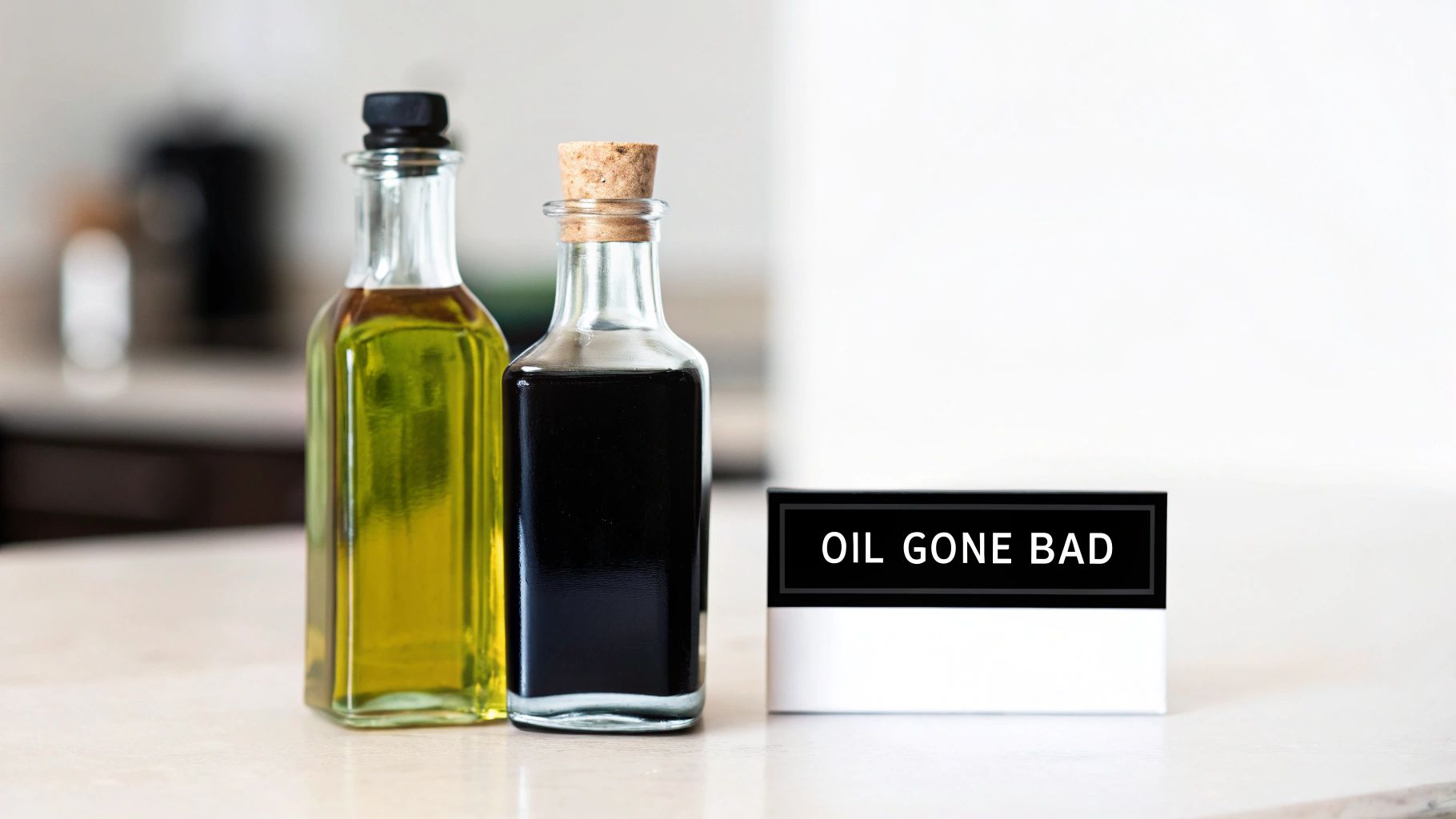
The secret is knowing what you're looking for. A bad oil doesn't just taste flat; it sends out very specific, hard-to-miss signals that it has decayed. Once you learn to recognize these clues, you’ll never be tricked by a bad bottle again.
The Tell-Tale Aromas of Decay
Your nose is your first line of defense, and it’s usually the most reliable. When you smell a fresh, high-quality extra virgin olive oil, it smells alive. You might pick up notes of fresh-cut grass, green tomatoes, artichokes, or even almonds. It’s a clean, inviting aroma that makes you want to dive right in.
A rancid oil, however, just smells… off. Stale. The smell is often the dead giveaway.
A rancid oil’s aroma isn't just a lack of freshness; it's the presence of something unpleasant. It’s the smell of decay, signaling that the oil's best qualities have vanished and been replaced by off-putting compounds.
Listen to your nose. Be on the lookout for these specific warning signs:
- Waxy or Crayon-Like: This is the classic signature of rancidity. If your oil smells like a box of Crayola crayons or that old tube of lipstick at the bottom of a drawer, it has definitely oxidized.
- Stale Nuts: Picture a bag of walnuts or pecans that’s been sitting open in the pantry for a year. That musty, slightly bitter, old-nut smell is exactly what rancid oil can smell like.
- Putty or Elmer's Glue: Some spoiled oils take on a scent that reminds people of window putty or old-school white glue. It's a flat, chemical-like aroma that has no business being in good olive oil.
If you smell any of these, your oil is past its prime. Don't even bother tasting it.
Master the Simple Kitchen Tasting Method
If the smell test leaves you unsure, a quick taste will tell you everything you need to know. Professional tasters have a formal process, but you can easily adapt it for your own kitchen. This isn't just about flavor; it's about paying attention to how the oil feels in your mouth and the taste it leaves behind.
Here’s a simple, three-step process to taste like a pro:
- Warm and Swirl: Pour about a tablespoon of oil into a small glass (a wine glass works great). Cup the glass in your hands to gently warm the oil for 30 seconds or so. Swirling it helps release all its aromatic compounds.
- Sniff Deeply: Bring the glass right up to your nose and take a good, deep sniff. Is the aroma fresh and fruity? Or are you getting those stale, waxy notes we talked about?
- Sip and Slurp: Take a small sip. Now, do something that feels a little weird at first: suck some air in through your teeth, making a slurping sound. This technique, called strippaggio, sprays the oil across your entire palate, hitting all your taste buds.
After the slurp, pay attention. A fresh extra virgin olive oil should have three positive qualities: fruitiness, bitterness (a good sign of freshness!), and pungency (that peppery kick in the back of your throat).
A rancid oil, on the other hand, will feel greasy and heavy, leaving a fatty film in your mouth without any pleasant aftertaste. If it tastes like old peanuts or just tastes like nothing at all, it's time to toss it.
By using these simple steps every time you open a new bottle, you'll sharpen your senses in no time. For those who want to dive deeper, you can learn how to taste olive oil with even more precision. It's a skill that puts you in control, protecting both your cooking and your health.
The Three Enemies That Destroy Olive Oil Freshness
The tragic decline of a vibrant, flavorful olive oil into a stale, useless liquid isn't just bad luck. The rancidity of olive oil is a predictable outcome, a slow-motion defeat in a battle against three relentless enemies that are probably in your kitchen right now: light, heat, and oxygen.
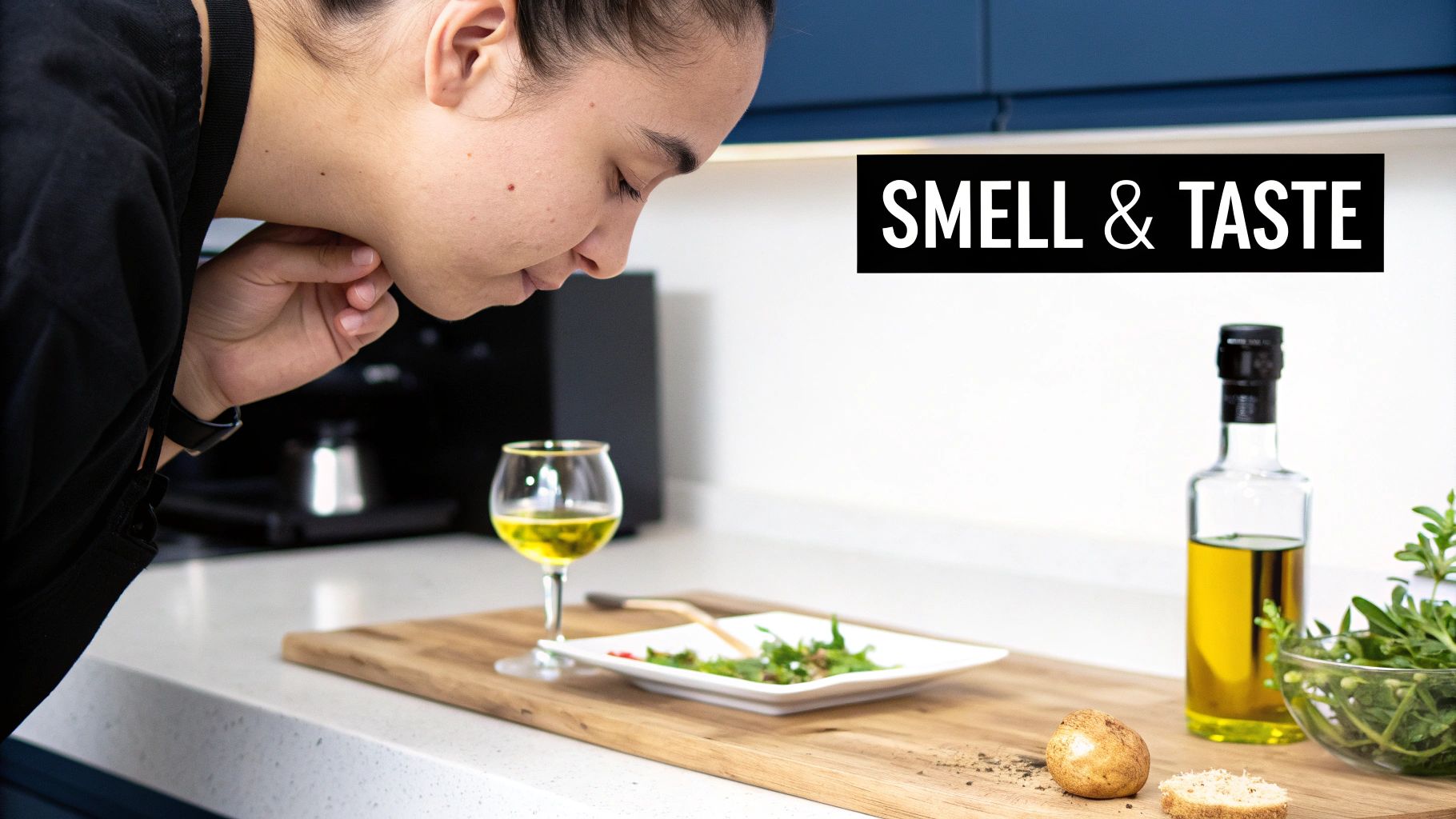
Think of your olive oil as a delicate work of art. Its beautiful colors, complex flavors, and healthy properties are all quite fragile. Exposing it to these three elements is like hanging a priceless painting in the bright sun and pouring rain. Decay isn't just a possibility; it's an absolute certainty.
Getting a handle on how each of these aggressors works is the first real step in defending your oil’s integrity.
Light: The Aggressive Catalyst
Light, especially the ultraviolet (UV) rays from the sun, is easily olive oil's most aggressive enemy. It acts like a powerful catalyst, kicking the oxidation process into hyperdrive. As light penetrates the oil, it energizes the molecules, triggering the chemical reactions that break down healthy fats and destroy precious antioxidants.
This is exactly why a clear glass bottle sitting on a sunny kitchen windowsill is a death sentence for freshness. Studies have shown that oil stored in clear glass can lose a huge chunk of its quality in just a few weeks, while oil in dark, protective packaging stays stable for months.
Light exposure doesn’t just drain the oil of its flavor; it actively creates the off-flavors associated with rancidity. The same light that nourishes the olive on the tree becomes its destroyer once pressed into oil.
This destructive process, known as photo-oxidation, is brutally efficient. It’s the main reason why reputable producers will never bottle their premium oils in clear glass. A dark green bottle, a tin, or a box isn't a style choice—it's essential armor.
Heat: The Silent Accelerator
Heat is the silent partner-in-crime to light and oxygen, working behind the scenes to speed up every destructive chemical reaction. You don't need scorching temperatures to do damage, either. Even the gentle, consistent warmth near your stovetop or on top of your refrigerator is more than enough to cause significant harm.
Basically, heat gets the oil's molecules all excited, making them more reactive and vulnerable to oxygen's attack. For every 18°F (10°C) increase in storage temperature, the rate of oxidation roughly doubles. That means an oil stored at a warm 80°F will degrade twice as fast as one stored at a cool 62°F.
This is why that convenient spot right next to your cooking range is the absolute worst place to keep your olive oil. The constant temperature swings create the perfect storm for accelerated decay, turning your liquid gold into a flavorless liability much faster than you’d expect.
Oxygen: The Persistent Foe
Of the three enemies, oxygen is the most persistent. You can manage light and heat with proper storage, but oxygen gets a fresh invitation every single time you open the bottle. It's the direct fuel for oxidative rancidity, the process where oxygen molecules attack the oil's fatty acids.
Each time you uncap the bottle to pour a little oil, you're refreshing the supply of oxygen in the headspace—that empty space between the oil and the cap. This new oxygen immediately gets to work, chipping away at the oil's integrity. Over weeks and months, this repeated exposure is what leads to those unmistakable stale, crayon-like flavors of decay.
This persistent attack is why a half-empty bottle will go rancid much faster than a full one. The larger headspace contains more oxygen, creating a more hostile environment for the oil that's left.
This challenge is so widespread that even the pros struggle with it. The NYIOOC World Olive Oil Competition revealed that rancidity was the second most common defect found in submissions—a startling statistic for oils that are supposed to be the best in the world. This just goes to show how pervasive the problem of oxidation is at every stage, from production to storage. You can read more about these competition findings on olive oil defects.
By understanding these three enemies, you can go from being a passive consumer to an active guardian of your olive oil, making sure every drop you use is as fresh and flavorful as the day it was bottled.
How to Read Labels and Choose Freshness Every Time
Walking into the olive oil aisle can feel like a pop quiz you didn't study for. Bottles of all shapes, sizes, and colors compete for your attention, plastered with seals, dates, and buzzwords. But amidst all that noise, only a few key clues on the label truly matter when you’re hunting for freshness and trying to avoid the disappointment of rancid oil.
Learning to read these labels is your secret weapon. It transforms you from a hopeful guesser into a savvy buyer who can see past the clever marketing and spot the signals of a truly exceptional oil. The power to choose a bottle bursting with flavor and health benefits is right there on the packaging—if you know where to look.
The Most Important Date on the Bottle
Forget the "best-by" or "use-by" date for a moment. While helpful, these dates are often arbitrary, set many months or even years into the future. The single most important piece of information for judging freshness is the harvest date.
This date tells you exactly when the olives were picked from the tree and pressed. Since olive oil is essentially a fruit juice, it is at its absolute peak right after it's made and begins a slow, steady decline from that moment on. A harvest date is a transparent declaration of age, giving you the real story.
Look for a harvest date that is as recent as possible, ideally within the last year. An oil harvested 18 months ago might still be inside its "best-by" window, but it has lost a significant amount of its vibrancy compared to one harvested just six months ago.
A "best-by" date tells you when the producer hopes the oil will still be good. A "harvest date" tells you the truth about when its life began. Always trust the harvest date.
If a bottle has no harvest date listed, it's a red flag. Reputable producers are proud of their fresh product and have no reason to hide this information. Its absence often suggests the oil inside is a blend from different years, making true freshness impossible to guarantee.
Your Oil's Best Defense: Packaging
Before you even look at the dates, the container itself tells a powerful story about the producer's commitment to quality. As we've learned, light is one of olive oil’s greatest enemies, acting as a catalyst for the chemical reactions that cause rancidity.
Therefore, the packaging should act as a fortress against light. Your best options are:
- Dark Glass: Look for bottles made of dark green or brown glass that are so opaque you can barely see the oil inside. This is the industry standard for protecting the delicate contents from harmful UV rays.
- Tins or Cans: Metal tins offer complete protection from light and are an excellent choice. They are lightweight, durable, and keep the oil perfectly shielded.
- Bag-in-Box: Some producers use a "bag-in-box" system, where the oil is in a collapsible bag inside a cardboard box. This format is fantastic because it not only blocks light but also prevents oxygen from getting in as you pour.
If you see an olive oil—especially one labeled "extra virgin"—packaged in a clear glass bottle, walk away. It's a clear signal that the contents are doomed to a shorter, less flavorful life, no matter how good the oil was when it was first bottled.
Decoding Quality Seals and Certifications
Seals and certifications can provide an extra layer of confidence, but it's important to understand what they actually mean. They aren't just fancy stickers; they are guarantees of origin and production standards.
Two of the most respected are European Union designations:
- PDO (Protected Designation of Origin): This is a very strict certification. It guarantees that the olives were grown, harvested, and pressed into oil all within a specific geographical region, ensuring a product with a distinct local character.
- PGI (Protected Geographical Indication): This seal is a bit more flexible. It guarantees that at least one stage of the production process (like growing or pressing) took place in the designated region.
While these seals don't directly guarantee an oil is free from rancidity, they do indicate a higher level of accountability and traceability, which often correlates with better quality control. For a deeper dive into the world of certifications and label terms, you can explore our detailed guide on understanding olive oil labeling.
Unfortunately, even a fancy label isn't a foolproof guarantee against rancidity. A landmark study from the UC Davis Olive Center found that a staggering 69% of imported olive oils labeled as extra virgin failed to meet quality standards, with rancidity being a major issue. This highlights a troubling gap between what's on the label and what's in the bottle, making your ability to spot freshness clues all the more critical.
Decoding Your Olive Oil Bottle for Freshness
To put it all together, here's a quick cheat sheet for interpreting the most common elements you'll find on a bottle of high-quality olive oil.
| Label Element | What to Look For | Why It Matters for Avoiding Rancidity |
|---|---|---|
| Harvest Date | The most recent date possible (e.g., "Fall 2023"). | This is the oil's "birth date." The fresher it is, the less time it's had to oxidize and go rancid. |
| Best-By Date | A date 18-24 months from the harvest date. | A secondary indicator. It should align with the harvest date. Be wary of a "best-by" date far in the future with no harvest date. |
| Packaging | Opaque dark glass, tin, or bag-in-box. | Protects the oil from light, a primary catalyst for rancidity. Clear bottles are a major red flag. |
| Country of Origin | Specific region or estate (e.g., "Tuscany, Italy"). | Single-origin oils are often higher quality and more traceable than blends from "multiple countries." |
| Quality Seals (PDO/PGI) | A recognized seal like PDO or PGI. | These certifications indicate adherence to strict production standards, which often includes better handling to prevent rancidity. |
Think of these clues as a puzzle. One piece might not give you the full picture, but when you put them all together—a recent harvest date, protective packaging, and a specific origin—you're stacking the odds in your favor for choosing a truly exceptional and fresh olive oil.
Simple Storage Rules to Protect Your Olive Oil
So you’ve done the hard work. You’ve scanned the labels, hunted down the harvest date, and brought home a perfect bottle of beautiful, vibrant olive oil. Now for the easy part: protecting that investment from the enemies lurking in your own kitchen.
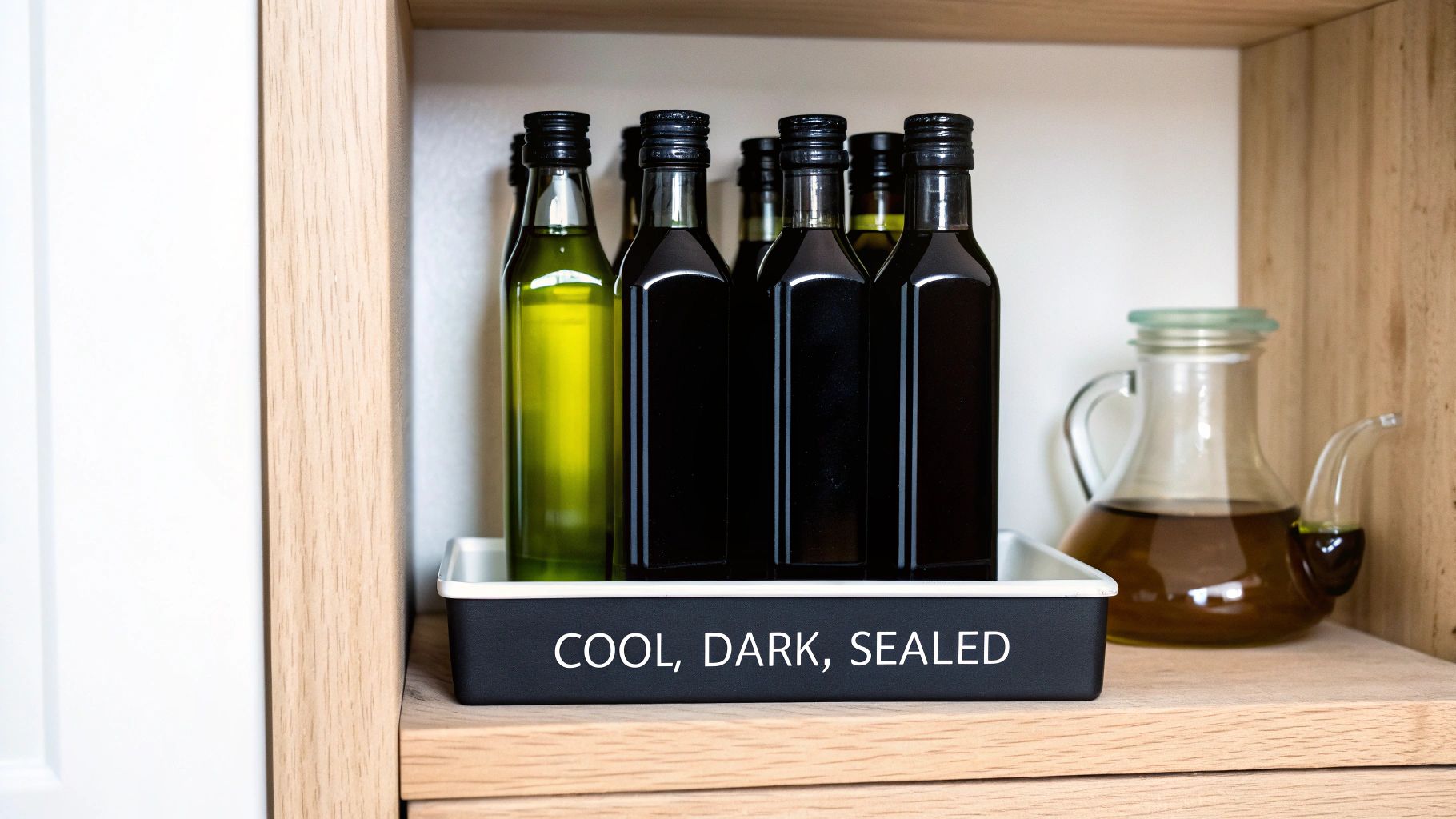
Keeping your oil fresh isn’t complicated. You don’t need any special equipment or secret knowledge. It all boils down to three simple rules: keep it cool, keep it dark, and keep it sealed. If you can master these, you'll make sure every drop you pour is as full of life as the day the olives were crushed.
Find a Cool, Dark Sanctuary
Heat and light are olive oil's two biggest enemies, but you can defeat them both with one simple move—picking the right storage spot. Your oil's happy place is a cool, dark pantry or cupboard, tucked away from the chaos of the kitchen. The ideal temperature hovers around 57°F (14°C), but really, any stable room temperature far from a heat source will do the trick.
This means that convenient spot right next to your stove? It's the absolute worst place you could put your oil. The constant heat blasts will kick the oxidation process into high gear, turning your oil rancid weeks or even months ahead of schedule. The same goes for that sunny spot on the windowsill, which is basically a tanning bed for your oil, bathing it in destructive UV light.
Think of your olive oil like a vampire. It thrives in the cool and dark, and it shrivels up in the sunlight. Your goal is to give it a nice, comfortable coffin to rest in, preserving its peak character for as long as possible.
You might be tempted to pop it in the fridge, but that often creates more problems than it solves. The cold will cause the oil's natural waxes to solidify, which is harmless but can be a pain. The real issue is condensation. Every time you pull that cold bottle out, tiny water droplets can form inside, introducing moisture that can lead to a different kind of spoilage. A cool pantry is always the better choice.
Seal the Bottle Like You Mean It
Oxygen is the slow and steady enemy. Every single time you open the cap, you're inviting it in to start its work. That’s why your final, and most crucial, daily habit must be to seal the bottle tightly after every single pour.
A loose cap or an open pour spout is like leaving the front door wide open for oxygen to come in and degrade your oil. Twist that cap on securely to minimize the air left in the bottle. This two-second habit makes a massive difference over the life of your oil.
This rule is even more important if you buy your olive oil in big, economical tins.
- Decant into a smaller bottle: Never cook directly out of a large tin for weeks on end. Instead, pour what you'll use for a week or two into a smaller, dark glass bottle for daily use.
- Keep your main supply safe: Store the large tin, sealed up tight, in that same cool, dark place. This protects the bulk of your oil from being repeatedly exposed to fresh air.
These simple habits are your best defense for preserving your oil’s incredible flavor and health benefits. You can get even more tips from our complete guide on how to store olive oil properly to make every bottle last.
The Hidden Costs of Using Rancid Oil
Using a bottle of rancid olive oil might feel like a minor kitchen sin, a harmless way to avoid wasting a few dollars. But the truth is, the cost is far greater than you might think. It's a double betrayal—first to your food, and more importantly, to your health.
In the kitchen, rancid oil is a saboteur. It doesn't just fail to add flavor; it actively ruins it. Those stale, waxy, or crayon-like notes will completely overpower the delicate flavors of your fresh ingredients. That beautiful tomato salad, that perfectly seared fish, that simple yet elegant pasta—all of it will be tainted by the taste of decay. You don't just lose the oil; you risk the entire dish.
The Nutritional Price You Pay
Beyond the disappointing flavor, the real problem lies with the health implications. The main reason we celebrate extra virgin olive oil is for its incredible concentration of polyphenols—powerful antioxidants that help fight inflammation and cellular damage in our bodies.
When rancidity sets in, these delicate, health-giving compounds are the first to go. Oxidation systematically destroys them, turning your liquid gold into a nutritional ghost. That vibrant, peppery kick you taste in fresh, high-quality oil? That’s the feeling of healthy polyphenols doing their job. When that sensation is gone, so are the benefits.
Instead of arming your body with antioxidants, you're doing the exact opposite.
A rancid oil is no longer a source of antioxidants; it has become a source of free radicals. These unstable molecules contribute to oxidative stress in the body, which is precisely what high-quality olive oil is meant to combat.
This means you're not just missing out on the good stuff—you're actively consuming the bad.
Your Food and Your Body Deserve Better
Ultimately, reaching for a fresh bottle isn't culinary snobbery. It's a fundamental choice about quality and well-being. Think of it as an investment in both the integrity of your food and the health of your body.
Consider the two paths you can take:
- The Fresh Path: You use a vibrant, fresh oil. Your food tastes clean, alive, and delicious. Your body gets a powerful dose of anti-inflammatory compounds and healthy monounsaturated fats. It's a clear win-win.
- The Rancid Path: You use a stale, oxidized oil. Your food is dulled by an unpleasant, greasy off-flavor. Your body ingests free radicals and misses out entirely on the nutritional benefits you thought you were getting. It's a definite lose-lose.
The difference is stark. Choosing fresh olive oil is one of the simplest, most impactful decisions you can make in your kitchen. It's a commitment to ensuring that what you cook and what you eat is not just palatable, but truly nourishing from the inside out. Don’t settle for a compromise that costs you both flavor and health.
A Few Common Questions About Olive Oil Rancidity
We've covered the science and the warning signs, but let's get down to the practical questions that pop up in the kitchen. Here are some straightforward answers to help you handle your olive oil with confidence.
Can Rancid Olive Oil Actually Make You Sick?
While it won't give you food poisoning like spoiled chicken, consuming rancid oil is definitely not good for you. You're essentially eating free radicals, which contribute to cellular damage and oxidative stress in your body.
Just as importantly, all the powerful, health-promoting antioxidants that make fresh olive oil so incredible are long gone. You miss out on all the benefits.
Is It Okay to Cook with Slightly Rancid Oil?
I would strongly advise against it. When you heat an oil that's already oxidized, you can create even more harmful compounds.
Beyond the health concerns, it's just going to make your food taste bad. It will add a stale, greasy flavor that can ruin an otherwise perfectly good dish. It's always better to toss it and start over with a fresh bottle.
Think of it this way: using rancid oil isn't saving money; it's wasting the good ingredients you're cooking with. The small cost of replacing the oil is nothing compared to the cost of a ruined meal.
Does Putting Olive Oil in the Fridge Stop It from Going Rancid?
No, and it can actually create other problems. While the cold does slow down oxidation a tiny bit, it also causes condensation to form inside the bottle every time you take it out.
That extra moisture can kickstart hydrolytic rancidity, a different type of spoilage. A cool, dark pantry or cupboard is always your best bet.
How Long Does Olive Oil Last Once I've Opened the Bottle?
For the best flavor and maximum health benefits, you should try to use up an opened bottle within 30 to 60 days. Each time you uncap it, you're letting in a fresh hit of oxygen, which really accelerates the aging process.
You can get a deeper dive into this topic by reading up on how long olive oil lasts and the factors that play the biggest role.
At Learn Olive Oil, our mission is to help you navigate the world of high-quality olive oil with confidence. From tasting like a pro to choosing the best bottle, we provide the expert insights you need. Discover the difference true freshness makes at https://learnoliveoil.com.
 Learn Olive Oil
Leave a comment