Walk down any grocery aisle, and you’ll see it. That little word on the olive oil bottle: ‘virgin’. Most people glance right past it, assuming it’s just another fancy marketing buzzword. But what if I told you it’s not a word at all, but a legally binding promise? A guarantee of purity, printed right on the label for anyone sharp enough to spot it.
It's your assurance that the oil inside that bottle was made using nothing but pure mechanical force. No chemical tricks. No industrial shortcuts.
Imagine the difference between a glass of freshly squeezed orange juice, bursting with life, and a glass of juice made from concentrate and water. One is the pure, unadulterated essence of the fruit. The other is a pale imitation. That’s the promise of ‘virgin’.
The Unfiltered Truth About a Single Word
Let’s cut through the noise. That one word, ‘virgin,’ is your first and most powerful clue about the authenticity of the oil you’re about to buy. It signals that the product is unrefined, untampered with, and true to the olive it came from.
This technical grade is built on two non-negotiable promises.
A Commitment to Natural Production
First and foremost, ‘virgin’ tells you how the oil was made.
What truly separates virgin olive oil from the pack is its completely mechanical extraction. There are no chemicals, no punishing heat—only the pure, unadulterated essence of olives pressed into liquid gold. While lesser oils are often doused in solvents like hexane to wring out every last drop, virgin olive oil is made by simply crushing olives and separating the oil from the fruit.
This profound purity is precisely why it’s called ‘virgin’; it is untouched by the industrial refining that brutally strips away natural flavors, aromas, and life-giving nutrients. This gentle process preserves over 30 different phenolic compounds, including oleocanthal, a natural anti-inflammatory powerhouse. You can explore these global classifications further on the official European Commission agricultural data portal.
A Promise of Quality
Second, the 'virgin' label is a guarantee of quality backed by cold, hard science.
To earn this grade, an oil must pass a battery of precise, measurable tests. These aren't suggestions; they are strict chemical thresholds for metrics like acidity and oxidation that prove the oil's freshness and stability. An oil can only be designated 'virgin' if it survives this lab analysis, confirming it hasn't been damaged on its journey from the tree to your table.
The 'virgin' designation is the ultimate benchmark for authenticity you can taste. It assures you that the oil is a genuine, unadulterated fruit juice, capturing the olive's natural character.
Ultimately, these two pillars—mechanical extraction and proven quality—are what make virgin olive oil virgin. While this is the foundation, it's just the starting point. To understand how the best of the best sets itself apart, you might want to read our guide on why it is called extra virgin olive oil.
The Journey From Olive Grove To Your Kitchen
Picture a sun-drenched grove where tradition isn’t just a charming story—it’s the actual method. What makes virgin olive oil virgin begins right there, long before it ever sees a bottle. The entire journey from tree to table is defined by an unwavering commitment to purity, one that relies entirely on mechanical force instead of industrial shortcuts.
Think of it like the difference between juicing an orange by hand versus creating orange-flavored soda in a lab. Virgin olive oil is the pure juice, extracted with nothing more than pressure and patience. No chemical solvents, no extreme heat.
This natural-first approach is what gives virgin olive oil its name. It’s all about two core principles: the process must be entirely mechanical, and the final product must meet strict, measurable quality standards.
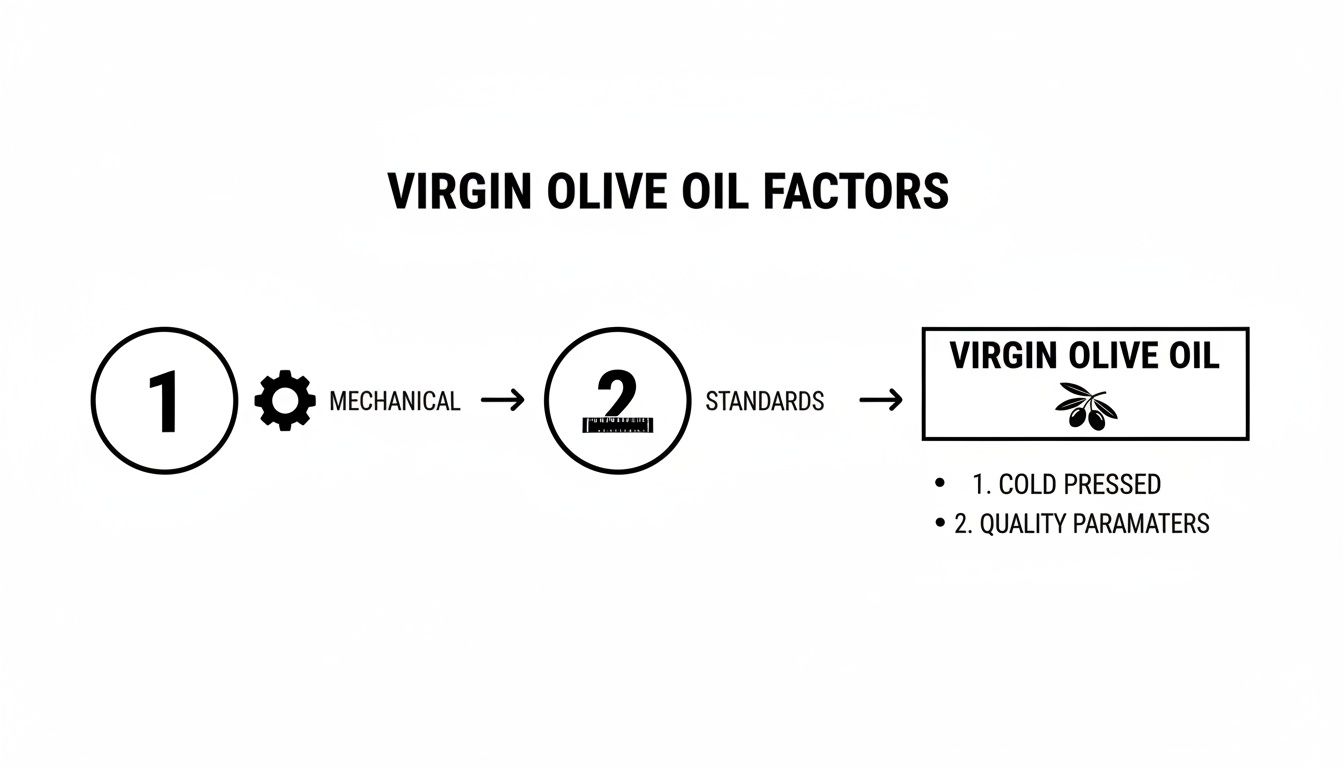
As you can see, the 'virgin' classification rests on these two pillars—a natural process backed by scientific proof of quality.
From Harvest to Mill
It all begins with the harvest, where timing is everything. Olives are picked at their absolute peak of ripeness to lock in the best flavor and highest nutritional value. From there, it's a race against time. The fruit must get to the mill within hours to prevent any bruising or fermentation that would quickly ruin the oil.
At the mill, the olives are washed and immediately crushed, pits and all, into a thick, fragrant paste. This is a purely physical act, done with either traditional stone wheels or modern hammer mills that break down the fruit’s cell walls to start releasing the oil.
The Art of Malaxation
Next up is a critical but often overlooked step: malaxation. The olive paste is slowly and gently mixed in a large trough for about 20 to 40 minutes. This isn't just random stirring; the slow churning helps the tiny droplets of oil find each other and clump together, which makes them much easier to separate later.
Temperature control here is non-negotiable. The paste must stay below 27°C (80.6°F). If it gets any hotter, the oil's delicate aromas and healthy polyphenols start to break down, and it can no longer be called 'virgin'.
This strict temperature ceiling is the true meaning behind the term "cold-pressed"—a guarantee of gentle handling.
The Final Separation
The last step is to separate the pure oil from the olive solids (pomace) and water. This is done with a centrifuge, which spins the paste at incredible speed. Simple physics takes over, using centrifugal force to pull the heavier water and solids away from the lighter oil.
No solvents. No chemicals. Just pure mechanical force.
Understanding this meticulous journey from grove to bottle really connects with the core of farm-to-table dining principles, where the focus is on fresh ingredients and a direct line from source to consumer. Every part of the process is designed to protect the oil's natural character. To get a closer look at the machinery and methods, you can learn more about how olive oil is extracted in our detailed guide.
How Science Verifies True Virgin Quality
So, the olives have been crushed and the oil separated, all without any chemical funny business. But how can we be absolutely certain the oil in the bottle is truly worthy of the “virgin” label? This isn't decided in a marketing meeting—it's proven in a lab.
The virgin designation is a grade backed by strict, internationally recognized scientific standards. These tests are like a chemical fingerprint, separating the real deal from the imposters and guaranteeing the oil is fresh, stable, and well-made. Don’t let the science intimidate you; the ideas behind it are surprisingly straightforward.
Free Acidity: The Ultimate Freshness Gauge
One of the most important tests measures free fatty acidity, or FFA. This has nothing to do with how acidic the oil tastes—it’s not about tart or sour flavors. A better way to think of it is as a freshness gauge. It’s the difference between the crisp snap of a just-picked apple and the soft mush of one that’s been sitting out for a week.
Free acidity tells us how much the fat molecules in the oil have started to break down. A low number is a fantastic sign, indicating the olives were healthy, processed quickly after harvest, and handled with care every step of the way.
The standards are crystal clear:
- Virgin olive oil must have a free acidity of 2.0% or less.
- The top-tier extra virgin olive oil must clock in under a much stricter 0.8%.
A low FFA isn't just a number; it's a direct reflection of a high-quality process from tree to bottle.
Peroxide Value: A Shield Against Spoilage
Next up is the peroxide value. This test reveals how much oxidation the oil has been through. Oxidation is the natural enemy of freshness—it’s the same process that turns a sliced apple brown or makes old butter taste rancid.
A high peroxide value means the oil was likely exposed to too much oxygen, light, or heat, kicking off the spoiling process. To earn the virgin classification, an oil's peroxide value must be no more than 20 milliequivalents of active oxygen per kilogram. This ensures the oil is stable and hasn't started to degrade, which protects both its beautiful flavor and its health benefits.
To make these official quality grades easier to understand, here’s a simple breakdown of the chemical goalposts an oil must meet.
Key Chemical Standards for Virgin Olive Oils
| Quality Parameter | Extra Virgin Olive Oil (Max Limit) | Virgin Olive Oil (Max Limit) | What It Tells You |
|---|---|---|---|
| Free Acidity | 0.8% | 2.0% | A measure of freshness. Lower is better, indicating healthy olives and quick, careful processing. |
| Peroxide Value | 20 meq O₂/kg | 20 meq O₂/kg | A measure of oxidation. A low value means the oil is stable and hasn't started to spoil. |
These standards show just how much higher the bar is for an oil to be called "extra virgin." It's a significant leap in quality that you can measure chemically.
Together, these chemical benchmarks create a non-negotiable quality floor. An oil that fails these tests cannot legally be labeled 'virgin,' no matter how it was made.
These scientific hurdles are just the first step. Producers aiming for the highest quality often seek out official recognition to prove they meet and exceed these standards. You can learn more about this rigorous process in our detailed guide to extra virgin olive oil certification, which covers everything from lab analysis to the crucial sensory panel approval.
The Final Verdict From a Trained Palate
Once an olive oil has cleared the hurdles of mechanical extraction and passed its chemical exams, it faces one last, crucial trial. This test isn't run by a machine or measured in a test tube. No, the ultimate judgment comes from a panel of highly trained human tasters.
This sensory analysis is the final gatekeeper. It’s the moment where the cold, hard science of chemistry meets the undeniable truth of taste and aroma. For an oil to truly earn the 'virgin' title, it can't just look good on paper—it has to be perfect to the human palate.
The Human Element in Quality Control
It might surprise you, but a team of eight to twelve certified tasters holds the power to make or break an oil. These aren't just foodies with a good sense of taste; they are sensory experts, trained to sniff out the slightest imperfections and identify positive flavors with incredible accuracy.
Their primary mission is to hunt for defects. These are flaws that tell a story—a story of something going wrong during the olive’s journey from branch to bottle. If an oil tastes muddy, musty, vinegary, or rancid, it’s immediately out. There is absolutely zero tolerance for error.
An oil can have perfect chemical scores, but if a trained panel detects even a single sensory defect, it cannot be legally sold as virgin olive oil. The human verdict is absolute.
This is why you can trust the 'virgin' label. It’s not just a guarantee that the oil meets scientific standards; it’s a promise that it delivers a clean, flawless taste experience, every single time.
Identifying the Signs of a Superior Oil
But the panel isn't only looking for what's wrong; they're searching for what's right. To be classified as virgin, an oil must show off positive characteristics, and the most important one is fruitiness. This isn't just about fruit, though. It can range from the scent of green, freshly cut grass to the ripe, buttery notes of almond or banana.
Beyond that lovely fruitiness, the tasters are looking for two other telltale signs of a high-quality oil:
- Bitterness: That pleasant bitter kick, especially on the sides of your tongue, is a hallmark of fresh, green olives and signals a healthy dose of polyphenols.
- Pungency: This is that peppery or spicy sensation you feel in the back of your throat, the one that might even make you cough. It’s a direct indicator of oleocanthal, a powerful anti-inflammatory compound.
The sensory perfection of virgin olive oil, judged by flavor and aroma, is what solidifies its status. Any oils that score below a 3.5/10 on the median defect scale get demoted, ensuring only the best make the cut. If you want to try this yourself, our guide on how to taste olive oil like an expert can help you develop your own palate. This human-led quality check is what makes virgin oil a benchmark, delivering the robust flavor from its 230+ volatile compounds and its significant health benefits.
Decoding The Labels In The Olive Oil Aisle
Walking down the olive oil aisle can feel like a pop quiz. ‘Extra Virgin,’ ‘Virgin,’ ‘Pure,’ ‘Light’—what do these labels actually mean? Believe me, it’s not just marketing fluff. Each term signifies a specific grade, with a world of difference in quality, flavor, and health benefits separating them. Understanding this hierarchy is your best tool for making a confident choice.
At the very top of the pyramid is extra virgin olive oil. Think of it as the valedictorian of the olive oil world. It has to meet the strictest requirements for both chemical purity, with a free acidity below 0.8%, and sensory perfection. That means it has zero defects and a noticeable, pleasant fruitiness. It’s the purest expression of the olive.
Just a small step down, you'll find virgin olive oil. This is still a high-quality, unrefined oil extracted using only mechanical methods, but the standards are a little more forgiving. Its free acidity can be up to 2.0%, and it might have very minor sensory imperfections. It's a perfectly good oil, it just doesn't quite hit the flawless mark of its "extra" sibling.
What Happens When Olive Oil Fails The Test?
So, where do all the oils that don't meet the strict virgin standards end up? They don't just get tossed out. Instead, they are sent to an industrial facility for a process that completely transforms them, stripping away not just their flaws, but their very essence.
These oils undergo chemical refining. This process uses a combination of high heat, chemical solvents (like hexane), and even bleaching clays to neutralize strong, unpleasant flavors and remove any defects. The result is a bland, colorless, and odorless fat that has lost nearly all of its original antioxidants and polyphenols.
This refined oil becomes the base for products you see labeled simply as ‘olive oil’ or ‘pure olive oil’. To make it sellable, producers blend in a small amount of virgin or extra virgin olive oil to add back a hint of flavor and color. It's a functional fat for cooking, but it’s a world away from the vibrant, nutrient-packed juice of a true virgin oil.
The term 'light' olive oil is probably the most misleading label on the shelf. It has absolutely nothing to do with calories or fat content. 'Light' refers exclusively to the oil's flavor and color, which are incredibly mild because it is almost entirely refined olive oil.
This clear distinction is what makes virgin olive oil virgin. It’s your guarantee that the oil is unrefined, untampered-with, and still holds the natural goodness of the olive. Once you understand the journey an oil takes after it fails the virgin test, you can see right past the marketing noise and choose the authentic quality you're actually paying for.
How To Choose And Protect Your Olive Oil
Alright, now you know the real promise behind the word ‘virgin’. This knowledge is your best friend when you're standing in the grocery aisle, trying to pick the right bottle. To make sure you bring home the good stuff—and keep it that way—you need to learn how to read the bottle.
The first thing I always look for isn't the price or a pretty label; it's the harvest date. Think of olive oil as fresh-squeezed fruit juice. You want it as close to the harvest as possible. Any producer worth their salt will be proud to print that date right on the bottle.
Don't be fooled by the "best by" date. It's often set two years out from bottling, which can be a trick to sell older, less vibrant oil. Your goal is to find an oil that was harvested within the last year—that’s where you’ll find the best flavor and all those healthy compounds.
The Three Enemies of Freshness
Once you've got your bottle home, your job shifts from buyer to guardian. Virgin olive oil is delicate, and it has three sworn enemies that are constantly trying to steal its flavor, aroma, and health benefits.
These culprits are:
- Light: Those clear glass bottles might look beautiful on the shelf, but they are absolutely terrible for olive oil. Light kicks off a process called photo-oxidation that degrades the oil fast.
- Heat: It's tempting to keep your oil right next to the stove, but that's one of the worst places for it. Heat is an accelerator, speeding up spoilage and turning a perfectly good oil rancid.
- Air: Oxygen is the final enemy. Each time you open the cap, you're letting in air that immediately starts to break down the oil's quality.
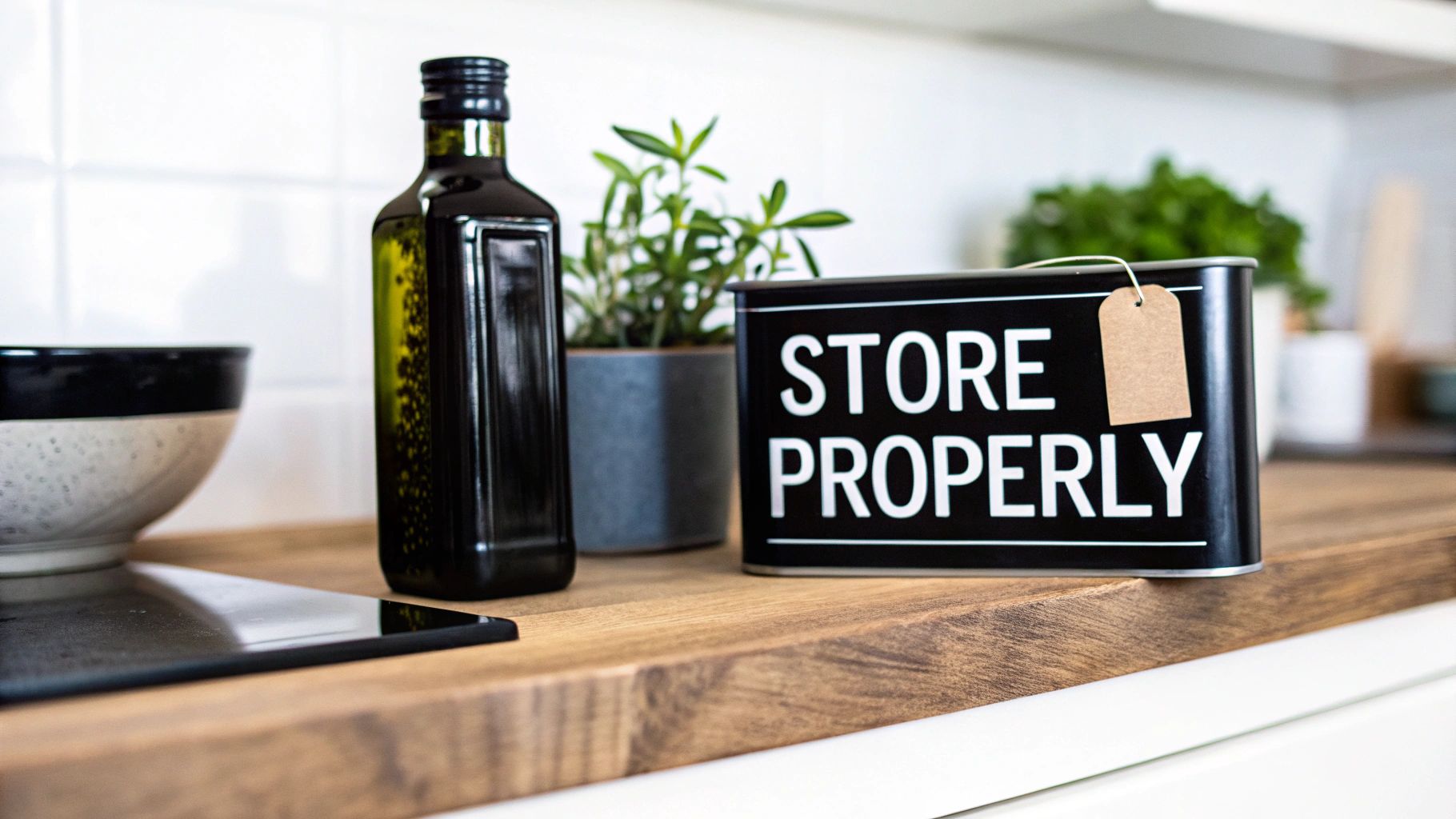
This is why proper storage is just as important as the oil you buy. Always, always choose an oil in a dark glass bottle or a tin. It's not about aesthetics; it’s a functional shield against light.
Keep your bottle sealed tightly and store it in a cool, dark place—a pantry or cupboard is perfect. Just don't put it in the fridge, as the cold can cause condensation and hurt the oil.
Protecting your oil from these three elements is simple, but it makes all the difference. For a more detailed breakdown, check out our complete guide on proper olive oil storage. It'll give you everything you need to keep that liquid gold fresh to the last drop.
Wrapping Up: Your Top Questions Answered
Even with all the details laid out, a few common questions always seem to surface. Let's tackle these head-on so you can feel completely confident the next time you're standing in the olive oil aisle.
Can I Actually Cook With Virgin Olive Oil?
Yes, you absolutely can. This is one of the most persistent myths we see, and it's time to put it to rest. A quality virgin olive oil typically has a smoke point between 350°F and 410°F (177°C to 210°C).
This range makes it a great choice for everyday cooking methods like sautéing and roasting. The idea that it's only good for drizzling over salads just isn't true.
What's the Real Difference Between 'Virgin' and 'Extra Virgin' One More Time?
It helps to think of it like academic grades. Both are high-quality, unrefined oils extracted purely by mechanical means—no chemicals allowed. The distinction comes down to perfection.
Extra virgin olive oil is the 'A+' student. It has to meet the strictest chemical criteria (like extremely low acidity) and, crucially, be deemed flawless in taste and aroma by a certified sensory panel. Virgin olive oil is the 'A' student—still an excellent, natural product, but it's allowed slightly higher acidity and may have very minor sensory imperfections.
Should I Be Judging an Oil By Its Color?
Not at all. The color of virgin olive oil tells you about the olive variety and when it was harvested, but it says nothing about the oil's quality. The hue can range from a bright, grassy green to a soft, golden yellow.
A deep green hue might look impressive, but it's often just due to higher chlorophyll from less ripe olives. It's not a shortcut to identifying a superior oil.
When you're looking for real quality signals, focus on a recent harvest date, a dark bottle that protects the oil from light, and the official classification on the label. These are the details that truly matter.
At Learn Olive Oil, we believe that genuine understanding is the key to true appreciation. We're here to give you the expert insights you need to choose and enjoy incredible olive oil with total confidence. Find out more at https://learnoliveoil.com.
 Learn Olive Oil
Leave a comment