That beautiful bottle of extra virgin olive oil on your counter? It began its life as a bitter, inedible fruit hanging from a gnarled, ancient-looking tree. The transformation of this humble fruit into what connoisseurs call liquid gold is a kind of alchemy, a delicate craft perfected over millennia.
This is a story about a desperate race against time—a frantic battle to capture peak flavor and precious health compounds before they simply vanish into thin air.
The Journey from Bitter Fruit to Liquid Gold
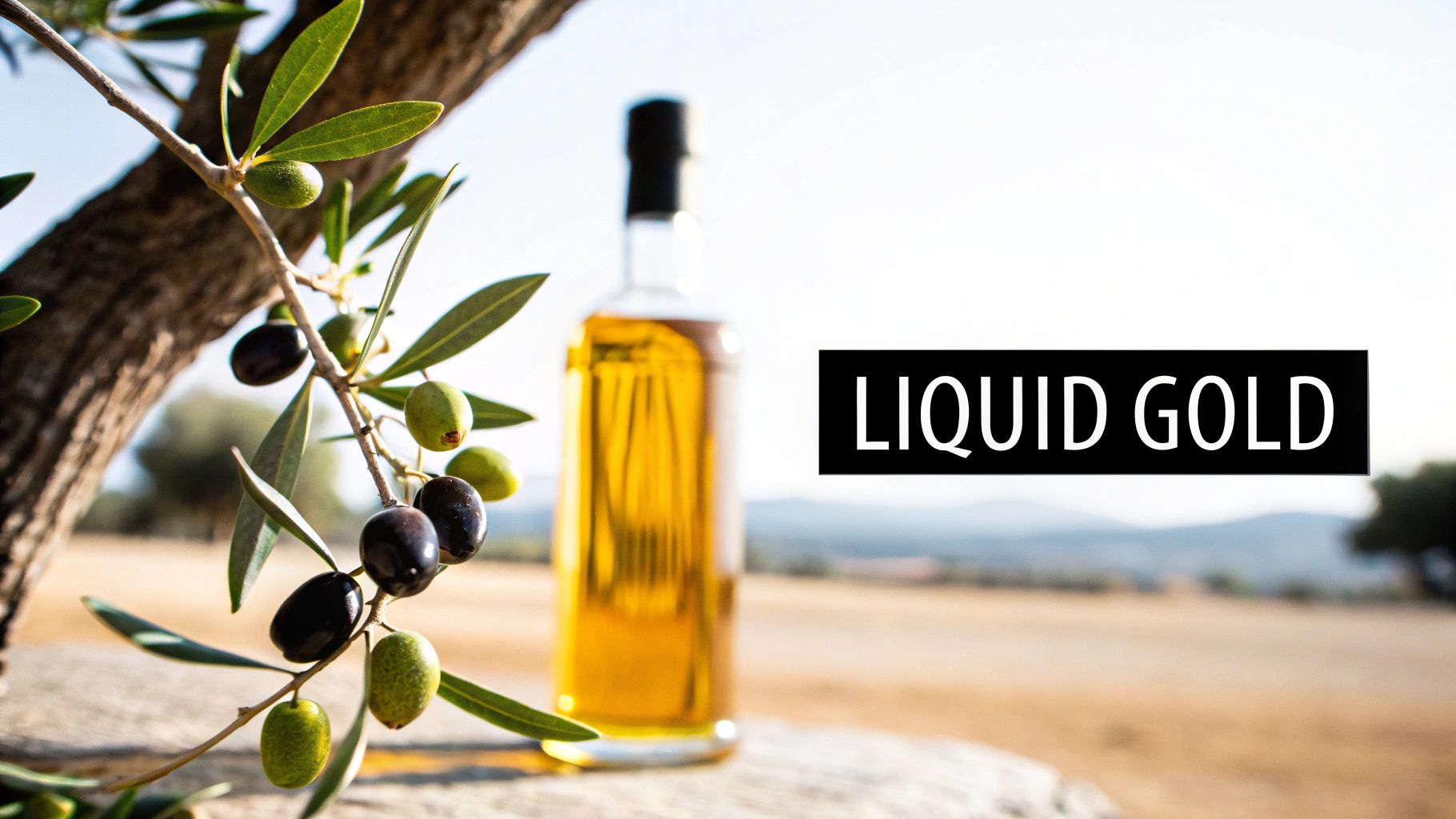
Most of us imagine olive oil production as a simple act of pressing fruit. But this comforting image misses the urgency, the artistry, and the science that separates a forgettable cooking oil from a truly extraordinary culinary experience. The entire journey is deeply rooted in the broader field of agriculture and farming, where it all begins with the olive grove itself.
From the very second an olive is plucked from its branch, a countdown timer starts ticking. Oxygen, heat, and time become sworn enemies, working to destroy the very qualities that make great olive oil so special.
What Defines Great Olive Oil Making
Exceptional oil is never an accident. It is the direct result of deliberate, meticulous decisions made at every single stage. Think of it like a master watchmaker, where one wrong move, one tiny slip, can ruin the entire piece. The same principle applies here, where every choice directly impacts the final taste, aroma, and health benefits locked inside the bottle.
This guide will pull back the curtain on this fascinating world. You will learn not just the steps but the why behind them. We will explore the critical moments that forge an oil's character:
- The Harvest: We'll discover why picking an olive just a week too early or a week too late can completely transform an oil from grassy and peppery to buttery and mild.
- The Milling: You'll see how modern genius has completely reshaped the ancient craft of extraction for the better.
- The Bottling: And we'll understand why the final steps of storage and protection are just as crucial as the very first ones in the field.
Here is the core truth every great producer lives by: making exceptional oil is a battle to preserve the soul of the olive. Every decision is a defense against time, temperature, and oxygen.
Here's a quick look at the fundamental stages we'll be diving into. These are the make-or-break moments in an olive's journey to becoming high-quality oil.
The Four Pillars of Quality Olive Oil Making
| Stage | What It Involves | Why It's Critical for Quality |
|---|---|---|
| Cultivation & Harvest | Growing healthy olives and picking them at the perfect moment of ripeness. | Timing is everything. It sets the stage for the oil's entire flavor profile, from peppery and robust to mild and fruity. |
| Extraction (Milling) | Crushing the olives and separating the oil from the solids and water, ideally within hours of harvest. | This is a race against oxidation. Fast, clean, and cool processing is essential to prevent defects and lock in freshness. |
| Filtration & Storage | Removing leftover fruit particles and storing the fresh oil in oxygen-free, temperature-controlled tanks. | Proper storage stops the clock on degradation, preserving the delicate flavors and healthy polyphenols until the oil is bottled. |
| Bottling & Handling | Protecting the finished oil in dark glass or tins to shield it from its two biggest enemies: light and air. | Even the best oil can be ruined by poor packaging. This final step ensures the quality crafted in the mill reaches your kitchen intact. |
By the end of this guide, you will no longer see a simple bottle of olive oil on the shelf. You will understand the story of passion, precision, and care that it contains. More importantly, you will be equipped to choose a bottle that delivers true quality, appreciating the incredible journey from a bitter fruit to the liquid gold in your kitchen.
Harvesting Olives: A Race Against Time
The story of a truly great olive oil does not begin in a mill. It starts in the quiet grove, under the sun. It is here, among the gnarled, silver-leafed branches, that the single most critical decision is made: when to pick. Think of it like a winemaker choosing the perfect day for their grapes; a few days in either direction can change absolutely everything.
Harvest too early, when the olives are a vibrant, hard green, and you will get an oil that is fiery and peppery, bursting with grassy, artichoke notes. This oil is an antioxidant powerhouse, but the yield is painfully low. Wait too long, until the fruit ripens to a deep, purplish-black, and you will get much more oil. It will be mild, buttery, and smooth, but it will have lost much of that antioxidant punch and the vibrant freshness that defines a world-class oil.
This is the tightrope every producer walks. It is that moment where agriculture and artistry collide, defining the soul of the oil before a single fruit is ever crushed.
The Gentle Hand vs. The Efficient Machine
Once the moment is right, how do you get the olives off the tree? For centuries, the answer was slow, painstaking work. Traditionalists still swear by hand-raking, where workers carefully comb the branches with wide-toothed rakes, letting the olives fall onto nets spread out below. It is incredibly gentle on the fruit and minimizes the bruising that can kickstart oxidation.
But that level of care costs time and money. So, many modern producers rely on mechanical shakers. These machines clamp onto the trunk or main branches and vibrate them powerfully, causing the olives to rain down in just a few seconds. It is a marvel of efficiency, allowing a producer to harvest an entire grove right at its peak—a feat that would be impossible by hand alone.
The debate is not about which is "better," but which is right for the specific oil being crafted. Both methods, however, share one urgent goal: get the olives off the tree quickly and carefully.
The Sprint to the Mill
The real drama begins the second an olive is separated from its branch. At that moment, it becomes a liability. Cut off from its life source, the fruit immediately starts to degrade. Every nick, bruise, and exposure to air triggers enzymes that begin the process of oxidation and fermentation.
The clock is now ticking. Loudly. Every minute that passes, the potential for greatness slips away. This is why you hear about olives being rushed to the mill within hours, not days.
Delay is the enemy. Olives left sitting in sacks or bins for even 24 hours can begin to ferment, leading to a "fusty" or "musty" taste in the final oil—an unforgivable flaw for any oil aspiring to be extra virgin. To prevent this, producers treat the harvest with an incredible sense of urgency. For a deeper dive into how different harvest timings and techniques impact the final product, you can explore more about the olive oil harvesting process in our detailed guide.
This frantic energy defines the entire process. It ensures the fruit arrives at the mill in pristine condition, ready to release its pure, vibrant essence. This race against time, won in the first few hours, is what separates a fresh, flawless oil from one that is merely ordinary. It is a sprint with no room for error.
Unlocking the Oil from Crush to Centrifuge
Once the olives arrive at the mill, the real transformation begins. This is where the fruit’s journey culminates, a place where age-old tradition meets modern science to release the liquid gold trapped inside. The air itself feels different here, humming with purpose as the romantic notion of olive oil making gives way to the precision of a true craft.
You probably have an image in your head of massive, granite stone wheels slowly crushing olives into a thick, fragrant paste. It is a beautiful picture, and for centuries, that is exactly how it was done. But this ancient method, while poetic, has a major flaw for anyone chasing excellence: it exposes the delicate olive paste to oxygen for far too long. Oxygen is the enemy of fresh, vibrant flavor.
Now, picture something else entirely. Think of a high-tech, industrial-strength salad spinner, but one designed to handle olive paste. This is the modern centrifuge, and it is the undisputed gold standard for producing world-class extra virgin olive oil today. It is a closed, clean, and incredibly efficient system that shields the oil from its greatest foe—the air.
This flowchart shows the critical first steps that happen before the mill, where timing and careful transport are everything.
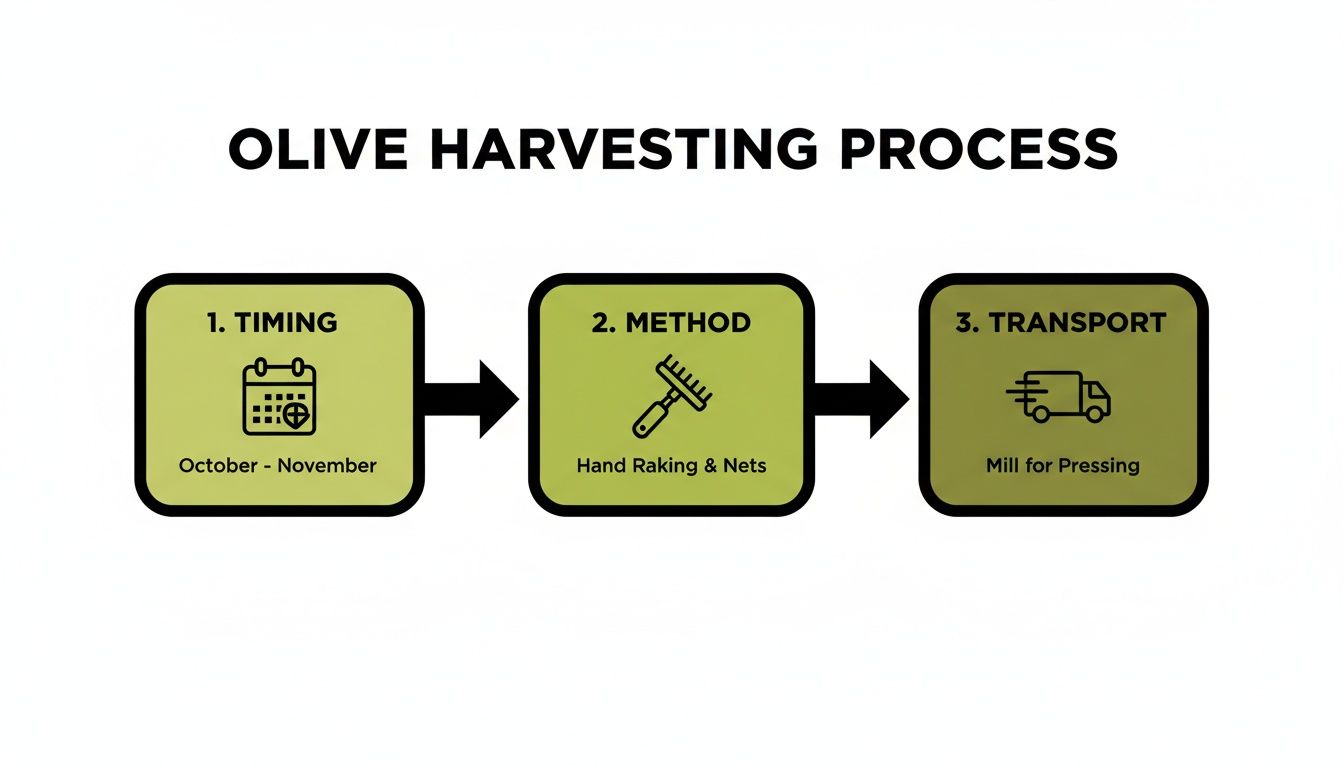
As you can see, the whole process is a race against the clock to get perfect olives from the tree to the crusher with as little delay and damage as possible.
The Magic of Malaxation
Before the centrifuge can do its job, there is a crucial, almost meditative step called malaxation. After the olives are crushed into a paste by a modern hammer mill—a process taking mere seconds—the paste is moved into a large trough where it’s gently and slowly stirred under controlled temperatures.
This is not just about mixing. On a microscopic level, this gentle churning is coaxing countless tiny oil droplets out of the fruit's cells, encouraging them to find each other and merge into larger drops. It is a delicate dance that takes anywhere from 20 to 40 minutes, and it is one of the most important moments for defining the oil's final character. For a deeper look at this process, our guide to olive oil extraction methods explains how modern mills operate in more detail.
This step proves that even in a high-tech process, patience and gentle handling are still king. The world’s best producers, particularly in places like Spain, have absolutely perfected this blend of speed and care.
What Cold-Pressed Really Means Today
Finally, let us clear up one of the most misunderstood terms you will see on a bottle: cold-pressed. You might see "first cold press" and think of that old stone wheel again. In reality, the term is mostly a nod to history.
In a modern mill, "cold-pressed" or "cold extraction" is not about a physical press at all. It is a legally defined guarantee that the temperature of the olive paste never went above 27°C (80.6°F) during the entire malaxation and extraction process.
Why does this matter so much? Because heat is the enemy of nuance. Sure, you could extract more oil by cranking up the temperature, but you would destroy everything that makes a great olive oil special. Heat kills the delicate aromas, the complex flavors, and, most importantly, the healthy polyphenols.
Here’s what that strict temperature control protects:
- Volatile Aromas: Those fresh, grassy, and fruity scents that leap from a great oil are fragile and simply evaporate with heat.
- Polyphenol Content: These are the powerful antioxidants that give an oil its peppery kick and most of its health benefits. They degrade quickly at higher temperatures.
- Overall Freshness: Keeping things cool prevents "cooked" or stale flavors, ensuring the final product tastes vibrant and alive.
So, when you see "cold extraction" on a label, understand it for what it is: a seal of quality. It is the producer’s promise that they chose flavor and health over simply getting more volume, protecting the true character of the olive from the crush all the way to the bottle.
What Truly Makes an Olive Oil Extra Virgin
You might see "Extra Virgin" on a label and think it is just a fancy marketing term, but it is far from it. This is a hard-won grade of excellence, a legally defined classification with rules as strict as any in the food world.
To earn the title, an oil has to prove its perfection in two separate arenas: a cold, hard chemistry lab and a rigorous blind taste test.
Passing one is not enough; it has to conquer both. An oil can have perfect lab results but fail the taste test, instantly disqualifying it. This dual-gate system is the only way to guarantee the quality, freshness, and flawless character that defines the pinnacle of olive oil.
The Unforgiving Chemistry Test
Before a drop of oil ever touches a taster's palate, it faces a battery of chemical analyses. The most critical measure here is its free fatty acidity (FFA).
Think of FFA as a scorecard for how well the olives were handled. The moment an olive's skin is broken or bruised, enzymes start breaking down the oil, releasing free fatty acids. Every misstep—a delay in milling, rough harvesting, or olives left sitting in piles—sends this number climbing.
To even be considered for the extra virgin category, an oil's free fatty acidity must be below a pristine 0.8%. Most world-class producers, however, treat that as a ceiling. They aim for much lower—often below 0.3%—as a personal badge of honor.
An oil’s acidity level is a direct reflection of the producer's care. It is the chemical proof that the olives were healthy, harvested gently, and milled with extreme speed and precision.
Understanding the rigorous manufacturing quality lab processes for food products that are used across the food industry helps put into perspective the level of control required to achieve this. These standards are what separate a true artisan from a mass-producer.
The Human Verdict: The Sensory Panel
Passing the chemistry test just gets an oil in the door. The real trial by fire is the sensory analysis, where the oil is judged by a certified panel of human tasters. These are not just foodies; they are highly trained experts whose palates can detect the slightest imperfection.
The tasting is done completely blind. They even use special blue glasses to hide the oil's color so it cannot influence their judgment. The panel has two missions: first, to identify positive attributes like fruitiness, and second, to hunt for any defects. To be extra virgin, an oil must have some discernible fruity character, but the most important qualification is having zero defects.
Even one tiny flaw means instant disqualification. These defects are like ghosts of mistakes made somewhere in the production process.
- Fusty: This defect smells like fermented olives or damp hay. It is the unmistakable sign of olives that sat in piles for too long before milling, causing them to heat up and ferment.
- Rancid: Smelling of old crayons or stale nuts, this is the most common defect. It is caused by oxidation from exposure to too much air, light, or heat after the oil is made.
- Musty: An aroma reminiscent of a damp, moldy cellar. This comes from milling moldy olives along with the healthy ones—a clear sign of poor selection and hygiene.
- Winey-Vinegary: A sharp, sour aroma that points to acetic acid fermentation. This often happens when the olive paste breaks down during malaxation, usually due to poorly cleaned equipment.
Ultimately, the "extra virgin" classification is a promise. For a complete breakdown of this standard, you can learn more about the official extra virgin olive oil definition. It is a testament that the producer successfully navigated every challenge, from the grove to the bottle, to deliver an oil that is not just technically perfect, but sensorially flawless.
Small-Batch vs. Industrial Production
Walk down the olive oil aisle, and you will see two bottles of extra virgin olive oil, both with beautiful labels, sitting side-by-side. Why is one ten dollars and the other thirty? The answer usually comes down to a story of scale. The world of olive oil is really split between two different philosophies: the focused, artisanal producer and the massive, industrial operation.
Think of a craft microbrewery that obsesses over a single, perfect IPA. That is your small-batch producer. They most likely manage a single grove, know their trees like old friends, and harvest a specific olive variety at the exact moment of ripeness. Their goal is not to make an oil that tastes the same year after year, but to create an oil that tastes exactly like this year, from this specific place.
Industrial production is the complete opposite. It is built for consistency. It is the global beer brand you can find in any country, tasting identical every single time. Olives are sourced from countless farms, sometimes across entire regions, and then skillfully blended to create a uniform flavor profile that meets a specific market demand, year in and year out.
The Artisan's Touch
For a small-batch producer, making olive oil is personal. Their entire process is designed to capture a unique expression of terroir—that one-of-a-kind flavor profile created by the local soil, climate, and olive variety.
This obsession with detail means everything:
- Single-Estate Olives: The fruit comes from one specific, known grove, which guarantees a consistent and unique starting point.
- Precision Harvesting: They decide when to harvest based on the exact flavor they are chasing, often picking early to get those peppery notes and a high polyphenol count.
- Immediate Milling: Olives are almost always milled within a few hours of picking at a dedicated or nearby facility, locking in absolute freshness.
What you get is an oil with a real personality. It might be intensely grassy with notes of artichoke one year, and then more like fresh tomato leaf the next. This is the story in the bottle—a snapshot of a specific time and place.
The Industrial Engine
The industrial model runs on a totally different set of rules: volume, consistency, and cost-efficiency. This is the approach needed to supply the enormous global demand for olive oil. For a comprehensive overview of all the steps involved, check out our guide on the complete olive oil manufacturing process.
Their system is built to iron out the variations that nature throws at them. An industrial producer might blend oil from thousands of different farms to hit a target flavor that consumers recognize and expect. While they produce huge quantities of reliable extra virgin olive oil, the unique character of any single grove gets lost in the blend.
The choice is not between "good" and "bad." It is between personality and predictability. The artisan sells you a story of a single harvest, while the industrial producer sells the comfort of consistency.
This massive scale also makes large producers more vulnerable to the whims of global climate patterns. For example, the olive oil world sees major swings from climate variability, which is expected to shift production regionally. Italy, for instance, is forecast to produce 300,000 tons in an upcoming season—a significant 30% annual increase—with southern regions like Apulia and Calabria expected to see their output rise by 30–40%. You can discover more insights about these olive oil trends. Big producers have to navigate these huge shifts to keep their supply chains running smoothly.
Ultimately, these two philosophies give you, the buyer, a fantastic choice. Do you want an oil that tells a unique story, or one that delivers a familiar and dependable taste for your everyday cooking? Understanding the difference in scale is the first step to choosing the perfect bottle for your kitchen.
How to Read the Label and Choose a Great Oil

Now that you understand what goes into making great olive oil, you can step into the grocery store aisle with a whole new perspective. This is where all that knowledge pays off, helping you cut through the marketing fluff and spot the real treasures on the shelf. It is time to become a label detective.
Your first mission is to find proof that the producer actually cares about their oil. Forget the flowery language on the front of the bottle for a moment; the real story is usually tucked away in the fine print on the back. And your most important clue is the harvest date.
Look for the Harvest Date
Do not be fooled by a "best by" date. That is often just a two-year countdown from the day the oil was bottled, which tells you nothing about when the fruit was actually picked and pressed. The harvest date, on the other hand, is the ultimate indicator of freshness. For the most vibrant flavor and health benefits, look for a date within the last year.
A harvest date is a producer’s promise of freshness. When it is missing, it is a huge red flag. It often means the oil is old, blended from different seasons, or untraceable. Never settle for ambiguity.
Beyond the date, the bottle itself speaks volumes. Light is one of olive oil's worst enemies, quickly turning it rancid and destroying its delicate flavors. Any producer who puts their oil in clear glass simply does not understand the basics. A dark glass bottle or an opaque tin is non-negotiable.
Decode the Origin and Variety
Next, check out where the oil came from. A vague phrase like "Product of the Mediterranean" is a tell-tale sign of a low-quality blend. It usually means a large corporation bought cheap oil from various countries and mixed it all together.
You are looking for specificity. "Product of Spain" or "Product of Italy" is a start, but a specific region—like "Sicily" or "Andalusia"—is a much stronger signal of a producer who takes pride in their local terroir.
Spotting the olive varietal on the label—like Picual, Koroneiki, or Frantoio—is another fantastic sign. This is just like a winemaker highlighting a specific grape. It shows an incredible attention to detail and means the producer is confident in the unique character of their olives. Our guide on understanding olive oil labeling has even more tips on what to look for.
The good news is that you are not alone. Demand for high-quality oil is surging worldwide. Olive oil imports in major markets recently jumped by over 11%, with extra virgin oil accounting for more than 70% of those exports. This shows that more and more people are learning to spot the markers of quality you now know. By looking for these clues, you are joining a growing movement of savvy buyers who know what they want and how to find it.
Olive Oil FAQs: Your Questions Answered
Let us tackle some of the most common questions that pop up when talking about how olive oil is made. These are the things people always wonder about, and getting straight answers will help you understand what really makes a great olive oil.
Does Color Tell You Anything About Quality?
Not in the slightest. This is probably the biggest myth out there. A fantastic olive oil can be anything from a deep, grassy green to a light, buttery gold.
The color is really just a reflection of two things: how ripe the olives were when they were picked and how much chlorophyll is in them. It has absolutely zero to do with the oil's actual quality or flavor profile. This is why professional tasters use special cobalt blue glasses—it hides the color completely so it cannot influence their judgment. The takeaway here is simple: trust your nose and your palate, not your eyes.
What’s the Deal with "First Cold Press" vs. "Cold Pressed"?
In the modern world of olive oil, these terms have become pretty much interchangeable. "First press" is a romantic term left over from the old days of traditional hydraulic presses. Back then, the ground olive paste was sometimes pressed a second time, often with hot water, to wring out every last bit of oil (which was of much lower quality).
Today's mills are far more advanced. The oil is extracted just once using a centrifuge. The legally meaningful term you should look for on a label is "cold pressed" or "cold extraction." This is a guarantee that the olive paste was kept below 27°C (80.6°F) during the process, which is crucial for preserving the oil's delicate aromas, flavors, and health-giving compounds. "First cold press" is really just marketing speak for that same single, high-quality, modern process.
That peppery tickle in your throat is not a flaw; it is a feature. It is the hallmark of a fresh, high-quality extra virgin olive oil packed with powerful antioxidants.
Why Does Some Olive Oil Make Me Cough?
If you taste an olive oil and get a surprising, peppery kick in the back of your throat that makes you cough, congratulations! You have likely found a fresh, high-quality, and genuinely healthy extra virgin olive oil. Do not worry, it is a very good sign.
That sensation comes from a specific antioxidant called oleocanthal, a natural anti-inflammatory compound that is abundant in fresh, healthy olives. A strong peppery finish is a clear indicator that the oil is packed with beneficial polyphenols and was made from olives harvested at the perfect time. So next time an oil makes you cough, embrace it—it is nature's way of telling you you have got the good stuff.
At Learn Olive Oil, we believe that understanding the craft behind the bottle is the key to enjoying it. We are dedicated to helping you discover the world of premium olive oil, from tasting like a pro to choosing the perfect bottle for any occasion.
Explore our expert guides and resources at https://learnoliveoil.com to continue your journey.
 Learn Olive Oil
Leave a comment