Imagine for a moment that every single tablespoon of the golden liquid you drizzle over your salad contains roughly 120 calories and 14 grams of fat. What it doesn't contain is a single carbohydrate, any protein, or a trace of cholesterol. And it is this unique, almost paradoxical, nutritional profile that makes it such a powerful cornerstone of lifelong health.
The Unvarnished Truth About EVOO Nutrition
Look past the elegant bottles, the fancy labels, and the marketing slogans. Let's get to the very core of what makes authentic extra virgin olive oil so profoundly different from any other fat in your kitchen. This isn't just hype; the scientific evidence reveals precisely why this ancient oil has been cherished by the world's healthiest civilizations.
We're about to break down the numbers that actually matter—the calories, the specific types of fats, and the crucial vitamins that transform this simple oil into a nutritional heavyweight.
A Tablespoon of Liquid Gold
Think of EVOO not as a simple cooking oil, but as a concentrated dose of nature's most perfect fuel. Each tablespoon is a shot of pure energy, composed almost entirely of fat. But here is the secret: not all fats are created equal. And the type of fat found in genuine EVOO is what makes all the difference.
A single tablespoon delivers between 120-126 calories and 14 grams of fat. Inside, you'll find zero carbohydrates, protein, cholesterol, sodium, or fiber. The real story—the one that matters to your health—is hidden in the fat composition, which is overwhelmingly dominated by 75-78% monounsaturated fats. To grasp how significant that is, consider that common sunflower oil contains only around 20% monounsaturated fat. You can discover the full story by exploring olive oil's composition for yourself.
This is the bedrock upon which its incredible health benefits are built.
At its core, extra virgin olive oil is more than just a cooking medium. It is a functional food, where every component—from its fatty acids to its micronutrients—works in concert to support your well-being.
To make it easy to see the key values at a glance, here’s a quick summary of what’s in a standard one-tablespoon (14g) serving.
Extra Virgin Olive Oil Nutritional Snapshot Per Tablespoon
| Nutrient | Amount | Percent Daily Value (%DV) |
|---|---|---|
| Calories | 126 | 6% |
| Total Fat | 14 g | 18% |
| Saturated Fat | 2 g | 10% |
| Polyunsaturated Fat | 1.4 g | – |
| Monounsaturated Fat | 10.2 g | – |
| Vitamin E | 1.9 mg | 13% |
| Vitamin K | 8.1 mcg | 7% |
This simple table reveals a profound truth: while EVOO is pure fat, it's overwhelmingly the "good" monounsaturated kind, and it delivers a meaningful dose of critical fat-soluble vitamins.
The Nutritional Blueprint
So, what exactly are you getting in that tablespoon? The main components are what make EVOO a celebrated part of healthy diets around the world.
- Heart-Healthy Fats: The undisputed star of the show is oleic acid, the primary monounsaturated fat in EVOO. This is the "good fat" widely credited with many of its heart-protective effects.
- Essential Vitamins: It’s a fantastic source of fat-soluble vitamins, especially Vitamin E (a powerful antioxidant) and Vitamin K (crucial for blood clotting and bone health).
- Powerful Antioxidants: Beyond vitamins, EVOO is brimming with bioactive compounds called polyphenols. These are the unsung heroes responsible for its anti-inflammatory powers and that signature peppery kick you feel at the back of your throat.
Understanding this nutritional blueprint is the first step. Now, let's explore how these numbers translate into real, tangible benefits for your heart, your brain, and your overall long-term health.
Decoding the Fats: The Good, The Bad, and The Beautiful
To truly understand what makes extra virgin olive oil so good for you, we must begin with a simple, powerful truth: not all fats are created equal. In the world of nutrition, some fats are villains, but others are the unsung heroes your body desperately needs. Extra virgin olive oil (EVOO) isn't just a minor character in this story; it's the protagonist, and its power lies in its unique lineup of fatty acids.
When you pour a drizzle of EVOO, you're looking at a liquid made almost entirely of fat. But this isn't the kind of fat that clogs arteries or expands your waistline. Instead, it’s a beautifully constructed profile that nature itself designed to protect and nourish. This is where the science gets truly fascinating—and incredibly important for your health.
The Reigning Champion: Monounsaturated Fat
The absolute star of the show in EVOO is oleic acid, a type of monounsaturated fat. It makes up a massive 55% to 83% of the oil's total fat content. Think of it as the lead actor in a blockbuster film; it gets the most screen time for a very good reason.
Oleic acid has earned its fame for its incredible ability to support heart health. It acts like a brilliant traffic controller for your cholesterol, helping to nudge down the levels of LDL (the "bad" cholesterol) while often keeping HDL (the "good" cholesterol) steady or even giving it a boost. This isn't just a minor adjustment; it's a powerful mechanism for helping keep your arteries clear and your heart working as it should.
This is the hero fat that truly sets EVOO apart from many other common cooking oils, which are often loaded with less stable polyunsaturated fats. The stability of monounsaturated fat also means it resists oxidation, a huge benefit both in the bottle and inside your body, helping to shield your cells from damage.
Oleic acid is the workhorse of extra virgin olive oil. Its dominance in the fatty acid profile is the primary reason EVOO is considered a cornerstone of heart-healthy diets like the Mediterranean diet.
Understanding the Supporting Cast
While oleic acid rightly grabs the spotlight, it doesn’t work alone. The other fats in extra virgin olive oil play crucial supporting roles, and it's their specific balance that creates such a powerful nutritional synergy.
- Polyunsaturated Fats (PUFAs): These make up around 10-11% of the fat content and include essential fatty acids like omega-6 and omega-3. Our bodies can't produce these, so we must get them from food. The ratio is what's important here. EVOO offers a healthy balance, unlike many seed oils that can be overloaded with omega-6, which may contribute to inflammation if consumed in excess.
- Saturated Fats: Often unfairly cast as the villain, saturated fats only account for about 14% of the total fat in EVOO. This modest amount is part of a well-rounded profile, providing the benefits of the good fats without the health risks associated with a diet high in saturated fat from sources like butter, lard, or fatty meats.
This precise fatty acid composition is what makes health experts and nutritionists so enthusiastic. It's a fat source that not only provides rich flavor and energy but also actively works to protect your body from the inside out.
From Fat Profile to Daily Vitality
Making the switch from other fats to EVOO is about more than just counting calories or following a trend. It's a strategic decision to upgrade the very building blocks your body uses every single day. For a deeper look into how these fats translate to energy, you can explore the numbers behind olive oil calories per tablespoon.
Imagine you're building a house. You could use cheap, flimsy materials, or you could invest in strong, durable, high-quality ones. From the outside, the house might look the same, but one is built to last a lifetime. That’s exactly what you’re doing for your body when you make EVOO your go-to fat. You're not just eating—you're rebuilding with superior materials.
The Antioxidant Powerhouse Within Every Drop
If the healthy fats in olive oil are the engine, then its antioxidants are the elite defense system. And it is here that true extra virgin olive oil (EVOO) sprints leagues ahead of the refined, pale yellow imposters on the shelf. We're about to peer into the microscopic world inside that bottle, a world teeming with powerful compounds that stand guard over your health.
This isn't abstract science. It's about tangible, protective compounds that give authentic EVOO its signature peppery flavor and its incredible ability to shield your body from damage and disease.
Meet the Polyphenol Protection Squad
Have you ever tasted a high-quality EVOO and felt that slight burn or tickle in the back of your throat? Congratulations. You are actually tasting the polyphenols. These are potent, naturally occurring compounds that act as antioxidants, waging a daily war against cellular damage inside your body.
Think of your cells like a brand-new car. Every day, they're exposed to things that cause rust—in the body, we call this oxidative stress. Polyphenols are the rust-proof coating, the protective wax, and the meticulous mechanic all rolled into one. They keep your cellular machinery running flawlessly.
EVOO contains more than 30 different phenolic compounds, but a few of them are true superstars.
- Oleocanthal: This is the compound behind that peppery sensation. In a stunning example of nature's intelligence, oleocanthal has been shown to have anti-inflammatory properties that mimic the action of ibuprofen, working to calm inflammation at a cellular level.
- Hydroxytyrosol: Considered one of the most powerful antioxidants in nature, hydroxytyrosol is a master at neutralizing harmful free radicals before they can wreak havoc. Its presence is a key reason EVOO is so closely linked to heart health.
- Tyrosol: Working alongside its more famous cousin, tyrosol also adds to the oil's protective qualities. It helps shield your cells from the steady march of aging and environmental stressors.
This incredible team of antioxidants is almost entirely absent from refined oils like "light" olive oil, canola, or vegetable oil. The high-heat processing they undergo strips them clean. You can learn more about how to spot a high-quality oil by understanding the importance of olive oil polyphenol content in our detailed guide.
Vitamins E and K: The Fat-Soluble Guardians
Beyond its unique polyphenols, EVOO delivers a healthy dose of essential fat-soluble vitamins that work hand-in-hand with its other components. This is another crucial piece of the nutritional information for extra virgin olive oil that truly sets it apart.
A single tablespoon gives you about 13% of your daily Vitamin E, a powerful antioxidant that helps protect your cell membranes. It’s especially important for healthy skin and a strong immune system.
That same tablespoon also packs around 7% of your daily Vitamin K, which is vital for proper blood clotting and is increasingly recognized for its role in building strong bones.
These aren't just letters on a nutrition label. They are functional nutrients your body needs for critical processes, and EVOO delivers them in a natural, easy-to-use form alongside the healthy fats required to absorb them properly.
From Cellular Defense to Disease Prevention
This antioxidant arsenal isn't just for show—it translates into real, measurable health benefits. EVOO's remarkable polyphenol content is why it consistently scores at the top of nutritional quality indexes. For example, a 2023 index awarded it a perfect 100/100 score, placing it far ahead of nearly all other plant oils for its potential in preventing chronic disease.
These powerful antioxidants, which are lost when other oils are refined, are directly linked to reduced risks for certain cancers, particularly those of the breast and digestive system. The polyphenols in olive oil also appear to play a role in bone health, with regular intake being tied to a lower risk of hip fractures and improved bone density. You can find more insights on EVOO's health benefits on WebMD.com.
This is the beautiful synergy of EVOO: the fats provide the energy and structure, while the antioxidants provide the protection. Together, they create a food that does more than just nourish—it actively defends.
So, What Do These Nutrition Facts Actually Do For You?
It's one thing to read numbers on a nutrition label. It is something else entirely to understand what they mean for your life, your health, and your future. How does the nutritional breakdown of extra virgin olive oil translate into real-world benefits? This is where the science connects with your everyday life, revealing why the Mediterranean diet has earned its legendary status.
The real magic of EVOO isn't found in one single ingredient. It’s the powerful synergy between its healthy fats, potent antioxidants, and essential vitamins. They work together, creating an incredible shield for your body's most important systems.
This isn't just folklore. Decades of rigorous scientific research have cemented extra virgin olive oil's reputation as one of the most powerful functional foods you can possibly add to your diet.
A Powerful Ally for Your Heart
At the very center of EVOO's health claims—literally—is its profound impact on cardiovascular wellness. Imagine your arteries are like busy highways. A poor diet can cause traffic jams and road damage (plaque buildup), leading to major problems. The oleic acid in EVOO acts like a master road crew, helping to keep those lanes clear by managing your cholesterol levels.
But that’s only half the story. The anti-inflammatory polyphenols in EVOO, especially one called oleocanthal, work to cool down the chronic, low-grade inflammation that is a root cause of heart disease. It's a brilliant one-two punch: the good fats improve your cholesterol profile, while the antioxidants protect your blood vessels from daily wear and tear.
What you pour over your salad or use to cook your vegetables today is a powerful investment in the long-term health of your heart. It's a simple, daily decision that really adds up over time.
The evidence is overwhelming. Some of the most compelling research shows that consuming just over 7 grams daily (about half a tablespoon) can potentially reduce the risk of dying from cardiovascular disease by a staggering 19%. This is backed by major studies that give EVOO an A-grade for heart health, primarily because its fat content is nearly 75% monounsaturated, which helps lower "bad" LDL cholesterol and raise "good" HDL. You can dive deeper into the science, including the famous PREDIMED trial, by reading up on EVOO's effect on heart disease risk.
More Than Just a Healthy Heart
While protecting your heart is EVOO's most famous benefit, its positive effects ripple throughout your entire body. The same properties that keep your arteries healthy also offer advantages for everything from your brain function to your blood sugar control.
This is what makes the nutritional profile of extra virgin olive oil so impressive. It’s not a one-trick pony; it’s a full-body health supporter.
-
Diabetes Prevention: Landmark studies have shown that a diet rich in EVOO can dramatically lower the risk of developing type 2 diabetes. The PREDIMED study, a massive trial with over 7,000 participants, found that a Mediterranean diet featuring at least four tablespoons of EVOO daily slashed diabetes risk by an amazing 30% compared to a standard low-fat diet.
-
Brain Health: Your brain is made of roughly 60% fat, so the quality of the fats you eat is absolutely crucial for its health and performance. The antioxidants in EVOO also help fight oxidative stress, a key factor in age-related cognitive decline.
-
Anti-Cancer Properties: While no single food can prevent cancer, large-scale population studies consistently link higher olive oil consumption with lower risks of certain cancers, especially those of the breast and digestive tract. Experts believe the polyphenols play a crucial role in protecting our cellular DNA from damage.
These are just a few of the well-researched advantages. To get the full picture of its wide-ranging effects, check out our complete guide on olive oil health benefits. The takeaway is clear: the numbers on the nutrition label directly translate into a stronger, more resilient body.
Choosing and Using Your Olive Oil for Maximum Nutrition
All this talk about antioxidants and healthy fats is wonderful, but it means very little if you bring home a subpar bottle or accidentally destroy all the goodness in your cooking pan. Knowing the nutrition facts is only half the battle. The other half is becoming a savvy shopper and a smart cook, turning that knowledge into real health benefits.
Let's pull back the curtain on how to navigate the supermarket aisle. We'll show you how to read labels like an expert, so you can spot authentic extra virgin olive oil and sidestep the imposters that offer little more than empty calories.
Decoding the Label Like a Pro
The olive oil section can be a confusing place, full of clever marketing terms that tell you nothing about quality. But once you know what to look for, the good stuff practically jumps off the shelf. Ignore the fancy graphics for a moment and focus on the details that truly matter.
Your mission is to find the freshest, least-processed oil you can. That's where you'll find the highest concentration of beneficial polyphenols. Think of it this way: time and processing are the enemies of nutritional value.
A truly great extra virgin olive oil is a time-sensitive product, much like fresh produce. Its health benefits are at their peak shortly after pressing and diminish over time. Your mission is to find the youngest, best-protected oil you can.
To do this, hunt for these key indicators on the label:
- Harvest Date: This is your single most important clue. Look for a specific date, like "October 2023." An oil without a harvest date is a major red flag. Always try to buy oil from the most recent harvest available.
- Dark Glass or Tin: Light is one of olive oil's worst enemies because it causes the healthy compounds to break down. A reputable producer will always protect their product in an opaque container. Never, ever buy EVOO bottled in clear glass.
- Country of Origin: Demand specifics. A label that just says "Product of Italy" could mean oils from various places were simply blended and bottled there. A specific origin, like "Sicily, Italy," suggests a much higher level of quality and care.
To truly master this, check out our complete guide on how to buy olive oil. It'll turn you into an expert shopper.
Preserving Nutrition in the Kitchen
So, you’ve brought home a fantastic bottle of EVOO. Now what? The next step is to use it in a way that protects all those precious nutrients you just paid for. It all comes down to proper storage and smart cooking.
First, let's bust the myth that you can't cook with extra virgin olive oil. High-quality EVOO actually has a smoke point between 350-410°F (177-210°C). This makes it perfectly safe for most of your everyday cooking, including sautéing and even light roasting.
The key is simply to use the right heat for the job. Gentle sautéing will preserve far more of those delicate polyphenols than high-heat frying. And for finishing dishes—drizzling over salads, or making dips—using it unheated delivers 100% of the oil's nutritional power.
Between uses, store your oil in a cool, dark place—a pantry or cupboard is perfect, but right next to the stove is a terrible spot. This protects it from its two biggest enemies: heat and light.
How Extra Virgin Olive Oil Compares to Other Oils
Walking down the cooking oil aisle can feel overwhelming. Every bottle promises a healthier meal, but when you look past the marketing slogans and get down to the hard science, extra virgin olive oil (EVOO) consistently stands apart.
This isn't about criticizing other oils. It's about giving you a clear, honest look at what really matters: the types of fats, the antioxidant levels, and how the oil is made. Once you see the facts side-by-side, the superior choice becomes obvious.
The Fatty Acid Face-Off
Let's begin with the fundamentals: the fat itself. The composition of an oil has a direct and powerful impact on your health.
- Extra Virgin Olive Oil: EVOO is the undisputed king of monounsaturated fats. A staggering 55-83% of its makeup is oleic acid, a heart-healthy fat celebrated for its stability. This is the compound that helps lower "bad" LDL cholesterol while leaving your "good" HDL cholesterol untouched.
- Coconut Oil: Something of an oddity in the plant world, coconut oil is loaded with saturated fat—over 80%, in fact. While it contains some medium-chain triglycerides (MCTs), its overall profile simply cannot compare to EVOO for supporting long-term heart health.
- Sunflower Oil: This oil is typically high in polyunsaturated fats, which are less stable than the monounsaturated kind found in olive oil. While you can find "high-oleic" versions that attempt to mimic EVOO's profile, standard sunflower oil doesn't offer the same protective balance.
The nutritional information for extra virgin olive oil tells a clear story. Its fat profile is practically engineered by nature to support cardiovascular wellness, a claim most other oils cannot make with the same level of scientific confidence.
When you choose an oil, you're choosing the primary type of fat you consume. EVOO offers a profile rich in stable, heart-friendly monounsaturated fats, while many seed and tropical oils are dominated by less beneficial polyunsaturated or saturated fats.
Cooking Oil Nutritional Showdown Per Tablespoon
To truly see the difference, let's put some of the most popular oils head-to-head. This table reveals how the fatty acid makeup and processing methods differ—a crucial distinction for understanding their true health impact.
| Oil Type | Primary Fat Type | Monounsaturated Fat (%) | Polyphenol Content | Processing Method |
|---|---|---|---|---|
| Extra Virgin Olive Oil | Monounsaturated | 55-83% | High | Cold-Pressed |
| Canola Oil | Monounsaturated | ~63% | Negligible | Refined (Heat/Chemicals) |
| Coconut Oil | Saturated | ~6% | Low | Varies (Refined/Virgin) |
| Sunflower Oil | Polyunsaturated | ~20% | Negligible | Refined (Heat/Chemicals) |
| Avocado Oil | Monounsaturated | ~70% | Moderate | Varies (Refined/Virgin) |
As you can see, while some oils might be high in monounsaturated fats, only unrefined, cold-pressed EVOO delivers that benefit along with a high polyphenol count. This combination is what truly sets it apart.
The Antioxidant Advantage
Here is where the difference between EVOO and other oils becomes crystal clear. It all comes down to how it's made.
EVOO is made by simply crushing olives and extracting the juice—a mechanical, cold-press method. This gentle process preserves its incredible wealth of polyphenols, which are powerful antioxidants like oleocanthal and hydroxytyrosol. These are the natural compounds that fight inflammation and protect your cells from damage.
On the other hand, most seed and vegetable oils (like canola, soy, or corn oil) are made using intense heat and chemical solvents. This industrial process strips away nearly all of the natural antioxidants, leaving you with a bland, neutral fat that offers none of the protective benefits of a true extra virgin olive oil. For a closer look at this, our guide comparing olive oil vs canola oil breaks it down even further.
At the end of the day, reaching for EVOO is more than just a culinary choice. It’s a simple strategy for getting a unique combination of healthy fats and powerful antioxidants that most other cooking oils simply cannot deliver.
Common Questions About EVOO Nutrition
Even with the nutritional facts laid bare, a few common questions always seem to surface about extra virgin olive oil. Let's clear up some of the confusion so you can feel completely confident using this incredible oil.
Is Light Olive Oil a Lower-Calorie Option?
This is perhaps one of the biggest deceptions you'll find in the cooking oil aisle. The short answer is an emphatic no. That word "light" on the label is a clever bit of marketing that refers to a lighter flavor and color, not fewer calories.
All olive oils, from the most robust extra virgin to the most refined "light" version, pack the exact same caloric punch: about 120 calories per tablespoon. The real difference is in the processing. Light olive oil is refined using heat and chemicals, which destroys the valuable polyphenols that give EVOO its profound health benefits. For your health, extra virgin is always the superior choice.
How Much Extra Virgin Olive Oil Should I Consume?
There’s no single magic number that works for everyone, but scientific research gives us a very good target. Many of the landmark studies that put EVOO on the map, like the famous PREDIMED trial, found significant health improvements with a daily intake of 2 to 4 tablespoons.
The goal isn't just to add more fat to your diet, but to make a strategic swap. Try replacing less healthy fats like butter, margarine, or processed seed oils with extra virgin olive oil. This way, you're making every calorie work harder for your health.
Even a small amount can make a big difference. Some studies have shown that as little as half a tablespoon per day can contribute to better heart health.
Does the Color of Olive Oil Indicate Its Nutritional Value?
Surprisingly, the color of an olive oil tells you very little about its quality or nutritional value. An authentic extra virgin olive oil can range from a vibrant, grassy green to a soft, golden yellow. The color simply reflects the type of olive used and how ripe it was at harvest.
A greener oil often has a peppery, robust flavor, while a golden oil might taste more buttery and smooth. Both can be equally packed with health-boosting polyphenols. To find a high-quality, nutrient-rich oil, look for these clues instead:
- A recent harvest date printed right on the bottle.
- Third-party certification seals, like PDO (Protected Designation of Origin) or COOC (California Olive Oil Council).
- That peppery tingle you feel in the back of your throat—that's a tell-tale sign of powerful antioxidants at work.
This chart gives a quick visual of how EVOO stacks up against a couple of other popular oils.
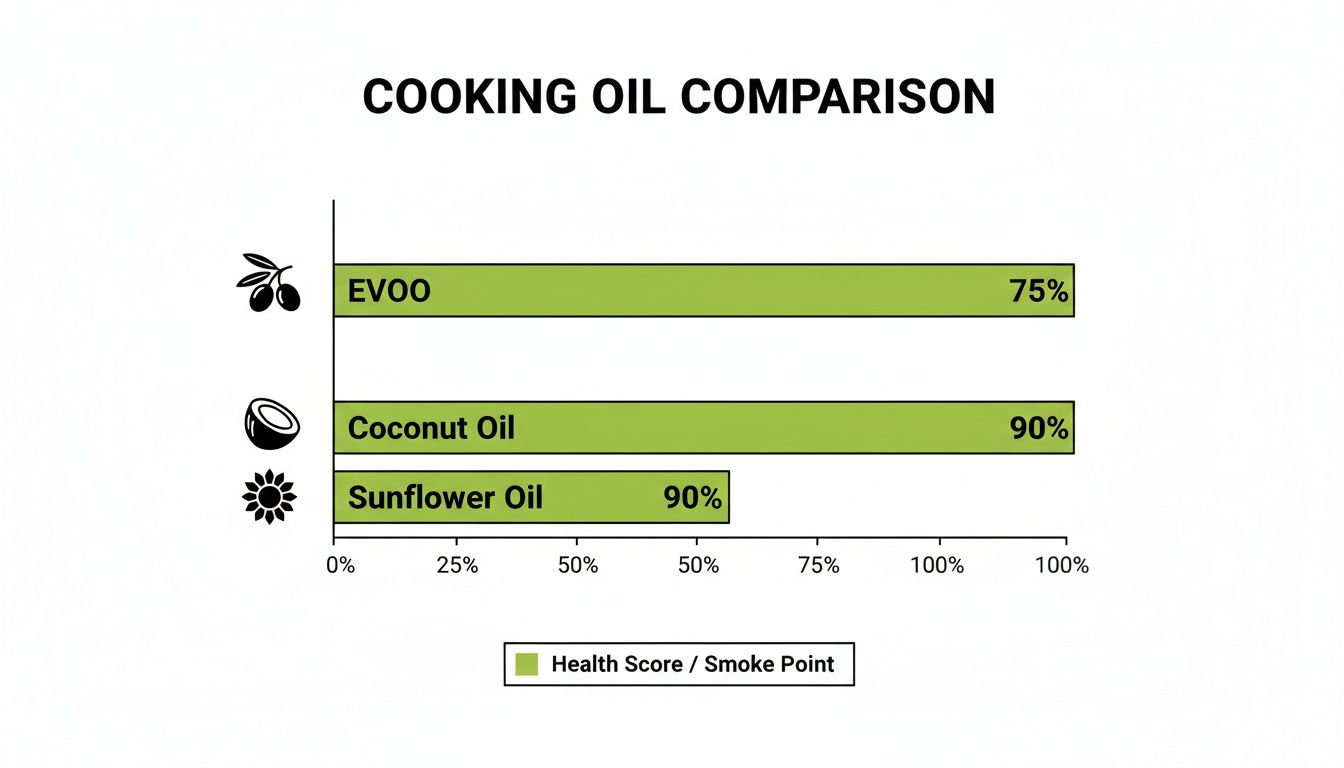
As you can see, while smoke points differ, the overall health score for extra virgin olive oil really sets it apart as a superior choice for everyday cooking.
 Learn Olive Oil
Leave a comment