Let's cut right to the chase. Here's the most important difference you need to know: extra virgin olive oil is pure, unadulterated fruit juice, cold-pressed from fresh olives and brimming with life-giving antioxidants. Canola oil, in stark contrast, is an industrial seed oil, born from a factory process that uses high heat and chemical solvents to create a uniform, lifeless product.
When you choose between them, you're deciding what matters more for your meal: the vibrant, natural goodness and rich flavor of an ancient food, or the blank-slate consistency and high-heat tolerance of a modern invention.
The Great Kitchen Debate: Olive Oil vs Canola Oil
Walk down any supermarket aisle and you'll see them: the two titans of the cooking oil world. On one side, the celebrated, golden-green olive oil. On the other, the ubiquitous, pale-yellow canola. You’ve probably heard the promises. One is the liquid gold of the heart-healthy Mediterranean diet. The other is hailed as a versatile, budget-friendly commodity. But what’s the real story behind these kitchen workhorses?
Believe me, this is more than just a simple choice at the grocery store. It's a decision about what you are fueling your body with. It’s about the very foundation of your health and your cooking. Every sizzle in your pan, every dressing you whisk, every meal you share begins with this single, crucial choice.
Unpacking the Pantry Staples
My promise to you is this: I will slice through the confusing marketing slogans and contradictory health claims to give you the unvarnished truth. This guide lays out the essential, must-know facts, empowering you to choose with unshakable confidence—whether you're searing a steak, dressing a salad, or baking a cake. We will follow the oil's journey from the field to your bottle, because how an oil is made determines everything.
At its very heart, the olive oil vs. canola oil debate isn’t a simple contest between fats. It is a fundamental clash between a whole, natural food and a highly refined industrial product.
Before we delve into the electrifying details, let's establish a clear starting point. Here is a quick, at-a-glance summary of the most critical differences to help you make a fast, informed decision for your kitchen right now.
Olive Oil vs Canola Oil at a Glance
| Key Factor | Extra Virgin Olive Oil | Refined Canola Oil |
|---|---|---|
| Source | Cold-pressed from whole olives | Extracted from rapeseed plants |
| Processing | Unrefined, mechanical extraction | High-heat, chemical solvent extraction |
| Flavor Profile | Robust, fruity, peppery | Neutral, nearly flavorless |
| Key Nutrient | Monounsaturated fat (Oleic Acid) | Monounsaturated fat, some Omega-3 |
| Antioxidants | Very high (polyphenols, Vitamin E) | Very low, stripped during processing |
| Common Uses | Dressings, finishing, sautéing | Deep-frying, baking, general use |
This table delivers the headlines, but the real, life-changing story is buried in the details. Now, let’s discover what these differences truly mean for your food and your family's health.
How Each Oil Gets to Your Kitchen
The journey an oil takes from a sun-drenched field to your kitchen bottle tells you everything you need to know about its character. It's the difference between a food that is alive and vibrant, and one that is a carefully engineered commodity. For olive oil, the story is one of beautiful, time-honored simplicity. For canola, it is a saga of modern industrial chemistry.
Imagine extra virgin olive oil as you would fresh-squeezed orange juice. The process is ancient and astonishingly direct: ripe olives are harvested, washed, and then crushed into a thick, fragrant paste. This paste is then slowly pressed to release its precious golden oil—all accomplished without the violence of high heat or chemical solvents.
This timeless method is known as cold-pressing, a purely physical act. It is a gentle extraction designed with one goal: to preserve the very soul of the olive. Its complex flavors, its powerful antioxidants, and all of its health-giving polyphenols. Because it is handled so minimally, the final product is a perfect, unblemished reflection of the fruit it came from.
The Industrial Creation of Canola Oil
The path canola oil takes from seed to shelf could not be more different. It begins with the tiny, black seeds of the rapeseed plant—a crop specifically bred to lower its naturally high levels of toxic erucic acid. But transforming that little seed into a clear, neutral oil requires a full-scale industrial onslaught.
First, the seeds are super-heated and crushed. To wring out every last drop of oil, this seed mash is then bathed in a chemical solvent—most often, hexane, a component of gasoline.
Herein lies the fundamental secret that divides these two oils: olive oil is pressed from a fruit. Canola oil is chemically extracted from a seed. This one difference in origin and method dictates everything that follows.
After the solvent wash, the crude canola oil is far from finished. It must endure a series of brutal refining stages to become the product you see on the shelf. This includes high-heat steam treatments to boil off the hexane, a "degumming" process using water and acids to remove solids, and filtering through acid-activated bleaching clays to strip its color and impurities.
The final, punishing step is deodorization. The oil is steam-distilled at scorching temperatures, often well over 400°F, to obliterate any remaining flavors or odors. This aggressive process also annihilates most of its natural vitamins and antioxidants, leaving behind a bland, uniform, and unnaturally shelf-stable fat.
Understanding this shocking contrast in production is the key. You can learn more about the different types of olive oil, from extra virgin to refined, and see how processing makes a world of difference. The olive oil vs. canola oil debate truly begins right here, with how each one is born.
Decoding the Nutritional Differences
Let's look past the simplistic "good fat vs. bad fat" labels you hear everywhere. To truly settle the olive oil vs. canola oil debate for yourself, we need to peer inside each bottle. It’s not just about the numbers on a nutrition panel; it’s about the quality and source of those nutrients.
Extra virgin olive oil is, above all else, a treasure trove of monounsaturated fats—specifically, a miracle worker called oleic acid. This incredible fat makes up about 73% of the oil and is celebrated by scientists for its profound benefits for heart health. But the real magic is what comes along for the ride.
Because it is unrefined, extra virgin olive oil is bursting with polyphenols, a class of potent antioxidants. These compounds, with names like oleocanthal and hydroxytyrosol, are fierce warriors against inflammation and cellular damage in your body. In fact, they are the very reason real olive oil has that peppery finish and a slightly bitter taste—you are literally tasting good health. You can see the full story by reviewing detailed olive oil nutrition facts.
Canola Oil's Nutritional Profile
Now, let's turn our attention to canola oil. On paper, it looks appealing. It also contains a high percentage of monounsaturated fats and even a decent amount of omega-3 fatty acids. But its nutritional story is one defined more by factory processing than by nature's design.
Canola oil's very low saturated fat content—a mere 7%—and its roughly 60% oleic acid content have made it a kitchen giant. It is a massive player on the world stage, with its market size projected to hit a staggering USD 51.10 billion by 2032.
Here is the critical distinction you must not forget: the life-giving nutrients in extra virgin olive oil are carefully preserved through a gentle, mechanical process. In contrast, the final nutritional profile of canola oil is merely what’s left over after a brutal regimen of high-heat, solvent-based extraction and refinement.
This image breaks down the fat composition and vitamin E content of both oils.
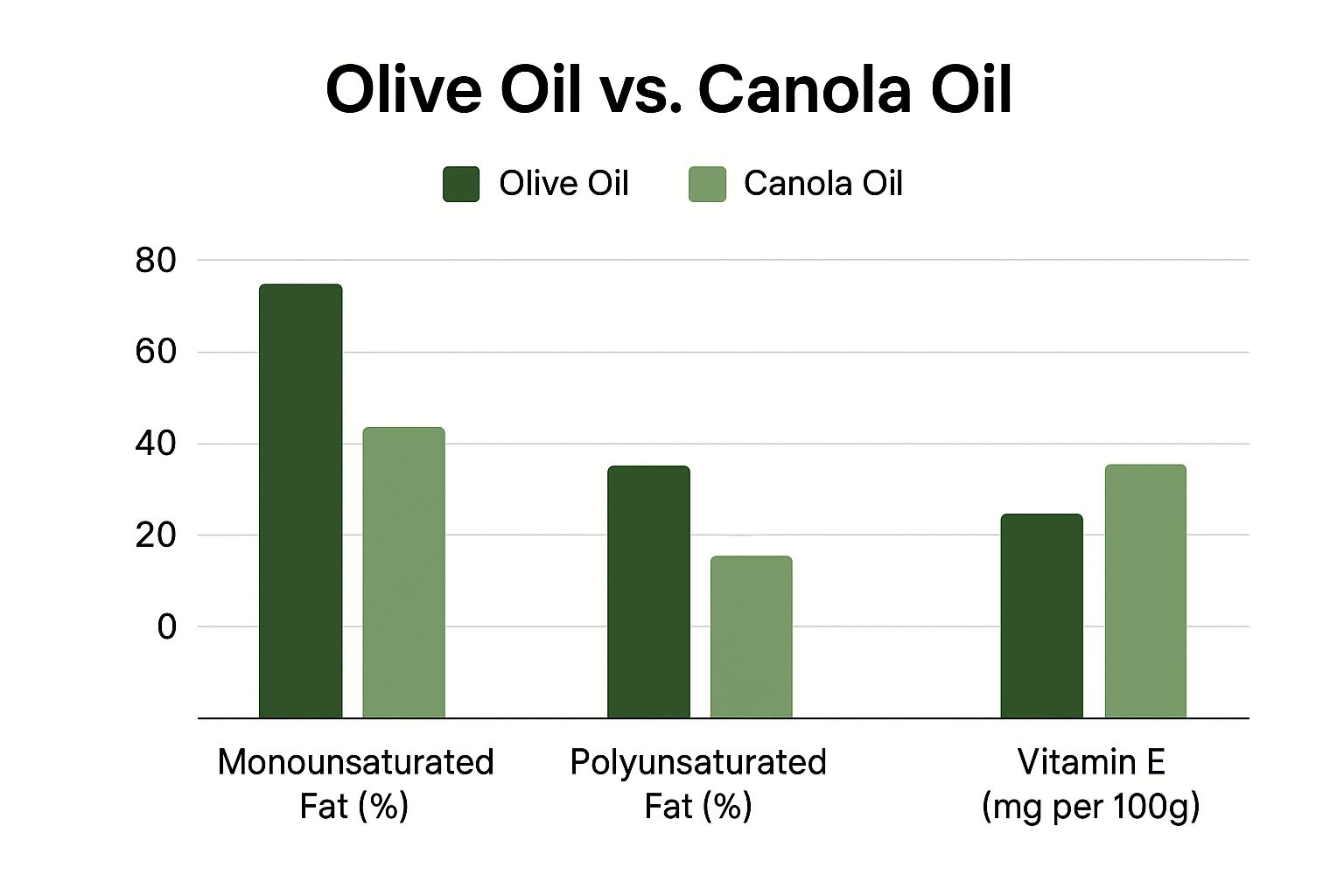
As you can see, while both are high in monounsaturated fats, olive oil has significantly more. Canola oil, on the other hand, contains a higher proportion of polyunsaturated fats.
The Omega Ratio: A Point of Contention
One of the most troubling concerns about canola oil is its ratio of omega-6 to omega-3 fatty acids. While it does contain beneficial omega-3s, it has about twice as much pro-inflammatory omega-6 linoleic acid. Modern diets are already dangerously flooded with omega-6s, and throwing that natural balance out of whack is a known contributor to chronic inflammation.
For optimal health, our dietary ratio should be close to 1:1. Canola oil’s ratio is around 2:1. It's certainly better than other seed oils like corn or soybean oil (which can have disastrous ratios of 15:1 or higher), but it still pushes the scale in the wrong direction.
Extra virgin olive oil, by contrast, is much lower in these volatile polyunsaturated fats overall. Its omega-6 to omega-3 ratio is typically around 10:1, but because the total amount is so small, its impact on your body’s overall omega balance is negligible. Instead, its spectacular health benefits come from its huge dose of stable monounsaturated fats and those powerful polyphenols—compounds that simply cannot survive canola's violent journey from plant to bottle.
What the Science Says About Your Health
Here is where the truth becomes undeniable. Beyond the nutrition label and the processing methods, what truly matters is how an oil affects your body over your lifetime. The small choices you make in your kitchen every single day add up, either building your health into a fortress or slowly chipping away at its foundations.
When we examine the hard evidence, an astonishingly clear picture emerges. The science doesn't just lean in favor of extra virgin olive oil; it's a landslide victory. Decades of relentless research have linked it to some of the most profound health outcomes known to medicine.
This is no accident. These benefits are directly tied to its unique composition—a brilliant combination of stable monounsaturated fats and a symphony of bioactive compounds that you simply will not find in any highly refined oil.
The Proven Power of Polyphenols
The true superstar in olive oil's story is its high concentration of polyphenols. These are not your average antioxidants; they are potent anti-inflammatory agents that work at a cellular level. One of the most famous is oleocanthal, the compound responsible for that signature peppery kick you feel in the back of your throat with a truly high-quality olive oil.
In fact, groundbreaking studies have shown that oleocanthal acts in a similar way to ibuprofen, actively blocking the body's inflammatory pathways. This powerful effect is a cornerstone of the Mediterranean diet's incredible success at slashing the risk of chronic disease.
The scientific literature points again and again to a few key advantages:
- Reduced Risk of Heart Disease: Regular consumption dramatically improves cholesterol profiles, lowers blood pressure, and—most importantly—prevents the oxidation of LDL ("bad") cholesterol, a key trigger for the buildup of deadly plaque in your arteries.
- Improved Brain Function: The potent antioxidants in extra virgin olive oil can cross the blood-brain barrier, shielding brain cells from oxidative damage and potentially lowering the risk of neurodegenerative diseases like Alzheimer's.
- Strong Anti-inflammatory Effects: So many of modern society's deadliest illnesses are driven by chronic, low-grade inflammation. The compounds in olive oil help to extinguish that systemic fire.
You can get a more detailed look at these incredible discoveries by reading about the full spectrum of olive oil health benefits. The evidence is overwhelming.
The Lingering Questions Around Canola Oil
While olive oil boasts a sterling and well-documented health record, canola oil is still haunted by controversy. The concerns aren't just about its fatty acid profile on paper, but about what happens to it during its punishing journey through the factory.
The high-heat refining, bleaching, and deodorizing it endures can damage its fragile polyunsaturated fats. This process can even create small amounts of deadly trans fats—which are universally recognized as harmful—even when the label is legally permitted to claim "0g trans fat."
The central issue is this: a food’s health impact is determined by its total character, not just a single nutrient. The journey of canola oil from seed to bottle fundamentally alters its natural state, raising legitimate questions about its long-term effects.
On top of that, its high omega-6 fatty acid content can worsen the imbalanced omega-6 to omega-3 ratio so common in Western diets—a known driver of inflammation. While canola oil might not be as dangerous as some other seed oils, it still tips the scales away from good health.
Ultimately, the debate over olive oil vs. canola oil often boils down to this simple contrast: one is a whole-food product with proven, time-tested benefits, while the other is a heavily processed product with unresolved questions hanging over its head.
Choosing the Right Oil for Your Cooking
Any great cook knows this secret: the right oil does more than just stop food from sticking—it's a foundational ingredient that builds flavor. Yet, so much of the conversation around cooking oils gets trapped by one single, often misleading number: the smoke point. This has fueled the stubborn and dangerous myth that extra virgin olive oil is too delicate for anything beyond a finishing drizzle.
The reality is far more interesting. An oil's stability under heat is a much better predictor of its performance than one specific temperature. When an oil is packed with stable fats and protective antioxidants, it stands up beautifully in the pan, even if its smoke point isn't the highest on the chart.
This is precisely where extra virgin olive oil triumphs. It is loaded with stable monounsaturated fats and an army of antioxidants that make it surprisingly resilient when heated. This makes it a fantastic, and deeply flavorful, choice for everyday sautéing, roasting, and even light frying.
When to Use Extra Virgin Olive Oil
Think of a good extra virgin olive oil as a flavor-builder. Its distinct, delicious character can elevate the simplest ingredients, making it the perfect workhorse for the vast majority of your cooking.
- Sautéing and Pan-Frying: It's ideal for cooking everything from delicate fish and chicken to robust vegetables. The oil's peppery, fruity notes will infuse directly into your food, adding a brilliant layer of complexity.
- Roasting: Tossing vegetables or potatoes in EVOO before roasting is a game-changer. It creates that perfect crispy exterior while imparting a rich, savory depth that is simply unforgettable.
- Finishing and Dressings: Of course, this is where it's most famous. A final swirl of high-quality olive oil over soup, pasta, or a fresh salad unleashes a burst of vibrant, fresh flavor that you just can't get from anything else.
Knowing what makes a quality oil is crucial. If you're unsure what to look for, our guide on how to choose the best olive oil will help you select a bottle that will perform like a champion in your kitchen.
An oil's true value in the kitchen is measured by its stability, not just its smoke point. The antioxidants in extra virgin olive oil act as a natural defense against heat-induced damage, making it a much safer and healthier choice for cooking than many people believe.
The Right Place for Canola Oil
So, where does that leave canola oil? Canola's main strengths are its high smoke point and its completely neutral flavor. It has a specific, though much more limited, role for those rare times you need very high, sustained heat without adding any taste to the dish.
Its culinary uses are quite different from olive oil's. You can often substitute olive oil for butter in recipes, but that's a swap you make for flavor. Canola is a swap you make for pure function.
Here are a few situations where canola's unique properties are genuinely the better choice:
- Deep-Frying: When making doughnuts or tempura, you need an oil that can hold a consistently high temperature without breaking down or lending its own flavor.
- High-Heat Wok Cooking: For a lightning-fast stir-fry where you want the pure, crisp flavor of the vegetables to shine, a neutral, high-heat oil is essential.
- Baking: If a recipe for a delicate cake calls for a liquid fat simply for moisture, canola is a functional pick that won't interfere with the intended taste.
Ultimately, the olive oil vs. canola oil debate isn't about one being "good" and the other "bad." It's about matching the right tool to the culinary job. For the lion's share of your daily cooking, where you want both incredible flavor and spectacular health benefits, extra virgin olive oil is the undisputed champion. But for those few, specific high-heat or flavor-neutral moments, canola can serve a practical purpose.
The Final Verdict in Your Pantry
After breaking down all the evidence, where do we finally land in the olive oil vs. canola oil showdown? The goal was never to crown one single "perfect" oil. The goal is to empower you to make an informed choice based on what you value most—health, flavor, and your cooking method.
For almost everything you do in the kitchen, from a quick sauté to a vibrant salad dressing, extra virgin olive oil is the decisive winner. Its stunning antioxidant content, well-documented anti-inflammatory powers, and rich, delicious flavor will elevate both your food and your health. To get the most from it, proper storage is vital, so be sure you know how to store olive oil properly to protect its precious compounds.
When Canola Has a Place
Does this mean you must banish canola oil from your home forever? Not necessarily, but its role should be that of a specialist, not a general practitioner. Canola's high smoke point and neutral flavor make it a practical tool for high-heat applications like deep-frying or in baking recipes where you don't want the fat to add any taste.
There's no denying its global dominance; production of rapeseed oil (its source crop) was projected to hit nearly 32.7 million metric tons in 2023/24, a testament to its widespread industrial use. You can see more data on global vegetable oil production on Statista.com.
Here’s the bottom line: Think of high-quality extra virgin olive oil as your everyday, all-purpose champion. Keep a bottle of canola oil on hand as a specialty tool, pulling it out only for those specific jobs where its unique characteristics are truly required.
Common Questions Answered
Even after comparing them side-by-side, a few practical questions always come up about olive and canola oil. Let's clear up the most common points of confusion so you can move forward with total confidence.
Is Organic Canola Oil a Healthier Choice?
When you see "organic" on a canola oil bottle, it definitely means a few good things. It guarantees the oil comes from non-GMO rapeseed and was grown without synthetic pesticides, which is a big plus.
But here is the crucial catch: the processing is still the same. Organic canola oil must endure the same industrial high-heat refining, bleaching, and deodorizing as conventional canola. So while you're avoiding pesticides, you are still getting an oil that has been violently stripped of the natural, life-giving compounds that make an oil like extra virgin olive oil so special.
Can I Really Fry with Extra Virgin Olive Oil?
Absolutely. This may be one of the biggest and most persistent myths in the entire world of cooking.
A good quality extra virgin olive oil has a smoke point between 375-410°F (190-210°C). That’s more than high enough for everyday pan-frying and sautéing. Even more important is this fact: its high percentage of stable monounsaturated fat, along with its army of protective antioxidants, makes it incredibly resilient to heat. It's not the best choice for deep-frying, but for almost everything else on your stovetop, it is a fantastic, flavorful, and healthy champion.
The smoke point is just one part of the story. How an oil holds up to heat really comes down to its fatty acid structure and antioxidant levels, which is where high-quality EVOO truly shines.
What Does Cold-Pressed Mean and Does It Matter?
"Cold-pressed" is a phrase of enormous importance. It is your guarantee that the oil was extracted from the olive using only mechanical force—no heat, no chemicals. This gentle process is absolutely essential for preserving all the delicate flavors, fragile nutrients, and powerful antioxidants.
This term is the gold standard for authentic extra virgin olive oil; it's the very reason EVOO is what it is. You'll almost never see it on a canola oil bottle because canola requires intense heat and refining just to be edible. Even if you found a rare "cold-pressed" canola, the subsequent factory processing would destroy any benefit from that initial gentle step.
Here at Learn Olive Oil, our mission is to demystify this liquid gold. We want to give you the expert knowledge to choose, taste, and cook with the world's best olive oils, from the grove all the way to your dinner table.
Ready to dive deeper? Discover the World of Premium Olive Oil and start your journey at https://learnoliveoil.com.

 Learn Olive Oil
Leave a comment