Let me share a little secret with you. The one ingredient that separates a forgettable, obligatory side salad from a show-stopping culinary experience isn't the farmer's market greens or the fancy, imported cheese. It’s the olive oil.
And not just any olive oil. To achieve salad perfection, you need a high-quality Extra Virgin Olive Oil (EVOO). But I want you to stop thinking of it as merely a dressing. See it for what it truly is: the single most important, flavor-defining ingredient you have. It's the lifeblood of your salad, the soul of the dish. It’s the fine wine that can either elevate every single bite or render the entire effort… flat.
This One Ingredient Changes Everything
Imagine, for a moment, a salad so vibrant and bursting with flavor that it becomes the star of your table. This is not some far-fetched chef’s fantasy. The secret isn't a rare herb or an obscure vinegar. The secret is the golden liquid you choose to pour over it.
This guide is here to shatter the myth that all olive oils are created equal. I’m going to reveal how the right bottle can transform a humble bowl of greens into something you’ll crave. This isn’t about just adding moisture; it’s about layering in character, aroma, and the very story of the sun-drenched grove where the olives were grown.
A Growing Global Appetite for Quality
And I'm not alone in this belief. This isn't some niche foodie trend; it's a global awakening. All around the world, people are discovering the power of true olive oil. In a recent crop year, global consumption soared to roughly 3,064,500 tonnes—a staggering 10.0% leap from the previous year.
This surge is being driven by home cooks just like you, who are finally realizing that great olive oil delivers not just incredible health benefits, but an unparalleled taste—especially on fresh, uncooked dishes like salads. Here in the United States, imports shot up by an astonishing 14.1%, proving that the demand for better oil is exploding. You can see the full story in the data over at the International Olive Oil Council.
Become Your Own Salad Sommelier
My promise to you is this: by the time you finish reading, you'll be a confident "salad sommelier" in your own kitchen. You will unlock a world of flavor that will change the way you look at salads—and perhaps food itself—forever.
You are about to learn:
- Why Extra Virgin Olive Oil is the only real choice for a truly great salad.
- The secret language of flavor—how to taste and identify profiles from peppery and pungent to smooth and buttery.
- How to pair the right oil with the right ingredients for an explosion of flavor.
- How to read a label like an insider to spot the real liquid gold and avoid the imposters.
It's time to banish bland salads from your life. A truly exceptional olive oil for salads doesn't just dress your greens; it gives them a voice.
Why Extra Virgin Olive Oil Is Your Only Real Choice
When it comes to dressing a salad, not just any olive oil will do. Walk down the grocery aisle and you’ll face a bewildering wall of bottles labeled "Pure," "Light," or simply "Olive Oil." They may seem like reasonable choices, but for a fresh salad, they are culinary ghosts—hollowed-out, lifeless versions of what olive oil is meant to be.
Think of it this way. What’s the difference between fresh-squeezed orange juice, bursting with sun-ripened flavor, and juice from concentrate? One is vibrant, alive, and packed with nutrients. The other is a pale, processed imitation, heated and refined until its very soul is stripped away. This is precisely the chasm that separates Extra Virgin Olive Oil (EVOO) from every other grade.
Drizzling a refined oil on your salad is like trying to paint a brilliant sunset with a black-and-white camera. You simply miss all the color, depth, and life.
The Magic of the First Cold Press
What gives EVOO its superpower? It comes down to one simple, profound truth: how it’s made. True Extra Virgin Olive Oil is nothing more than the pure, unadulterated juice of fresh olives, extracted without heat or chemicals. This gentle, mechanical method, known as first cold pressing, is designed to do one thing: preserve the oil’s magnificent, natural character.
This careful handling is what keeps the oil’s spirit alive. It protects the precious, health-giving compounds called polyphenols—the powerful antioxidants responsible for that peppery kick and satisfyingly bitter finish you find in a world-class oil. These compounds are also the source of its legendary health benefits.
An olive oil’s flavor is its health certificate. Those bold, peppery, and even bitter notes are the direct result of the potent antioxidants that make EVOO a nutritional powerhouse. If your oil tastes like nothing, it’s giving you nothing.
Lesser grades like 'pure' or 'light' olive oil are born in an industrial inferno. They endure high heat and chemical solvents that obliterate the polyphenols, strip out every nuance of flavor, and neutralize the aroma. What’s left is a bland, colorless fat, useful for high-heat cooking where its neutrality is a feature, not a fatal flaw. You can learn more about the strict standards that define EVOO and what sets it apart.
Flavor and Health Go Hand in Hand
So, when you reach for EVOO for your salads, you're not just making a choice for superior taste; you're making a choice for your health. Its starring role in healthy eating is undisputed; you'll notice that top-tier Mediterranean diet meal delivery services build their entire philosophy around its use.
Ultimately, when you anoint your greens with a true EVOO, you're adding more than oil. You're adding the authentic taste of the olive grove itself—a complex, aromatic, and deeply satisfying ingredient that elevates your salad from mere food to a true pleasure. For any raw dish, there is simply no substitute.
Learning the Language of Olive Oil Flavor
To truly elevate your salads, you must move beyond simply thinking an olive oil is “good.” Think of it like wine; once you learn to speak its language, you can make brilliant choices in the kitchen instead of just guessing.
When experts taste olive oil, they aren't just looking for something pleasant. They are hunting for three specific positive attributes that prove the oil is fresh, skillfully made, and brimming with those healthy compounds that make it so extraordinary.
Learning to spot these three flavor pillars is your key to unlocking the full, glorious potential of olive oil for salads.
The Three Pillars of Great Olive Oil
To truly appreciate what’s in your bottle, you must get to know what I call the holy trinity of olive oil flavor. These aren't just fancy tasting notes; they are undeniable signals of an oil's quality and freshness.
-
Fruitiness: This is the aroma of fresh, healthy olives. It can range from green, unripe olives (evoking fresh-cut grass or artichoke) to ripe, black olives, which yield a more nutty or buttery scent.
-
Bitterness: Do not fear this! A pleasant bitterness on your tongue is a powerful sign of freshness. More importantly, it signals the presence of those potent antioxidants. It is a health certificate you can actually taste.
-
Pungency: This is the signature peppery kick you feel in the back of your throat a moment after swallowing. That little cough is caused by a powerful anti-inflammatory compound called oleocanthal, and it’s the hallmark of a truly high-quality, robust oil.
A world-class olive oil must possess all three of these characteristics in perfect harmony.
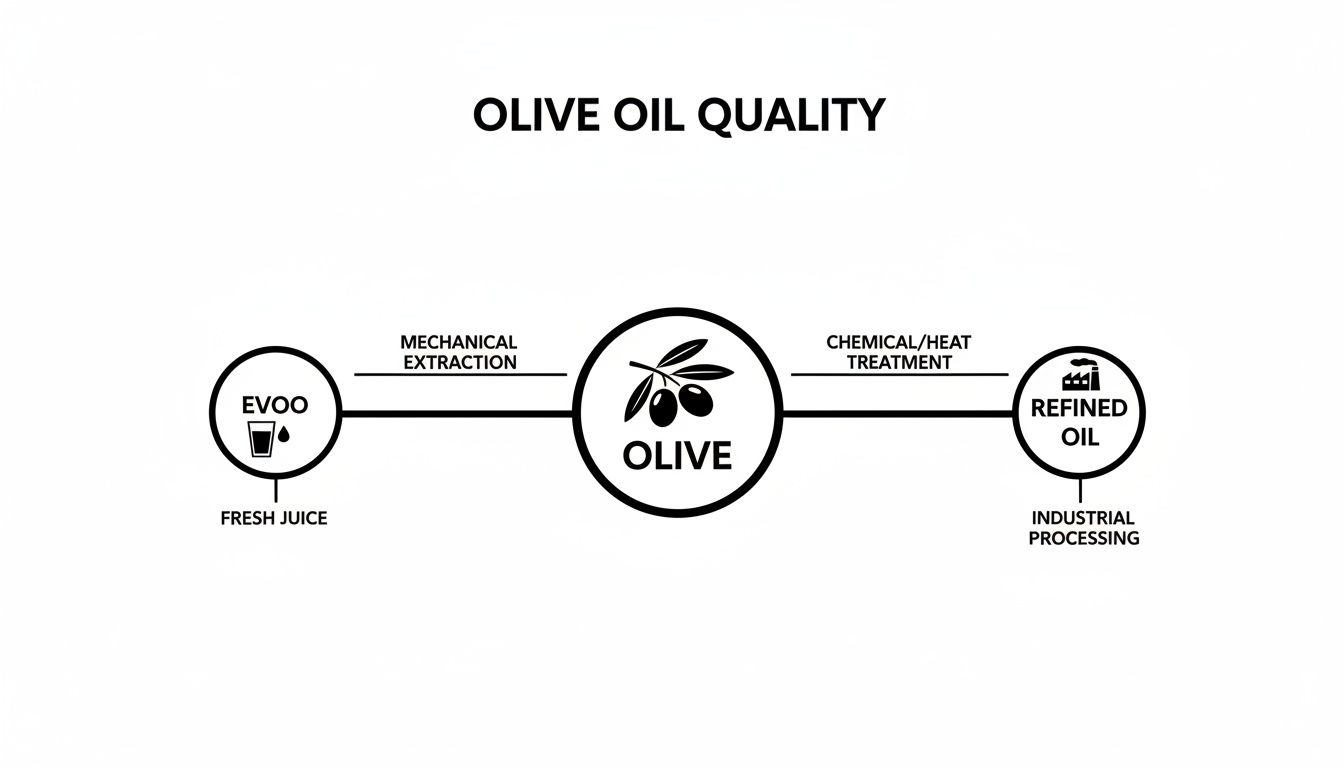
This image drives home the critical difference: Extra Virgin Olive Oil is a natural fruit juice, while refined oils are the product of an industrial process that eradicates both flavor and health benefits.
Matching Intensity to Your Ingredients
Beyond these three pillars, we describe an oil by its overall intensity. This is perhaps the most vital concept for pairing oil with your salad. Learning how to taste olive oil properly will empower you to distinguish these styles and find the perfect partner for any dish.
The secret to a perfect vinaigrette isn't just the oil's flavor, but its intensity. A powerful, robust oil will bulldoze delicate greens, while a delicate oil will disappear beneath a mountain of feta and Kalamata olives. Balance is everything.
You can think of olive oils as falling into one of three main camps:
-
Delicate: Smooth, buttery, and mellow oils with just a whisper of fruitiness. They are perfect when you don't want to overpower other ingredients, like in a simple spring green salad, over mild fish, or on a Caprese salad where the fresh mozzarella is the star.
-
Medium: This is your versatile, everyday champion. These oils strike a beautiful balance of fruity, bitter, and peppery notes. They are fantastic on almost anything, from a Caesar salad to a simple bowl of arugula and parmesan.
-
Robust: Think bold, assertive, and complex. These oils are intensely grassy and peppery, with a pronounced bitterness. They are made to stand up to strong flavors, like bitter greens (radicchio, endive), grilled steak, or a hearty Greek salad loaded with toppings.
Matching Olive Oil Intensity to Your Salad
Use this quick reference to pair the intensity of your olive oil with your salad ingredients for a perfectly balanced dish.
| Oil Intensity | Flavor Profile | Perfect Salad Pairings |
|---|---|---|
| Delicate | Mellow, buttery, nutty, with light fruitiness and a smooth finish. | Simple butter lettuce, spring mix, fresh mozzarella, mild seafood, fruit-based salads. |
| Medium | A balanced blend of fruity and peppery. Notes of green tomato or almond. | Caesar salads, spinach salads with bacon, roasted vegetables, pasta salads, chicken or tuna salads. |
| Robust | Bold, grassy, and peppery with a distinct bitter kick. | Radicchio or kale, Greek salads with feta and olives, grilled steak or lamb salads, anything with strong cheeses. |
Getting the intensity right is a simple change that makes a world of difference. It ensures every component of your salad shines.
How to Pair Olive Oil and Salads Like a Chef

This is where the magic truly happens. Moving from understanding flavor profiles to creating stunning pairings is the difference between knowing the notes in a song and conducting the orchestra.
The guiding principle is incredibly simple, yet profoundly powerful: match intensity with intensity. A big, bold, peppery olive oil demands a salad with equally strong-willed ingredients to stand up to it. Conversely, a soft, buttery oil needs a lighter touch, paired with ingredients that allow its subtle notes to sing.
Get this right, and you don't just have a salad; you have an experience.
Pairing with Tender Greens and Fruits
Think of those salads built around delicate ingredients—spring mix, butter lettuce, fresh berries, or a mild chèvre. For these, your olive oil must be a gentle partner, not a loudmouthed bully. An overpowering oil will completely steamroll those subtle flavors into oblivion.
Here, you must reach for a delicate olive oil. Look for smooth, buttery oils made from varietals like the Ligurian Taggiasca from Italy or the French Picholine. Their gentle, nutty character will elevate the greens and fruit without ever stealing the show.
Often, a simple vinaigrette with one of these oils, a splash of white wine vinegar, and a pinch of salt is all that's needed to create perfection.
Taming Bitter Greens and Bold Flavors
Now, let's swing to the other end of the flavor spectrum. We're talking about salads with attitude—bitter radicchio, hearty kale, pungent arugula, or robust additions like feta, Kalamata olives, and sun-dried tomatoes. These ingredients cry out for an oil that can hold its own in a fight.
This is where you unleash the robust olive oil. A peppery Spanish Picual or a grassy Italian Coratina possesses the backbone and pungency to cut through bitterness and stand up to salty, savory elements. The oil’s assertive character creates a beautiful counterpoint, bringing the entire dish into breathtaking balance.
The rule of thumb for perfect salad pairings is achieving harmony, either through contrast or complement. A robust oil contrasts with bitter greens to create balance, while a delicate oil complements the gentle flavors of a summer fruit salad.
This philosophy is second nature in Mediterranean cultures. Just look at the per capita consumption numbers: Greece leads the world, consuming around 24 liters of olive oil per person annually, followed by Spain at 14.2 liters and Italy at 11.3 liters. These cultures instinctively pair local oils with fresh ingredients—a tradition Americans are slowly embracing, with our current consumption at a mere 1.1 kilograms. You can dive deeper into these global olive oil consumption trends to see just how much room we have to grow.
Pairing with Nuts, Cheeses, and Grains
What about salads with rich, earthy components? Think toasted walnuts, creamy cheeses, or hearty grains like farro and quinoa. They have more substance than delicate greens but aren't as aggressive as a classic Greek salad.
For these, your trusted ally is a versatile, medium-intensity olive oil. An Arbequina from Spain or a Frantoio from Tuscany offers that perfect middle ground. These oils often have lovely notes of green almond and tomato leaf with a pleasant peppery kick that brilliantly ties all the earthy and savory elements together.
For even more creative twists, you might enjoy exploring some unique flavored olive oil recipes to add another delicious layer to your creations.
Reading the Label to Find Liquid Gold

The olive oil aisle can feel like a battlefield of confusing terms and clever marketing ploys. But with a little insider knowledge, you can cut through the noise and find the real treasures. Think of the label not as an advertisement, but as a treasure map leading you to an exceptional olive oil for salads.
Forget the flashy "First Cold Pressed" claims—by definition, all real EVOO is made this way. Instead, your eyes should hunt for one crucial piece of information that tells you everything you need to know about freshness.
The most important detail on any olive oil bottle is the Harvest Date. Ignore the "Best By" date, which is often arbitrary. Freshness is flavor, and the harvest date is the oil’s true birth certificate.
An oil is at its absolute peak within 18 months of its harvest date. If a bottle doesn't list it, leave it on the shelf. The producer is hiding something—most likely, that the oil is old, tired, and past its prime.
Decoding the Details
Once you've spotted a recent harvest date, a few other clues will confirm you're on the right track. These details separate the mass-market imposters from the artisanal gems that will make your salads sing.
-
Country of Origin: Specificity is your friend. A label that vaguely says "Product of Italy" might just mean the oil was bottled there using olives from all over the world. A high-quality producer, however, will proudly name a specific region, like Tuscany, Sicily, or Crete.
-
Olive Varietal: Just like wine is made from different grapes, olive oil comes from different olive varietals. Seeing a specific type listed—like Arbequina, Koroneiki, or Picual—is an excellent sign that the producer cares deeply about their craft.
-
Protective Packaging: Light is one of olive oil's greatest enemies. Always, always choose oil in a dark glass bottle or an opaque tin. A clear bottle is a massive red flag; it signals that the producer cares more about shelf appeal than the quality of the oil inside.
Beyond the olive oil aisle, knowing how to read nutrition labels effectively is a fantastic skill for making healthier food choices all around.
Understanding Global Influence
The country of origin also tells a story about the global supply chain. For example, Spain's dominance directly impacts the availability and price of the oils you find, as the nation accounts for roughly 40% of the world's entire production.
This means a dry season in Andalusia can affect the cost of your favorite salad oil in Ohio. Learning to read the label gives you the power to navigate this complex world with confidence.
Your Most Common Olive Oil Questions Answered
Even armed with all this information, you likely still have a few questions. Let's tackle them head-on. Think of this as our final chat over a great salad, clearing up any lingering confusion so you can choose and use your olive oil with the confidence of a seasoned chef.
Can I Use My Cooking Olive Oil on Salads?
You can. But please, don't. It would be like trying to paint a masterpiece with watercolors meant for a kindergartener—the result will be disappointingly dull.
Regular or "light" olive oils are refined with heat and solvents, a harsh process that neuters their flavor, aroma, and all those fantastic health-boosting polyphenols. They are designed for high-heat cooking, where all you need is a neutral fat. A salad, however, is where the oil is the star of the show.
Using a refined oil on your greens is a tragic, missed opportunity. A true Extra Virgin Olive Oil isn't just a fat; it's a condiment, the final, life-giving touch that makes everything sing.
What Is the Best Way to Store Olive Oil?
Your beautiful bottle of EVOO has three mortal enemies: heat, light, and air. These are the villains that will turn a fresh, vibrant oil into a dull, rancid one with shocking speed. Thankfully, protecting it is simple.
- Find a cool, dark home. A pantry or kitchen cabinet is perfect. Storing it next to the stove or on a sunny windowsill is the fastest way to destroy it.
- Keep it sealed tight. Oxygen is the enemy of freshness. Every time you open the bottle, air gets in and begins the process of oxidation.
- Trust the dark bottle. Good producers use dark glass or opaque tins for a reason. They're like sunglasses for your oil, shielding it from damaging light.
Remember, a great EVOO is a fresh product. Try to use it within a few months of opening for the best taste. For a deeper dive, check out our guide on what is the shelf life of olive oil.
Does a Higher Price Mean Better Olive Oil?
More often than not, yes. When it comes to extra virgin olive oil, the old saying "you get what you pay for" holds true. While a high price tag isn't a 100% guarantee of quality, it's a very strong indicator. And for salads, where the raw flavor of the oil is front and center, this is not the place to pinch pennies.
Price often reflects the true cost of quality: meticulous harvesting, careful milling of fresh olives, proper storage, and honest labeling. A cheap oil has likely cut corners in one—or all—of these critical areas.
The few extra dollars between a generic supermarket oil and a true, fresh EVOO is the difference between a forgettable salad and an incredible one. It's the single biggest upgrade you can make for just pennies per serving.
What Is a Good All-Purpose Olive Oil for Salads?
If you're just starting out and want one fantastic, do-it-all bottle for your pantry, you can't go wrong with a medium-intensity, fruity EVOO. Think of it as the Swiss Army knife of the olive oil world—it’s balanced enough not to overpower delicate lettuces but has enough personality to stand up to bolder ingredients.
Here are a couple of olive varieties that usually fit this profile perfectly:
- Spanish Arbequina: Tends to be buttery and a little nutty, with a gentle, peppery kick at the end.
- Italian Frantoio: Often brings notes of green almond and fresh herbs, with that classic, pleasant bitterness.
An oil like this is a fantastic starting point. It works beautifully with everything from a simple arugula and Parmesan salad to a complex grain bowl, making it the perfect gateway into the amazing world of high-quality olive oil.
At Learn Olive Oil, we believe that understanding olive oil is the key to unlocking its incredible potential in your kitchen. We provide the expert insights and clear guidance you need to choose, taste, and cook with the best oils in the world. Elevate your meals by exploring our resources at https://learnoliveoil.com.
 Learn Olive Oil
Leave a comment