You reach into your pantry for a beautiful bottle of extra virgin olive oil, ready to bring a salad to life. But a nagging question stops you cold: just how long has this been sitting here? It’s a question every cook asks, and it’s a crucial one. Because unlike a fine wine aging gracefully in a cellar, olive oil’s greatest virtue is its youth.
Let me give you the answer right up front: a high-quality, unopened bottle of olive oil lasts 18-24 months from the day it was harvested. But the moment you crack that seal, a new, much faster countdown begins. An opened bottle should be used within 30 to 60 days if you want to experience the vibrant flavor and full health benefits you paid for.
The Secret Lifespan of Your Olive Oil
That date printed on the bottle? Think of it less as a hard deadline and more as a whisper of a promise—a promise of quality from the producer, assuming the oil has been stored like a precious jewel. But the real story of your olive oil’s lifespan is a silent, daily war fought against three invisible enemies in your own kitchen: heat, light, and air.
Imagine your oil is a bouquet of flowers, just picked from the garden—vibrant, fragrant, and bursting with life. From the second those olives were pressed, the oil's delicate flavors and powerful antioxidants began a slow, inevitable decline. This is perfectly natural. But leaving that bottle on a sun-drenched countertop is like leaving those flowers in a hot car. Its vitality won't fade in months; it will vanish in days.
Understanding the Timeline
The clock on freshness starts ticking the moment the olives are crushed, not when you bring the bottle home. This is why a harvest date is a far more honest indicator of freshness than a vague "best by" date. A top-tier extra virgin olive oil, armed with a high concentration of natural preservatives called polyphenols, has a much stronger defense against spoilage than a refined, pale, lighter-bodied oil.
To paint a clearer picture, here’s a quick reference for how long different olive oils typically last under ideal storage conditions.
Olive Oil Shelf Life At a Glance
| Olive Oil Type | Unopened Shelf Life (From Harvest) | Shelf Life After Opening |
|---|---|---|
| High-Polyphenol Extra Virgin | Up to 24 months | 30-60 days |
| Standard Extra Virgin | 18-24 months | 30-60 days |
| Refined/Light Olive Oil | 12-18 months | 30-60 days |
This table reveals a critical truth: while unopened shelf life varies slightly by quality, the clock speeds up dramatically for all types once they're exposed to air.

As you can see, opening the bottle is the single biggest event that shortens the window for peak freshness. This really drives home the importance of using it up in a timely manner.
The core takeaway is this: Freshness is fleeting. The goal isn't just to use your olive oil before it goes "bad," but to enjoy it while its flavors are bold and its health benefits are at their most potent.
While this guide is all about olive oil, the principles of proper storage and food safety are universal in the kitchen. For more on keeping your ingredients fresh, you can learn about how long meal prep lasts and food safety tips. To dig deeper into the specific factors at play with olive oil, see our guide on https://learnoliveoil.com/how-long-does-olive-oil-last.
The Three Enemies Hiding in Your Kitchen

Every bottle of olive oil, no matter how exquisite, is in a constant, silent battle. Hiding in plain sight in your own kitchen are three assassins working around the clock to ruin its flavor, aroma, and health benefits. They are light, heat, and air—a relentless trio that wants to turn your beautiful oil into something you'd rather not eat.
Think of a premium extra virgin olive oil like a freshly picked bouquet of flowers. At its peak, it's vibrant, fragrant, and full of life. But its perfection is fleeting. Exposed to the elements, it quickly wilts. The same goes for your oil. Those delicate, peppery notes and grassy aromas are the first casualties in this fight for freshness.
This isn't just a metaphor; it's a chemical reality. The process behind this decay is oxidation, the very same reaction that turns a cut apple brown. When olive oil meets its enemies, a chain reaction kicks off, degrading its quality one molecule at a time.
The Thief Known as Oxygen
The moment you first twist open that bottle, you’ve invited the first enemy inside: air. Oxygen is an aggressive little molecule that immediately gets to work stealing electrons from the oil’s healthy fats and protective polyphenols. This is ground zero for rancidity.
Every time you uncap the bottle for a quick pour, more oxygen rushes in to fill the void. This is precisely why a half-used bottle goes bad so much faster than a full one. The more "headspace" of air at the top, the more ammunition oxygen has for its attack.
The rule of thumb is simple but crucial: The less air your olive oil touches, the longer it will keep its peak character. This is the key to understanding what olive oil's shelf life really means in your kitchen.
Oxidative damage doesn't just make the oil taste off. It systematically dismantles the very antioxidants that make it a superfood. The compounds that protect your body are the same ones that sacrifice themselves to protect the oil from oxygen.
The Accelerant Called Heat
If oxygen is the thief, heat is its getaway driver. Heat doesn’t start the damage on its own, but it speeds up the entire oxidation process dramatically. Storing your olive oil right next to the stove or in a cabinet that gets warm is a recipe for rapid decline.
Imagine oxidation as a slow-burning fire. At a cool room temperature, it's just smoldering embers. But add heat, and you're essentially pouring gasoline on those embers, creating an inferno of chemical reactions.
For every 10°C (18°F) increase in storage temperature, the rate of oxidation roughly doubles. That means an oil that might have stayed fresh for a year in a cool, dark pantry could become stale in just a few months in a typically warm kitchen. And that sunny spot on your countertop? It's a battlefield your olive oil is guaranteed to lose.
The Catalyst of Light
The final enemy is light, especially UV light. Light is pure energy. When it hits a bottle of olive oil, it energizes the molecules inside, making them far more vulnerable to oxidation. It’s like giving the enemy a key to bypass the oil's natural defenses.
This is exactly why you'll never see a truly high-quality extra virgin olive oil packaged in a clear glass bottle. Reputable producers use dark green glass, tins, or even ceramic containers for one simple reason: they act as a fortress, shielding the precious oil from light's damaging rays.
- Dark Glass: Blocks out most of the harmful UV light.
- Tins or Opaque Containers: Offer 100% protection from light.
- Clear Glass: Offers virtually no protection, leaving the oil completely exposed.
Learning how to fight back against these three forces is the single most important skill for preserving the oil you paid for. For a deeper dive, our detailed guide on proper olive oil storage lays out all the actionable strategies you need. Protecting your oil isn’t just about avoiding bad flavor—it's about safeguarding its quality from the moment you bring it home.
How Temperature Dictates the Countdown to Rancidity

Have you ever wondered why one bottle of fantastic olive oil seems to last forever, while its identical twin, stored just a few feet away, tastes old in a matter of months? The culprit isn’t some mystery. It’s a single number you won’t find on any label: the storage temperature.
Think of heat as the accelerator pedal for every chemical reaction that turns great olive oil bad. In a cool, dark pantry, the delicate molecules in your oil are in a state of calm, preserving their structure and flavor. But as you introduce heat, you’re essentially flooring that pedal. Those molecules start crashing into each other, breaking down, and that beautiful, vibrant oil begins its inevitable descent into rancidity.
This isn't a theory; it's hard science. For every 10°C (18°F) rise in storage temperature, the rate of oxidation roughly doubles. That’s a catastrophic leap.
The Science of the Slowdown
The impact of temperature is so profound that we can actually predict how long an oil will last just by knowing where it’s kept. And the data proves just how much power you hold over your oil's fate.
For example, research has demonstrated that a good quality olive oil stored at a typical room temperature of 22°C (72°F) will likely maintain its best qualities for about a year. But watch what happens when you drop the temperature. That very same oil, if kept in a cool cellar around 10°C (50°F), could see its shelf life stretch to an incredible 36 months or more. If you're curious about the specifics, you can dig into the findings on how temperature impacts olive oil's lifespan in this study.
This stark difference highlights a fundamental truth for any olive oil lover: where you store your oil is just as important as what you buy. A cool pantry is a preservation chamber; the cabinet above your stove is a fast track to disappointment.
Finding the Sweet Spot for Storage
So, what's the magic number? The good news is you don’t need a fancy wine cellar to make a huge difference. The goal is simple: find a spot that's consistently cool, dark, and stable.
-
The Ideal Range: Aim for a temperature between 14°C and 18°C (57°F to 65°F). This is the sweet spot that dramatically slows oxidation without getting too cold.
-
Why Not the Fridge? While cooler is generally better, the refrigerator is a step too far. The cold causes the natural waxes in the oil to solidify into harmless clumps, and worse, it can introduce condensation inside the bottle. Moisture is an enemy of olive oil.
-
Creative Storage Solutions: If you don’t have a cellar, get creative. Look for the coolest, most stable spot in your home. This might be a low cabinet in the pantry away from appliances, a closet on an interior wall, or even a corner of the garage if the temperature doesn’t swing wildly.
Some people even wonder about taking this to the extreme and using the freezer. While it’s not a standard practice, you can find out what happens by reading our article on whether you can freeze olive oil.
The key takeaway is that temperature isn't a minor detail—it is the single most powerful environmental factor that determines how long your olive oil will retain its fresh, vibrant character.
Just by moving your bottle from the countertop next to your oven to a cooler, darker location, you can easily double its window of peak flavor and health benefits. You have more control over your oil's journey than you might think.
What the 'Best By' Date Really Tells You
That "Best By" date printed on your olive oil bottle? It’s probably one of the most misleading things in your pantry. We've been trained to treat it like a stopwatch, a hard deadline for freshness. But in the world of olive oil, it’s more of a suggestion—a producer’s best guess at peak quality, assuming that bottle has lived a charmed life in a perfect, climate-controlled bubble from the moment it was sealed.
Think of it less as a cliff it falls off and more as a gentle, downward slope. It’s not a safety warning, but a fragile promise. That promise is based on an industry standard that a high-quality, unopened extra virgin olive oil can hold onto its vibrant character for up to 24 months. The catch? That's only if it's been kept under "optimal conditions."
And what are these mythical conditions? Imagine a cool, dark cellar, shielded from light and temperature swings. It’s a world away from the punishing journey most bottles actually take to get to your kitchen.
From Sheltered Grove to Supermarket Shelf
The long voyage from a quiet Italian olive grove to a brightly lit, temperature-fluctuating supermarket shelf is where that 24-month promise begins to shatter. An oil can leave the mill in perfect condition, only to bake on a sun-drenched loading dock or sit for weeks in a sweltering warehouse.
Once it finally hits the store shelf, it's under constant assault from fluorescent lights and the store's ambient heat. Every bit of exposure is like a tiny puncture, slowly letting the life—and flavor—out of the oil. The peppery bite softens, the fresh, grassy notes fade, and the clock on rancidity ticks ever faster. This is where the gap between the date on the label and the oil's actual condition yawns into a chasm.
The "Best By" date assumes a perfect, unbroken chain of ideal storage from bottling to your kitchen. The reality is that this chain is almost always broken, making the date a best-case scenario, not a guarantee.
The Science Behind the Timeline
That 24-month figure isn't just pulled out of thin air; it’s grounded in chemistry. To earn its "extra virgin" status, an oil must pass a battery of strict chemical tests. When stored perfectly, a well-made oil can stay within those parameters for two years. But throw in real-world variables, and that timeline shrinks dramatically.
For example, research has shown that an oil's peroxide value—a key measure of oxidation—can stay nice and low under controlled conditions. But take that same oil and expose it to real-world heat and light for just 12 months, and its peroxide levels can shoot through the roof, pushing it far outside the limits of quality. If you want to dive into the science, you can learn more about the chemical integrity of olive oil over time.
What this means is that an oil can lose its "extra virgin" quality long before its "Best By" date ever arrives. Your job is to stop relying on the label and start trusting the only true experts: your own senses. The date is a starting point, but it's far from the final word.
How to Tell if Your Olive Oil Is Past Its Prime
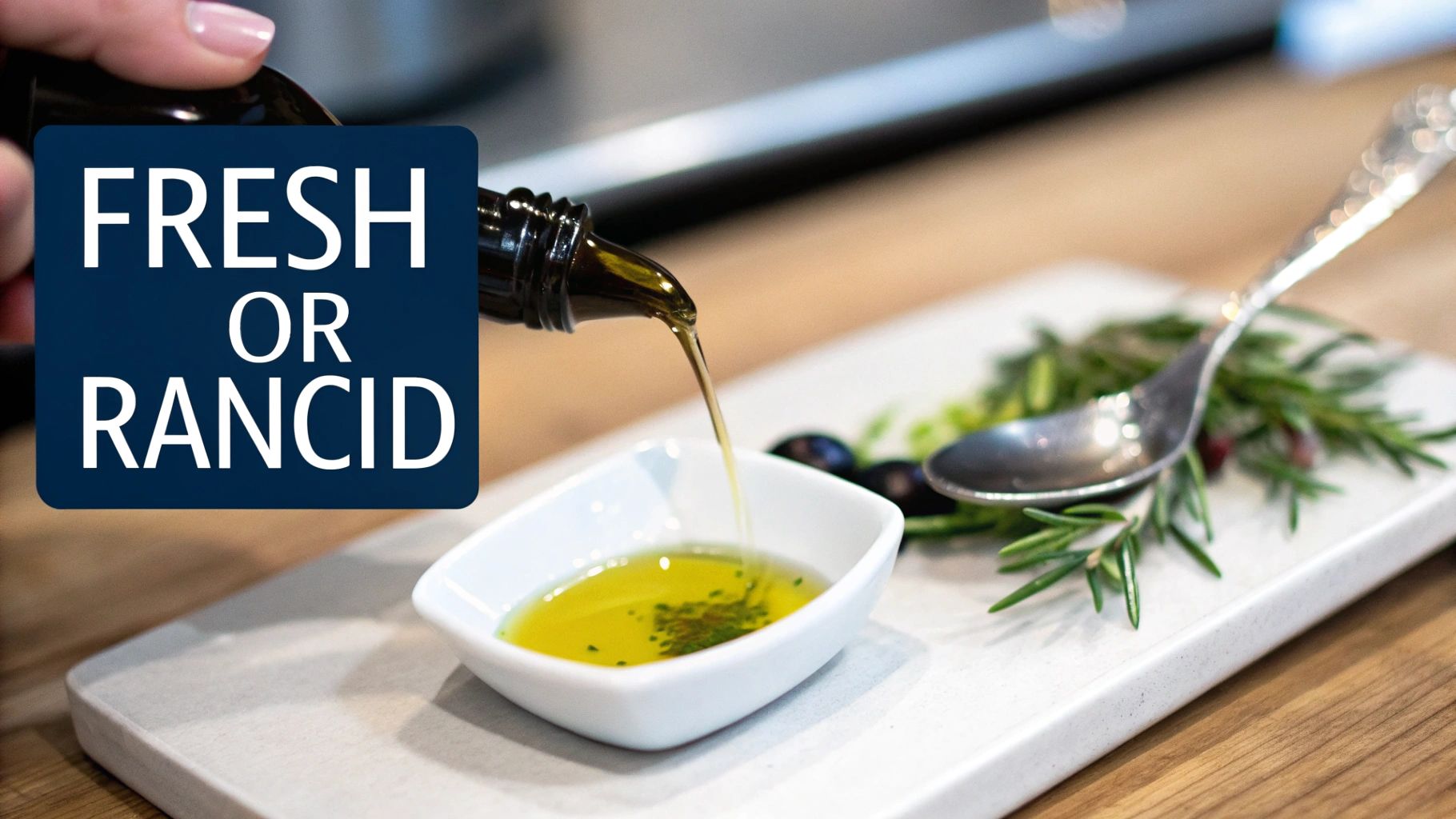
Forget the date printed on the bottle. The most sophisticated tool for judging olive oil freshness is one you already own—your own nose and palate. They are infinitely more reliable than any date stamped in a factory.
Think of this as a mini-masterclass in tasting. Once you learn to recognize the difference between fresh, lively oil and one that's gone stale, you will never have to guess again. You will trust your senses and dodge that crushing disappointment of a flat, lifeless flavor.
Here's how. Pour about a tablespoon of oil into a small glass. Cup the glass with one hand to gently warm it—this helps release all the subtle aromas—and give it a gentle swirl.
The All-Important Smell Test
Now, bring the glass to your nose and take a deep, deliberate sniff. What do you smell? A high-quality extra virgin olive oil should smell alive. You’re searching for bright, "green" aromas that transport you to the outdoors.
Signs of a Fresh, Healthy Oil:
- Fruity Notes: Think fresh olives, green bananas, or even artichoke.
- Grassy or Herbaceous Aromas: Like newly-cut grass or tomato leaves.
- Peppery or Pungent Scents: A sharp, clean kick in the nose is a brilliant sign of healthy polyphenols.
On the other hand, an oil that has turned rancid will smell dull, tired, and stale. The difference is as clear as night and day once you know what you’re looking for.
Telltale Signs of a Rancid Oil:
- Waxy or Greasy: This is the most common sign. It's an unmistakable smell, like crayons, old putty, or even a stale bag of nuts.
- Musty or "Off": Anything that reminds you of old buttered popcorn or just plain stale.
- No Scent at All: A total void of aroma is also a bad sign. It means the oil is old and has lost all its character.
If your oil smells like any of those bad examples, it's past its prime. For a more detailed look at these off-putting smells, our guide on how to tell if olive oil is rancid breaks it down even further.
The Professional Taste Test
If the oil passes the smell test, it's time to taste it. Take a small sip and try "slurping" it by drawing in a bit of air. Professional tasters do this to spray the oil across their entire palate, revealing its true flavors.
A great olive oil should feel bold and lively in your mouth. You're actually looking for a bit of bitterness on the tongue and a peppery sensation that hits the back of your throat.
That peppery kick—the one that might even make you cough—is the signature of a fresh, high-polyphenol oil. It’s a direct sign of the powerful antioxidants that make olive oil so good for you.
If the oil just feels greasy, tastes flat, or leaves a waxy film in your mouth, its best days are definitely behind it. Trust your palate; it knows what it's talking about.
The Hidden Cost of Fading Flavor and Nutrients
You bought that beautiful bottle of extra virgin olive oil for a reason. You were after that bold, peppery flavor and its well-earned reputation as a health powerhouse. But what happens when those very qualities silently vanish from the bottle, long before you’ve used the last drop? That is the hidden cost of a ticking shelf life.
The real value of your oil isn't just the liquid; it's the potent, delicate compounds swimming within it. We're talking about phenolic compounds, the tiny warriors that give high-quality olive oil its antioxidant firepower and that signature peppery kick you feel at the back of your throat. These are what make it a true superfood.
Unfortunately, they’re incredibly fragile. Time, heat, and air are their mortal enemies, breaking them down with surprising speed. This isn't just a minor problem—it's a massive blow to the oil's character and its nutritional punch.
The Vanishing Act of Vital Compounds
Think of those phenolic compounds as the oil's life force. When fresh, the oil is packed with them, protecting both the oil from spoiling and your body from oxidative stress. But as the oil ages, and especially if it's stored poorly, these compounds basically sacrifice themselves to fight off oxidation. Their numbers plummet.
The result is a devastating one-two punch. First, the flavor goes completely flat. Those vibrant, grassy notes turn dull, and the peppery finish vanishes. Second, and perhaps more importantly, the health benefits you paid a premium for are gone. Your oil becomes a ghost of its former self, offering little more than empty calories.
This is the key takeaway: understanding olive oil's shelf life is really about preserving its nutritional integrity. It’s not just about avoiding a bad taste; it's about getting every bit of the incredible flavor and health benefits you paid for.
The Unseen Toll of Time and Temperature
This decline happens with shocking speed. Even at typical room temperatures of 68-72°F (20-22°C), the breakdown of these vital phenols can hit 50% in just 12 months. This oxidative decay strips away the flavor, the aroma, and the very nutrients that make a great olive oil worth buying. And once you crack that seal, the process speeds up dramatically. You can find more details on how olive oil quality changes over time.
This is precisely why understanding olive oil polyphenol content is so crucial for anyone who wants to buy good oil. An oil with a high polyphenol count starts with more of these beneficial compounds, giving it a longer runway before it starts to fade.
Letting a fantastic oil degrade on your shelf is, in its own way, a form of waste. To really tackle this hidden cost, it helps to adopt effective food waste reduction strategies in your kitchen, starting with using your best ingredients when they’re at their absolute peak. Your olive oil is an investment in both your cooking and your health—make sure you get the full return.
Got Questions About Olive Oil Freshness? We've Got Answers.
Even after you've got the basics down, a few practical questions always seem to come up in the kitchen. Here are some quick, straightforward answers to the things people ask most about keeping their olive oil at its best.
Can I Still Use Olive Oil After the "Best By" Date?
You can, but it's a big "maybe." Think of the "best by" date as the producer's promise of peak quality, not a hard-and-fast expiration date. Using an oil past this date won't harm you, but it’s likely a shadow of its former self—its bright, peppery flavors, fresh aroma, and powerful antioxidants will have faded significantly.
So, what should you do? Give it a quick sniff and a small taste. If it still smells and tastes fresh, it's probably fine for general cooking where its nuances won't be the main event. But if you get a whiff of waxy crayons or stale nuts, that flavor will ruin your food. It's time to toss it.
Does Putting Olive Oil in the Fridge Make It Last Longer?
It sounds logical, but the refrigerator is actually a terrible place for olive oil. While cool temperatures do slow down decay, the fridge is simply too cold. The chill causes the natural fats and waxes in the oil to solidify and get cloudy, which messes with the texture even after it returns to room temperature.
Worse yet, the cycle of chilling and warming can create condensation inside the bottle. Moisture is a sworn enemy of olive oil freshness.
The sweet spot for storage is a cool, dark place like a pantry or cellar, kept at a steady 14–18°C (57–65°F). This gives you all the benefits of coolness without the downsides of refrigeration.
Which Is Better: A Tin or a Dark Glass Bottle?
Honestly, both are great choices. They both tackle one of olive oil's biggest threats: light. Tins are the ultimate protector, offering 100% protection from light exposure. You can't go wrong with a good quality tin.
Dark green or brown glass bottles are also excellent, as they do a fantastic job of blocking out the most harmful UV rays. The only thing you absolutely want to avoid is clear glass—it offers no protection at all. Whatever you choose, make sure it has a tight, secure seal to keep oxygen out, too.
Should I Buy That Giant Bottle of Olive Oil to Save a Few Bucks?
Buying in bulk might seem like a smart move, but with olive oil, it's often a false economy. The second you break the seal on that huge container, the clock on freshness starts ticking much faster. Every single time you open it, you're letting in a fresh wave of oxygen.
For most of us, it makes way more sense to buy a smaller bottle you know you can get through in a month or two. This way, you're always using oil that's fresh, flavorful, and packed with health benefits. The money you save on that giant tin is worthless if half of it turns rancid before you can even use it.
At Learn Olive Oil, we're convinced that understanding freshness is the first step to truly appreciating this liquid gold. Our guides are here to help you choose, taste, and use the world's best olive oils like a pro.
Dive deeper with our expert insights at https://learnoliveoil.com and take your cooking to the next level.


Leave a Reply