For most day-to-day cooking, your best bet is a high-quality extra virgin olive oil (EVOO). A robust, flavorful one works wonders for high-heat cooking, while a more delicate bottle is perfect for finishing touches. A versatile, everyday EVOO from a classic producer like Spain or Italy really hits the sweet spot—it gives you that perfect balance of flavor, health benefits, and a surprisingly high smoke point. It's a true kitchen workhorse.
The Simple Secret Your Kitchen is Missing
Imagine, for a moment, an ingredient so powerful it could transform a simple, weeknight meal into something truly memorable. That's the power hiding inside a bottle of the right olive oil. This guide is here to slice through the clutter and confusion, getting straight to what matters. Because choosing the perfect oil isn’t about becoming a food snob; it’s about unlocking rivers of flavor, boosting your health, and making everything you cook taste better.
And this isn’t some fleeting foodie trend. The world is waking up to the magic of great olive oil, with global consumption expected to hit nearly 3 million tonnes in 2025. People are finally catching on. They’re discovering that premium extra virgin olive oils—especially from legendary producers in places like Spain—hold onto their healthy polyphenols even when you cook with them.
Why Your Choice of Cooking Oil Matters
To believe that all olive oils are the same is like saying every bottle of wine tastes identical. The reality is far more delicious. The bottle you grab for your pan can be a simple, forgettable fat, or it can be an active ingredient—one that injects its own personality and soul into a dish.
Choosing the right olive oil is the first, and perhaps most important, decision you make before you even turn on the stove. It sets the stage for the entire flavor profile of your meal.
Consider this: a bold, peppery EVOO doesn’t just cook a steak; it sears it with a magnificent crust that a neutral oil could only dream of creating. By the same token, a delicate, buttery oil can elevate a simple vinaigrette from good to sublime without bulldozing the fresh greens. Once you begin to master these distinctions, you gain a level of control in your kitchen you never thought possible.
What This Guide Will Do for You
This guide is your roadmap. It’s designed to demystify the labels, shatter the myths about smoke points, and tune your palate to the symphony of flavors waiting for you. We’ll dive deep into why this "liquid gold" is a non-negotiable staple in the world’s best kitchens and explore the profound benefits of cooking with olive oil.
Here's a taste of what we’ll uncover to build your expertise:
- Decoding Labels: We'll crack the code, revealing the real difference between "Extra Virgin," "Pure," and "Light."
- The Smoke Point Myth: You'll learn the truth about why a quality EVOO is far safer and better for cooking than you’ve been led to believe.
- Perfect Pairings: Discover the art of matching the right oil to your cooking method for an explosion of flavor.
- Smart Shopping and Storage: Protect your investment and ensure every last drop stays vibrant and delicious.
By the time you finish reading, you’ll see that cooking with the right olive oil is about so much more than taste—it’s a cornerstone of a healthier, more flavorful life. Let's begin this journey and transform your cooking, one golden drop at a time.
Decoding the Labels on the Shelf
Walking down the olive oil aisle can feel like facing a fortress wall. You’re bombarded with a dizzying array of bottles, all shouting terms like ‘Extra Virgin,’ ‘Virgin,’ ‘Pure,’ and ‘Light.’ They all promise quality, but what do these words truly mean for the meal you're about to cook?
Let’s cut through the marketing noise. Think of this as your secret decoder ring for the olive oil shelf. We're going to break down these terms with simple, powerful analogies so you can feel the confidence that comes from knowing you’re spending your money on superior flavor and better health.
Extra Virgin: The Gold Standard
The term 'Extra Virgin' isn't just pretty marketing language; it is a legally protected grade with ironclad rules. It's the highest quality you can buy, and it tells you two critically important things about the oil in that bottle.
First, it means the oil was extracted using only mechanical methods—no high heat or chemical solvents were allowed anywhere near it. Second, it must pass a battery of chemical tests and, crucially, a sensory tasting by a certified panel to guarantee it has zero defects and possesses a genuine fruity character.
Here’s the simplest way to think about it: Extra Virgin Olive Oil (EVOO) is the freshly squeezed, first-press juice of the olive. It is pure, unadulterated, and tastes precisely like the fruit it came from. This gentle process is vital because it preserves the oil’s precious polyphenols—the potent antioxidants responsible for that peppery finish, most of its health benefits, and its surprising stability in a hot pan.
Virgin Olive Oil: Close, but Not Quite
One step down the quality ladder, you’ll find 'Virgin' olive oil. Like its more decorated sibling, it's also produced without chemicals or heat. The key difference is that it's permitted to have minor flavor defects and a slightly higher acidity level.
It’s still a good, unrefined oil, but it simply fails to meet the flawless standard of EVOO. If extra virgin is that perfect, vibrant glass of freshly squeezed juice, virgin olive oil is the juice from yesterday—still good, but it has lost some of its brilliant spark.
Understanding Refined Oils: Pure and Light
Now we enter an entirely different universe. When you see labels like 'Olive Oil,' 'Pure Olive Oil,' or 'Light Olive Oil,' you are looking at a refined, industrial product.
These oils began their lives as virgin olive oils that failed to make the grade. They are then subjected to heat and chemical solvents to strip away all the off-flavors and defects. The catch? This aggressive process also obliterates the flavor, aroma, color, and nearly all of those healthful polyphenols.
Do not be fooled by the word 'Light.' This label has absolutely nothing to do with calories or fat. It refers only to the oil's pale color and neutral flavor after the refining process has stripped it of its original character.
To make them palatable, producers blend a tiny amount of virgin or extra virgin olive oil back in. In our analogy, these are the "juice from concentrate" of the olive oil world. They have a place for certain high-heat applications due to their higher smoke point and neutral taste, but they lack the flavor and nutritional firepower that makes a great olive oil so special.
If you wish to dig deeper, a full guide to understanding olive oil labeling can provide even more detail. By learning to read these signals, you can walk into any store, instantly spot the real deal, and leave the imposters on the shelf where they belong.
The Smoke Point Myth Busted
Let's confront one of the biggest, most persistent myths in the culinary world right now: the fallacy that you can't cook with extra virgin olive oil. For decades, we’ve been told it's too delicate, its smoke point too low, and that heating it is a waste of money that might even be bad for you.
This is simply not true.
It’s time to demolish that myth, not with stuffy scientific jargon, but with practical, real-world evidence. You deserve to feel confident reaching for that bottle of good EVOO the next time you fire up your stove.
The truth is, a high-quality extra virgin olive oil possesses a much higher smoke point than you’ve been led to believe. While a cheap, low-grade oil might start smoking at lower temperatures, a genuine, fresh EVOO typically has a smoke point between 375°F and 410°F. This range is more than sufficient for the vast majority of home cooking, from sautéing and roasting to even pan-frying.
Why Oxidative Stability Is the Real Hero
Focusing only on smoke point is like judging a car solely by its top speed—it ignores what actually matters for daily performance. When it comes to cooking oils, a far more critical factor is oxidative stability. This is simply a measure of how well an oil resists breaking down and forming harmful compounds when heated.
Think of it this way: an oil with low stability is like a fragile snowflake—it disintegrates the moment it senses heat. An oil with high stability, like a superb EVOO, is more like a diamond—it can handle the pressure without falling apart.
The secret to extra virgin olive oil's strength isn't just its respectable smoke point; it's the army of antioxidants it brings to the fight against heat. These natural compounds protect the oil from degradation, making it one of the most stable cooking fats you can use.
This is where true EVOO leaves refined seed oils in the dust. The very compounds that give extra virgin olive oil its incredible flavor, peppery bite, and vibrant hue—its high concentration of polyphenols and vitamin E—are also powerful antioxidants. They act like microscopic bodyguards, shielding the oil’s healthy fats from heat damage. So when you cook with it, you’re not just adding amazing flavor; you’re using a fat that is naturally engineered to take the heat.
The Proof Is in the Pan
This isn't just theory; it's proven science, tested every single day in kitchens across the Mediterranean. A high-quality EVOO doesn't just survive the heat; it thrives in it. A closer look at the extra virgin olive oil smoke point reveals exactly how its chemical structure grants it this incredible resilience under normal cooking conditions.
If you’re searching for the best cooking oils, market forecasts for 2025 point toward European powerhouses like Spain, Italy, Greece, and Portugal. They craft oils perfect for both high-heat cooking and finishing a dish. With the EU’s production poised to hit 2.1 million tons in 2024/25—a staggering 40% jump from last season—these are the regions to watch. Spain is leading the pack with an estimated 1.41 million tons, producing robust oils like Picual, which boasts a smoke point around 420°F and has legendary stability.
Research has even shown that premium EVOOs from these regions can retain as much as 75% of their healthy polyphenols after being heated. That’s a world away from the rapid degradation seen in many common seed oils.
The message is clear: do not be afraid to cook with your extra virgin olive oil. The fear is rooted in outdated information and a misunderstanding of what makes a cooking oil truly great. So go ahead—sauté your vegetables, pan-sear that fish, and roast your chicken with that beautiful, flavorful EVOO. Your food, and your body, will thank you.
Matching the Right Oil to Your Dish

Using a single, all-purpose olive oil for every meal is like trying to paint a masterpiece with only one color. Yes, you can cover the canvas, but you miss out on the breathtaking depth and complexity that makes art—and food—truly sing. The real magic begins when you start matchmaking the oil’s unique personality to the ingredients on your plate.
This is the moment your cooking graduates from routine to remarkable. It’s time to look beyond generic labels and begin exploring the incredible spectrum of flavors a great olive oil can deliver. From grassy and peppery to buttery and nutty, each oil has a story to tell and a specific role it is dying to play in your food.
The Three Tiers of Flavor Intensity
Let’s simplify things by breaking down extra virgin olive oils into three main flavor profiles. Understanding these categories is the first step toward developing an intuitive sense for pairing. This is less about memorizing rigid rules and more about learning to trust your own palate.
- Delicate: These are the gentle whispers of the olive oil world. They are often buttery, mellow, and fruity with just a hint of pepper. They are perfect for dishes where you want the oil to support, not dominate, the other ingredients.
- Medium: Think of these as your versatile workhorses. They strike a beautiful balance between fruitiness and pepperiness, often with notes of green grass. They are assertive enough to make their presence known but won’t overpower your food.
- Robust (or Intense): These are the bold, charismatic leaders. They deliver a powerful peppery punch, often with notes of bitter greens, artichoke, or spicy herbs. You use these when you need an oil that can stand up to equally strong flavors.
This framework is your starting point. If this is new territory, our guide on the different types of olive oil is a great resource for mastering these distinctions.
Creating Perfect Culinary Pairings
Once you have these categories in your mind, matching oil to food becomes a thrilling creative process. The goal is to create harmony—where the oil either complements the dish with similar notes or provides a brilliant contrast that makes the other ingredients explode with flavor.
Think about that aha moment when a squeeze of lime suddenly awakens a taco. A robust olive oil can have that same electrifying effect on a grilled steak.
A peppery Tuscan oil, for example, doesn't just cook a piece of beef; it seasons it from the inside out. Its spicy notes cut right through the richness of the fat to create a perfectly balanced bite.
Here are a few concrete examples to spark your imagination:
- For Flaky White Fish: A delicate French Picholine or a buttery Spanish Arbequina is the ideal partner. Its gentle flavor will enhance the fish's subtlety without ever masking it.
- For a Hearty Steak or Lamb: Reach for that robust Tuscan oil. A bold Spanish Picual or a Greek Koroneiki also works wonders, as their peppery finish can stand up to the strong, savory meat.
- For a Simple Vinaigrette: A medium-intensity oil often hits the sweet spot, providing enough character to liven up the greens without being overbearing. A buttery Arbequina is another fantastic secret weapon for a creamy, mild dressing.
The deep cultural connection between specific oils and their native cuisines also offers powerful clues. It’s no coincidence that the oils that work best for traditional Mediterranean dishes often come from the very regions where those recipes were born. Greece, for instance, leads the world in olive oil consumption at an astonishing 24 liters per person annually. Their treasured Koroneiki olives yield an oil with exceptional stability, which is why it shines in everything from baked goods to stir-fries.
Building Your Olive Oil Wardrobe
Just as you wouldn’t wear hiking boots to a black-tie gala, you shouldn’t rely on a single oil for every culinary occasion. The goal is to build a small but versatile "olive oil wardrobe" in your pantry.
Start with two essential bottles:
- A Versatile, Everyday EVOO: A good medium-intensity oil from Spain or Italy is a perfect workhorse for daily sautéing, roasting, and general cooking.
- A High-Quality Finishing Oil: This is your special occasion bottle. Think of a robust, peppery oil for drizzling over steaks and soups, or a delicate, fruity one for finishing fish and vegetables.
By having at least two distinct oils on hand, you instantly expand your culinary arsenal. You'll start to notice how one oil makes your roasted potatoes taste earthy and bold, while another transforms a simple tomato salad into something truly extraordinary. This isn't about being pretentious; it's about flavor, intention, and the pure joy of making good food taste even better.
How to Buy and Store Olive Oil Like a Pro
You've done the work. You can decode a label, you've conquered your fear of smoke points, and you know exactly which oil to grab for which dish. But here's the trap: all that hard-won knowledge is useless if the bottle you bring home is already past its prime or if you store it improperly.
Choosing a great olive oil is only half the battle. Protecting it is the other half. When you buy a high-quality extra virgin olive oil, you are investing in a fresh, living product, packed with the delicate compounds that create its spectacular flavor and health benefits. And like any fresh food, it has enemies.
The Three Enemies of Olive Oil
Imagine your olive oil is a superhero. It has three arch-nemeses constantly plotting to steal its power: light, heat, and air. These villains are relentless. They will take a vibrant, peppery oil and turn it into a flat, rancid disappointment faster than you can say "wasted money."
This is precisely why that pretty, clear glass bottle sitting on a sunny kitchen windowsill is a culinary crime. It might look lovely, but the constant bombardment of light and heat is literally destroying the very qualities you paid for.
The moment you open a bottle of olive oil, a countdown timer begins. Oxygen immediately starts to break the oil down, which is why your goal should always be to use it and enjoy it, not hoard it for some distant special occasion.
To win this fight, you need a smart strategy—both in the grocery aisle and in your own kitchen.
Your Pre-Purchase Checklist
Before a bottle even makes it into your shopping cart, give it a quick inspection. This simple habit can save you from the heartbreak of stale, subpar oil. The journey to using the best olive oil begins with a smart purchase.
- Check the Container: Always—and I mean always—choose an oil that comes in a dark glass bottle or an opaque tin. Any producer who genuinely cares about their product would never sell it in clear glass.
- Find the Harvest Date: This is the single most important date on the label. Ignore the "best by" date and hunt for the harvest date. You want the freshest oil possible, which usually means it was harvested within the last 12-18 months.
- Look for Seals of Quality: Certifications like PDO (Protected Designation of Origin) or PGI (Protected Geographical Indication) are excellent signs. They are a guarantee that the oil is from a specific region and was produced according to strict quality standards.
To get even more granular on what to look for, check out our detailed guide on how to buy olive oil. It takes a much deeper dive into making the best choice at the shelf.
The Rules of Smart Storage
Once you get your liquid gold home, your mission is to protect it. The rules are simple, but they are not negotiable.
Find a cool, dark place for your oil. A kitchen cupboard or pantry—away from the stove and out of direct sunlight—is perfect. The ideal temperature is around 57°F (14°C), but a consistent room temperature is fine. The key is to avoid dramatic temperature swings.
And please, keep the cap screwed on tight. Every time you open that bottle, you invite more oxygen to the party. Seal it back up the moment you’re done pouring to keep that exposure to a minimum.
Proper storage is just as crucial as your initial purchase for preserving that precious flavor. For more ideas on organizing your kitchen space, you might find some inspiration in these smart kitchen storage solutions.
Finally, buy a bottle size you can realistically use within a month or two after opening. Those giant tins might seem like a bargain, but if it takes you six months to finish one, the last half of that oil will be a sad, pale shadow of its former self. Follow these simple rules, and you’ll ensure every drop you use is as fresh and flavorful as the day it was pressed.
Your Everyday Olive Oil Cooking Playbook
All the theory in the world about polyphenols and harvest dates is fascinating, but what truly matters is how it performs on the plate. Let’s shift from the what to the how and put all this knowledge to work for you in your kitchen.
This is your practical, in-the-trenches guide. We'll walk through the most common cooking methods you use every day and pinpoint the perfect olive oil for each job. Think of this as the quick-reference cheat sheet you can return to again and again.
Sautéing and Pan-Frying
For that everyday sizzle in the pan—sweating onions for a sauce, browning chicken thighs, or wilting spinach—you need a reliable workhorse. Your best choice is a good-quality, medium-intensity extra virgin olive oil.
A Spanish Arbequina is a fantastic go-to here. It has a smooth, buttery character with a hint of fruit that plays well with other ingredients, adding a layer of flavor without shouting over everything else. A milder Italian or Greek blend also works beautifully. The goal is to find a fresh EVOO that can handle the heat and infuse your food with a gentle, savory flavor right from the start.
This flowchart breaks down the essential things to look for when you're standing in the grocery aisle.
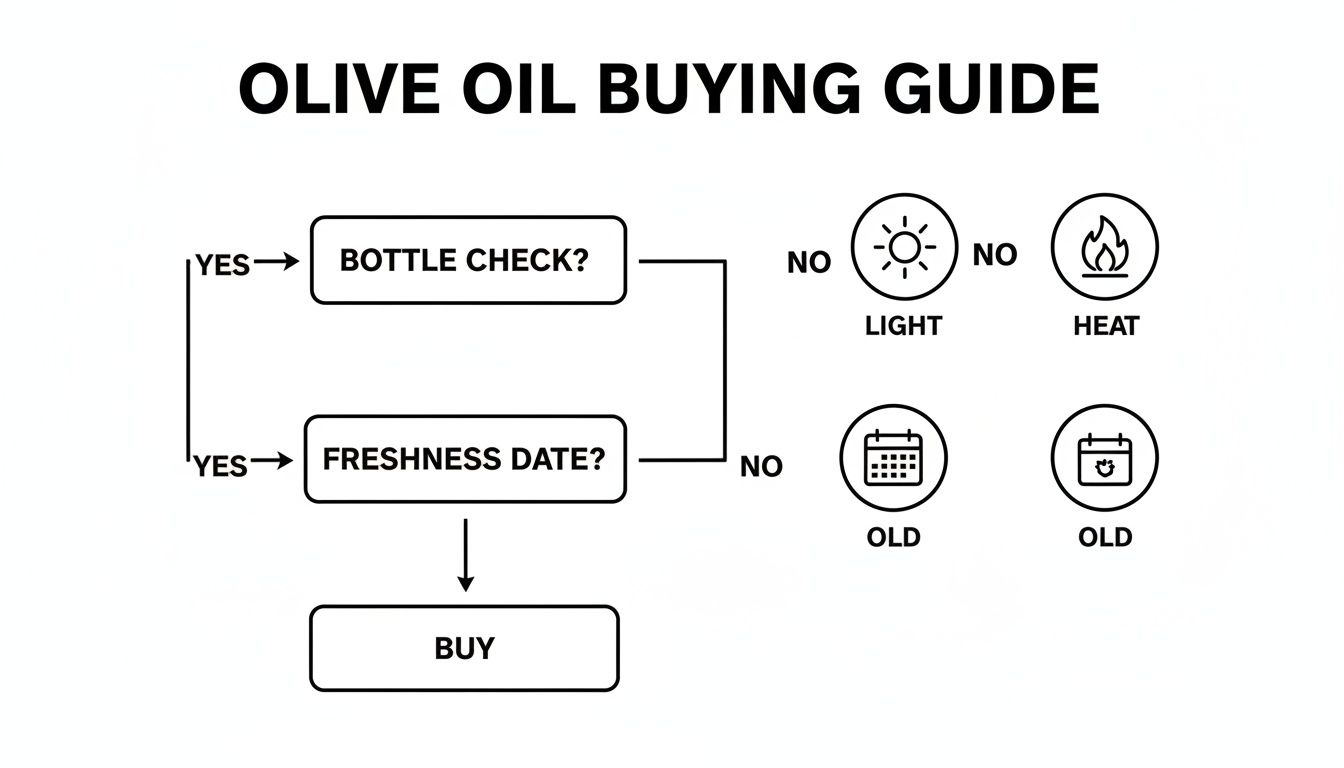
It really just boils down to three things: checking the bottle, looking for a recent harvest date, and making sure it's been stored away from its biggest enemies—light and heat.
Roasting and Baking
When the oven is on and you're chasing perfectly crispy roasted potatoes or a moist, tender olive oil cake, you need an oil that won't retreat from the heat. This is where a robust extra virgin olive oil truly shines.
For roasting, the Spanish Picual is an absolute champion. It possesses a bold, peppery flavor that mellows beautifully in the oven, and its extraordinarily high polyphenol count gives it incredible stability at higher temperatures. If you're baking, a Greek Koroneiki is another star. Its fresh, grassy notes add a beautiful complexity that cuts through the sweetness in cakes and muffins.
Remember, the goal is not just to cook the food, but to season it from within. A robust oil becomes an active ingredient, its flavor weaving itself into every bite as it cooks.
Finishing Drizzles and Dressings
Now for the fun part. This is where your best, most expressive olive oil gets its moment in the spotlight. When you're drizzling it over a perfectly cooked steak, a hearty bowl of soup, or a simple plate of pasta, you want a flavor that makes a bold statement.
A classic Tuscan EVOO with its signature peppery kick is just the thing to slice through rich, savory dishes. But for a delicate vinaigrette to toss with fresh greens or for a final touch on flaky white fish, go for something softer. A buttery Arbequina or a fruity French Picholine will complement the food without stealing the show. Think of your finishing oil as the final flourish—the secret weapon that makes the whole meal sing.
To give you a head start, here’s a quick guide to some of the most popular olive varietals you’ll find on the shelf. Each one has its own personality and brings something different to the table.
Olive Oil Varietals and Their Best Culinary Uses
| Olive Varietal | Typical Flavor Profile | Best For Sautéing & Roasting | Ideal For Finishing & Dressings |
|---|---|---|---|
| Arbequina (Spain) | Smooth, buttery, fruity, with hints of almond; low bitterness. | Excellent | Perfect for delicate vinaigrettes or drizzling on fish. |
| Picual (Spain) | Bold, peppery, tomato leaf notes; pleasantly bitter finish. | The undisputed champion for high heat. | Fantastic on grilled meats, hearty soups, and aged cheese. |
| Koroneiki (Greece) | Grassy, herbaceous, and robust with a peppery kick. | Very Good | Drizzle over feta, legumes, or use in bold dressings. |
| Picholine (France) | Mildly fruity and nutty with a light, peppery finish. | Good | A beautiful, subtle choice for salads and vegetables. |
| Frantoio (Italy) | Fruity and aromatic with a distinctively sharp, peppery finish. | Good | The classic choice for bruschetta or a Tuscan bean soup. |
Getting to know these varietals is like building a spice rack—the more you have, the more nuanced and delicious your cooking can become. Don't be afraid to experiment and find the ones you love most.
Still Have Questions About Cooking with Olive Oil?
It's one thing to read a guide, but it's another to stand in front of the stove with a bottle in your hand. Questions always come up. Let's clear up a few of the most common ones so you can cook with absolute confidence.
Can I Really Fry with Extra Virgin Olive Oil?
Yes, you absolutely can! While you probably don't want to use that prized, peppery finishing oil for deep-frying a turkey, a quality EVOO is more than capable of handling everyday pan-frying and sautéing. Many premium extra virgin olive oils have a smoke point reaching as high as 410°F.
The real hero here is the oil's freshness and its rich antioxidant content. These natural compounds, called polyphenols, act as a defense against heat, making the oil more stable and preventing it from breaking down. So for searing a steak or sautéing vegetables, a good EVOO is not just safe—it’s a fantastic choice for adding both flavor and health benefits.
Think of it like this: the high polyphenol count is a natural shield for the oil. It’s what helps EVOO hold its own in a hot pan, often performing even better than highly refined seed oils.
What Does "First Cold Press" Actually Mean?
This term is a bit of a throwback, but it still signals a commitment to quality. "First press" historically meant the olives were crushed just once to get the highest quality juice. "Cold press" assured that no heat (kept under 80.6°F or 27°C) was added during extraction, which is crucial for preserving the oil's delicate aromas, flavors, and nutrients.
These days, almost all true extra virgin olive oil is produced this way, though modern centrifuges have replaced the old-school presses. Seeing "first cold press" on a label is reassuring, but the official "Extra Virgin" classification is the real guarantee you should be looking for. It's the modern gold standard.
My Olive Oil Looks Cloudy in the Fridge—Did It Go Bad?
Not at all! Seeing your olive oil turn cloudy in the cold is completely normal and totally reversible. The natural waxes and healthy fats in authentic olive oil simply start to solidify at cooler temperatures, which can make the liquid look hazy or even semi-solid.
It’s definitely not a sign of spoilage. Just leave the bottle on your counter at room temperature for a bit, and it will return to its clear, liquid state. The quality and flavor will be perfectly fine. To avoid this altogether, it's best to store your oil in a cool, dark pantry instead of the refrigerator.
At Learn Olive Oil, we're passionate about helping you understand this liquid gold. Our goal is to give you the expert insights needed to choose, taste, and cook with the world's best olive oils. To explore the world of premium olive oil, come visit us at https://learnoliveoil.com.

 Learn Olive Oil
Leave a comment