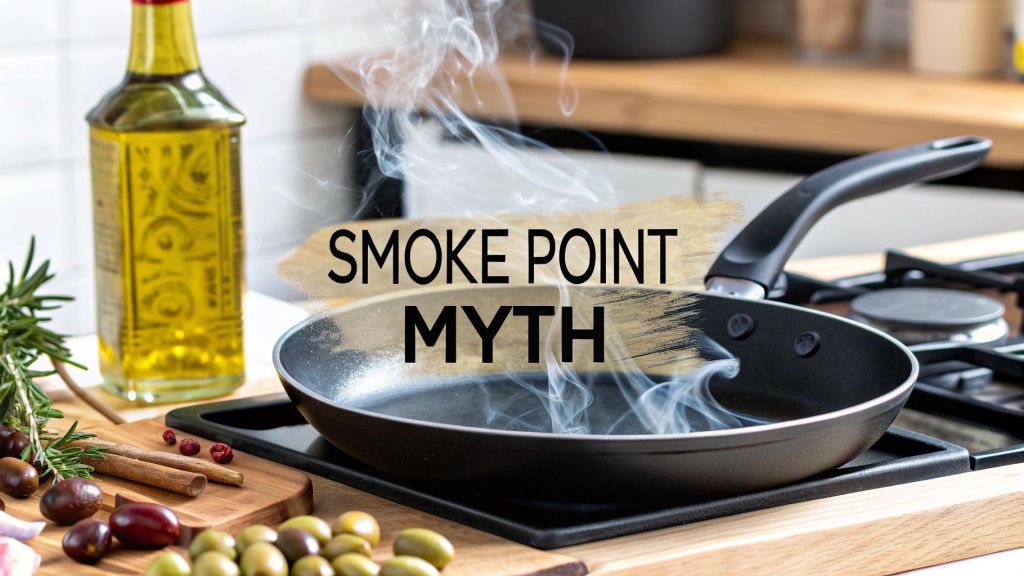
For generations, a single piece of misinformation has kept one of the world's most glorious cooking oils chained to the salad bowl. You've heard the lie repeated a thousand times. That your precious extra virgin olive oil just can't take the heat.
I'm here to tell you that this is not only wrong, it’s a culinary crime.
The truth is, the smoke point of extra virgin olive oil isn't some delicate, fragile thing. It sits comfortably within a remarkably versatile range of 350°F to 410°F, making it one of the most stable, flavorful, and healthiest choices you can possibly put in a hot pan.
The Myth That Robs Your Cooking of Flavor and Health
It’s a story whispered in kitchens everywhere: using your best olive oil for anything beyond a finishing drizzle is a waste, or worse, a health hazard. This stubborn falsehood has cheated countless meals out of spectacular flavor and robbed you of the potent health benefits locked inside every bottle. It's time to expose this myth for what it is.
Let's finally put the fear of smoking pans and ruined dinners to bed. High-quality EVOO isn't just safe for cooking at high temperatures; it's one of the most structurally sound and nutritious fats you can use.
Unlocking Your Oil's Hidden Power
Picture this: searing a thick steak to get that perfect, mahogany crust, or roasting vegetables until their natural sugars caramelize into sweet, golden-brown perfection. Now, imagine all of that infused with the rich, complex character of a premium olive oil. This isn't a pipe dream; it's how cooking is supposed to taste. The secret is understanding that the smoke point isn't a cliff's edge.
Nearly all of your daily home cooking happens well within EVOO's comfort zone. A typical stovetop sauté sizzles around 350°F. Most baking rarely pushes past 400°F. Even deep-frying often sits squarely in the 350-375°F range, putting it safely in the kill zone for a quality bottle. You can discover more truths about EVOO at learnoliveoil.com.
The belief that EVOO has a low smoke point is one of the most destructive myths in the culinary world. It actively prevents home cooks from using one of the healthiest and most flavorful oils available for everyday cooking.
Why Does This Lie Persist?
So, where did this giant misunderstanding come from? It's a toxic cocktail of outdated advice and a fundamental confusion between different grades of olive oil. Cheap, highly refined "light" olive oils behave in a completely different universe than a true, unrefined extra virgin olive oil. This guide will dismantle that lie, piece by piece, showing you exactly why a high-quality EVOO is a fortress of stability in your pan.
It's time to stop holding back. Let's unleash the full power of your best olive oil and bring its incredible character from the pantry straight to the fire.
What Smoke Point Really Means for Your Cooking
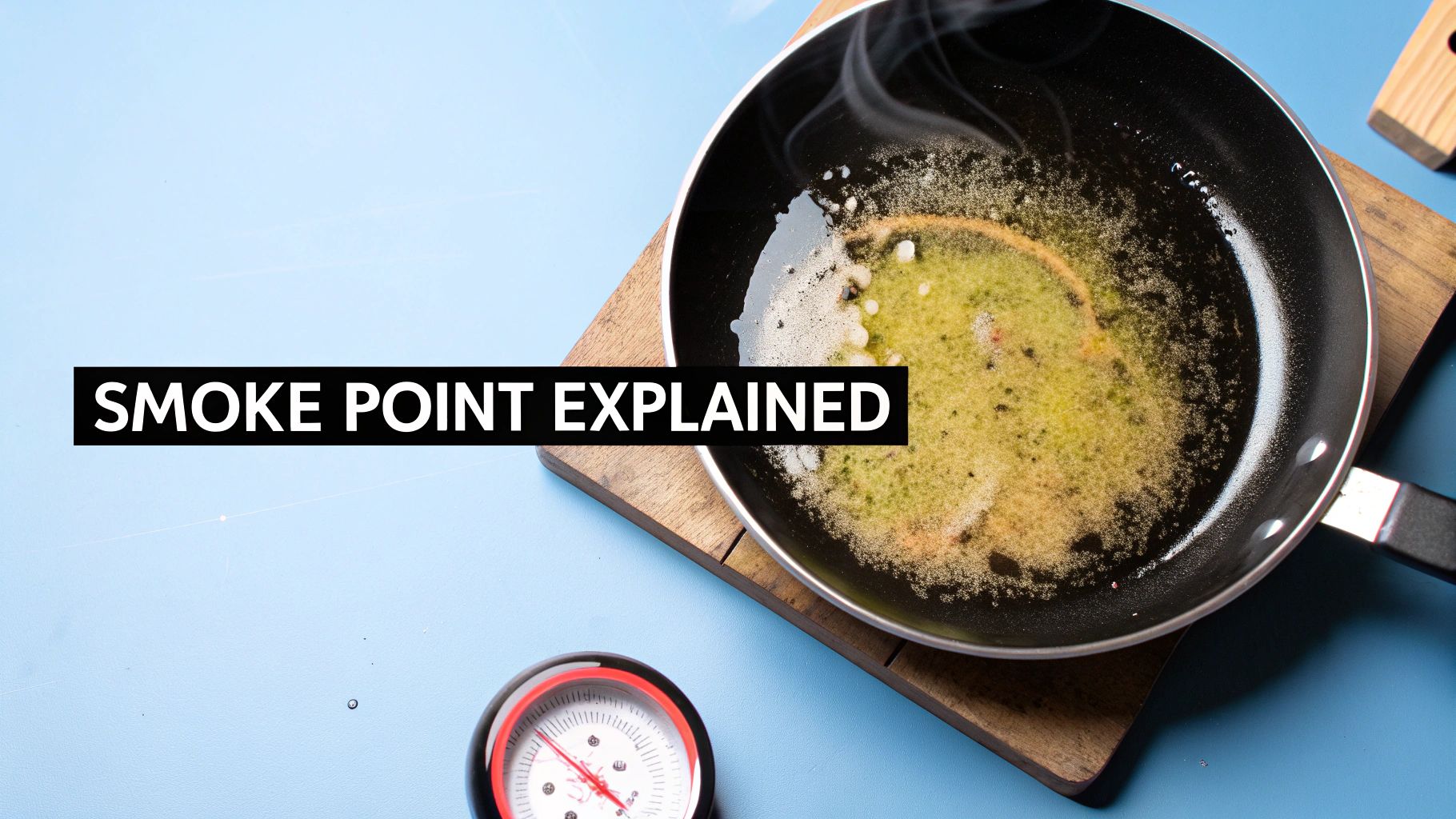
Most of us have a mental picture of a smoke point as a strict, non-negotiable line in the sand. Cross it, and your oil instantly degrades into a toxic, smoking wreck. But the reality is far more nuanced—and frankly, a lot less frightening. It’s better to think of it not as a culinary doomsday clock but as a simple communication from your pan.
When you see that first wisp of smoke, your oil isn't suddenly ruined. It’s just sending you a signal. The extra virgin olive oil smoke point is simply the temperature where the oil begins to give off a continuous, visible stream of bluish smoke. This tells you it’s starting to break down, not that it’s already a lost cause.
Beyond Smoke: The Flash and Fire Points
To truly understand what's happening in your pan, you need to know what comes after the smoke point. These are the stages you absolutely want to avoid, but knowing them puts that initial wisp of smoke into its proper context.
- Flash Point: If you keep blasting the heat about 100-150°F past the smoke point, the vapors coming off the oil can momentarily ignite if they find a spark or flame. That’s the flash point.
- Fire Point: Push the temperature even higher, and you’ll reach the fire point. This is where the oil itself can sustain a continuous flame—a very real and dangerous kitchen fire.
Looking at it this way, you can see that the smoke point is an early warning system, not a five-alarm fire. For a fantastic side-by-side comparison of various fats, this complete cooking oil smoke points chart is an invaluable resource.
The smoke point isn’t the end of the story; it's the beginning of a conversation between you and your ingredients. The true measure of an oil's performance is how well it resists breaking down long before it ever smokes.
The Real Hero: Oxidative Stability
This brings us to what I believe is the single most important factor for any cooking oil: oxidative stability. This is an oil's innate, built-in resistance to breaking down and forming harmful compounds when exposed to heat.
Think of it like two buildings in a hurricane. One is a sleek glass skyscraper—that’s your highly refined seed oil. It might look impressive and reach great heights (a high smoke point), but its walls are thin and fragile. It can’t handle the storm (heat) for long before it begins to shatter.
The other building is a stone fortress—that's your high-quality EVOO. It may not be the tallest structure, but its walls are incredibly thick, reinforced with natural defenders like polyphenols and other antioxidants. This fortress weathers the storm far better, protecting everything inside.
This is precisely why a good EVOO is a champion in the kitchen. It dominates in the pan because it acts like a fortress against heat, holding onto its structure and health benefits long after other oils with misleadingly high smoke points have surrendered.
The Three Pillars of a High-Performance Olive Oil
Have you ever wondered why one bottle of extra virgin olive oil performs like a dream in your pan, while another smokes and sputters at the first kiss of heat? It's not magic. The secret is a powerful trifecta of quality markers that separates the champions from the pretenders.
The truth is, a vast performance gap exists among extra virgin olive oils. The extra virgin olive oil smoke point can swing from a disappointing 347°F all the way up to a rock-solid 410°F. This range isn’t random—it’s a direct reflection of the oil's quality, purity, and freshness. Once you know what to look for, you'll unlock its true potential in the kitchen.
Pillar One: The Purity of Low Acidity
First, and arguably the most crucial factor, is the oil’s Free Fatty Acids (FFA) level. Think of FFA as a report card for the oil’s overall health and stability. It is the number one predictor of how well it will hold up when the heat is on.
A low FFA percentage is the hallmark of a top-tier, heat-stable oil. It tells you the olives were pristine, handled with care, and pressed immediately. While international standards for EVOO permit an FFA up to 0.8%, the true performers often clock in at a stunning 0.2% or less. The rule is simple: the lower the FFA, the higher the smoke point.
Pillar Two: The Power of Polyphenols
Next, let's talk about the oil's secret weapon: polyphenols. These are potent antioxidants that give authentic EVOO its signature peppery kick and pleasant bitter notes. But they do far more than just add flavor; they act as the oil’s personal bodyguards.
Polyphenols shield the oil from breaking down under the assault of heat and oxygen. They are the source of EVOO's incredible oxidative stability, creating a natural defense that keeps the oil intact long after other fats have waved the white flag. An oil loaded with these compounds is an oil that’s built to cook. You can even learn how to spot olive oil polyphenol content to find a more durable oil for your kitchen.
The one-two punch of low acidity and high antioxidant content creates a culinary fortress. This synergy is what makes high-quality EVOO one of the most stable cooking fats you can buy.
Pillar Three: The Guarantee of Freshness
Finally, we have a pillar everyone understands instinctively: freshness. Picture a crisp, juicy apple just plucked from the tree versus a bruised, mealy one that’s been languishing in a warehouse for months. Which one is more vibrant?
Olive oil is no different. It is a fresh fruit juice, and like any juice, it degrades over time. As an oil ages, its FFA level creeps upward while its protective polyphenols vanish, causing the smoke point to plummet. Always look for a harvest date on the bottle. A recent harvest is your best guarantee that the oil inside is ready to perform at its peak.
How EVOO Stacks Up Against Other Cooking Oils
Alright, let's get into a head-to-head battle. In the world of cooking fats, the smoke point number is often wielded like it's the only statistic that matters. But focusing on that single number is a classic marketing smokescreen, designed to distract you from what's really happening in your pan.
It’s time to put extra virgin olive oil in the ring with the usual suspects. Once you look past the misleading labels, a much clearer picture emerges. The extra virgin olive oil smoke point tells only part of the story; its real strength comes from its incredible stability and nutritional integrity, even under intense heat.
The Smoke Point Showdown Is a Lie
A sky-high smoke point on a refined seed oil—think canola, soy, or corn oil—is usually a sign of profound weakness, not strength. These oils are almost always bleached, deodorized, and chemically stripped of every last one of their natural defenses. Sure, they might not smoke quickly, but they can silently degrade and form harmful compounds at surprisingly low temperatures, giving you no warning signs at all.
On the other hand, a high-quality EVOO is a fortress of stability. It's packed with powerful antioxidants and stable monounsaturated fats that act as bodyguards, fighting breakdown and protecting both the oil's phenomenal flavor and its health benefits throughout the cooking process.
The infographic below brings home the key pillars that give EVOO its superior performance.
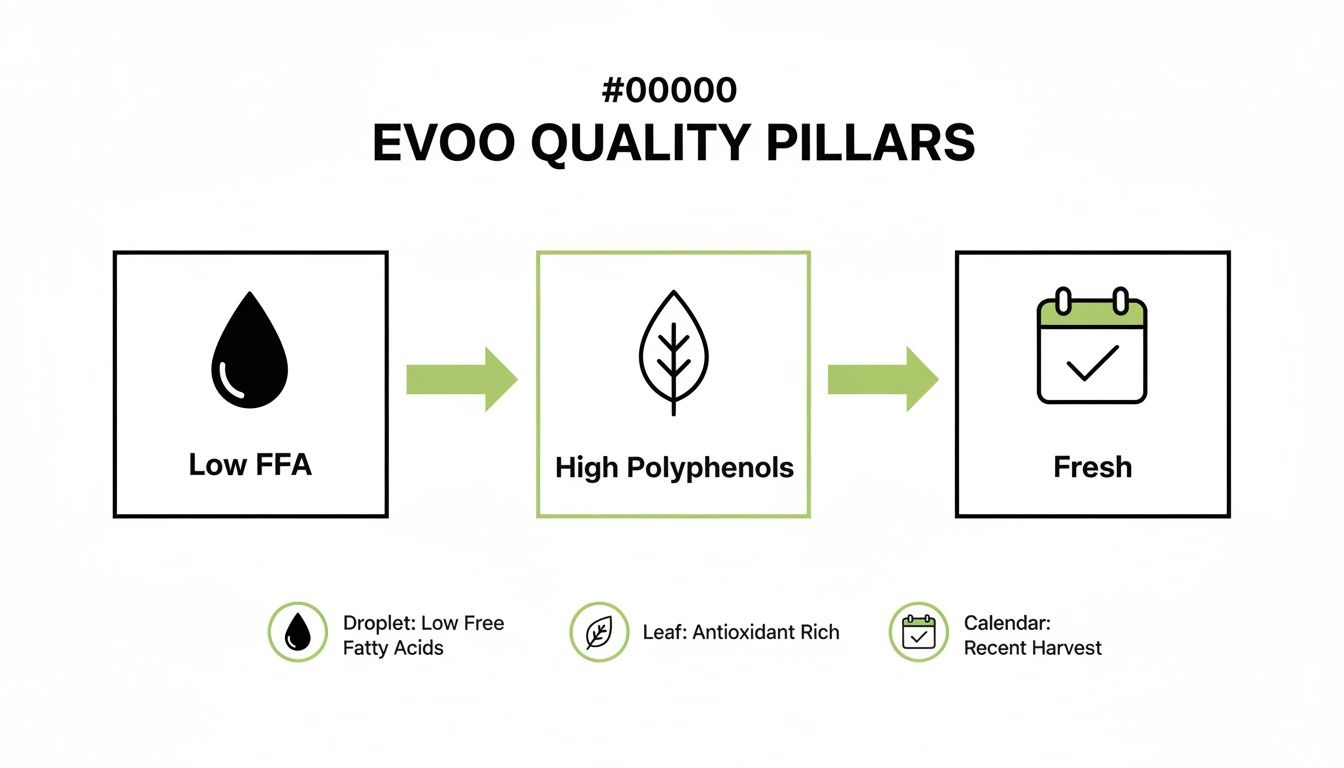
You can see how low free fatty acids, a high polyphenol count, and supreme freshness work in concert to create an oil that’s simply built better for cooking.
The Real-World Comparison
Let's talk practical numbers. A quality EVOO’s smoke point of up to 410°F puts it leagues ahead of common fats like butter (302°F) and unrefined coconut oil (350°F). This makes it a true kitchen workhorse, perfectly suited for over 95% of what you’ll ever do on your stove, from a gentle sauté to a 400°F roast. And it does all this while holding onto its nutritional superpowers.
Of course, in certain industrial settings, the needs can be different. Some highly specific tasks, like applying high-smoke-point oil for seasoning a cast-iron griddle, might call for a different tool. But for your kitchen, EVOO's blend of heat stability, flavor, and health is simply unmatched.
The most important question isn't "When will it smoke?" It's "How well does it hold up to heat?" And on that count, high-quality EVOO consistently destroys the highly processed competition.
Cooking Oil Performance Showdown
To truly see how the major players compare, let's lay it all out. This table cuts through the marketing fog and focuses on what actually matters for your health and your food.
| Cooking Oil | Typical Smoke Point (°F) | Oxidative Stability | Primary Fat Type | Key Feature |
|---|---|---|---|---|
| Extra Virgin Olive Oil | 350-410°F | High | Monounsaturated | Rich in antioxidants, stable under heat |
| Canola Oil (Refined) | 400°F | Low | Polyunsaturated | Neutral flavor, but highly processed |
| Coconut Oil (Unrefined) | 350°F | Moderate | Saturated | Distinct flavor, solid at room temp |
| Avocado Oil (Refined) | 520°F | Moderate-High | Monounsaturated | Very high smoke point, neutral flavor |
| Butter | 302°F | Low | Saturated | Rich flavor, but burns easily |
As you can see, EVOO's combination of a versatile smoke point and high oxidative stability makes it the undisputed champion for most everyday cooking.
Choosing the right oil is about so much more than preventing smoke. It's about creating flavor, preserving nutrients, and ultimately, protecting your health. For an even deeper look at making the smartest choice for your skillet, see our guide on the best olive oil to cook with. When you're armed with the truth, you’ll see why EVOO is the king of your kitchen.
Mastering Your Skillet with EVOO
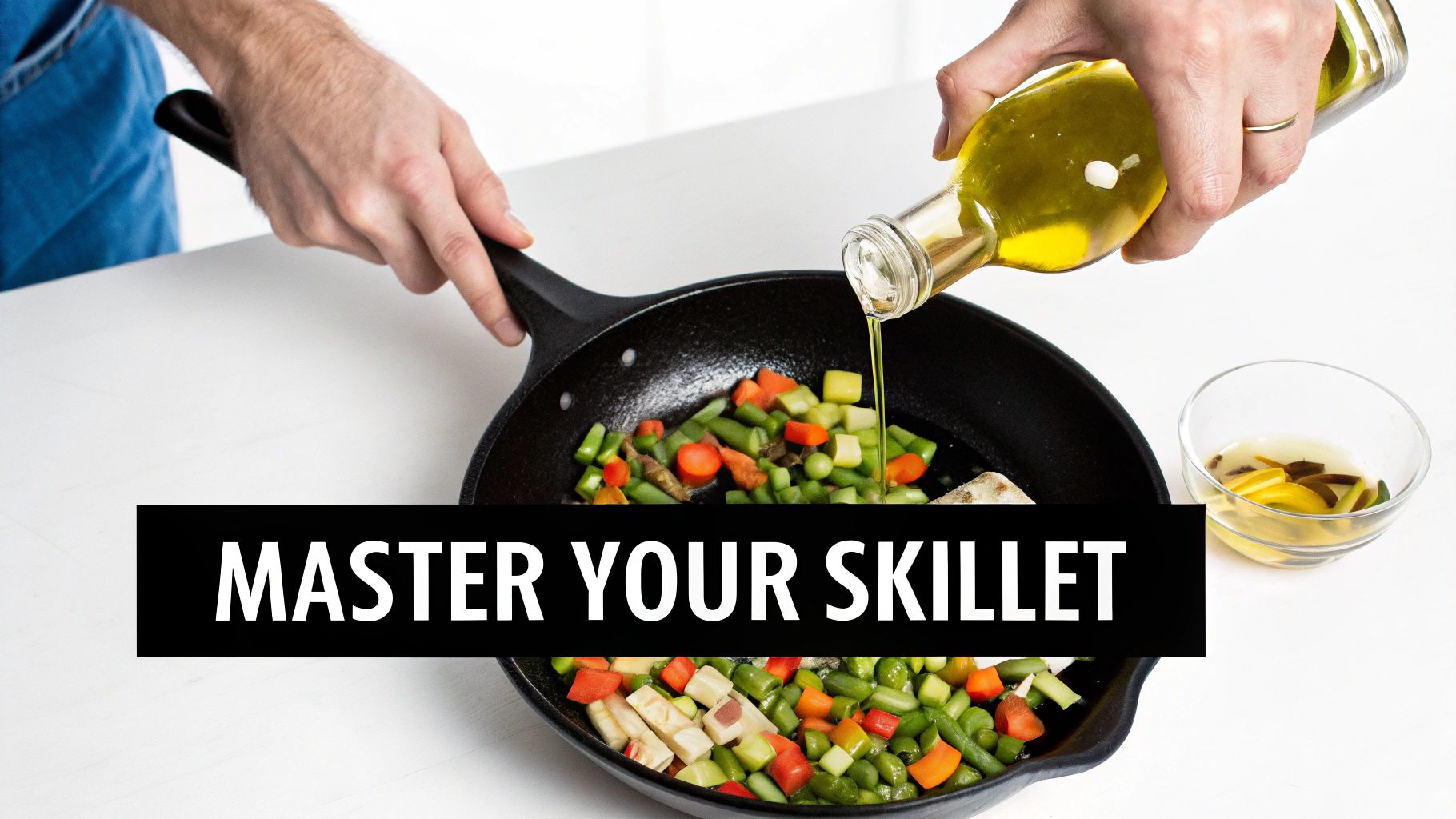
Knowing the science behind the extra virgin olive oil smoke point is one thing, but true mastery happens at the stovetop. It's time to put that theory into practice and get some delicious results. This isn't about staring at a thermometer; it's about learning to read the oil and trust your senses.
You can stop worrying about overheating your EVOO. Once you know what to look for, you’ll be able to hit that perfect cooking temperature every single time, ensuring your food gets a beautiful sear without ever pushing the oil past its limit.
Reading the Language of Your Pan
The most valuable skill any cook can develop is learning to watch the oil, not the clock. Your EVOO will give you clear, unmistakable signals when it’s ready for food. You just have to know what you’re looking for.
The very first sign of a perfectly heated pan is the "shimmer." As the oil warms, you'll see faint, wavy lines rippling across its surface—it looks a bit like the heat haze coming off hot asphalt. This is your green light. The pan is hot and ready.
Immediately after the shimmer, you might notice the first delicate wisps of vapor rising from the oil. Do not panic—this is not smoke. This is the sweet spot. It means the oil is at the ideal temperature to create a magnificent sear that locks in moisture and flavor.
Forget rigid temperature rules. The shimmer and the first wisp of vapor are the only guides you will ever need. They are the language of the pan, telling you, "I'm ready to cook."
Pro Tips for a Perfect Sauté
Executing a flawless sauté or sear with EVOO is simple once you master a few key habits. These small adjustments make a world of difference, helping you avoid splattering and sticking while giving you absolute control. It's especially critical when using olive oil for sautéing, where heat management is everything.
These simple steps will transform your cooking:
- Heat the Pan, Then Add the Oil: Always begin by heating your empty, dry skillet over medium heat. You'll know it's ready when you can hold your hand an inch above the surface and feel a solid, radiating warmth. Then add your EVOO. This simple trick prevents the oil from soaking into your food and guarantees it sears the surface instead.
- Pat Your Food Bone-Dry: Moisture is the mortal enemy of a good sear and the number one cause of angry, splattering oil. Before adding ingredients like chicken, fish, or even vegetables to the pan, pat them completely dry with a paper towel. A dry surface is what creates that beautiful, delicious browning and caramelization.
- Don't Crowd the Pan: Give your ingredients room to breathe. Piling too much food into the skillet at once plummets the oil's temperature and causes everything to steam instead of sear. It is far better to cook in batches if you must—the crisp, intensely flavorful results are worth the extra minute.
When you combine these fundamental techniques with a little sensory awareness, the smoke point myth becomes totally irrelevant. You'll find yourself cooking with EVOO confidently, creating healthier and more delicious meals every single day.
Your EVOO Smoke Point Questions Answered
We’ve busted the myths and walked through the science, but the real test is feeling confident in your own kitchen. Let's tackle the most common questions that pop up when the heat is on. This is where we clear up any final doubts and give you the practical answers you need to start cooking with your extra virgin olive oil tonight.
Can I Really Deep Fry with Extra Virgin Olive Oil?
Yes, you absolutely can—and it's a far healthier choice than most people realize. The sweet spot for deep-frying is typically between 350-375°F, a range that a quality EVOO can handle with total ease, thanks to its smoke point of 350-410°F.
But here's the real magic: its incredible oxidative stability. Think of this as the oil's superpower. It is exceptionally resistant to breaking down and forming harmful compounds, performing far better under heat than highly processed seed oils. In fact, studies have shown that because of its high antioxidant content, you can even reuse it for frying several times with surprisingly little degradation.
Will Cooking Destroy the Flavor and Health Benefits of EVOO?
This is perhaps the most stubborn myth of all. While it's true that the most delicate, ethereal aromas might soften slightly with heat, the bold, fruity, and peppery soul of a great EVOO will absolutely shine through and make your dish taste better.
More importantly, the main health benefit—its remarkably stable monounsaturated fat—is almost completely unaffected by normal cooking temperatures. A significant portion of its powerful polyphenols also survives the journey from the pan to your plate, infusing your food with their well-known anti-inflammatory goodness. You're not cooking the benefits out; you're cooking them in.
The fear of losing health benefits to heat is largely unfounded. The core structure of EVOO is built to withstand cooking, delivering its nutritional payload directly to your plate.
How Do I Know if My Olive Oil Is Overheated?
Your own senses are the best tools you have. You are not waiting for a dramatic plume of smoke like in a movie. The real telltale sign is a continuous, steady stream of blue-grey smoke rising from the entire surface of the oil.
You will also notice a harsh, acrid smell that is a world away from the oil's fresh, inviting aroma. If you see and smell this, the oil has broken down. The best course of action is to turn off the heat, let the pan cool completely, wipe it out, and start over with fresh oil.
Should I Use My Expensive 'Finishing' EVOO for Cooking?
You certainly can, and because of its high quality, it will perform beautifully. But is it the most practical or cost-effective choice? Probably not. The complex, nuanced aromas of a truly premium finishing oil are best experienced when it's raw.
A smarter strategy, used by chefs everywhere, is to keep two different EVOOs in your kitchen:
- A "workhorse" EVOO: A high-quality, dependable, and more affordable bottle for all your daily cooking, from sautéing vegetables to roasting chicken.
- A "showstopper" EVOO: Your special, more intensely flavored oil that you save for drizzling over a finished dish. This is for that final, stunning pop of flavor right before serving.
This two-bottle system gives you fantastic performance in the pan and the biggest flavor impact on the plate, all without draining your wallet.
Ready to explore the world of high-quality olive oil with confidence? At Learn Olive Oil, we provide expert guides, tasting notes, and recommendations to help you find the perfect bottle for every dish. Elevate your cooking and your health by discovering what makes this liquid gold so special. Start your journey with us at https://learnoliveoil.com.
 Learn Olive Oil
Leave a comment