You hold in your hands a bottle of liquid gold. A treasure prized for centuries, not just for its flavor, but for the vibrant health it seems to bestow. Yet, a nagging question whispers in your ear every time you reach for it: how much olive oil is too much?
Let’s cut through the noise. For most of us, the answer trusted by researchers and health experts is remarkably simple: somewhere between 2 to 4 tablespoons daily. This is the amount consistently linked to a cascade of health rewards, without tipping the scales on your daily calorie budget.
But if you think that number is the whole story, you’re about to miss the most important part.
Finding the Goldilocks Zone for Olive Oil
Knowing that number is like being handed the key to a treasure chest… but with no map. The true power of olive oil isn’t something you can measure with a spoon. It's about a much bigger, more beautiful picture—how it fits onto your plate, and into your life.
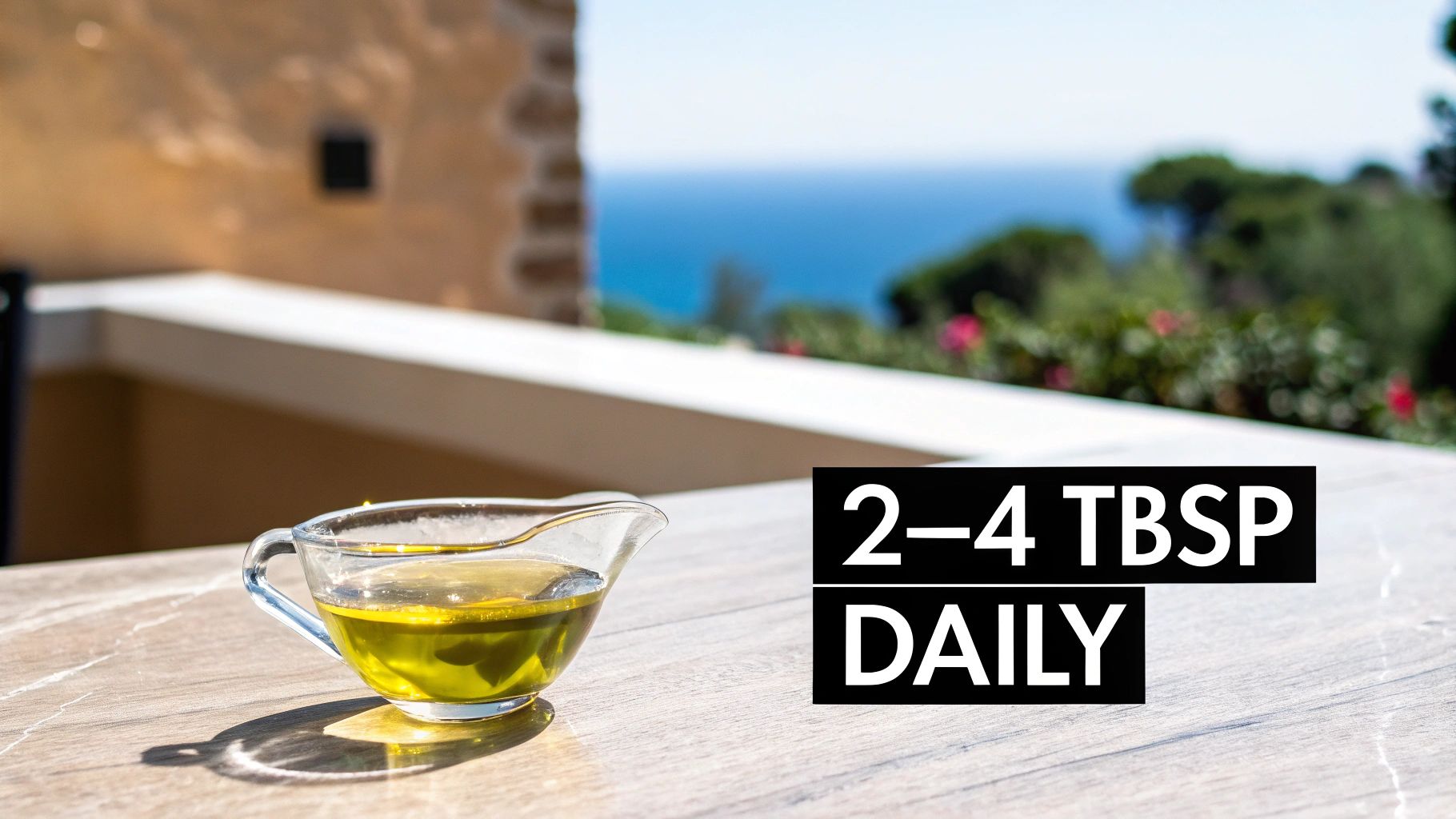
Picture for a moment the sun-drenched coasts of Greece or Italy. Generations of people there have enjoyed well over four tablespoons a day, all while experiencing incredible health and longevity. So what’s their secret? It’s this: their olive oil is never a solo act. It’s the star performer in a brilliant ensemble cast of whole, vibrant foods.
This isn’t a contradiction; it’s the key that unlocks everything. It tells us the conversation shouldn’t just be about quantity, but about quality, context, and—most importantly—balance.
It’s Far More Than Just a Number
To truly understand what "too much" means for you, we must look past the oil itself and at the company it keeps. The real magic happens when olive oil is drizzled over a symphony of other life-giving foods.
Here’s what we’re about to uncover:
- The Calorie Equation: How to make this precious fat work within your daily energy needs, not against them.
- The Mediterranean Secret: Why high olive oil consumption is a cornerstone of health in its traditional dietary home.
- The Tipping Point: How to listen to your body’s subtle whispers that you might be getting a little too generous with your pour.
The most enlightened way to think about olive oil isn't as a medicine to be measured, but as a fundamental cornerstone of a vibrant, whole-foods diet. Its benefits are magnified by the healthy foods it embraces.
This guide will help you stop worrying about exact measurements and start using olive oil with the confidence and intuition of a seasoned chef. You'll learn not just how much to use, but how to make it a delicious and powerful ally on your health journey. To grasp why this is so critical, you can explore the remarkable olive oil health benefits it brings to the table.
The Simple Math Behind Calories and Healthy Fats
Determining your ideal olive oil intake isn’t about discovering a magic number that works for everyone. It’s a matter of personal math. The clearest way to see it is to picture your daily diet as a simple budget. Every food you eat is a transaction—an expenditure of calories that buys you the energy to live your life.
Within this budget, olive oil is a high-value investment. A single tablespoon contains about 120 calories and 14 grams of fat. That might sound like a significant withdrawal from your account, but here’s the crucial difference: not all fats are created equal.
Distinguishing Nutritional Heroes from Villains
The fat in olive oil is overwhelmingly the good kind—monounsaturated fat. This is the nutritional hero of our story, a completely different character from dietary villains like trans fats or an excess of saturated fats. Think of it like investing in a high-quality, durable kitchen tool versus buying a cheap one that breaks. The initial cost might seem similar, but the long-term value is worlds apart.
Monounsaturated fats are celebrated for their role in championing heart health, helping to lower bad cholesterol, and even fighting inflammation. This is precisely why a tablespoon of olive oil, despite its calorie density, is a savvy addition to your diet—not a wasteful expense. For a complete look at the numbers, our guide on olive oil calories per tablespoon breaks it down even further.
When you drizzle olive oil over a salad, you aren't just adding calories. You're making a wise investment in a health-promoting ingredient that unlocks the nutrients in your vegetables, making them more available to your body.
Fitting Olive Oil into Your Daily Budget
So, how does this play out in real life? Let's see how olive oil fits into a standard 2,000-calorie diet.
How Olive Oil Fits into Your Daily Calorie Budget
This table shows how different amounts of olive oil contribute to a typical daily diet, illustrating the percentages of total calories and the recommended daily fat intake (based on an average of 65g).
| Amount of Olive Oil | Calories | % of 2,000 Calorie Diet | Total Fat (grams) | % of Daily Fat Rec. (65g) |
|---|---|---|---|---|
| 1 Tablespoon | 120 | 6% | 14g | 22% |
| 2 Tablespoons | 240 | 12% | 28g | 43% |
| 3 Tablespoons | 360 | 18% | 42g | 65% |
| 4 Tablespoons | 480 | 24% | 56g | 86% |
As you can see, the numbers add up, but they're entirely manageable when you’re mindful of your overall intake.
Two tablespoons a day, for instance, comes to 240 calories, which is just 12% of your daily intake on a 2,000-calorie plan. That’s a perfectly reasonable amount, especially when it replaces less healthy fats from things like processed dressings, margarine, or butter.
Understanding this balance is crucial for maintaining your energy levels, much like choosing the best snacks for energy can make or break your afternoon. The key is simply awareness. When you see each pour through the lens of your personal calorie budget, you can confidently enjoy all the benefits without worrying about tipping the scales.
When a Good Thing Becomes Too Much
Even the world's healthiest foods have their limits, and olive oil is no exception. But let me be clear: the line you cross isn’t a dramatic one. Forget the sensational myths about sudden heart damage or toxicity. The real consequences of overdoing it are far more practical and rooted in one simple truth: energy balance.
The most straightforward risk is weight gain. Olive oil is, after all, a pure fat, making it incredibly dense in calories. A heavy hand can easily turn a light, healthy salad into a high-calorie meal. Over time, that adds up. This is why learning how to use it strategically is the secret to using olive oil for weight loss without accidentally sabotaging your efforts.
Beyond the scale, a sudden flood of fat can throw your digestive system for a loop. If your body isn’t accustomed to a high-fat diet, consuming too much olive oil at once might lead to uncomfortable issues like stomach cramps or diarrhea. This isn't a red flag that olive oil is "bad," but rather a gentle nudge from your body that it needs a moment to adjust.
The Real Risks vs. The Myths
It's vital to separate fact from fear-mongering. A few extra tablespoons of olive oil aren’t going to clog your arteries overnight. The genuine risks are much less dramatic, but far more real.
The concept of 'too much' olive oil is almost always a question of caloric balance, not toxicity. The true issue isn't the oil itself, but how it fits—or doesn't fit—into your overall daily diet.
This is where the numbers tell the unvarnished truth. Olive oil contains about 884 kcal per 100g. If you’re on a 2,500-calorie diet, getting more than 10% of your calories from olive oil (about 28g, or two tablespoons) could create a surplus if it’s not accounted for elsewhere.
Fascinatingly, traditional Mediterranean diets often have olive oil contributing up to 25% of daily energy—a habit linked with remarkable longevity in Blue Zones. You can dig into more of this data in the latest olive oil sector statistics.
Listening to Your Body’s Subtle Signals
So, how do you know when enough is enough? Your body is your best guide. Just pay attention to these simple cues:
- Unexplained Weight Gain: If the scale is creeping up but nothing else in your diet has changed, it might be time to take a closer look at your olive oil portions.
- Digestive Discomfort: Feeling bloated or noticing changes in your digestion after meals heavy on olive oil? That could be your body’s signal to pull back a bit.
- Oily or Heavy-Feeling Meals: If your food starts to taste greasy or leaves you feeling sluggish and weighed down, you've probably overpowered the dish instead of enhancing it.
The goal is to use olive oil to elevate your food and your health, not to treat it like a magic potion with no limits. By recognizing these practical, real-world downsides, you can find that perfect, delicious balance.
Unlocking the Mediterranean Diet Secret
If you're still worried about using "too much" olive oil, the eating habits of people in places like Greece, Spain, and Crete might seem baffling. They consume liters of it every year, yet they enjoy some of the lowest rates of chronic disease on the planet. How is this possible?
The answer isn’t a genetic magic trick. It’s all about the company that olive oil keeps.
The secret is context. In the Mediterranean, olive oil isn’t treated as an isolated health supplement. It's the cornerstone of a complete dietary pattern—the celebrated Mediterranean diet. This way of eating is less a rigid plan and more a philosophy of life. High olive oil intake is perfectly balanced by plates piled high with fresh vegetables, fiber-rich legumes, and lean protein from fish, all while avoiding heavily processed foods. In this environment, olive oil works its wonders as part of a team, not as a solo act.
The Power of the Whole Plate
Think of olive oil as the conductor of an orchestra. By itself, it’s a single, beautiful note. But when it leads a symphony of other nutrient-dense foods, it creates a powerful harmony that supports incredible health. The antioxidants in the oil work in concert with the vitamins from fresh vegetables, and its healthy fats actually help your body absorb those very same vitamins far more effectively.
This holistic approach is the real key. It shifts the question from "How much olive oil is too much?" to "How can I build a diet where a generous amount of olive oil is a benefit, not a burden?" For a deeper look into this kind of balanced eating, check out a practical guide to a heart-healthy diet plan, where healthy fats like those in olive oil play a starring role.
This isn't just folklore; it's a powerful synergy that researchers have observed for decades, backed by hard evidence linking these dietary patterns to amazing health outcomes.
Lessons from High-Consumption Cultures
The numbers are stunning. In a country like Greece, the average person might consume anywhere from 9.3 to 24 liters of olive oil every single year. Yet, when you look at their population-wide health data, you don't see widespread negative consequences. This points to a remarkably high safety threshold when olive oil is woven into the fabric of a whole-foods lifestyle.
The famous Seven Countries Study, which began back in 1958, was one of the first groundbreaking studies to connect high olive oil intake with lower rates of heart disease. Decades of modern research have only reinforced this finding, confirming the diet's protective power.
This brings us to the most important lesson: your overall dietary pattern matters more than any single ingredient. Instead of fearing olive oil, we should learn from the cultures that have mastered its use for centuries. When you embrace the principles of balance and whole foods, you unlock the true potential of this liquid gold, turning it into a source of health and flavor, not a source of anxiety.
A Practical Guide to Perfect Portions
It’s one thing to discuss tablespoons and nutrition labels, but it’s another thing entirely in the hustle and bustle of a real kitchen. You don't have time to measure every splash of oil, and frankly, you shouldn't have to. The true secret to getting your olive oil portions right isn't about obsessive measurement; it's about building your culinary intuition. Let's turn abstract knowledge into an effortless, everyday habit.
Think of it like learning to ride a bike. At first, you’re wobbly, hyper-aware of every movement. But soon enough, balance becomes second nature. The same idea applies here. All you need are a few simple visual cues to guide you until pouring the right amount feels completely automatic.
This is a core principle of the Mediterranean diet, where generous olive oil use, dietary balance, and overall health work in perfect harmony.
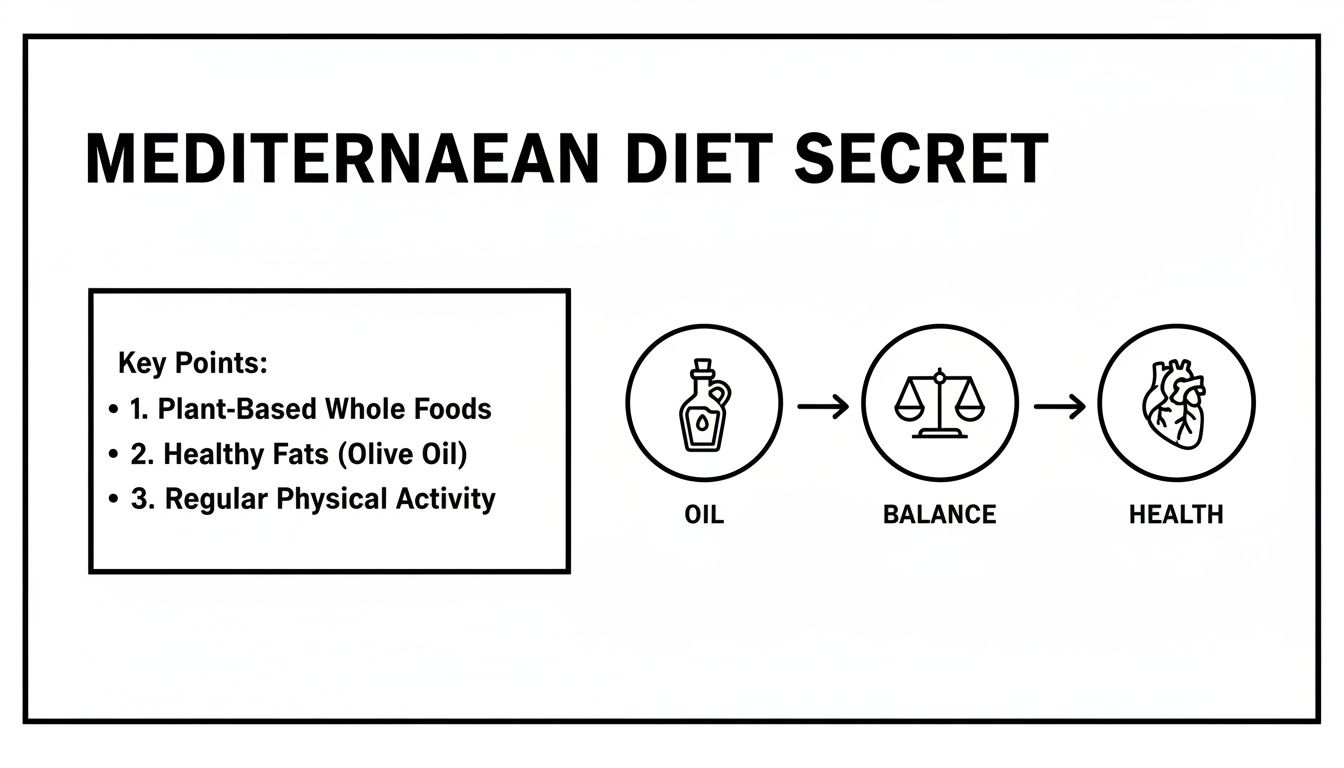
As this infographic shows, using olive oil generously works wonders when it's part of a diet rich in whole foods—the very combination that leads to those incredible health outcomes.
Mastering the Art of the Pour
Let's set the tablespoon aside for a moment and get practical. You can develop a real feel for the right amount by using simple, repeatable techniques that work in real-world cooking.
- The Three-Second Pour: This is your go-to for a single-serving salad. Pouring a steady, thin stream of olive oil for about three seconds will give you roughly one tablespoon—perfect for a light vinaigrette.
- The Bottle Cap Guide: Need just a little for dipping crusty bread? A standard olive oil bottle cap holds about half a teaspoon. Two of those give you a perfect portion without waste.
- The Pan Swirl: When you're about to sauté, pour a small circle in the center of a cold pan, about the size of a quarter. As the pan heats, give it a swirl. If the oil thinly coats the entire bottom, you've nailed it.
Your goal is to season the pan, not to create a swimming pool for your vegetables. For most cooking, a thin, shimmering layer is all you need.
Adjusting Your Pour for the Task at Hand
Of course, not all cooking is the same, and your olive oil use should reflect that. The right amount is always dictated by what you're cooking and the technique you're using.
For example, if you're roasting a whole tray of potatoes, you'll need enough oil to coat every surface to get them crispy and golden. This might mean using two to three tablespoons. But if you're wilting a huge bunch of spinach, you only need about one tablespoon, because the leaves release their own water and shrink down to almost nothing.
Learning the difference between coating, sautéing, and finishing is a huge part of developing that chef’s intuition. Eventually, you’ll just know how much to use without a second thought. For a more detailed breakdown, our complete guide to olive oil serving size can help you master these nuances.
By using these visual cues and context-based adjustments, you can gracefully integrate olive oil into your meals. You’ll feel confident that you’re getting all the benefits without any of the excess, making portion control feel liberating instead of restrictive.
Your Top Olive Oil Questions Answered
Let's tackle some of the most common questions people have about olive oil. I want to give you direct, clear answers so you feel completely confident about how you're using this amazing fat in your kitchen. We’ll cover everything from daily spoonfuls to cooking myths, putting the final pieces of the puzzle into place.
You understand by now—the idea of "too much" olive oil isn't about a magic number. It's all about how it fits into your life and your diet. Still, specific questions come up all the time, and getting straight answers can make all the difference.
Can Drinking a Spoonful of Olive Oil Daily Be Harmful?
For most people, taking a tablespoon of olive oil straight is not only safe but can be a fantastic health habit. It’s a time-honored practice for getting a direct infusion of heart-healthy monounsaturated fats and powerful antioxidants. This simple ritual is often linked to benefits like reduced inflammation and better cholesterol levels.
The only catch is the calorie count. That single spoonful carries about 120 calories, and that needs to have a place in your daily energy budget to avoid unintentional weight gain. As long as you account for it, this daily habit is widely considered a healthy boost, not a harmful one.
Does the Type of Olive Oil Change How Much Is Too Much?
No. The "too much" line, which is really about total calories, stays the same no matter which type of olive oil you choose. The calorie and fat content are virtually identical whether you grab extra virgin, virgin, or a "light" olive oil. A tablespoon of any kind will be about 120 calories.
What does change is the nutritional potency. Extra Virgin Olive Oil (EVOO) is the gold standard—it's the least processed and is bursting with the highest concentration of polyphenols and antioxidants. This makes it the superior choice for health benefits, especially when used unheated in salad dressings or as a finishing drizzle. For high-heat cooking, a more refined olive oil is a stable option, but your portion awareness should remain exactly the same.
The grade of olive oil (from extra virgin to light) impacts its flavor and antioxidant content, not its calorie count. Your portion size should be guided by your overall dietary needs, regardless of the type you use.
Are There Medical Conditions That Limit Olive Oil Intake?
While olive oil is a phenomenal choice for the vast majority of people, a few specific health conditions do require caution. It's not that the oil itself is bad, but high-fat foods in general can sometimes cause issues for certain individuals.
For instance, someone with gallbladder disease might find that any significant amount of fat, including from olive oil, can trigger painful symptoms. Similarly, some people with severe acid reflux (GERD) notice that fatty foods can worsen their condition.
Finally, anyone on a medically prescribed low-fat diet for a specific issue like pancreatitis should absolutely consult their doctor before adding much of any oil to their diet. For everyone else, the rule is simple and effective: moderation and listening to your body.
How Does Cooking Affect Olive Oil and How Much I Use?
Cooking with a good-quality olive oil is perfectly safe and an exceptionally healthy choice. There's a stubborn myth that heating olive oil makes it toxic, but this is simply untrue. While some of the most delicate antioxidants may decrease slightly with prolonged high heat, the stable, heart-healthy monounsaturated fats hold up beautifully.
The most important thing to remember is that the food you're cooking absorbs the oil—and its calories. A tablespoon or two is usually all you need to coat a pan for sautéing vegetables or to get a nice roast on them. The oil adds wonderful flavor and aids the cooking process, but it becomes part of the meal's total calorie count. It's still a far healthier cooking fat than common alternatives like butter or many other vegetable oils.
At Learn Olive Oil, we believe that truly understanding this incredible ingredient can transform your cooking and your health. Explore our expert guides to find the perfect olive oil for your kitchen. Discover the World of Premium Olive Oil at https://learnoliveoil.com.

 Learn Olive Oil
Leave a comment