We’ve all been there. You place a beautiful piece of fish in a hot pan, anticipating that perfect, golden-brown sear. Then it happens—a thin wisp of acrid smoke curls into the air, the smoke alarm shrieks its piercing cry, and your dinner, along with your ambitions, goes up in smoke.
The secret to avoiding this culinary catastrophe isn't some complex technique taught only in fancy cooking schools. It’s about a simple, powerful piece of knowledge: understanding the oil in your pan. This guide and its indispensable cooking oil smoke points chart will become your trusted ally, empowering you to choose the right oil, for the right job, every single time.
Your Definitive Cooking Oil Smoke Points Chart
Let's get right to the heart of the matter. An oil's smoke point is that critical temperature where it stops shimmering elegantly and starts sending up smoke signals of defeat. At this point, the oil is breaking down. This chemical surrender not only infuses your food with a terrible, bitter taste but can also release harmful compounds. Pushing an oil past its smoke point is the fastest way to ruin a perfectly good meal.
This chart is your secret weapon, breaking down common cooking oils by their heat tolerance. With it, you can match the right fat to your cooking method without a moment's hesitation.
Quick Reference Cooking Oil Smoke Points Chart
Here is your at-a-glance map to culinary success, detailing the most common oils you'll find in your kitchen. It reveals their smoke point and, more importantly, what they are truly best for.
| Cooking Oil | Refinement | Smoke Point (°F) | Smoke Point (°C) | Best For |
|---|---|---|---|---|
| Avocado Oil | Refined | 520°F | 270°C | Searing, deep-frying, grilling |
| Safflower Oil | Refined | 510°F | 265°C | Deep-frying, stir-frying |
| Ghee | Clarified | 485°F | 252°C | Searing, sautéing, pan-frying |
| Peanut Oil | Refined | 450°F | 232°C | Stir-frying, deep-frying |
| Grapeseed Oil | Refined | 420°F | 216°C | Sautéing, roasting, baking |
| Canola Oil | Refined | 400°F | 204°C | General high-heat cooking |
| Olive Oil | Refined/Light | 390°F | 199°C | Baking, sautéing, roasting |
| Extra Virgin Olive Oil | Unrefined | 325-375°F | 163-190°C | Drizzling, dressings, sautéing |
| Walnut Oil | Unrefined | 320°F | 160°C | Dressings, finishing, low-heat baking |
| Flaxseed Oil | Unrefined | 225°F | 107°C | Dressings, smoothies (no heat) |
This simple table instantly clarifies why a seasoned chef reaches for avocado oil to sear a steak but saves their prized extra virgin olive oil for a delicate salad dressing.
For High Heat: Searing, Frying, and Grilling
When your recipe demands intense heat—for a crispy deep-fried delicacy or a magnificent crust on a steak—you need an oil that stands firm, refusing to break down and smoke you out of the kitchen. These are your culinary workhorses.
- Refined Avocado Oil: At a staggering 520°F (270°C), this is the undisputed champion of high-temperature cooking. It’s incredibly stable and brings a neutral flavor that lets your food shine.
- Safflower Oil: Nipping at its heels at 510°F (265°C), this is another superb, neutral choice for deep-frying just about anything to golden perfection.
- Refined Peanut Oil: A time-honored favorite for stir-frying and deep-frying, it withstands temperatures up to 450°F (232°C) and lends a subtle, pleasing nutty note.
- Canola Oil: This is your everyday, all-purpose high-heat hero. It’s affordable, neutral in flavor, and reliably stable up to 400°F (204°C).
The bar chart below offers a powerful visual comparison of how common fats perform under fire.

The difference is dramatic. Avocado oil stands tall as a titan of heat, while butter quickly falters, proving itself a poor choice for the rigors of searing.
For Medium Heat: Sautéing, Pan-Frying, and Baking
These are the oils you’ll likely turn to most often. They strike a perfect balance between flavor and stability for the everyday cooking tasks that don't require a roaring inferno.
- Grapeseed Oil: Its light, clean taste and 420°F (216°C) smoke point make it ideal for sautéing vegetables when you want their natural flavors to sing, not be overpowered by the oil.
- Light Olive Oil: Do not mistake this for its extra virgin cousin! This refined version boasts a much higher smoke point around 390°F (199°C), making it a dependable choice for baking and general cooking. To better grasp these distinctions, you can explore the various types of olive oil for cooking.
- Ghee (Clarified Butter): By removing the easily scorched milk solids from butter, you unlock a powerhouse with a smoke point soaring to 485°F (252°C)! It delivers a rich, nutty, buttery flavor that is simply divine for pan-frying fish or vegetables.
For No Heat: Dressings, Drizzling, and Finishing
These oils are ambassadors of flavor, not heat. Typically unrefined, they are treasured for their distinct tastes and delicate nutrients. Heating them is a crime against your palate, as it destroys the very essence that makes them special.
- Extra Virgin Olive Oil: With its low smoke point (around 325°F or 163°C), its robust, peppery flavor is meant to be savored raw in vinaigrettes, dips, or as a final, luxurious drizzle over pasta or soup.
- Flaxseed Oil: This is a strict no-fly zone for heat, with a smoke point of just 225°F (107°C). Its nutty character is a wonderful addition blended into a smoothie or used in a salad dressing.
- Walnut Oil: Here is another flavor-forward oil that adds a sublime richness to salads. With a smoke point of 320°F (160°C), it’s best kept far from the flame.
What It Means When Your Cooking Oil Starts Smoking
Have you ever seen that first, faint wisp of smoke rise from your pan and wondered if it was a cause for alarm? The answer is an emphatic yes. That smoke is a distress signal, a cry for help from your oil, telling you it has reached its limit and is beginning to self-destruct. This critical temperature is its smoke point.
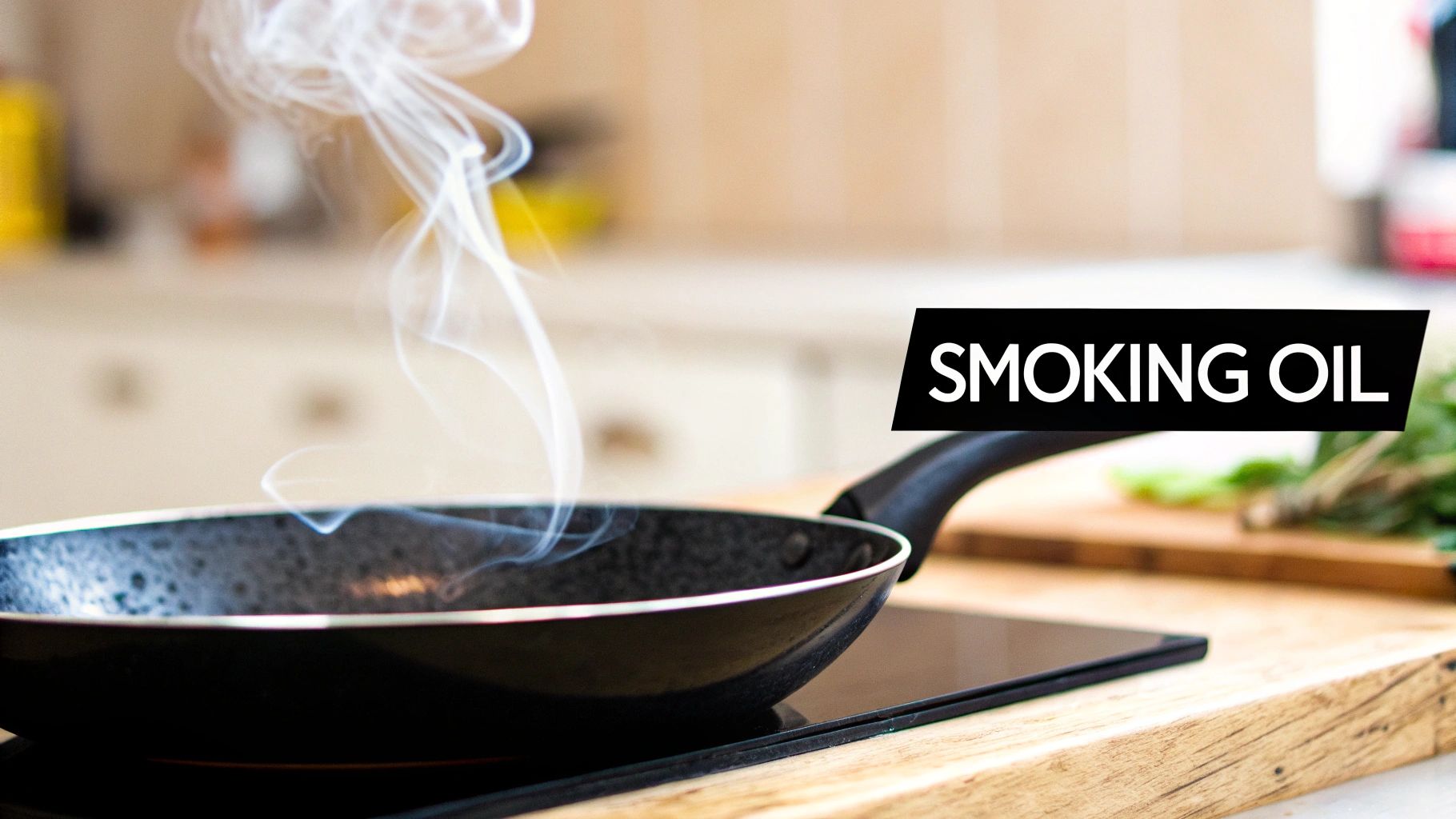
This isn’t just a minor inconvenience; it's a full-blown chemical meltdown in your skillet. At the smoke point, the very structure of the oil begins to collapse. The healthy fats and valuable nutrients you paid for start to degrade, triggering a chain reaction that harms both the flavor of your food and your health.
The Chemical Breakdown in Your Pan
When you push an oil past its smoke point, it’s not just getting hotter—it’s decomposing. This process fundamentally changes the oil, and never for the better.
The most immediate result is a foul-smelling compound called acrolein. This is the culprit behind that sharp, bitter taste that obliterates a dish. It’s an unmistakable flavor, and once it has tainted your food, there is no going back.
But a ruined dinner is only part of the story. This chemical breakdown also unleashes a flood of free radicals, unstable molecules notorious for causing cellular damage in the body. The very fats you chose for their health benefits are transformed into compounds you want to avoid at all costs.
That smoke is not just a sign of high heat. It is the visible evidence that your oil is being stripped of its nutritional value and creating harmful substances, right there in your pan.
Flavor and Nutrition Up in Smoke
Grasping what is happening on a chemical level is the secret to becoming a more intuitive, confident cook. When an oil overheats, you’re not merely scorching your food; you’re annihilating the oil’s finest qualities.
Consider a beautiful extra virgin olive oil. It is prized for its delicate antioxidants and polyphenols. If you heat it too high, those precious nutrients are the first casualties. You are literally burning away the very components that make it a healthy choice.
This knowledge empowers you to make smarter decisions. By respecting the smoke point of your oil—a task our cooking oil smoke points chart makes effortless—you achieve two critical goals at once:
- You Preserve Flavor: Your food tastes clean, vibrant, and as it should, free from that acrid, burnt aftertaste that screams of a mistake.
- You Maximize Nutrition: You keep the healthy fats and beneficial compounds intact, ensuring your meal is as nourishing as it is delicious.
When you learn to read the signals your pan is sending, you can act before disaster strikes, turning out perfectly cooked, flavorful food every single time.
How Oil Refinement Unlocks Higher Cooking Temperatures
Have you ever wondered why one bottle of avocado oil can withstand the roaring heat of a cast-iron skillet, while another begins to smoke almost instantly? This isn't magic—it's the result of a deliberate industrial process called refinement. This single factor is the most powerful determinant of whether an oil is destined for high-heat cooking or a simple salad dressing.
The journey from a raw, unrefined oil to its polished, refined counterpart is a story of purification. Unrefined oils, often labeled "virgin" or "cold-pressed," are brimming with natural compounds. Think of microscopic plant matter, enzymes, and free fatty acids. While these elements bestow the oil with its unique, rich flavor and aroma, they are also highly volatile and burn with ease, which drastically lowers the oil's smoke point.
Refinement is a multi-step process engineered to strip these "impurities" away. Methods like filtering, neutralizing, and deodorizing cleanse the oil at a molecular level. The final result is a far more uniform and stable product, and with it, a dramatically higher tolerance for heat.
The Stark Difference Between Refined and Unrefined
A simple analogy brings this to life. Think of unrefined oil as a raw log—it’s full of sap and bark, so it will ignite quickly and produce a great deal of smoke. A refined oil, by contrast, is like a piece of kiln-dried lumber. It's clean, seasoned, and burns at a much higher, more consistent temperature.
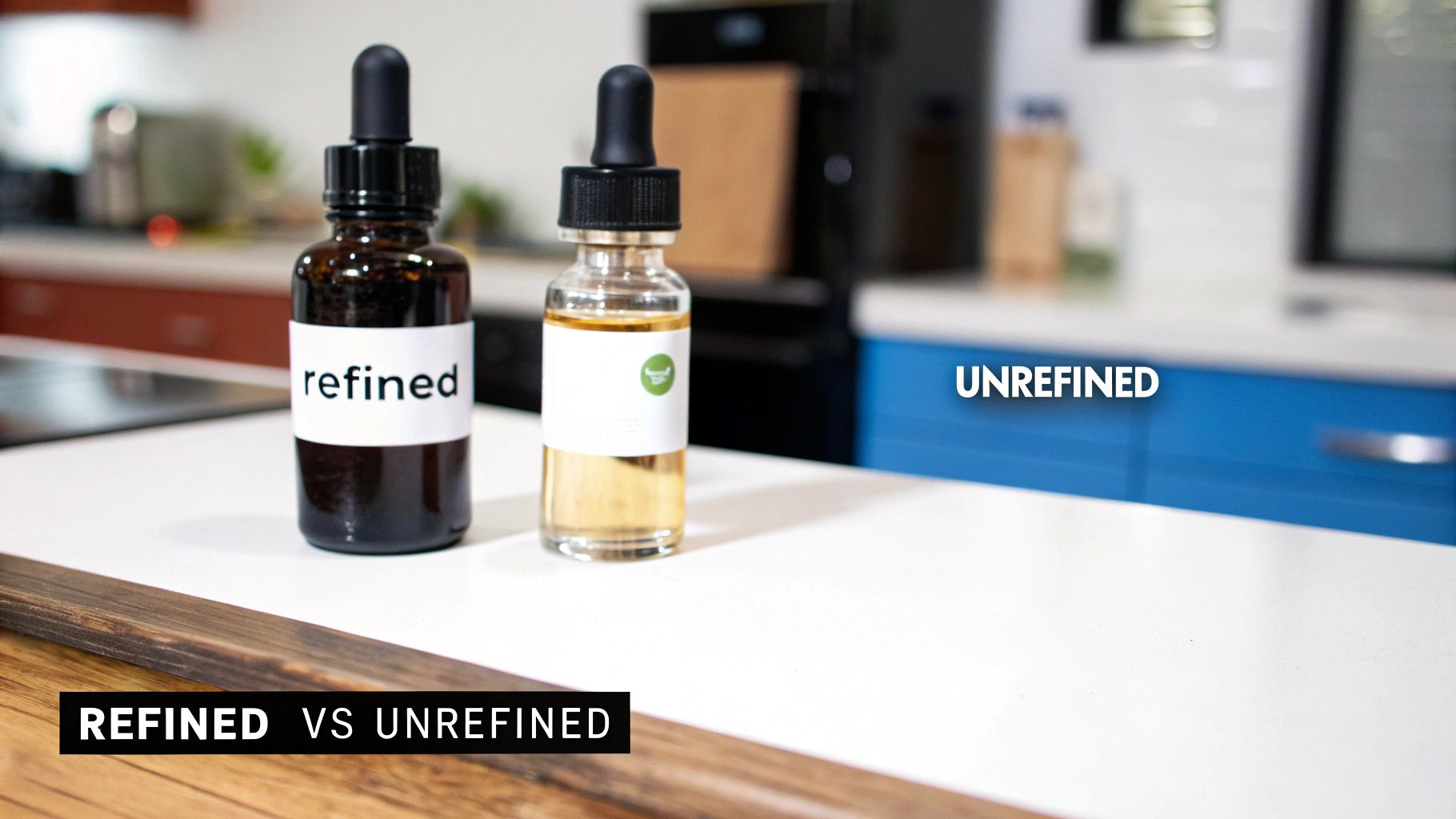
The image above provides a perfect visual illustration. Refinement often yields a lighter-colored, more neutral product. These precise refining techniques are frequently perfected in specialized laboratory setups for oil analysis to ensure consistent results.
Let's examine two real-world examples from our cooking oil smoke points chart that drive this point home with undeniable force.
- Avocado Oil: The unrefined version registers a smoke point around 375°F (190°C), suitable for a moderate sauté. But its refined counterpart is a high-heat superhero, boasting a smoke point all the way up to 520°F (270°C).
- Olive Oil: Extra virgin olive oil is unrefined, with a smoke point lingering in the 325-375°F (163-190°C) range. In contrast, "light" or refined olive oil can handle heat up to 470°F (243°C). Understanding the difference between pure and extra virgin olive oil is crucial for grabbing the right bottle for the job.
The trade-off is simple but profound: refinement sacrifices some of the natural flavor and nutrients for a higher smoke point and a longer shelf life. Unrefined oils give you that robust, authentic taste at the cost of heat tolerance.
Age and Storage: The Silent Smoke Point Killers
Remember, an oil's smoke point is not etched in stone. Over time, exposure to its enemies—light, heat, and air—causes the oil to oxidize and break down. This slow degradation steadily lowers its smoke point.
An oil that was perfect for searing a steak when you first bought it might start smoking at a much lower temperature a year later, especially if stored improperly. To keep your oils performing at their peak, always store them in a cool, dark place. This simple habit will do wonders to preserve their integrity and heat tolerance.
Matching the Right Oil to Every Cooking Method
This is where science steps out of the lab and onto your stovetop. It’s one thing to know the numbers on a smoke point chart; it’s another thing entirely to transform that knowledge into a winning strategy in your kitchen. This is how you elevate your cooking from a mere process to a true mastery of your ingredients, ensuring every dish emerges exactly as you envisioned.
The secret isn’t just about avoiding smoke. It's about creating a perfect harmony of temperature, technique, and flavor. Let's break down the best oils for the job, cross-referencing our main chart to reveal not just what to use, but precisely why it's the superior choice.
For Searing and High-Heat Roasting
When you're pursuing that deep, mahogany crust on a steak or perfectly crisped vegetables from a blazing hot oven, you need an oil that can take the punishment. This is no place for delicate fats; you need a heavyweight champion that won't break down and start smoking the moment it hits the pan.
These are your best bets for high-temperature cooking:
- Refined Avocado Oil (520°F / 270°C): This is the undisputed champion for a reason. Its astonishingly high smoke point and clean, neutral flavor mean it performs its duty flawlessly without ever interfering with the food's natural taste.
- Grapeseed Oil (420°F / 216°C): A fantastic and often more budget-friendly alternative. Grapeseed oil is light, tastes clean, and holds up beautifully under the pressure of a hot skillet. It’s perfect for achieving that coveted sear without adding any unwanted flavors.
- Ghee (485°F / 252°C): If you do want to introduce a rich, nutty flavor, ghee is an extraordinary choice. Because the milk solids have been removed, it can handle much higher temperatures than regular butter, making it ideal for pan-searing fish or chicken.
For Deep-Frying and Stir-Frying
Deep-frying and stir-frying demand an oil that is not only stable at high temperatures but also neutral and economical enough for larger quantities. The oil's mission is to transfer heat swiftly and evenly, creating that signature crispiness without a hint of burning.
Professional kitchens and savvy home cooks alike rely on a few trusted workhorses for these tasks.
- Refined Peanut Oil (450°F / 232°C): A timeless classic. Its high smoke point and faint nutty background note make it a favorite for countless Asian dishes and for frying everything from chicken to french fries.
- Canola Oil (400°F / 204°C): This is the backbone of many kitchens, both commercial and home. Canola offers an excellent smoke point and a completely neutral flavor profile at a price that is hard to beat. It’s a true all-rounder for nearly any deep-frying task.
Choosing the right oil for high heat is about more than just preventing a smoky kitchen. It’s about seizing control over the final result. A stable oil is your guarantee of a clean taste and a perfectly crisp, golden-brown texture, every single time.
For Everyday Sautéing and Pan-Frying
For the majority of your daily cooking, you aren’t pushing the temperature to its absolute limit. This is the sweet spot where you can employ oils that balance good heat tolerance with more pronounced, enjoyable flavors.
For these moderate-heat methods, a refined or "light" olive oil is a superb choice. With a smoke point around 390°F (199°C), it’s far better suited for a gentle sauté than its extra virgin cousin. For a deeper dive, our guide on using olive oil for cooking offers more detailed tips. This approach allows you to cook effectively without sacrificing all of the oil's character.
To make it even clearer, here is a quick-reference table that matches common cooking methods with the best oils for the job.
Best Oils by Cooking Technique
| Cooking Method | Ideal Temperature Range | Recommended Oils (High Smoke Point) | Oils to Avoid (Low Smoke Point) |
|---|---|---|---|
| Searing/Blackening | 400-500°F (204-260°C) | Avocado Oil, Safflower Oil, Ghee | Extra Virgin Olive Oil, Butter |
| Deep-Frying | 350-375°F (177-190°C) | Peanut Oil, Canola Oil, Vegetable Oil | Flaxseed Oil, Walnut Oil |
| Stir-Frying | 350-450°F (177-232°C) | Grapeseed Oil, Peanut Oil, Sesame Oil | Butter, Unrefined Oils |
| Roasting | 350-425°F (177-218°C) | Refined Olive Oil, Avocado Oil, Canola Oil | Extra Virgin Olive Oil, Flaxseed Oil |
| Sautéing | 325-375°F (163-190°C) | Light Olive Oil, Coconut Oil, Grapeseed Oil | Butter, Unrefined Nut Oils |
| Baking | 325-375°F (163-190°C) | Canola Oil, Vegetable Oil, Melted Butter | Toasted Sesame Oil, Strong Olive Oils |
| Finishing/Dressing | No Heat | Extra Virgin Olive Oil, Walnut Oil, Flaxseed Oil | Refined/Neutral Oils (lack flavor) |
Use this table as your guide, and you will build an intuition in the kitchen. Over time, you'll find yourself naturally reaching for the right bottle without a second thought, ensuring your cooking is always delicious and smoke-free.
How Smoke Points Shaped Global Cuisines and Markets
An oil's smoke point isn't just a number on a chart. It is a powerful, often invisible, force that has literally shaped how the world eats. This single characteristic has dictated entire culinary traditions, influenced cultural habits, and built massive, billion-dollar industries from the ground up.
In essence, how much heat an oil can handle is directly tied to its destiny, both in the kitchen and on the global market.
This powerful connection made certain fats the cornerstone of regional cooking. Consider Indian cuisine, where high-heat methods like tadka (tempering spices in hot fat) are fundamental. Ghee, with its incredible 485°F (252°C) smoke point, wasn't just a preference—it was a necessity. It allowed whole spices to toast and bloom, releasing their essential oils without instantly turning to ash.
From Mediterranean Kitchens to Global Markets
Now, contrast that with the food culture of the Mediterranean. Here, cooking evolved around gentle sautés, slow braises, and raw drizzles of flavorful extra virgin olive oil. Its lower smoke point was not seen as a weakness; it was a feature that defined a style of cooking celebrated for its fresh, nuanced flavors. To go deeper, you can explore the origins of olive oil and its rich history.
This dynamic isn't just a relic of the past; it continues to drive the modern global market for cooking oils. The explosion of the fast-food industry, for instance, created a voracious appetite for cheap, neutral-tasting oils that could withstand the punishing heat of commercial deep fryers, often for hours at a time.
An oil’s ability to handle high heat is not merely a technical specification. It is the key that unlocked culinary methods, defined regional flavor profiles, and fueled the growth of international food economies.
This commercial demand is what propelled oils like canola, soybean, and sunflower to the forefront. Refined canola oil, with a smoke point between 400°F and 475°F (204°C–246°C), became an industrial workhorse. Its high-heat stability and perceived health benefits helped it capture a huge slice of the market.
From the super-heated woks of Asia that rely on peanut oil to the deep fryers of North America filled with canola, an oil’s smoke point has always been its passport to the world’s kitchens. Seeing it this way turns a simple cooking oil smoke points chart from a dry list of temperatures into a fascinating story of culture, commerce, and taste.
The Hidden Health Dangers of Cooking Past the Smoke Point
When your cooking oil begins to smoke, it's doing far more than just making a mess of your kitchen. That acrid, hazy smoke is a blaring alarm: the oil is breaking down at a chemical level, creating compounds you definitely do not want anywhere near your food.
Pushing an oil past its smoke point turns it into a miniature factory for harmful free radicals. These are unstable, rogue molecules that can wreak havoc on your body's cells, leading to inflammation and other serious health issues. In that moment, the oil transforms from a source of nourishment into something actively working against your well-being.
The Destruction of Goodness
Even the very best oils are not immune to this destructive process. Take a high-quality extra virgin olive oil, for instance. We choose it for its magnificent flavor and its payload of healthy polyphenols and antioxidants. But when you overheat it, those delicate, beneficial compounds are annihilated. The heat essentially incinerates the very things that made the oil so good for you, leaving you with little more than damaged fat.
This is not a new discovery. The concept of a smoke point has shaped cooking techniques for centuries, from the high-heat ghee used in traditional Indian cooking to the gentle sautés common in Mediterranean kitchens. Cooks have always known, intuitively, that overheating an oil ruins not just the flavor, but the very soul of the ingredient. You can learn more about how different oils have been used throughout history at napoleon.com.
More Than Just Burnt Flavor
The real danger isn't just what you lose, but what you create. As the oil breaks down, it forms new, sinister compounds. One of the most infamous is acrolein—the very same chemical that gives burnt food its awful, bitter taste and is also found in cigarette smoke. It's a known irritant and certainly not something you want to be ingesting.
When you see smoke, you are witnessing the transformation of a healthy ingredient into a source of harmful substances. Respecting the smoke point isn't just a culinary rule—it's a fundamental health practice.
Beyond what ends up on your plate, smoking oil releases invisible compounds like Volatile Organic Compounds (VOCs) that degrade the air quality in your home. For those concerned about this, getting information on indoor air quality VOC testing can be a valuable step. After all, a great meal should nourish your body, not challenge it. To get more specific, our detailed guide explains the nuances of the olive oil smoking point and why it's so critical for both your cooking and your health.
Still Have Questions? Let's Talk Cooking Oil
Even with a great smoke point chart at your side, questions can still pop up right when you're standing over a hot pan. Let's clear up a few of the most common ones so you can cook with absolute confidence.
Can I Reuse Frying Oil? And What Happens to Its Smoke Point?
Yes, you can certainly reuse frying oil, but it has its limits. Each time you heat oil, it breaks down a little. Any tiny food particles left behind accelerate that process, causing the oil's smoke point to drop lower with every use.
A reliable rule of thumb is to reuse the oil no more than three or four times. To maximize its life, let it cool completely, then strain it through a fine-mesh sieve or cheesecloth. If you notice the oil has darkened, smells off, or foams up when heated, it's time to retire it.
What's the Healthiest Oil for High-Heat Cooking?
When you're turning up the heat, you need an oil that is both stable and loaded with good fats. For that mission, refined avocado oil is nearly impossible to beat. It possesses an incredibly high smoke point (around 520°F or 270°C), which means it won't break down and form harmful compounds.
Beyond its stability, it's rich in oleic acid, a heart-healthy monounsaturated fat. This powerful combination of high-heat resilience and an excellent nutritional profile makes it the top choice for searing, frying, and grilling.
Is It a Good Idea to Mix Different Oils Together?
As a general rule, mixing oils is not a good strategy. It's a common myth that you can raise an oil's smoke point by adding one with a higher tolerance, but it simply doesn't work that way. The smoke point of a blend is always dictated by the oil with the lowest smoke point.
For example, pouring high-smoke-point avocado oil into your delicate extra virgin olive oil won't rescue it. The mixture will begin to smoke the second the olive oil reaches its own, much lower, smoke point.
Why Does My Expensive Olive Oil Smoke So Easily?
This is a fantastic and very common question. The answer isn't about quality; it's about the oil's nature. That pricey, delicious extra virgin olive oil (EVOO) is unrefined, and the very things that give it that incredible flavor are also what make it smoke so quickly.
All those natural flavor compounds and free fatty acids that create the peppery, fruity notes we adore simply cannot withstand intense heat. Refined or "light" olive oil has had those delicate compounds stripped away, which gives it a much higher smoke point but a blander, more neutral flavor. So, your good stuff isn't failing you—it's just meant for finishing, not frying.
At Learn Olive Oil, we believe understanding these nuances can turn cooking from a chore into an art. Ready to discover the rich world of premium oils, from tasting notes to health benefits? Explore the World of Premium Olive Oil and find your next favorite bottle.
 Learn Olive Oil
Leave a comment