Here is the lie that has likely cost you years of delicious food: you cannot, under any circumstances, cook with extra virgin olive oil.
This single, stubborn piece of misinformation is the reason beautiful, flavor-packed bottles are timidly saved for salads while lesser oils get all the action on the stove. But the truth—the science-backed, chef-approved truth—is that the actual olive oil smoke temp is far higher, and vastly more versatile, than you have ever been led to believe.
Debunking the Great Olive Oil Smoke Screen
You’ve heard it whispered in home kitchens. You've seen it repeated on cooking shows. It's an insidious myth that has pushed one of the world's most ancient and healthful fats into a supporting role, never the star of a hot pan. This entire idea is built on a foundation of rumor, not science. It’s time to finally clear the air.
The fear is that a little heat will instantly scorch your expensive extra virgin olive oil (EVOO), torching your food and filling your kitchen with a plume of bitter smoke. This has driven generations of well-meaning cooks to reach for highly refined vegetable oils, believing they were making the safer, more practical choice.
But what if that choice was based on a complete and utter misunderstanding?
The Real Numbers That Shatter the Myth
Let’s cut through the noise and look at the facts. The smoke point of a genuine extra virgin olive oil typically falls between 356°F and 419°F (180°C to 215°C). Some exceptional oils can climb even higher.
That temperature range is more than enough for the vast majority of your daily cooking—from sautéing and roasting to even shallow frying.
The idea that EVOO is some delicate, heat-sensitive flower is one of the biggest fallacies in modern cooking. A fresh, high-quality extra virgin olive oil is incredibly stable, thanks to the army of protective antioxidants it contains.
That stability is the secret. While some highly refined seed oils might boast a higher smoke point on a chart, they've been stripped of the very natural compounds that prevent them from breaking down under heat.
In this guide, we are going to dismantle this smoke screen, piece by piece. We will show you not only why you can cook with EVOO, but why you probably should. We'll also tackle several other pervasive olive oil myths that are holding your cooking back.
What Smoke Point Actually Means for Your Food
https://www.youtube.com/embed/atgZekV_oPo
The term "smoke point" gets thrown around constantly, but what does it really mean for the food on your plate? It’s not just a number on a bottle; think of it as the temperature where your cooking oil stops helping you and starts actively harming your meal.
Picture the oil in your pan as a stable, well-built structure. As it heats up, it beautifully transfers that energy to your food, creating a perfect sear or a golden-brown crust. But once you push it past its smoke point, that structure literally begins to break down.
This isn't just about a bit of smoke in your kitchen. When an oil hits its olive oil smoke temp, its healthy fats begin to degrade, creating bitter-tasting compounds and unhealthy free radicals. The very oil you chose for its vibrant flavor and health benefits suddenly becomes something that makes your food taste acrid and awful.
The Science of Smoke
That first little wisp of bluish smoke is a chemical distress signal. At that moment, the oil's fatty acids are breaking away from their glycerol backbone, a process that creates a harsh compound called acrolein. That's the unmistakable cause of the sharp, burnt smell that stings your eyes.
It is a clear warning from your pan that you've pushed the heat too far. The complex, peppery notes of a beautiful extra virgin olive oil have been incinerated, and its potent, health-boosting antioxidants have been destroyed right along with them.
The smoke point isn’t a finish line you should race toward; it’s a bright red warning light. Respecting it means preserving the flavor, nutrition, and integrity of both the oil and the food you’re cooking.
Why It’s More Than Just a Temperature
Developing a feel for this process is what separates good cooks from great ones. It explains why a high-quality oil not only tastes better but performs better under heat than a cheap, highly refined one. Your goal should never be to reach the smoke point, but to cook confidently and effectively well below it.
This is especially critical when you start comparing different types of olive oil. For a deeper look at how this works in practice, check out our guide on using olive oil for high-heat cooking for tips on choosing the right oil every time. When you understand an oil's limits, you can control the heat, protect its unique character, and make your food taste absolutely incredible.
Why All Olive Oils Are Not Created Equal
When you walk down the cooking oil aisle, it's easy to get overwhelmed. You see labels like “Extra Virgin,” “Virgin,” “Light,” and just plain “Olive Oil.” It’s tempting to believe they’re all basically the same thing with different price tags. That couldn’t be further from the truth.
The journey an olive takes from the tree to the bottle fundamentally changes the oil's character, flavor, and, most importantly, how it behaves in a hot pan. This isn't just about taste—it's about the oil's very integrity.
The Gold Standard: Extra Virgin Olive Oil
Think of Extra Virgin Olive Oil (EVOO) as fresh-squeezed juice from olives. It’s made using a simple mechanical process called cold-pressing, which extracts the oil without any chemicals or intense heat. This gentle approach is the key to its quality.
Because it’s so minimally processed, EVOO holds onto its most precious cargo: polyphenols. These are potent antioxidants that act like natural bodyguards, protecting the oil from breaking down under heat. A top-notch EVOO, with its low free fatty acid content and high antioxidant count, is an incredibly stable cooking oil precisely because its natural defenses are still intact.
A higher smoke point does not automatically mean a better or safer oil for cooking. It often means the oil has been aggressively refined, sacrificing its natural protective compounds and nutritional value for a number on a chart.
The Compromise: Refined Olive Oil
At the other end of the spectrum are oils labeled "Light" or simply "Olive Oil." These are refined products. They often begin as lower-quality oils with defects, which are then stripped away using industrial processes like high heat and chemical solvents.
This aggressive refining does two things: it makes the oil taste neutral, and it jacks up the smoke point. But there's a serious trade-off. The very polyphenols and antioxidants that give EVOO its stability and health benefits are obliterated in the process. You're left with an oil that resists smoking but has lost the flavor, character, and protective qualities of its unrefined cousin. The high olive oil smoke temp of refined oil is a manufactured trait, not a sign of quality.
The global olive oil market is a massive $19.4 billion industry, and much of that is driven by the demand for healthy, versatile cooking fats. While refined oil's smoke point can hit 446°F (230°C), a good, robust extra virgin olive oil sits comfortably between 356°F and 419°F (180°C to 215°C)—a range that covers almost any home cooking you can imagine. Understanding the trade-off between purity and processing is key to grasping the fundamental differences in olive oil grades.
The Hidden Factors That Alter an Oil's Smoke Point
That smoke point you see printed on a bottle of olive oil? It's not set in stone. Think of it less as a fixed number and more as a starting line—the oil's absolute best-case scenario.
From the moment that oil is pressed, a host of invisible forces begin to chip away at that number. Understanding what’s going on inside the bottle is the real secret to using olive oil well. It’s what separates a beautiful sear from a kitchen full of bitter smoke.
Free Fatty Acids: The First Domino to Fall
At its core, an oil's stability comes down to something called its Free Fatty Acid (FFA) level. In a fresh, high-quality extra virgin olive oil, the FFA is incredibly low—usually below 0.8%. This indicates a healthy, intact chemical structure.
But as an oil ages or is handled poorly, those fatty acid chains start to break apart. The more "free" fatty acids you have floating around, the more unstable the oil becomes, and the sooner it will start smoking when you heat it.
Age and Exposure: The Enemies of Freshness
Time and exposure are the oil's greatest adversaries. An old bottle of olive oil that’s been collecting dust in your cabinet for a year simply isn’t the same product you first brought home. Its smoke point has dropped, its flavor has faded, and its best days are long behind it.
It’s not just about the calendar, though. Every single time you open that bottle, you’re letting in its two mortal enemies: light and oxygen. These two kickstart oxidation, a destructive process that breaks down the very things that make olive oil so stable.
This is precisely why proper storage isn’t optional. An oil kept in a cool, dark place will hold onto its high smoke point for much, much longer than one left out on the counter next to a sunny window.
The Lasting Scars of Heat
Ever reuse your cooking oil? Most of us do. But it's vital to know that every time you heat oil, you are fundamentally changing it. Each heating cycle degrades the oil on a molecular level, permanently lowering its smoke point for the next time you cook with it.
So, that olive oil smoke temp isn't just a number on a label—it's something you have direct control over.
Here’s what really matters:
- Freshness is everything. The younger the oil, the stronger its structure and the higher its smoke point.
- Quality is resilience. A top-notch EVOO packed with protective polyphenols is naturally more durable than a refined oil that's been stripped of its defenses.
- Storage is non-negotiable. Keep your oil away from heat, light, and air to keep it in fighting shape.
When you understand what is olive oil made of, you can see why an oil rich in natural antioxidants is just better equipped for the job. Protect those qualities, and your oil will perform beautifully every time.
Cooking With Confidence: A Practical Guide
Alright, let's move from theory to the stovetop. Knowing the numbers is one thing, but actually using that knowledge to create better food is where the real magic happens. Think of this as your playbook for turning the science of olive oil smoke temp into delicious, perfectly cooked meals—every single time.
Forget about that nagging fear of a smoking pan. With a few simple visual cues, you can become the master of your heat and get the absolute best out of each type of olive oil. This is all about replacing guesswork with confidence.
Choosing Your Oil For The Task
The first step is simply matching the right oil to the right job. Different cooking methods demand different levels of heat, so your choice of olive oil should reflect that. It’s wonderfully straightforward.
- Sautéing and Pan-Searing (Medium-High Heat): A robust Extra Virgin Olive Oil is your best friend here. Its high polyphenol count provides impressive stability, making it perfect for cooking fish, chicken, and vegetables without breaking down.
- Roasting (Up to 400°F): A quality EVOO is also an excellent choice for roasting. It beautifully coats your vegetables or meats, creating a delicious crust without any risk of smoking.
- Dressings and Finishing: This is where your most delicate, flavorful EVOOs truly shine. To preserve their complex aromas and tasting notes, you’ll want to drizzle them on after the cooking is done.
Reading The Signs Before The Smoke
You don't need a fancy thermometer to know when your oil is ready. A hot pan speaks its own language, and learning to read it is simpler than you think. Long before an oil ever smokes, it gives you a clear signal that it has hit the perfect temperature for cooking.
Look for the shimmer.
Pour your oil into a preheating pan and simply watch it. As it warms up, its viscosity changes, and you’ll see faint, shimmering waves ripple across the surface. That is the sweet spot. It is the ideal moment to add your ingredients. If you see even a single wisp of smoke, you’ve pushed it just a bit too far.
Of course, the key to preserving your oil's stability and smoke point lies in how you care for it before it even hits the pan.
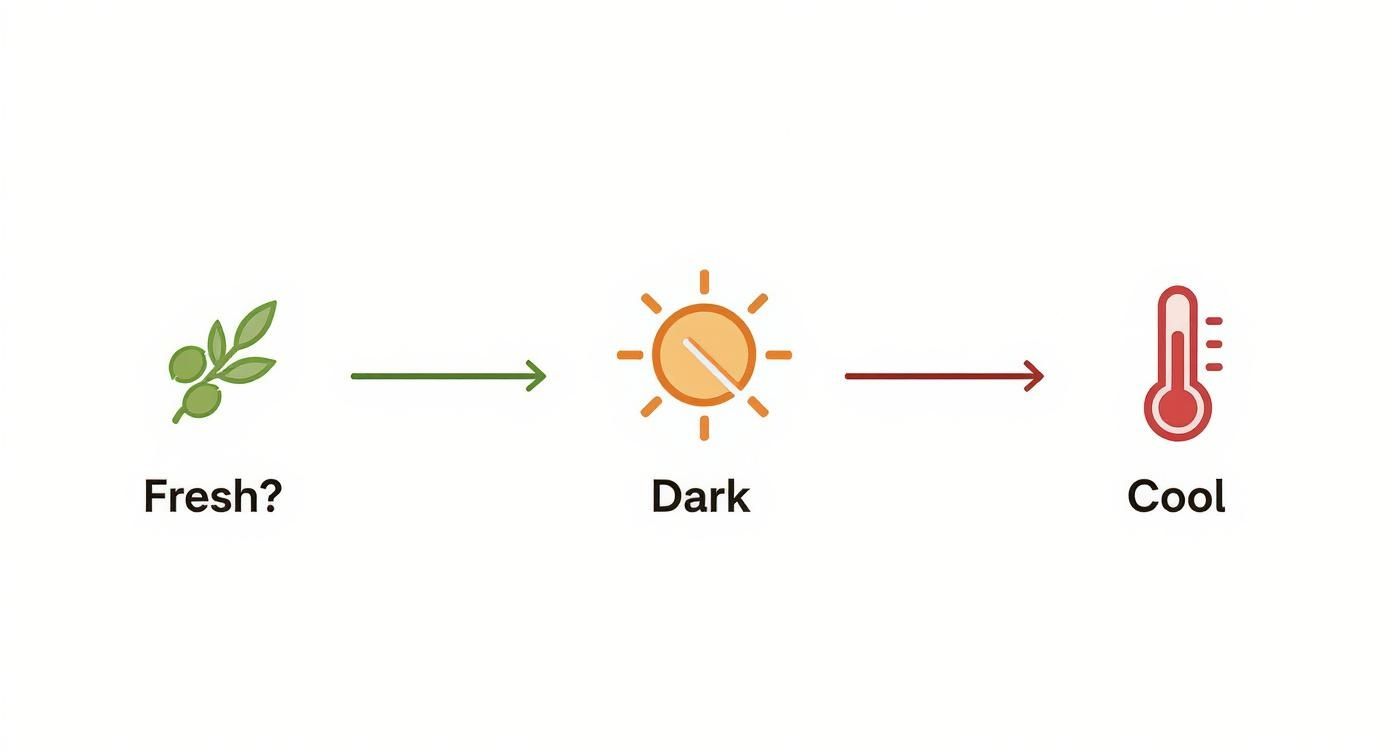
As this shows, protecting your oil from its two biggest enemies—light and heat—is absolutely crucial for maintaining both its high smoke point and its incredible flavor.
The shimmer, not the smoke, is the sign of a perfectly heated pan. Catching this visual cue is the single most important skill for cooking with olive oil like a professional.
In fact, studies have confirmed that extra virgin olive oil’s smoke point is generally higher than other common fats like butter (350°F) and unrefined sunflower oil (320°F). This makes it a superior choice for most everyday stovetop tasks. This natural resilience is a key reason for its popularity in Mediterranean cooking for centuries.
Olive Oil vs Other Cooking Fats Smoke Points
To put this all into perspective, let's see how olive oil stacks up against other common fats you might have in your kitchen. This comparison can help you make smarter choices based on what you're cooking.
| Oil/Fat Type | Smoke Point (°F) | Best For |
|---|---|---|
| Extra Virgin Olive Oil | 350-410°F | Sautéing, roasting, dressings |
| Virgin Olive Oil | 390°F | General-purpose cooking, baking |
| Refined Olive Oil | 465°F | High-heat searing, deep frying |
| Unrefined Coconut Oil | 350°F | Sautéing, baking |
| Butter | 350°F | Baking, low-heat sautéing |
| Avocado Oil (Refined) | 520°F | High-heat searing, frying |
As you can see, the idea that EVOO is a "low-heat only" oil is a complete myth. A good quality extra virgin olive oil holds its own for the vast majority of home cooking applications.
Having the right equipment makes a big difference, too. Investing in quality cooking sets, including pots and pans that distribute heat evenly will help prevent hot spots that can burn your oil.
For a deeper dive into techniques, check out our complete guide on how to cook with olive oil and start putting these tips into practice tonight.
Your Olive Oil Smoke Point Questions Answered
It's tough to shake off old kitchen myths. For years, we've been told to be wary of heating olive oil, so it's only natural to have a few lingering questions about its actual smoke point. Let's clear the air and get to the science-backed truth so you can cook with total confidence.
Think of this as your go-to guide. We’ve gathered the most common questions we hear from home cooks and are here to give you simple, direct answers.
Is It Unhealthy to Heat Olive Oil Past Its Smoke Point?
Yes, absolutely. When any oil is heated past its smoke point, it’s doing more than just burning—it's chemically breaking down. This process, known as thermal decomposition, is bad news for your food and your health.
This breakdown unleashes a wave of harmful compounds, including free radicals and an unpleasant substance called acrolein. Acrolein is the culprit behind that sharp, bitter smell and taste of burnt food. It's a clear signal that your healthy fat has morphed into something that will ruin your dish.
Pushing an oil past its smoke point doesn’t just create bad flavors; it destroys the very things that make it good for you. The powerful antioxidants and beneficial polyphenols in extra virgin olive oil are delicate and simply can't survive that kind of extreme heat.
If you see wisps of smoke coming from your pan, treat it like a fire alarm. The best thing to do is lower the heat, carefully wipe the pan clean (use tongs to hold a paper towel), and start fresh with new oil. Your body and your taste buds will thank you for it.
Can I Deep-Fry with Olive Oil?
You technically can, but it's rarely the best tool for the job. Proper deep-frying requires a consistent oil temperature, typically between 350°F and 375°F. A refined or ‘light’ olive oil has a smoke point high enough to manage this.
But here’s the thing: using a beautiful, flavorful extra virgin olive oil for deep-frying is a huge waste. All those nuanced, peppery, or grassy notes you paid for will be obliterated by the prolonged high heat. You're effectively turning a premium finishing oil into a very expensive, neutral frying fat.
For deep-frying, you’re much better off with more economical, neutral-tasting oils that have high smoke points. Canola, peanut, or even a basic refined olive oil are better suited for this task, letting you save your best EVOO for moments where its flavor can really be the star.
Does the Color of Olive Oil Affect Its Smoke Point?
This is one of the biggest and most stubborn myths out there. The color of olive oil—whether it's a bright, grassy green or a soft, buttery gold—has zero connection to its smoke point or its quality.
An oil's color simply tells you two things: how ripe the olives were at harvest and how much chlorophyll they contained. Green oils often come from younger, less ripe olives, while golden hues come from more mature ones. Neither is inherently better; they just offer different flavor experiences.
The real factors determining an oil’s stability and high smoke point are completely invisible. They are:
- Low Free Fatty Acidity: This is a sign of healthy, undamaged olives and high-quality processing.
- High Polyphenol Content: These amazing antioxidants act as natural bodyguards, protecting the oil from heat damage.
These two traits are the hallmarks of a fresh, well-made extra virgin olive oil. So, don't judge an oil by its color. Instead, look for a recent harvest date and quality certifications on the bottle—that's how you find an oil that will perform beautifully in your kitchen.
At Learn Olive Oil, we believe that understanding the simple truths about this amazing ingredient empowers you to cook better and eat healthier. We're dedicated to helping you explore the world of premium olive oil, from the grove to your table. Discover the World of Premium Olive Oil and elevate your cooking today.

 Learn Olive Oil
Leave a comment