You’ve heard the whispers, haven’t you? That extra virgin olive oil is good for you. But do you know the secret hiding inside the bottle? It’s a tiny, astonishingly powerful molecule called hydroxytyrosol.
Think of it as the unsung hero of the olive, a microscopic guardian working tirelessly to defend your body. This guide is here to pull back the curtain on this remarkable antioxidant. You’ll discover why hunting down an olive oil with the highest hydroxytyrosol content isn’t just about buying a better condiment—it's about making a profound investment in your health.
Why High-Hydroxytyrosol Olive Oil Is a Health Revelation
Picture this: your body is under constant attack from rogue molecules called free radicals. They cause a kind of internal rust known as oxidative stress—a primary driver of aging and countless chronic health problems. Hydroxytyrosol is your cellular bodyguard, an elite protector that disarms these threats with breathtaking efficiency.
But calling it just another antioxidant is a massive understatement. It is, in fact, one of the most potent ever discovered in nature, effortlessly outclassing the famous catechins in green tea and even CoQ10.
Raw power, however, is only half the story. What truly sets hydroxytyrosol apart is its phenomenal bioavailability. This is a scientific way of saying your body absorbs it and puts it to work almost instantly. It’s this critical advantage that elevates an oil from a simple kitchen staple into a true, health-promoting elixir.
To grasp what makes hydroxytyrosol so extraordinary, let’s examine its unique powers.
Hydroxytyrosol: A Profile in Potency
| Attribute | What This Means for Your Health |
|---|---|
| Superior Antioxidant | A master at neutralizing free radicals, shielding your cells, fats, and even your precious DNA from relentless damage. |
| High Bioavailability | Your body absorbs it with incredible speed and efficiency, ensuring you receive the maximum benefit from every single drop. |
| Anti-Inflammatory | It helps extinguish the low-level, chronic inflammation that smolders at the root of so many modern diseases. |
| Cardiovascular Protector | It specifically defends your LDL ("bad") cholesterol from oxidation—a crucial first step in keeping your arteries clear and healthy. |
| Crosses Blood-Brain Barrier | It possesses the rare ability to enter the brain, offering direct antioxidant protection to your body’s command center. |
This remarkable combination of traits transforms it into a guardian for your most vital systems.
The Guardian of Your Health
Hydroxytyrosol delivers its protective magic with a devastating one-two punch:
- As an Antioxidant: It directly intercepts free radicals, neutralizing them before they can ignite a chain reaction of cellular damage.
- As an Anti-inflammatory Agent: It soothes the smoldering, low-grade inflammation that can silently undermine your health for years.
Perhaps its most celebrated role is protecting LDL cholesterol from oxidation. When LDL particles are damaged, they begin to clog your arteries, leading to atherosclerosis (the hardening of the arteries). Hydroxytyrosol acts like a shield, preventing that initial damage from ever occurring.
This isn't just a hopeful theory; it's a scientific fact. The European Food Safety Authority (EFSA) has issued a formal health claim, confirming that a daily intake of 5 mg of hydroxytyrosol and its derivatives helps protect your blood lipids from the ravages of oxidative stress.
Beyond heart health, hydroxytyrosol has the rare gift of crossing the blood-brain barrier, delivering its protective power directly to your brain cells. This is a key reason why the benefits of extra virgin olive oil are so profoundly far-reaching. When you seek out an olive oil rich in this compound, you’re not just buying a condiment—you’re choosing a functional food, designed by nature itself to protect and preserve your well-being.
Where Nature Forges the Most Potent Olive Oils
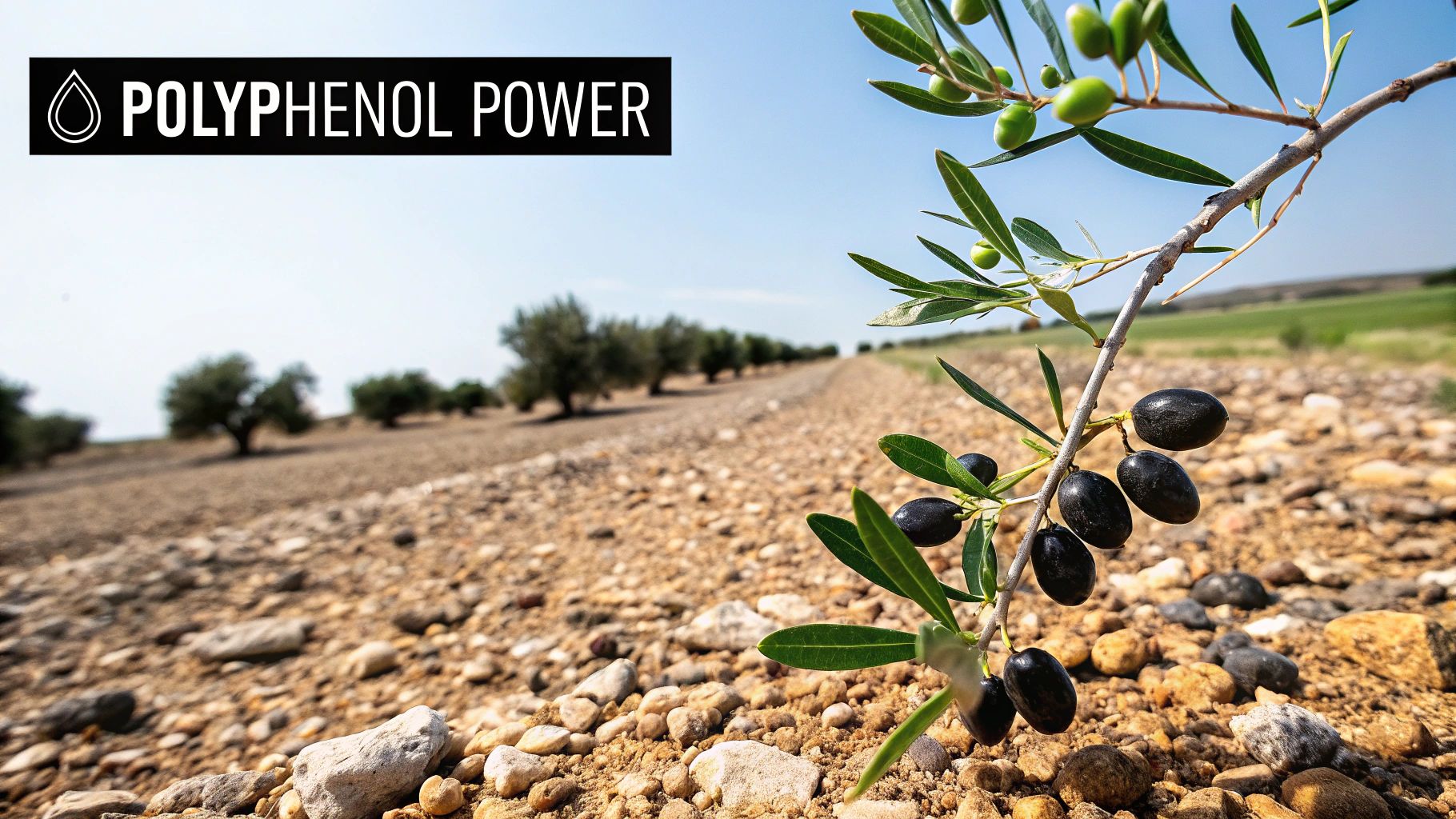
The world’s most powerful olive oils are not engineered in a sterile lab. They are forged in nature’s crucible. The hydroxytyrosol that delivers such stunning health benefits is not an additive; it's a gift from the olive tree itself. Think of it as the tree's personal defense system, created under specific—and often stressful—conditions. It’s a perfect illustration of how true strength is born from adversity.
Imagine the difference between a tiny, wild blueberry, bursting with intense flavor, and its larger, cultivated cousin. Both are good, of course. But the wild one had to fight harder to survive, and in that fight, it supercharged itself with protective compounds. The very same principle applies to olives.
The Genetic Champions of Hydroxytyrosol
Just as some racehorses are bred for speed, certain olive cultivars are genetically wired to be polyphenol powerhouses. These varieties consistently produce oils with that robust, peppery kick that screams high hydroxytyrosol content. They are the titans of the olive world.
Among the most celebrated are:
- Koroneiki: A small but mighty Greek olive, legendary for producing intensely grassy oils with a remarkably high polyphenol count.
- Picual: The undisputed star of Spain, prized for its stability and characteristically bitter notes—a direct result of its rich phenolic profile.
- Nocellara del Belice: A treasured Sicilian varietal that yields an exceptionally vibrant, green oil with a complex flavor and consistently high antioxidant levels.
These cultivars are nature’s blueprint for producing an olive oil with the highest hydroxytyrosol content.
For instance, some producers achieve astonishing results by focusing exclusively on these elite varietals. One of the highest hydroxytyrosol contents ever reported in a commercial oil comes from Papa Vince Extra Virgin Olive Oil, which clocks in at a staggering 15 mg/kg of hydroxytyrosol. That's three times the European Commission's benchmark for making a health claim. Its mind-boggling levels of oleacein and oleocanthal are credited to its exclusive use of the Nocellara del Belice olive. You can dive into the lab reports and the science behind this high-potency oil to see the proof for yourself.
How Stress Creates Superiority
Beyond genetics, the environment plays a starring role. An olive tree's struggle is your gain. When a tree faces environmental stress—an arid climate, rocky soil, relentless sun—it shifts into survival mode. It dramatically ramps up production of protective polyphenols, including hydroxytyrosol, to defend its precious fruit.
It is one of agriculture’s most beautiful paradoxes: the more difficult the growing conditions, the more resilient and nutritionally potent the olive becomes. This is nature’s way of ensuring the survival of its seeds, and in turn, how we get the most powerful oils on earth.
Once you understand this, your perspective changes. You begin to see a bottle of high-polyphenol olive oil not as a mere product, but as the culmination of a specific place, a specific tree, and a specific struggle. It’s an appreciation for an ancient art where true quality is a story written by sun, soil, and survival.
The Secrets of Processing for Maximum Potency
The journey from a sun-drenched grove to a bottle of high-hydroxytyrosol oil is a delicate, high-stakes race against the clock. A single misstep can shatter the very molecules we seek to capture. Real potency is not just about the olive variety; it's about the producer's obsessive skill and profound sense of urgency. Every decision, every hour, matters.
Think of it like trying to preserve a rare, fragile orchid. You wouldn’t leave it wilting in the sun or handle it roughly. Olives destined for high-potency oil demand the same fanatical care from the very second they leave the branch.
The Critical Role of an Early Harvest
You’ve likely seen "early harvest" on premium olive oil labels, and I can tell you it is far more than marketing fluff. This is the single most important decision for maximizing polyphenol content. When olives are still young and green, they are absolutely bursting with defensive compounds, including the building blocks of hydroxytyrosol.
As an olive ripens, turning from green to purplish-black, the quantity of oil it contains goes up, but its polyphenol levels plummet. Producers making olive oil with the highest hydroxytyrosol content know this trade-off intimately. They deliberately sacrifice a larger yield for superior quality, harvesting their fruit weeks before most other farms even begin. This commitment is what gives the oil its characteristic sharp, peppery flavor—a vibrant, tell-tale sign of its antioxidant might.
That peppery sensation you feel at the back of your throat? That’s a direct chemical interaction with a polyphenol called oleocanthal. It is not a defect; it is a vivid, physical confirmation of the oil's freshness and power.
Why "Cold-Pressed" is Non-Negotiable
Once the olives are picked, the clock is ticking. They must be milled within hours, not days. This is where the term "cold-pressed" becomes an ironclad rule. Hydroxytyrosol and its polyphenol cousins are incredibly sensitive to heat. Any extraction method that allows the temperature to creep above 27°C (around 80°F) will begin to destroy these priceless molecules.
Top-tier, modern extraction facilities are engineered to keep the olive paste cool from start to finish. This gentle, meticulous approach ensures the oil retains its full nutritional integrity. We explore how producers master this in our guide to modern olive oil extraction methods. This step is what truly separates authentic extra virgin oils from refined products that have been stripped of their life force.
Filtration and Final Protection
But the journey isn’t over after pressing. Freshly milled oil is cloudy with tiny particles of olive fruit and water, which can trigger oxidation and spoil the oil quickly. While some enjoy the rustic charm of "unfiltered" oil, a light filtration actually preserves the precious polyphenols and extends the oil's shelf life.
Finally, the oil’s last line of defense is its container. You will always find high-potency oils packaged in dark, opaque glass or tins. This isn't for aesthetics; it’s a crucial shield. Light is a sworn enemy of olive oil, causing it to degrade with shocking speed. A clear bottle sitting on a brightly lit grocery store shelf is a screaming red flag—a sign that the oil has likely lost much of its power before you even take it home.
Finding Authentic High-Potency Oils: How to Read the Label
Let’s be honest: the olive oil aisle is designed to confuse you. You’re confronted with a sea of green glass, shiny tins, and feel-good marketing slogans. But hidden in that chaos are the truly potent, high-hydroxytyrosol oils you are seeking. This section is your decoder ring. It will teach you to cut through the noise and spot the real deal.
Once you know what to look for, you will shift from a hopeful buyer to a confident one. It’s about learning to ignore the flashy front label and instead hunting for the quiet clues on the back that signal true quality. These are the markers that separate genuine liquid gold from a simple kitchen commodity.
The Telltale Signs of a Potent Oil
When you pick up a bottle, your mission is to find three critical pieces of information. Think of these as the non-negotiable signs that a producer is serious about preserving every last drop of polyphenol power.
-
A Specific Harvest Date: This is not the "best by" date. The harvest date tells you exactly when the olives were picked, and when it comes to potency, freshness is everything. Look for a date within the last 12-18 months. The closer you are to that date, the more powerful the oil will be.
-
Named Olive Cultivar: Vague terms like "Product of Italy" or "European Blend" are a giant red flag. A producer who takes pride in their oil will tell you exactly which olive varietal was used, like Koroneiki, Picual, or Nocellara del Belice. This specificity demonstrates a profound commitment to quality, from the grove to the bottle.
-
Dark, Protective Packaging: As we’ve discovered, light is the enemy of polyphenols. A truly high-potency oil will always be sold in a dark glass bottle or an opaque tin. If you see an olive oil in a clear bottle, you can assume its precious compounds have already been degraded.
Using just these three checks will allow you to instantly filter out the vast majority of low-quality oils on the shelf.
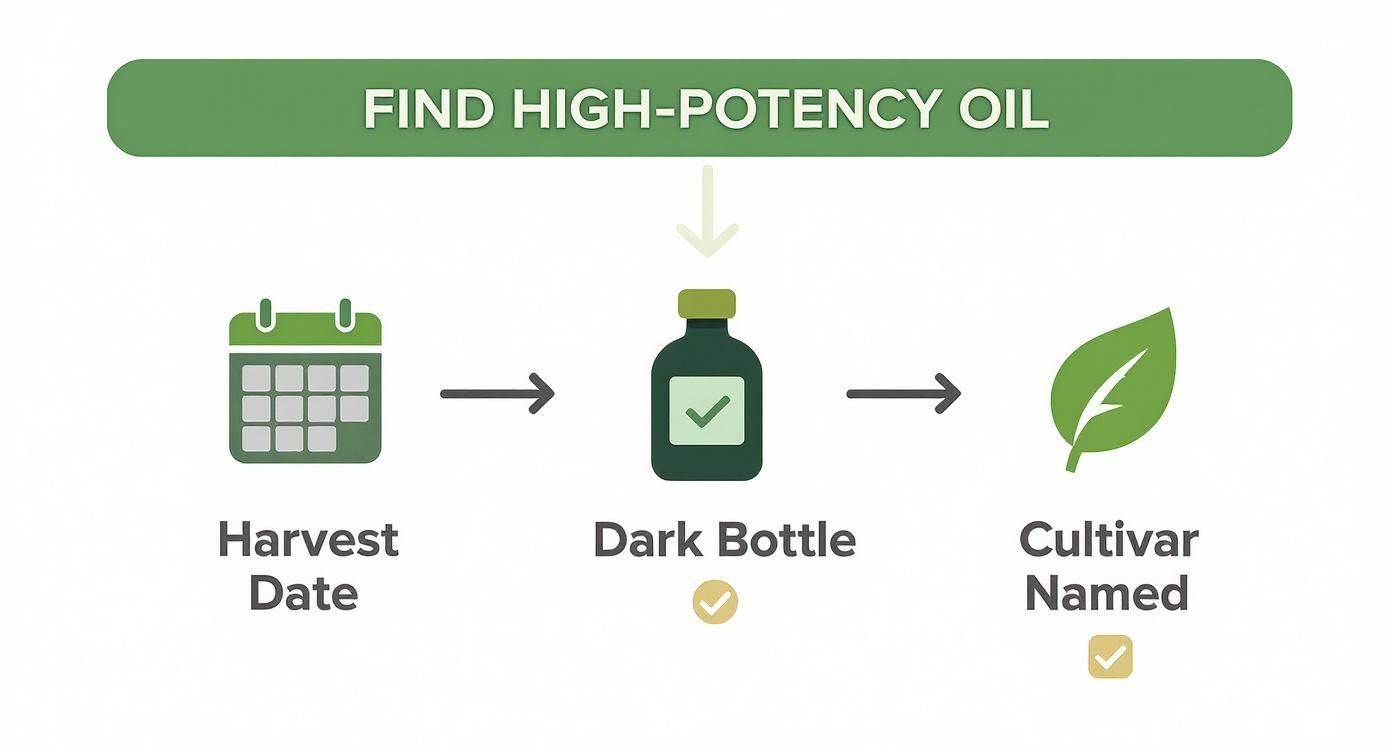
This visual guide breaks down the three fundamental checks—harvest date, bottle type, and named cultivar—that are your first line of defense in identifying a superior oil.
Verifying the Potency: From Health Claims to Lab Reports
Beyond those initial checks, there are two other ways to get undeniable proof of an oil’s hydroxytyrosol content.
The first is the EU Health Claim. Under EU Regulation 432/2012, oils containing at least 5 mg of hydroxytyrosol and its derivatives per 20g serving are legally permitted to state on their label that they "contribute to the protection of blood lipids from oxidative stress." If you spot this claim, you have found a verified, therapeutically potent oil. To get a better handle on what all the different terms mean, our guide to the complexities of olive oil labeling is an invaluable resource.
The ultimate proof, however, is a Certificate of Analysis (CoA). This is a third-party lab report that reveals the exact polyphenol and hydroxytyrosol numbers for that specific batch of oil. The best producers are immensely proud of their results and often make these reports available right on their websites. If you don't see one, do not be afraid to ask for it. This level of transparency is the final, definitive sign you’ve found an olive oil with the highest hydroxytyrosol content.
Where to Find the World's Highest Hydroxytyrosol Oils
The entire Mediterranean is famous for its liquid gold, but when it comes to hydroxytyrosol, some regions are in a league of their own. These are the hotspots where a perfect storm of genetics, tradition, and terroir forges olive oils with staggering potency. We're not just talking about a country, but specific, sun-scorched landscapes that push olive trees to their absolute limit.
Imagine a place so arid and challenging that the trees must fight for every drop of water. That struggle is the secret ingredient. To protect themselves in these harsh conditions, the olives produce a huge amount of protective polyphenols, and the result is an oil with unparalleled strength.
Morocco: The New Frontier of Potency
One of the most exciting places for high-potency oil right now is Morocco. The arid, sun-drenched foothills of the Atlas Mountains create intense environmental stress, which in turn forces the olive trees to produce some of the highest hydroxytyrosol levels ever recorded. It's nature's perfect recipe for turning hardship into liquid gold.
Moroccan extra virgin olive oils have been making waves for their astonishing polyphenol counts. Some specially crafted oils, like Gundry MD Polyphenol-Rich Olive Oil, have reported hydroxytyrosol levels hitting 561 to 612 mg/kg. That's nearly 30 times more hydroxytyrosol than you'd find in a typical supermarket oil, which often contains just 7 to 20 mg/kg. Those tough growing conditions are directly responsible for that incredible antioxidant boost. For more on these remarkable Moroccan oils, you can check out the rundown on bhooc.com.
The Mediterranean Champions: Spain and Greece
Back in the traditional heartland of olive oil, two countries remain undisputed champions.
- Andalusia, Spain: This vast, sun-baked region is the kingdom of the robust Picual olive. Known for its incredible stability and distinctively bitter notes, the Picual is a true polyphenol powerhouse, consistently producing oils that are both potent and built to last.
- Greece: From the ancient groves of the Peloponnese peninsula comes the revered Koroneiki olive. It may be a small olive, but it's mighty, yielding an intensely grassy and peppery oil celebrated for its exceptionally high antioxidant profile.
These regions, along with certain terroirs in Italy, really form the core of the world's high-polyphenol production. Growers here have spent generations mastering the art of turning environmental stress into nutritional gold. If you want to dive deeper into the world's most potent oils, you might enjoy our guide on olive oil with the highest polyphenols.
Protecting Your Investment in Liquid Gold
So you’ve done the hard work. You’ve found an exceptional product—an olive oil with the highest hydroxytyrosol content you can find. Wonderful. Now, how do you make sure that investment pays off?
Hydroxytyrosol may be an antioxidant titan, but it is also surprisingly fragile. It has three mortal enemies: light, heat, and air.
It helps to think of your high-potency oil as a premium, living ingredient. The absolute worst thing you can do is store it next to your stove. That constant, gentle warmth slowly but surely dismantles the very compounds you paid a premium for.
A cool, dark cupboard or pantry is its ideal home—a sanctuary where its chemical integrity remains uncompromised.
And please, never pour that beautiful oil into a clear glass cruet to display on the counter. While they look lovely, those bottles are a death sentence for polyphenols, inviting damaging light to wreak havoc. The original dark glass or tin it came in is its best defense. Keep it sealed tightly in its fortress.
Preserving Potency in the Kitchen
There is endless debate about cooking with high-polyphenol EVOO, but the answer is refreshingly simple. If you want the full therapeutic benefits, you must consume it raw.
A generous drizzle over a finished soup, a swirl over steamed vegetables, or a simple salad dressing are perfect delivery systems. These methods deliver every last microgram of that precious hydroxytyrosol directly to you.
Your goal is to preserve the integrity of these delicate compounds. Gentle, low-temperature heating is acceptable, but high-temperature frying is off the table, as it will destroy the fragile antioxidants.
To get a better handle on this, understanding cooking temperatures is key. This comprehensive cooking oil smoke points chart is a fantastic resource for visualizing where olive oil stands.
By treating your oil with the reverence it deserves, you ensure every single drop is working for your health. For a deeper dive, check out our complete guide on proper olive oil storage. Your investment in this liquid gold is worth it.
Answering Your Questions About Hydroxytyrosol
Diving into the world of high-potency olive oil often brings up a few questions. Let's tackle the most common ones so you can feel completely confident about bringing this powerful food into your daily life.
Why Does High-Hydroxytyrosol Oil Taste So Peppery?
That sharp, peppery sensation you feel at the back of your throat is a very good thing! It’s the signature of a potent, high-quality oil, not a flaw.
This distinct feeling comes from another powerful polyphenol called oleocanthal, which almost always accompanies high levels of hydroxytyrosol in early-harvest oils. Think of that peppery finish as your body’s way of confirming the oil’s antioxidant strength. A bland, buttery oil might seem smooth, but it’s a sure sign its protective compounds are low. Many people grow to love that peppery taste, knowing it’s the mark of true potency.
Is This Type of Olive Oil More Expensive?
Yes, you can expect to pay more for an olive oil with the highest hydroxytyrosol content, and there are very good reasons for the premium price.
Producers must harvest their olives when they’re still green, a decision that means sacrificing quantity for quality. A green olive yields far less oil than a ripe one. On top of that, the careful cold-pressing methods and the expense of third-party lab testing to verify polyphenol levels add to the cost. You’re not just buying cooking oil; you’re investing in a functional food where every step of the process is optimized to protect its therapeutic compounds.
What Is a Good Daily Amount to Consume?
Consistency is what truly matters for seeing health benefits. Most research points to a daily intake of one to two tablespoons (about 20 mL) of a high-polyphenol extra virgin olive oil. This is the amount that typically delivers the 5 mg of hydroxytyrosol needed to meet the European Food Safety Authority (EFSA) health claim for protecting blood lipids from oxidative stress.
Remember, the potency varies wildly between oils. A standard EVOO likely won't hit this target, but a premium oil might deliver the full dose in a single tablespoon.
The only way to be certain is to choose an oil that provides a Certificate of Analysis (CoA) confirming its exact hydroxytyrosol content.
Do Different Olive Varieties Have Different Levels?
Absolutely. Just as a Granny Smith apple is tarter than a Fuji, certain olive varieties are naturally wired to produce more polyphenols. Research consistently shows huge variations in hydroxytyrosol across different cultivars.
One of the most potent varieties is the Kalamata olive from Greece and Cyprus, which can produce oils with total polyphenol levels soaring between 1,000 and 1,500 mg/kg. You can learn more about how olive varieties influence antioxidant activity on myolivea.com.
At Learn Olive Oil, we are passionate about helping you discover the world’s finest olive oils. Our expert guides and resources will empower you to choose, taste, and use premium olive oil with confidence. Start your journey and elevate your appreciation for liquid gold at learnoliveoil.com.

 Learn Olive Oil
Leave a comment