You’ve heard the whispers, the warnings, the outright myths passed down in kitchens for generations. One chef swears by olive oil for everything. Another treats it like a delicate flower, warning you to keep it far, far away from a hot pan.
So, who is telling you the truth?
The simple, unvarnished truth is this: a good bottle of olive oil isn't just safe for sautéing—it is often the single secret ingredient that makes an ordinary dish sing with flavor. It's high time we dragged this tired old debate out into the light and settled it, once and for all.
The Sizzle and Truth of Sautéing with Olive Oil
Let's clear the air. For decades, home cooks have been fed a myth: that a fine bottle of olive oil is too precious, too delicate for the business of a hot pan. This misunderstanding all boils down to one wildly misinterpreted term: the "smoke point."
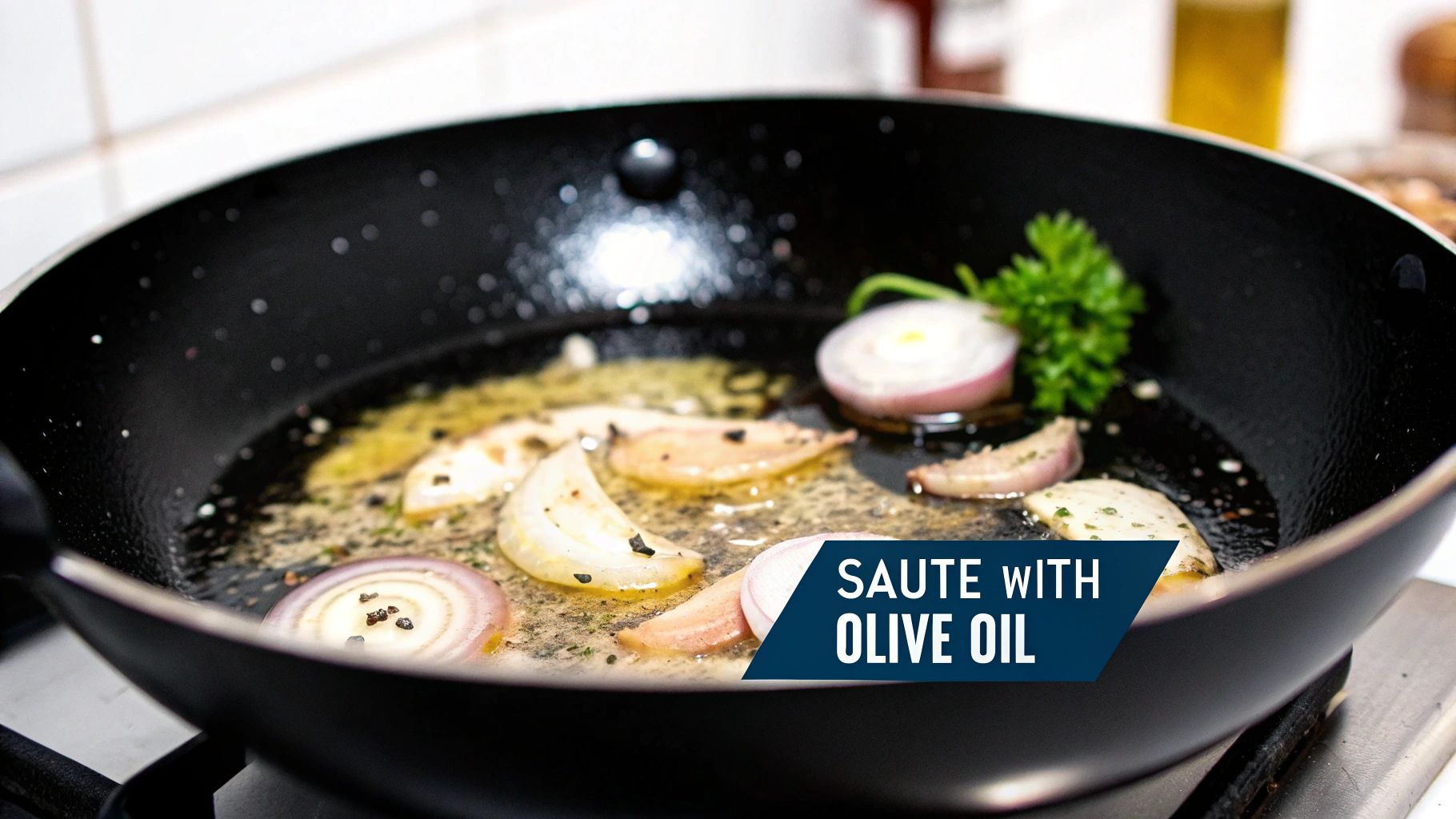
The reality? A quality olive oil doesn't just survive typical cooking temperatures; it thrives in them. Sautéing, at its heart, is the art of cooking food swiftly in a small amount of fat over medium-high heat. This is the precise zone where olive oil not only performs beautifully but also imparts a rich, nuanced flavor that bland, industrial seed oils can only dream of matching.
This guide is your roadmap. It will walk you, step-by-step, through the why and the how, proving beyond a shadow of a doubt that this ancient, golden oil is the superior choice for your everyday cooking.
The goal of a great sauté isn't merely to cook the food—it's to build layers of unforgettable flavor. Using the right olive oil is the first and most critical step in transforming a simple meal into something truly memorable.
We are going to demystify the process, from picking the perfect bottle to mastering the technique. By the time you're finished reading, you will cook with a newfound confidence, creating dishes infused with the authentic, vibrant character that only real olive oil can deliver. Your journey to the perfect sauté starts now.
Decoding The Smoke Point: A Chef's Perspective
The term "smoke point" has been given a terrible rap. It’s often brandished like a weapon—a terrifying, absolute limit that, once crossed, will instantly ruin your meal and fill your home with bitter, acrid smoke. But let me tell you a little secret from inside the world of professional kitchens: that is one of the biggest myths in all of cooking.
It's far more useful to think of an oil's smoke point not as a cliff edge, but as a speed limit. You wouldn’t want to floor the accelerator and go screaming past it, but there is a perfectly safe, wide, and effective range for everyday driving—or in this case, cooking. When you're sautéing, you rarely need to push the heat to its absolute maximum anyway.
What you are truly chasing is a lively, energetic sizzle, not a raging, out-of-control inferno. And for that, a good bottle of olive oil is more than up to the task.
What Is A Smoke Point, Really?
In the simplest terms, the smoke point is the temperature at which an oil starts to break down and produce a continuous, visible trail of smoke. It is indeed a sign that the fats are beginning to degrade. But the panic this idea has created, particularly around olive oil, is completely overblown.
A high-quality extra virgin olive oil (EVOO) typically has a smoke point somewhere between 374°F and 419°F (190°C to 215°C). This window is comfortably above the temperatures required for most home cooking, and it's certainly high enough for a perfect sauté. That remarkable stability is precisely why it can lend such a beautiful, complex flavor to your food in a way that flavorless, neutral oils simply cannot.
The real secret isn't obsessively avoiding the smoke point. It's learning to recognize the difference between an oil that's shimmering and ready for your ingredients, and one that's actually burning.
Seeing a single, wispy tendril of smoke is not a disaster. It’s just a helpful signal from your pan, telling you to nudge the heat down a touch. The more you understand the true burning temperature of olive oil, the more you'll realize it is a dependable, everyday workhorse. Real burning—the kind that smells awful and produces thick, continuous smoke—is easily avoided just by paying attention to your stove.
To put this all into perspective, here's a quick look at how olive oil stacks up against other common cooking oils you might have in your pantry.
Cooking Oil Smoke Point Reference Guide
| Cooking Oil | Typical Smoke Point (°F) | Typical Smoke Point (°C) | Best For |
|---|---|---|---|
| Extra Virgin Olive Oil | 374°F – 419°F | 190°C – 215°C | Sautéing, roasting, dressings |
| Coconut Oil (Refined) | 450°F | 232°C | High-heat sautéing, frying |
| Avocado Oil (Refined) | 520°F | 271°C | Searing, deep-frying |
| Canola Oil | 400°F | 204°C | General-purpose cooking, baking |
| Butter | 302°F | 150°C | Low-heat cooking, baking, flavor |
As you can see, extra virgin olive oil sits comfortably in the range needed for most everyday cooking, especially when compared to an oil with a very low smoke point like butter.
Choosing the Right Olive Oil for Your Pan
Walking down the cooking oil aisle can feel like a test you haven't studied for. You're confronted by a wall of bottles—Extra Virgin, Virgin, Light, Pure—and it’s hard to know what any of it really means when all you want to do is sauté some vegetables for dinner. Let's cut through that confusion, right now.
Think of olive oil grades like you would different types of wine. Some are complex, bold, and meant to be the star of the show. Others are reliable, everyday workhorses. For sautéing, you are looking for that perfect sweet spot: an oil with fantastic flavor that can handle the heat and won't cost a fortune.
Here’s a secret not every home cook knows: a good Extra Virgin Olive Oil (EVOO) is almost always your best choice for sautéing. Its bright, fruity, peppery character doesn't simply vanish on the stove; it deepens, building a wonderful flavor foundation that you simply cannot get from neutral oils. What's more, it’s far more stable at cooking temperatures than the old myths would have you believe.
EVOO vs. Regular Olive Oil
So, what about those bottles labeled simply "Olive Oil" or "Light Olive Oil"? These are more refined oils, a process that strips out much of the flavor, color, and powerful antioxidants, giving them a higher smoke point but a much milder, less interesting taste.
These refined oils have their place. They're useful when you need a completely neutral-tasting fat, perhaps for certain delicate baked goods, or when you’re cranking the heat to its absolute limit. But for your daily sauté—the garlic and onions, the chicken breasts, the medley of summer vegetables—a quality EVOO is your most flavorful and dependable partner in the kitchen. If you want to become a true pro, this guide on how to choose the right olive oil is an invaluable resource.
This chart gives you a quick visual of how olive oil stacks up against other common fats.
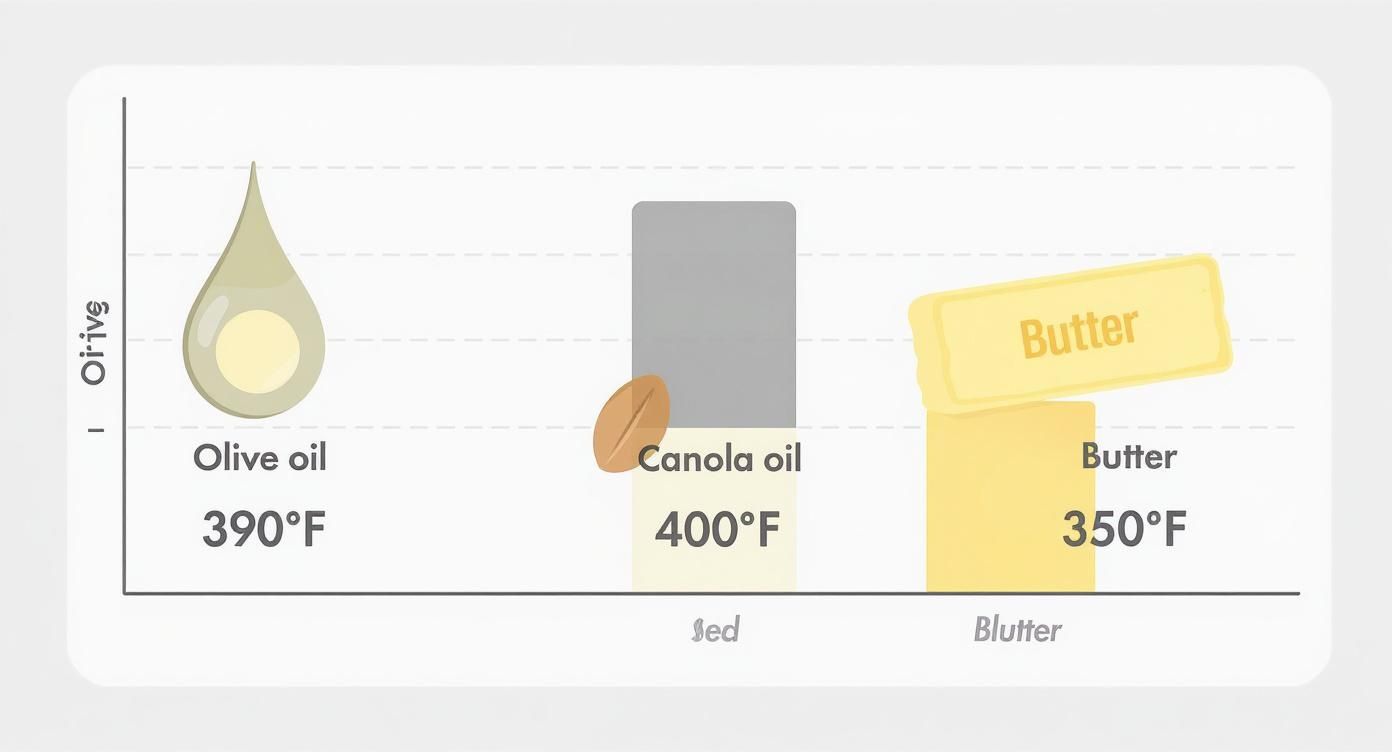
As you can see, olive oil’s smoke point is well above butter’s, which makes it a much more stable and versatile choice for the medium heat that most sautéing calls for.
Choosing the right olive oil for sautéing isn't about finding the one with the highest smoke point. It's about selecting an oil that contributes flavor, remains stable, and elevates the final dish.
Of course, the oil is only one half of the equation. The pan you use matters just as much. Understanding the different types of cooking pans is key, because even the best oil can't save you from a pan that heats unevenly. Your cookware and your cooking oil are a team; choose them both wisely.
Mastering the Perfect Saute with Olive Oil
A great saute is not about blasting your pan with heat and frantically stirring. It's more of a graceful dance, a deliberate method for building deep, foundational flavor with patience and control. This is the moment where you stop just following a recipe and start cooking with your senses.
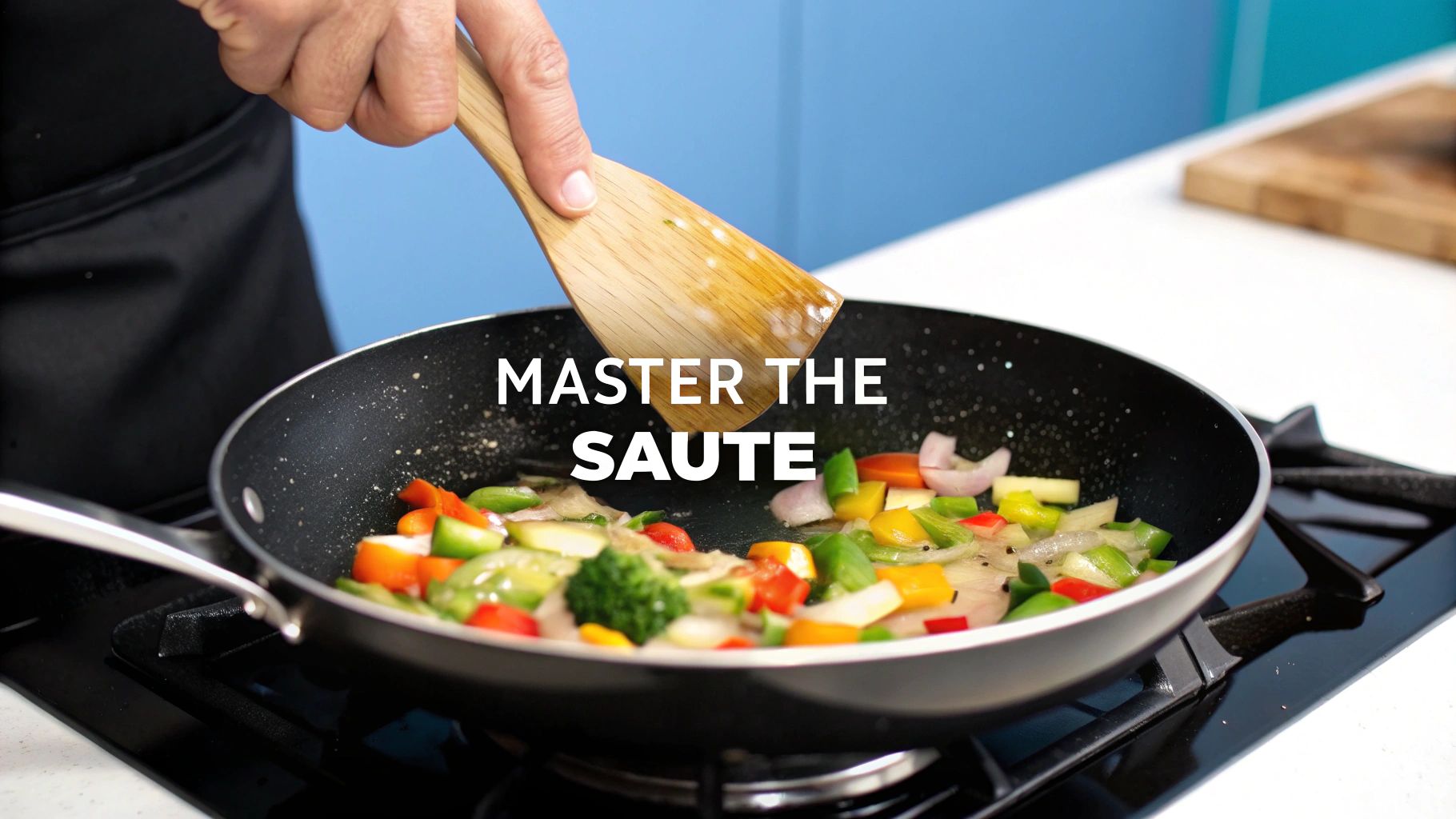
The first secret to a flawless, non-greasy saute? Preheat your pan properly. This is non-negotiable. Set your empty pan over medium heat for a minute or two before a single drop of oil goes in. This simple but crucial step allows the metal to expand, which helps create a more uniform, naturally non-stick surface.
Once the pan is properly hot, it’s time for the olive oil. You don’t need to flood the pan; just add enough to create a thin, shimmering layer across the entire bottom. That shimmer is your green light—it’s the unmistakable visual cue that the oil is at the perfect temperature and ready for your ingredients.
Listen to the Sizzle
The sound your food makes the instant it hits the hot oil is your most important guide. A confident, energetic sizzle tells you the temperature is exactly right.
If you hear a weak, sad sputter, your pan is too cool. On the flip side, a loud, angry crackle accompanied by wisps of smoke means it's far too hot.
The perfect saute speaks to you through its sizzle. Learning to listen is what separates a dish that’s steamed and soggy from one that’s crisp, caramelized, and bursting with life.
The final, and perhaps most critical, rule is to avoid overcrowding the pan. Dumping too much food in at once causes the pan's temperature to plummet, making your ingredients steam in their own juices instead of searing. It is always better to cook in batches if you must. The delicious, golden-brown results are more than worth the extra minute of your time.
These are the fundamentals that truly make a difference. You can dive deeper with our complete guide on how to cook with olive oil.
By mastering these small details—heating the pan first, watching for the shimmer, listening to the sizzle, and giving your food space to breathe—you will elevate your everyday cooking from good to truly exceptional.
Why Olive Oil Is a Global Kitchen Staple
Our deep-rooted reliance on olive oil is anything but a passing culinary trend. It is a tradition woven into the very fabric of cooking itself, stretching back thousands of years to the ancient Mediterranean cultures that first mastered the art of sautéing. That bottle in your kitchen? It's the final chapter in a massive global story connecting ancient groves to your dinner table.
This liquid gold is more than just an ingredient; it’s an economic and cultural powerhouse. The sheer scale of its production and consumption reveals just how essential it has become. It’s a non-negotiable staple, the silent workhorse behind countless family recipes and the first splash of flavor in millions of professional kitchens every single day.
A Worldwide Culinary Cornerstone
The global appetite for olive oil is simply immense. In a recent season, the European Union produced roughly 2.1 million tons, with Spain alone responsible for a staggering 1.41 million tons of that total. And it's not just a European obsession—the United States consumes around 381,000 tons yearly, which proves just how deeply it has embedded itself in kitchens on both sides of the Atlantic. You can find more insights into the global olive oil market on certifiedorigins.com.
These aren't just abstract numbers; they paint a crystal-clear picture. From the sun-drenched coasts of the Mediterranean to the bustling kitchens of North America, olive oil is a foundational element of daily cooking. Its universal appeal comes down to a unique, unbeatable combination of function and phenomenal flavor.
Olive oil’s journey from a regional treasure to a global necessity wasn't an accident. It was driven by its incredible versatility, its proven health benefits, and an undeniable ability to make good food taste even better.
This worldwide embrace is a testament to its enduring, essential role. To truly appreciate its place on your counter, it helps to understand the rich history behind it. You can explore the fascinating story of olive oil origins to see how this ancient food became such an indispensable modern-day staple.
Your Sautéing Questions Answered
Even when you've mastered the basics, a few nagging questions always seem to pop up. Let's tackle the most common ones about sautéing with olive oil so you can approach your stove with absolute confidence.
It's no accident that cooking with olive oil has become so popular; it's a worldwide move toward better flavor and healthier cooking. Think about this: global olive oil consumption jumped from around 1.8 million tons in the 1990s to 3 million tons by 2016, and it's projected to hit nearly 4.7 million tons. This massive growth is all tied to a cooking philosophy that puts great olive oil right where it belongs—at the center of the kitchen. You can see more on this trend over at bulkbycho.com.
Should I Use Expensive EVOO for Sautéing?
Absolutely. While you might want to save that ultra-pricey, grassy finishing oil for a final drizzle over a finished dish, a good quality, everyday EVOO is a fantastic workhorse for your daily sauté. The powerful antioxidants packed inside it actually make it more stable at cooking temperatures than most people realize.
What's more, its rich flavor profile gives your food a depth and character that a bland, neutral oil simply cannot touch. You aren't just heating your ingredients; you're building a foundation of flavor from the very first sizzle.
When you stick to the medium heat used for sautéing, a high-quality olive oil isn't just safe—it's a better choice. Its monounsaturated fats and antioxidants help it stand up beautifully to heat without breaking down.
How Do I Know If My Oil Is Too Hot?
Trust your senses—they are your most reliable tool in the kitchen. If you see a lot of thick, continuous smoke pouring from the pan, that's the dead giveaway that your oil is well past its smoke point. You'll also smell something sharp and burnt, a world away from the wonderful, fragrant aroma of gently heated olive oil.
If that happens, don't even think about using it. The best course of action is to carefully dispose of the oil, give the pan a quick wipe, and start fresh. The perfect moment to add your ingredients is when the oil has a gentle, elegant shimmer, not when it’s sending up smoke signals. You can dive deeper into this in our complete guide to using olive oil for high heat cooking.
By learning to read these simple cues, you’ll ensure your olive oil always brings incredible flavor to the party, and never bitterness.
At Learn Olive Oil, we are dedicated to helping you discover the rich world of premium olive oil. From the grove to your table, we make understanding this liquid gold simple and rewarding. Start your journey today!

 Learn Olive Oil
Leave a comment