Have you ever tasted a truly exceptional extra virgin olive oil and felt that sharp, peppery kick at the back of your throat? A pleasant tingle that seems to say, "This is the real thing."
That sensation isn't just a mark of quality. It's your first, unmistakable encounter with olive oil phenols.
These are nature's microscopic bodyguards, the powerhouse compounds that single-handedly elevate olive oil from a simple cooking fat into one of the most potent health-promoting foods on the planet. And most people have no idea they even exist.
The Life Force Trapped in Your Olive Oil
I want you to see that bottle of olive oil on your counter in a completely new light. Imagine it not as a mere kitchen staple, but as a liquid guardian for your health. This isn't fanciful thinking; it's the reality unlocked by its phenolic content. These compounds are the very reason olive oil has been revered for millennia, not just for its flavor, but for its almost medicinal properties.
Let's cut through the confusing chemistry. In nature, phenols are the olive's personal defense system, a sophisticated shield it creates to protect itself from pests, disease, and the harsh stress of the sun.
When we consume a high-quality, phenol-rich oil, we get to borrow that powerful protective shield for our own bodies.
A Peek Inside Nature's Potent Pharmacy
Here’s a crucial fact: not all olive oils are created equal. The concentration of these beneficial compounds can vary wildly. It's a story written by the olive's genetics, the richness of the soil, the intensity of the climate, and the precise moment of harvest.
Take, for instance, the superstar phenol oleocanthal, celebrated for its astonishing anti-inflammatory effects. Its concentration can swing from nearly non-existent in a low-grade oil to breathtakingly high levels in premium cultivars. While many oils sit below 500 mg/kg, certain varieties can soar past 1000 or even 2000 mg/kg. You can see the staggering range for yourself in the full study on phenolic compounds.
This vast difference is the secret that separates a generic cooking oil from a true wellness tool. My goal here is to pull back the curtain and show you how these compounds work their magic, so you can transform the way you buy and use olive oil forever.
Think of olive oil phenols as the life force of the olive, captured in a bottle. The more vibrant that life force, the greater the benefits passed on to you.
Getting to know these compounds is the first step toward making a direct and powerful investment in your long-term health. The connection between these tiny molecules and our well-being is simply too compelling to ignore.
To dive deeper, explore the health benefits of extra virgin olive oil in our comprehensive guide.
What Exactly Are Olive Oil Phenols?
To truly grasp what makes one olive oil a health powerhouse and another a mere disappointment, you must look beyond the elegant bottle and the alluring golden-green hue. The real magic, the secret sauce, is happening at a microscopic level. It’s all thanks to a remarkable family of compounds called olive oil phenols.
Put the complex chemistry aside for a moment. Picture an olive tree, standing resilient under a blistering Mediterranean sun. To protect its precious fruit from this relentless assault, the tree manufactures an arsenal of natural defensive compounds. These are the phenols.
When those olives are harvested at the peak of their power and skillfully milled into extra virgin olive oil, that natural shield is transferred directly into the bottle. So, every time you drizzle a high-phenol oil, you are, in essence, borrowing the olive's own sophisticated self-defense system to help protect your body.
Meet the A-Team of Olive Oil
A truly great extra virgin olive oil can contain over 20 different types of phenols, but a select few are the real heavy hitters. Each one plays a unique role, influencing everything from the oil's peppery taste and shelf life to its incredible health benefits.
Think of them as a highly specialized team of operatives, all working in perfect sync.
The infographic below gives you a clear visual breakdown of these crucial compounds, showing how they fit into the larger family of phenols and what they do.
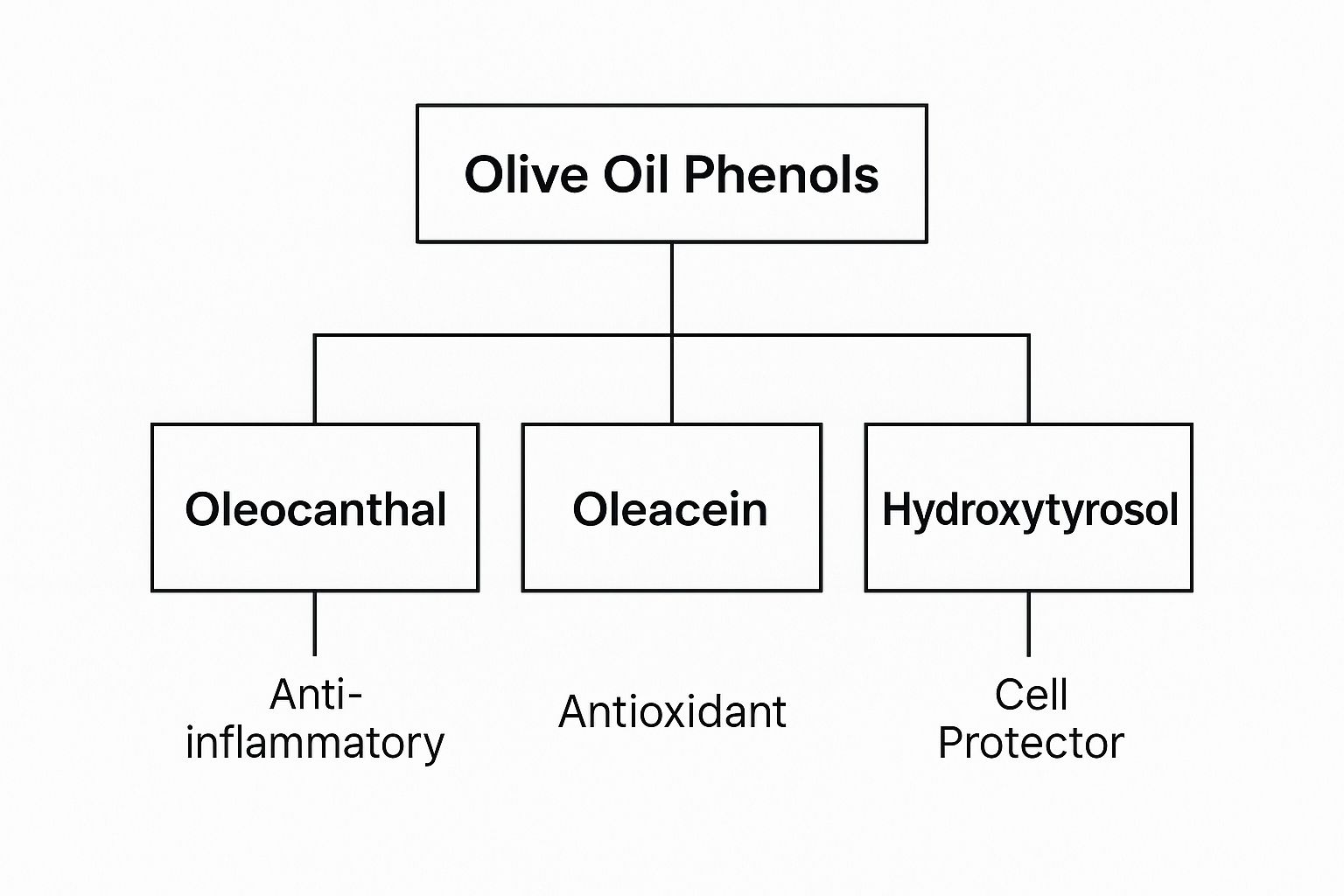
This chart helps reveal a critical point: these aren't just generic antioxidants. They are targeted commandos, each with a specific mission to support your well-being.
The Power Players Inside Your Oil
Learning the names of the main phenols is like getting to know the star players on a championship team. Their interaction is what gives an oil its distinct personality—its taste, its aroma, and its profound health properties.
To make this simple, here's a look at the most important phenols you’ll find in a truly high-quality olive oil.
The Key Phenols in Your Olive Oil
| Phenolic Compound | Primary Role and Benefit | Associated Flavor Sensation |
|---|---|---|
| Oleocanthal | A powerful natural anti-inflammatory, works similarly to ibuprofen. | The signature peppery "kick" or sting at the back of the throat. |
| Oleacein | A potent antioxidant that protects blood lipids from oxidative damage. | A slightly bitter note, often perceived on the sides of the tongue. |
| Hydroxytyrosol | One of nature's strongest antioxidants, protects cells from free radicals. | Contributes to the overall bitter and robust flavor profile. |
These compounds work in beautiful harmony, creating the complex and beneficial character of a true extra virgin olive oil.
Let's break down what each one brings to the table:
-
Oleocanthal: The Natural Fire Extinguisher
Ever taste an olive oil and feel that peppery sensation catch in your throat? That’s Oleocanthal announcing its presence. This remarkable compound has been shown to possess anti-inflammatory properties that astonishingly mimic the effects of ibuprofen. It's the source of the oil's pungency and a surefire sign of its power. -
Oleacein: The Master Defender
This is the oil's primary guardian. Oleacein is brilliant at protecting the oil itself from going rancid. But more importantly for you, it helps shield your blood lipids from the ravages of oxidative stress—a key trigger in heart disease. This is one of the main reasons the Mediterranean diet is so revered for its heart-health benefits. -
Hydroxytyrosol: The Cellular Bodyguard
Widely considered one of the most potent antioxidants ever discovered in nature, Hydroxytyrosol is a true bodyguard for your cells. It excels at neutralizing free radicals—the unstable molecules that cause cellular damage, accelerate aging, and pave the way for disease.
These are not just passive ingredients. They are biologically active compounds that transform authentic extra virgin olive oil from a simple cooking fat into a genuine functional food. Their concentration is the single greatest difference between a generic bottle on the supermarket shelf and a true wellness tool.
Understanding these key players is the first step toward appreciating why not all olive oils are created equal. The level of these phenols directly dictates an oil's health benefits and its taste. To dig deeper into the basics, check out our guide on what is olive oil made of. This is where the story of real quality truly begins.
The Proven Health Benefits of a Phenol-Rich Diet
We've met the key players—the phenolic compounds that give extra virgin olive oil its stunning character. Now, let’s get to the best part: how these powerful little molecules translate into real, science-backed benefits for your health.
This is about much more than just flavor. Choosing an olive oil brimming with phenols is a conscious, strategic move to armor your body against some of the biggest health challenges of our time.
Taming the Hidden Fire of Chronic Inflammation
Imagine chronic inflammation as a low-grade fire, smoldering silently inside your body, day after day. It’s a sinister culprit that science now links to an enormous range of major health problems, from heart disease and arthritis to cognitive decline.
This is where oleocanthal, the phenol behind that peppery kick in your throat, enters the scene. What it does is nothing short of remarkable. At a molecular level, oleocanthal acts much like a small dose of ibuprofen, working to block the very same inflammatory pathways in the body.
The difference is profound. A daily spoonful of high-phenolic olive oil offers a consistent, gentle anti-inflammatory effect—not as a quick fix, but as a long-term strategy. It helps cool that internal fire before it has a chance to cause lasting damage. You can discover more about how olive oil's anti-inflammatory properties work in our other article.
Think of it as preventative maintenance for your body. The consistent presence of Oleocanthal helps manage inflammation at its source, protecting your systems from the constant stress that fuels disease.
The Antioxidant Bodyguard Service
Every day, your cells are under relentless attack from unstable molecules known as free radicals. This assault causes what’s called oxidative stress—a process you can think of as cellular rust. It damages DNA, proteins, and fats, which accelerates aging and throws open the door to illness.
This is where the other star olive oil phenols, like hydroxytyrosol and oleacein, truly shine. They are master antioxidants, acting as selfless bodyguards for your cells.
Their entire job is to hunt down and neutralize these destructive free radicals before they can cause mayhem. By sacrificing themselves, these phenols protect your cellular machinery, keeping everything running smoothly.
This protective detail is especially vital for your heart. One of the very first steps in atherosclerosis (the hardening of arteries) is when LDL cholesterol becomes oxidized. Phenols in olive oil help shield these blood lipids from that oxidative damage—a benefit so significant it's officially recognized by the European Food Safety Authority (EFSA). It is a foundational strategy for supporting your cardiovascular system.
Fueling Brain Health and Longevity
The impact of olive oil phenols extends all the way to our most complex organ: the brain. Because it is an oxygen-guzzling machine, the brain is incredibly vulnerable to oxidative stress. The antioxidant power of phenols provides a desperately needed defense for our delicate brain cells.
What's more, exciting new research suggests these compounds might even help clear out amyloid-beta plaques, the infamous protein buildups linked to Alzheimer's disease. By aiding in cellular cleanup and reducing neuroinflammation, a diet rich in phenols is a powerful investment in your long-term cognitive health.
This mountain of scientific evidence isn't going unnoticed. The public is waking up, and it’s showing in the market. Projections indicate the global olive oil market is set to swell from $20.3 billion in 2025 to over $30.6 billion by 2032, driven largely by health-conscious consumers seeking natural ways to fend off modern lifestyle diseases.
The message is simple but powerful. A daily dose of high-phenolic olive oil isn’t a magic pill. But it is one of the smartest, simplest, and most delicious ways you can build a strong foundation for a long and healthy life.
Why Olive Variety and Harvest Time Are Crucial
Have you ever wondered why one bottle of extra virgin olive oil delivers an intense, peppery punch while another is as smooth and gentle as butter? The answer doesn't start in the pressing mill or the bottling facility. It begins out in the grove, with two factors that make all the difference in the world: the olive's genetic heritage and the exact moment it's plucked from the branch.
Creating an olive oil that is a true powerhouse of phenols is no accident. It is a deliberate, painstaking process that hinges on choosing the right type of olive and harvesting it at the pinnacle of its power. Once you understand these two factors, you will graduate from a casual buyer to someone who can spot true quality that goes far beyond a simple "extra virgin" label.
The Olive's Genetic Blueprint
Just as different grapes yield wildly different wines, various olive cultivars are programmed to produce oils with their own unique personalities. Some olives are simply born to be phenolic heavyweights; their genetic code instructs them to create more of these protective compounds from the start.
This is where the olive variety, or cultivar, plays a starring role. An oil's potential for a high phenol count is largely predetermined by its DNA. It's a foundation that no amount of careful processing can fundamentally change.
Think of it this way: you can't get a bold, tannic Cabernet Sauvignon from a light, crisp Pinot Grigio grape. In the same way, you can't expect a pungent, phenol-rich oil from an olive variety that’s genetically wired to be mild and delicate.
Certain cultivars are famous for their naturally robust phenolic profiles. Olives like the Spanish Picual and the Greek Koroneiki are renowned for producing oils that are not only bursting with flavor but are also brimming with these beneficial compounds. On the other hand, an olive like the Spanish Arbequina is prized for its gentle, nutty flavor, which is a direct reflection of its inherently lower phenol content.
This genetic difference is not subtle. One revealing study found that fresh Koroneiki olives contained a staggering 19,500 mg/kg of total phenols, with Picual close behind at 18,500 mg/kg. Arbequina, by contrast, registered a much lower 3,800 mg/kg. You can discover more insights from this study of olive cultivars to see the data for yourself. This is undeniable proof that the potential for high olive oil phenols is locked in from day one.
The Decisive Moment of the Harvest
Even with the perfect olive variety, timing is everything. This brings us to the second crucial factor: harvest time. As an olive ripens, its chemical composition is in constant flux.
Early in the season, when the olives are still green, firm, and unripe, their phenol content is at its absolute peak. These young, vibrant fruits are loaded with the very compounds that give high-quality oil its signature bitterness and peppery finish—the tell-tale signs of oleocanthal and other phenols at work.
But as the olive matures, turning from green to violet and finally to black, the oil yield increases, but the phenol concentration takes a nosedive. The flavor profile softens, becoming more buttery and less assertive. This is why late-harvest oils are typically much milder and lack that characteristic peppery kick.
Producers dedicated to crafting the most healthful, highest-quality oil will always choose to harvest early. You can learn more about the benefits of early harvest olive oil and understand why it is so prized. This decision is a sacrifice; they are consciously trading quantity for quality. Early-harvest green olives yield far less oil than their fully ripe counterparts, which is a major reason these potent oils often command a higher price.
This obsession with timing isn't unique to olive oil. Top chefs have always known that exceptional flavor comes from using ingredients at their absolute peak. A closer look at the role of seasonal ingredients in elevating dishes reveals this philosophy in action across the culinary world. It’s a shared commitment to capturing nature's best at the perfect moment.
How to Read the Label and Find High-Phenolic Oil
Alright, you now understand the science behind why olive oil phenols are so incredibly good for you. Now for the exciting part: turning that knowledge into power. Walking down the olive oil aisle can feel overwhelming, but it doesn't have to be.
Think of this as your secret decoder ring for cutting through the marketing noise. All the clues you need to find a truly exceptional oil are printed right there on the bottle—if you know what to look for.
The Only Date That Truly Matters
First things first: ignore the "best by" or "use by" date. The single most critical piece of information on a bottle of world-class extra virgin olive oil is the harvest date.
Phenols are powerful, but they are not immortal. They begin to degrade from the very moment the oil is pressed. Therefore, the closer you are to that harvest, the more potent and beneficial the oil will be. Look for a specific month and year. If a producer hides this information, they likely aren't prioritizing freshness, and you should walk away.
Demand the Proof: The Phenol Count
This is where the rubber meets the road. Trustworthy producers who endure the expense and effort to create high-phenolic oil are proud of their work, and they will prove it by putting the total polyphenol count directly on the label. You'll typically see it measured in milligrams per kilogram (mg/kg).
This number is your direct window into the oil's health-promoting power. It quantifies the concentration of those amazing antioxidant and anti-inflammatory compounds we've been discussing. Without it, you’re flying blind.
A listed polyphenol count is a producer’s badge of honor. It signals that they have invested in laboratory analysis to verify their oil’s quality, elevating it from a simple condiment to a proven functional food.
So, what’s a good number? Here’s a quick reference guide:
- Good: Anything over 250 mg/kg. This is the baseline required to carry the official EU health claim for protecting blood lipids from oxidative damage.
- Excellent: Oils clocking in between 400 mg/kg and 600 mg/kg. These are seriously robust, high-quality oils with noticeable health benefits and a bold, peppery flavor.
- Exceptional: Any oil registering above 600 mg/kg. These are often considered "medicinal grade" and pack the most powerful phenolic punch you can find.
If you want to become even more skilled, our guide to understanding olive oil labeling provides more expert tips to help you shop with absolute confidence.
Finally, trust your own senses. That peppery tingle you feel at the back of your throat? That’s oleocanthal, one of the star phenols, giving you a high-five. A distinct bitterness and a pungent, spicy finish are the most reliable sensory clues you have. It’s nature’s own seal of approval.
Protecting Your Investment in Health
Bringing home a bottle of high-phenolic olive oil is a smart move. You’ve made a deliberate choice to buy an oil packed with the antioxidant and anti-inflammatory compounds that serve your body well. But that investment is only worthwhile if you fiercely protect what’s inside the bottle.
Those precious olive oil phenols are powerful, but they are also fragile. They have three mortal enemies: light, heat, and oxygen. Think of them as the Kryptonite to your olive oil’s superpowers. Each one relentlessly degrades the phenols, chipping away at both the vibrant flavor and the health benefits you paid a premium for.
This means how you store your oil is just as important as which one you buy. It’s simple to protect it, but it requires breaking some bad habits.
The 3 Golden Rules of Preservation
To keep those phenols intact and working for you, you must give your oil a safe home. This isn't complicated; it just means abandoning a few common kitchen practices that most of us are guilty of.
Here are the non-negotiable rules for storing your liquid gold:
-
Embrace the Dark: Light is a primary catalyst for oxidation, which is the kiss of death for phenols. It's why all superior oils come in dark glass bottles or opaque tins. Keep your bottle hidden away in a dark cabinet or pantry, far from any sunlit countertops.
-
Keep it Cool, Never Cold: Heat accelerates the breakdown process almost as fast as light. The single worst place for your olive oil is right next to the stove, yet that’s where countless people keep it. A consistent, cool room temperature is your goal.
-
Seal It Tight, Every Time: Oxygen is the final enemy. Every time you open the bottle, air rushes in. Make it a habit to screw the cap on tightly after every single use to minimize this exposure and keep your oil fresh and potent.
Treat your high-phenolic olive oil like a fine wine after it’s been opened. You wouldn't leave it uncorked on a sunny windowsill. Grant your oil the same respect to preserve its complex character and powerful health benefits.
The Myth of Cooking with EVOO: Busted
One of the most stubborn and misleading myths out there is that you shouldn't cook with extra virgin olive oil. This idea likely stems from bad experiences with cheap, refined oils that have low smoke points and can't handle heat. But high-quality, high-phenolic EVOO is an entirely different animal.
A genuinely well-made extra virgin olive oil has a smoke point between 375°F and 410°F. That is more than high enough for the vast majority of home cooking, including sautéing, roasting, and even light frying.
What's more, studies have shown that the phenols in olive oil are surprisingly resilient when heated. They actually form a protective shield, not just for the oil itself, but for the nutrients in the food you're cooking. This makes it an outstanding choice in the kitchen, ensuring you get all the antioxidant and anti-inflammatory goodness you paid for, from the pantry all the way to your plate.
Answering Your Top Questions About Olive Oil Phenols
Once you dive into the world of olive oil phenols, a few key questions always surface. It's only natural. Let's tackle the most common ones head-on to give you complete confidence when choosing and using this liquid gold.
What’s a “High” Phenol Level, Anyway?
When you see a number on a bottle, you need a frame of reference. After all, every extra virgin olive oil has some phenols, but the concentration can swing from trivial to tremendous. Here’s a quick guide to what those numbers really mean for your health.
- Good (Over 250 mg/kg): This is the magic number required to make the official EU health claim about protecting blood lipids. Consider this the entry point for a truly health-focused oil.
- Excellent (Over 500 mg/kg): Now we're in the big leagues. Oils in this category are considered genuinely high-phenolic, packing a serious antioxidant and anti-inflammatory wallop.
- Exceptional (Over 800 mg/kg): These are the true wellness powerhouses. Oils with phenol counts this high are often sought for their potent, almost medicinal, qualities and their intensely robust flavor.
Can You Actually Taste Phenols?
Absolutely. In fact, your own palate is one of the best tools for detecting them. That characteristic bitterness that registers on your tongue and the peppery sting you feel in the back of your throat? Those are the phenols making their presence known loud and clear.
If an oil tastes completely smooth, buttery, and has zero peppery finish, it’s a dead giveaway that its phenol content is low. That distinct "kick" is your proof of potency.
Think of that peppery sensation as the phenols announcing their arrival. It's nature's way of telling you that the powerful, protective compounds are present and ready to go to work.
Does the Color of the Oil Mean Anything?
This is perhaps the biggest myth in the olive oil universe. Many of us have been led to believe that a deep, vibrant green color signals higher quality or more phenols. The truth is, the color comes from chlorophyll and is determined almost entirely by the olive variety and how early it was harvested.
While it's true that many early-harvest, high-phenolic oils are green, you can easily find a golden-hued oil with an exceptionally high phenol count. Color tells you about ripeness and chlorophyll content, but it is not a reliable indicator of its phenolic power.
Is High-Phenolic Olive Oil Worth the Extra Money?
When you see that higher price tag, you’re not just paying for a fancy label. You are investing in a product that is far more difficult, risky, and expensive to create. Making it demands specific olive cultivars, a perfectly timed early harvest (which yields significantly less oil), and incredibly careful, rapid milling to preserve these delicate compounds.
So, is it worth it? A resounding yes. You're paying for documented antioxidant power, proven anti-inflammatory benefits, and a level of quality that your average supermarket oil cannot begin to approach. It’s an investment in your wellness, one delicious spoonful at a time.
At Learn Olive Oil, our mission is to help you navigate the world of premium olive oil. From decoding labels to training your palate, we provide the expert insights you need to choose with confidence. Start your journey with us and discover what makes this liquid gold so special.

 Learn Olive Oil
Leave a comment