Let's cut to the chase. The fundamental difference between olive oil and canola oil is breathtakingly simple, and it changes everything.
Think of olive oil as a fruit juice, squeezed directly from whole olives through sheer mechanical force. A gift from nature. In stark contrast, canola oil is a seed oil, wrested from the tiny seeds of a specially bred plant through a complex, industrial ballet of heat, pressure, and chemical refinement.
Your decision, then, isn’t about which oil is “better.” It’s about a choice between two entirely different tools. Are you looking for a flavorful, antioxidant-rich finishing touch? Or do you need a silent, high-heat workhorse that never steals the show?
Choosing Your Kitchen's Essential Ally
In one corner, you have olive oil—the soul of Mediterranean cooking, celebrated for its profound, complex flavor and a heritage stretching back millennia. In the other, canola oil—the quiet, dependable professional, prized for its absolute neutrality and astonishing versatility.
This choice, seemingly minor, is one of the most consequential you'll make in the grocery aisle. The oil you bring home will profoundly impact the taste, the health profile, and the ultimate success of everything you cook.
This guide will slice through the marketing noise and deliver the practical truths you need. We'll unearth how each oil is born, what gives them such radically different personalities, and which one is the perfect instrument for the culinary masterpiece you have in mind.
Forget the brand slogans. We're zeroing in on the facts that will empower you to cook with more intelligence and make your food taste precisely as you imagined. And if you truly want to master this world, our definitive guide on how to choose olive oil will teach you to read labels and spot true, unadulterated quality.
Olive Oil vs Canola Oil: The Tale of the Tape
To grasp the difference instantly, let's place these two titans side-by-side. This table strips away the non-essentials and reveals the core attributes that define them—from their very origin to their ultimate purpose in your kitchen.
| Attribute | Olive Oil | Canola Oil |
|---|---|---|
| Source | Fruit (Olives) | Seed (Canola Plant) |
| Production | Primarily mechanical pressing (for EVOO) | Solvent extraction & refining |
| Flavor Profile | Varies; fruity, peppery, grassy | Neutral, almost flavorless |
| Primary Fat Type | Monounsaturated Fat (Oleic Acid) | Monounsaturated and Polyunsaturated |
| Key Compounds | Rich in polyphenols (antioxidants) | Good source of Omega-3s |
| Best For | Dressings, finishing, low-heat cooking | Frying, baking, general-purpose cooking |
| Price Point | Generally higher, especially for EVOO | Budget-friendly and accessible |
As you can see, their starkly different origins and production methods create two profoundly distinct products. Neither is inherently "better"—it's a question of selecting the right champion for the battle you intend to win.
The Story Behind Extra Virgin Olive Oil
Think of extra virgin olive oil not as a cooking fat, but as a fresh-pressed fruit juice. Because that is precisely what it is. This is no modern, factory-born commodity; it is an ancient food, a pillar of civilization, created by the simple, elegant act of crushing olives to release their oil. The finest oils emerge from purely mechanical methods—no scorching heat, no chemical solvents. Just pure, liquid gold.
This gentle, time-honored alchemy is what preserves the oil’s incredible character. It is how the vibrant, peppery flavors and the legion of powerful antioxidants survive the journey to your bottle. The entire olive oil manufacturing process is a testament to protecting the soul of the fruit, a relentless focus on quality over brute-force quantity.
From Grove to Bottle: An Artisanal Journey
The saga of any great olive oil begins in the grove. Like wine grapes, the olive's terroir—that magical symphony of climate, soil, and geography—is the architect of its final flavor. An oil from the sun-scorched hills of Tuscany might strike your palate with a grassy, sharp bite, while its cousin from Greece could be a whisper of smooth, buttery elegance.
This specialized art is concentrated in just a few hallowed regions of the world. For centuries, the Mediterranean has been the undisputed heartland, with Spain as its reigning monarch. Spain alone summons forth a staggering 1.41 million tons of olive oil, accounting for nearly 40% of the entire world's supply. This intimate, almost spiritual connection to the land is a universe away from the globe-spanning agricultural footprint of canola.
The difference between olive oil and canola oil truly ignites right here, in this bond with the earth.
This is why olive oil is best understood as a star ingredient, not just a cooking fat. Its production is more akin to art than industry, resulting in a premium product with deep cultural and culinary significance.
The Standard of 'Extra Virgin'
That "extra virgin" insignia on the bottle is not some clever marketing gimmick; it is a legally enforced coat of arms, a guarantee of supreme quality. To earn this title, an oil must survive a gauntlet of chemical trials and, most importantly, a sensory judgment by a trained tasting panel. It must be flawless.
These ironclad requirements ensure the oil you buy is:
- Chemically Pure: It must possess an exceptionally low acidity (below 0.8%) and satisfy other critical purity benchmarks.
- Flavorful: It must be utterly free of any taste defects while singing with distinct, delightful fruity notes.
This obsessive quality control is the reason a bottle of authentic extra virgin olive oil commands a higher price. You are not merely paying for a cooking medium. You are investing in a product crafted with immense care, one that carries the authentic taste of its origin from the grove straight to your table.
Understanding Canola Oil's Modern Origins
If olive oil’s story is an ancient epic, canola oil’s is a thrilling tale of modern science and agricultural genius. It wasn’t discovered in a sun-drenched grove; it was born in a laboratory. Its journey starts not with a fruit, but with the rapeseed plant—a crop historically high in compounds that made it unfit for human consumption.
In the 1970s, Canadian scientists took up a challenge. Through meticulous, old-school plant breeding, they developed a new rapeseed variety, systematically erasing the unwanted components. They christened their creation "Canola," a brilliant portmanteau of "Canada" and "ola" (meaning oil). This wasn't a minor tweak; it was a revolution that unleashed an entirely new agricultural titan.
From Engineered Seed to Kitchen Staple
Transforming tiny canola seeds into the clear, neutral oil on your shelf is an industrial marvel, a process galaxies away from the simple pressing of olives. The entire system is engineered for maximum efficiency and yield, which is the very heart of the difference between olive oil and canola oil.
The production method is a multi-step industrial process:
- Heating and Flaking: First, the seeds are heated and then crushed into flakes. This ruptures the cell walls, making the oil within more accessible.
- Solvent Extraction: To wring out every last drop of oil, the flakes are washed with a solvent. This solvent, of course, is completely removed later on.
- Refining and Bleaching: The crude oil is then refined, bleached, and deodorized. This purges any impurities, colors, and leftover aromas, leaving behind a perfectly neutral, almost invisible final product.
This high-tech symphony is the secret to canola oil's consistency and affordability. It enables production on a colossal scale, making it a reliable and budget-friendly ally for everyone from home cooks to food manufacturing giants. This relentless efficiency is why it reigns as one of the most widely produced vegetable oils on Earth.
Canola oil's origin isn't rooted in terroir or tradition, but in brilliant problem-solving. It was engineered to be the perfect blank canvas—stable, versatile, and economical, designed from the ground up to perform flawlessly in any modern kitchen.
Globally, rapeseed oil (mostly canola) production recently crested 34.10 million metric tons, cementing its status as a major global commodity. Nations like Canada, China, and much of Europe are the primary producers, with Canada serving as a key source for the U.S. market.
But its commodity status means prices dance to the tune of global forces like demand for biodiesel, which can trigger major price swings. For a closer look, this canola oil market price guide for 2025 offers deeper insight. This industrial scale and market volatility are a world away from the artisanal, regionally-focused universe of extra virgin olive oil.
A Practical Guide to Health and Nutrition
https://www.youtube.com/embed/gpAXZVvGMC8
Standing in the grocery aisle, facing a wall of cooking oils, the health claims can feel like an avalanche. But the truth is simpler than you think. It's not about discovering a single "healthiest" oil. It's about understanding which one is the right tool for your body and your cooking. This is where the nutritional differences between olive oil and canola oil become a powerful, practical guide, not just a topic for debate.
Extra virgin olive oil has earned a sterling reputation, and deservedly so. Its foundation is a fortress of monounsaturated fats, led by the superstar oleic acid. This is the very same heart-healthy fat that has made the Mediterranean diet a global benchmark for wellness.
But olive oil's true secret weapon lies beyond the fats. It is teeming with polyphenols, potent antioxidants that wage war on inflammation and cellular damage in your body. These are the very compounds that give high-quality olive oil its signature peppery finish—that faint tickle in your throat is the literal taste of powerful, health-promoting compounds at work.
The Canola Oil Advantage
Canola oil, however, enters the ring with its own unique set of strengths. While it's also rich in monounsaturated fats, it boasts one of the lowest levels of saturated fat of any common cooking oil—a mere 7%. For anyone meticulously managing their saturated fat intake, this makes it an extremely compelling choice.
Beyond that, canola oil delivers a very respectable balance of omega-6 and omega-3 fatty acids, with a ratio of about 2:1. That’s a significant detail, as achieving the right balance between these essential fats is critical for keeping inflammation under control.
The choice isn't a moral one of good versus bad. It's a strategic one. Are you seeking a flood of antioxidants for a salad dressing, or are you looking for a heart-conscious fat profile for a high-heat sear? Your mission defines your oil.
Making an Informed Choice
In the end, the right oil for you is the one that aligns with your health objectives and your culinary ambitions. You wouldn't use a delicate, expensive finishing oil for deep frying, just as you wouldn't use a completely neutral oil when you want a burst of flavor. The key is to see them as distinct instruments in your kitchen orchestra.
To make truly intelligent decisions about what you eat, it's vital to know how to effectively read food labels. This skill empowers you to look past the marketing curtain and understand what you’re actually fueling your body with.
For a deeper exploration of what makes olive oil a nutritional champion, explore our guide on olive oil nutrition facts. Understanding these details will help you appreciate why it remains a cornerstone of healthy eating worldwide. By harnessing the unique benefits of both oils, you can build a more versatile and nutritionally complete pantry.
Winning in the Kitchen: Flavor and Heat
Choosing between olive oil and canola oil isn't a minor preliminary step; it is a fundamental strategic decision that will define your dish. This is where the oil meets the pan, and the core difference between olive oil and canola oil becomes brilliantly, undeniably clear. Think of one as the star of the show and the other as the master of the supporting cast.
Extra virgin olive oil (EVOO) strides into the kitchen as an ingredient in its own right. You are meant to taste it. Its complex, fruity, and sometimes peppery notes are not meant to be hidden; they exist to elevate. Picture that final, confident drizzle over a finished pasta, the vibrant soul of a fresh vinaigrette, or the simple, profound pleasure of a dip for warm, crusty bread. That is EVOO’s stage.
Canola oil, by contrast, is the consummate behind-the-scenes professional. Its greatest power lies in its almost complete neutrality. It quietly retreats, allowing the true stars of your dish—be it the delicate flavor of a white fish or the deep sweetness of a chocolate cake—to shine without a hint of interference. It’s the oil you reach for when you need unwavering performance without a strong personality.
Navigating the Smoke Point
The ultimate trial for any cooking oil is how it behaves under fire. This is where the smoke point—the temperature at which an oil begins to break down and smoke—is absolutely mission-critical. Pushing an oil past this point doesn't just cloud your kitchen; it obliterates the flavor of your food and can generate harmful compounds.
Here, canola oil asserts its dominance as a high-heat champion. With a smoke point around 400°F (204°C), it’s tailor-made for the most demanding culinary tasks: searing a steak, deep-frying chicken, or roasting vegetables at searing temperatures. It remains stable, reliable, and unflappable when the heat is on.
The chart below provides a stunning visual breakdown of how these oils perform under pressure and on the palate.
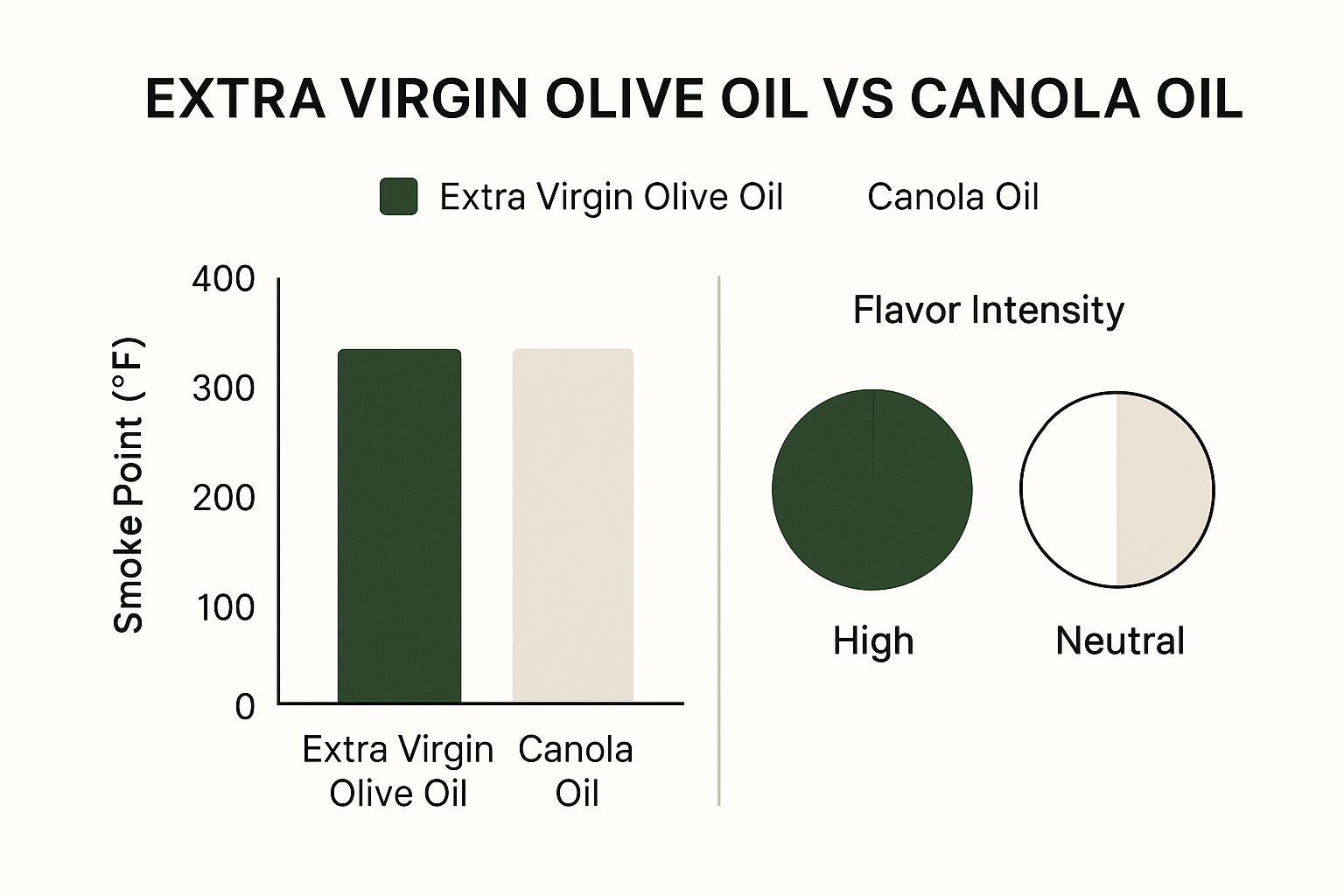
As you can clearly see, while canola wins the prize for heat tolerance, extra virgin olive oil commands a powerful flavor presence that canola simply cannot hope to match.
Matching the Oil to the Mission
Extra virgin olive oil, with its more modest smoke point of around 375°F (191°C), is a different kind of weapon for a different kind of war. Its delicate structure and precious polyphenols are best shielded from the brutal assault of high-temperature cooking.
Using extra virgin olive oil for deep-frying is like using a fine silk scarf to wash your windows. Yes, it will work, but you've just destroyed the very qualities that made it valuable in the first place.
Instead, let it shine in low-to-medium heat engagements. A gentle sauté of garlic and herbs, a slow poach of delicate fish, or a simple pan-fry of vegetables are all perfect assignments. Not all olive oils are created equal when it comes to heat, and you can dive deeper into the nuances of the olive oil smoke point to truly understand its capabilities.
For a definitive at-a-glance guide, let's break down their culinary performance side-by-side.
Culinary Performance Olive Oil vs Canola Oil
| Property | Extra Virgin Olive Oil | Refined (Light) Olive Oil | Canola Oil |
|---|---|---|---|
| Smoke Point | ~375°F (191°C) | ~465°F (240°C) | ~400°F (204°C) |
| Flavor Impact | Pronounced: Fruity, peppery, grassy. A finishing flavor. | Neutral: Very mild, almost no flavor. | Neutral: Clean and unobtrusive flavor. |
| Best For | Vinaigrettes, dips, finishing, gentle sautéing, poaching. | High-heat searing, roasting, baking, frying. | Frying, searing, baking, stir-frying, general use. |
Ultimately, choosing the right oil is about matching its innate character to your culinary endgame. Are you looking for a silent partner or a bold declaration of flavor? Your answer will tell you whether to reach for that bottle of golden-green olive oil or the pale, unassuming canola.
Decoding the Price: Why Quality Costs More
Have you ever stood in the grocery aisle, stared at a $25 bottle of extra virgin olive oil next to a $5 jug of canola, and wondered what that price gap truly represents? It’s not just clever marketing or an elegant label. That price difference tells a dramatic story of farming, geography, and the painstaking journey from plant to pantry.
The premium price of good olive oil begins in the grove. Harvesting olives is often a delicate, manual affair, sometimes done by hand to prevent the precious fruit from bruising. These ancient trees are also notoriously picky, flourishing only in specific microclimates. This is a universe apart from the vast, sprawling fields where canola is grown and harvested with massive, efficient machinery.
That fundamental difference between olive oil and canola oil widens even further when you account for the ironclad standards required to earn the "extra virgin" designation. It is a seal of absolute purity that demands a perfect, flawless process, which naturally adds to the final cost.
The Economics of Production
Canola oil’s story is one of colossal scale and industrial efficiency. Enormous, mechanized farms and high-yield processing plants are engineered to produce a consistent and affordable product. It is a global commodity, designed from its very DNA to be accessible, which is precisely why it’s a budget-friendly staple in kitchens worldwide.
Olive oil, especially from smaller, artisanal producers, operates under an entirely different set of economic laws. Its value is inextricably linked to quality, not just brute volume. The global market reflects this, with projections showing it will climb from $19.4 billion to over $30.6 billion as more consumers seek out its health benefits and premium character. High-quality export prices can average around €554 per 100 kg.
Canola, meanwhile, follows the ebb and flow of commodity markets, with retail prices often hovering around $12-$16 per gallon. For a closer look at these market dynamics, you can explore more on the global canola oil market.
Price is more than a number on a tag; it’s a direct reflection of the journey from plant to pantry. One path is an industrial highway built for speed and volume, the other is a winding country road prioritizing character and quality.
Value Beyond the Price Tag
Once you grasp these economic realities, you can make smarter, more strategic choices. This isn't just about which oil is cheaper—it's about securing the right value for the job at hand. When you need a dependable, neutral workhorse for high-heat frying or baking, the cost-effective performance of canola is an unbeatable proposition. It performs its duty without emptying your wallet.
But when a dish cries out for flavor, for a rich aroma, for a final touch that transforms the merely good into the sublime, you are investing in the craft behind a quality olive oil. Learning what drives extra virgin olive oil prices helps you appreciate what’s in the bottle. You’re not just buying a cooking fat; you’re buying an ingredient with a soul.
Your Questions Answered
We get asked all the time about the real-world differences between olive oil and canola oil. One of the most common questions is whether canola is actually the healthier option. The truth is, it's not a simple yes or no answer—it really depends on what you're trying to achieve.
Extra virgin olive oil, for instance, is packed with those powerful, anti-inflammatory polyphenols. On the other hand, canola brings a fantastic omega fatty acid profile to the table. Each one has its place.
Another question that pops up constantly is about swapping them in baking. You absolutely can, but you have to think about the flavor. Canola is completely neutral, so it lets the sweet stuff, like chocolate or vanilla, really shine. A bold, grassy olive oil can introduce a savory note that might not be what you're going for in a delicate cake.
Ultimately, your choice should always come down to the specific recipe and your personal health goals.
At Learn Olive Oil, we're here to help you navigate these kinds of decisions. We want you to feel confident in the kitchen and discover how premium olive oil can make every meal something special. Explore more at Learn Olive Oil.
 Learn Olive Oil
Leave a comment