Finding the best inexpensive olive oil can feel like chasing a ghost. But I’m here to tell you a little secret the gourmet food industry hopes you never discover: incredible quality does not require a painful price tag. You’ve seen the real winners a hundred times. Some of the most flavorful, dependable extra virgin olive oils are hiding in plain sight on supermarket shelves—brands like California Olive Ranch, Bertolli, and even Costco's powerhouse, Kirkland Signature.
The real trick isn't spending more money. It's about knowing the secrets hidden on the label—the clues that guarantee you're taking home a fresh, beautifully made product every single time.
Why a High Price Tag Does Not Guarantee Quality
Let’s be honest. You’ve stood there, paralyzed in the grocery store aisle, staring at a wall of olive oil bottles. It’s a carefully designed trap. It’s easy to assume the best one must be the expensive one in the impossibly beautiful bottle. That's a story the gourmet industry has been whispering in our ears for years, and frankly, it's often just a clever disguise for a mediocre product.
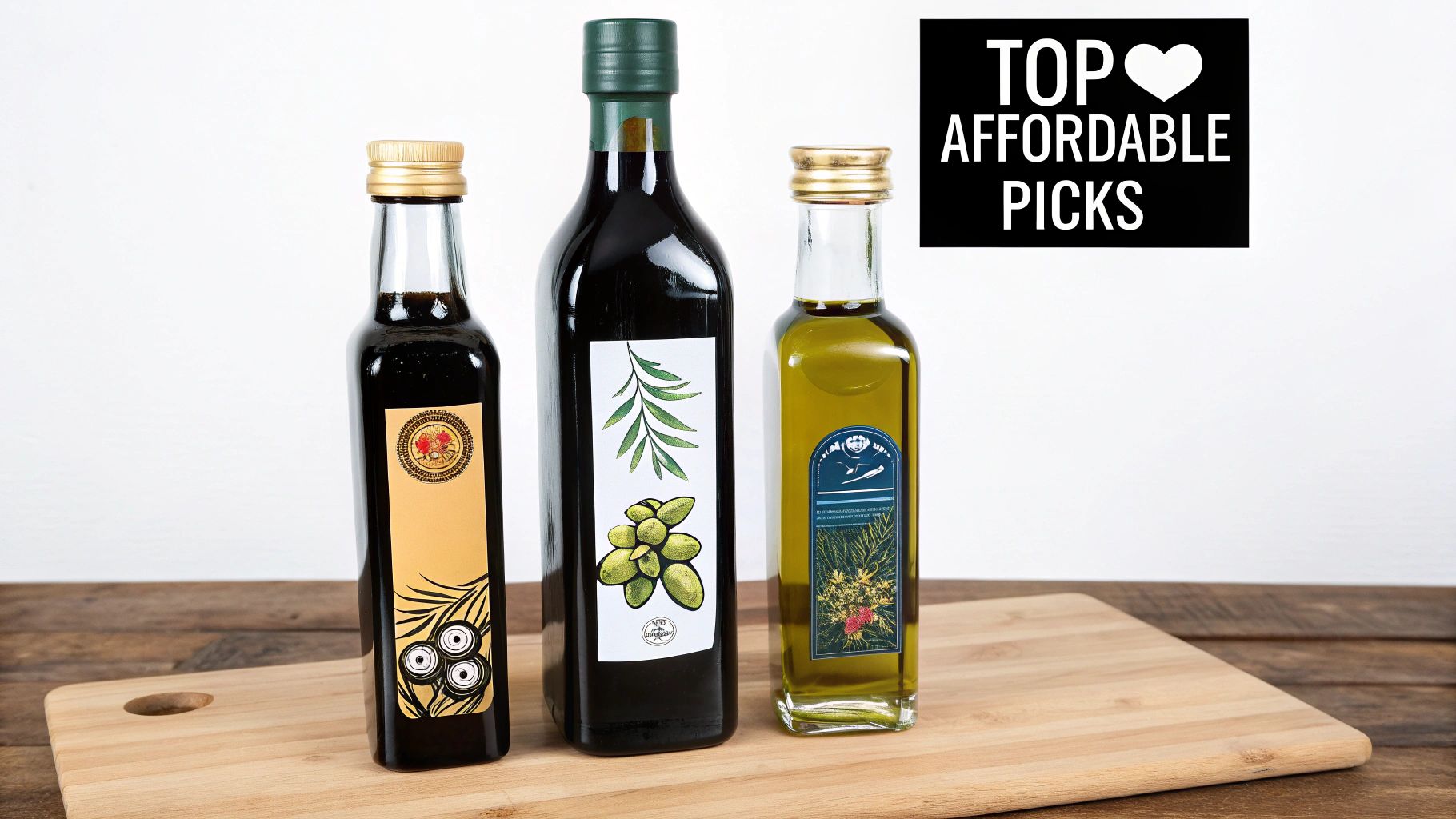
Today, we're going to tear that myth to shreds. The truth is, exceptional flavor and an affordable price can—and should—go hand-in-hand. I'm going to show you how to spot the true champions on the shelf and become the kind of shopper who always finds the hidden gems.
The Real Cost of Olive Oil
Imagine a home cook, utterly defeated by expensive oils that promised the world but delivered only bland disappointment. Fed up, she gambled on something different. She picked up an unassuming, budget-friendly bottle that had one crucial detail the pricey ones were missing: a clearly printed harvest date.
The difference in her kitchen was seismic. Her salad dressings suddenly exploded with flavor. Her sautéed vegetables sang with a fragrance she hadn't experienced before.
This wasn't a lucky guess. She had stumbled upon the core truth of olive oil: freshness and proper production are infinitely more important than a fancy label or a romantic story about a distant Tuscan grove. Many factors influence extra virgin olive oil prices, including production scale, harvesting methods, and transportation. Quality is just one piece of a much larger puzzle.
The most expensive bottle is often just the one that traveled the farthest or paid the most for marketing. True value is found in understanding what makes an oil great, not what makes it costly.
What You Are Actually Paying For
When you grab that high-priced bottle, you're paying for a lot more than what’s inside. The final cost is bloated by things that have zero impact on taste or quality.
These hidden costs often include:
- Elaborate Packaging: Heavy, custom-designed glass bottles and ornate labels that look fantastic on your counter but add dollars to the price.
- Importing Fees: Oils from tiny, boutique estates in Europe rack up punishing expenses in transportation, tariffs, and distribution.
- Marketing Budgets: Those glossy magazine ads and celebrity chef endorsements aren't free. You're footing the bill.
Conversely, the producers behind the best inexpensive olive oils are obsessed with efficiency. They use smart, modern harvesting techniques and practical bottling to deliver a fresh, delicious product to your kitchen without all the unnecessary markup. They are living proof that a small budget can still buy you magnificent flavor, turning your everyday meals into something truly special.
Quick Guide to Spotting Value
When you're at the store, it's easy to get lost in the noise. This table cuts through the clutter, breaking down the most important clues on the label to ensure you're getting a high-quality oil for a fair price.
| Quality Indicator | What to Look For | Why It Matters for Value |
|---|---|---|
| Harvest Date | A specific date (e.g., "Fall 2023"). Avoid "Best By" dates alone. | This is the single best indicator of freshness. The closer to the harvest date, the more flavorful and healthy the oil. |
| Country of Origin | A specific country (e.g., "Product of Spain," "Grown in California"). | Vague terms like "Product of Mediterranean" can mean a blend of old oils. A single origin suggests better traceability. |
| Certifications | Look for seals like COOC (California Olive Oil Council) or PDO/PGI (from Europe). | These seals verify that the oil meets strict quality and production standards, ensuring you're not buying a fraudulent product. |
| Acidity Level | An FFA (Free Fatty Acidity) of 0.5% or lower. Must be below 0.8% for EVOO. | Lower acidity is a sign of healthy olives and careful processing, which directly translates to better flavor and a longer shelf life. |
Ultimately, these clues help you look past the marketing mirage and focus on what's actually in the bottle. A great bottle of olive oil doesn't need to empty your wallet if you know the signs of true quality.
How to Read an Olive Oil Label
Ever feel like you need a secret decoder ring just to buy olive oil? The labels can seem intentionally confusing, cluttered with marketing fluff designed to make you grab the prettiest bottle. Let’s cut through that noise.
Think of it like buying a used car. You wouldn't just kick the tires and admire the shiny paint; you'd pop the hood and inspect the engine. We're going to do the exact same thing, but for olive oil.
It’s time to learn how to ignore the charming pictures of sun-drenched Italian hillsides and focus on the hard facts—the small print that tells the real story of what’s inside the bottle.
The Non-Negotiable Details
When you're in that grocery aisle, your first mission is to find three crucial pieces of information. Ignore everything else until you spot these. They are your shield, especially when you're hunting for a great deal.
-
Extra Virgin Olive Oil (EVOO): This is the highest grade. Period. It guarantees the oil was extracted mechanically—without chemicals or high heat—which protects its phenomenal flavor and health benefits. If the label doesn't say "Extra Virgin," put it back.
-
Harvest Date: Olive oil is a fruit juice. Freshness is everything. Hunt for a specific harvest date, like "Fall 2023." A "Best By" date can be a trap; it's often set two years after bottling, but the oil could have been sitting in a tank for a year before that. Always choose the most recent harvest.
-
Country of Origin: You want to see a specific place named, like "Product of Spain" or "Grown in California." Vague wording like "Product of the Mediterranean" is a huge red flag. It usually means it’s a generic blend of oils from different countries and different ages, a perfect way to hide lower-quality product.
Master these three, and you're already miles ahead of most shoppers. For a much deeper dive into every term you might see, our full guide on olive oil labeling is an invaluable resource.
Decoding Acidity and Certifications
Once you've locked down the basics, two other markers can confirm you've found a true winner. The first is acidity. For an oil to legally be called Extra Virgin, its free fatty acidity (FFA) must be below 0.8%. But the best oils are much lower. A low number is a clear sign that the olives were healthy and processed with great care.
Next, look for a quality seal. In Europe, the gold standard is the PDO (Protected Designation of Origin) seal. This is a rock-solid guarantee that the oil was grown, processed, and bottled in one specific region using time-honored methods. For California olive oil, the COOC Seal offers a similar promise of authenticity and quality.
Think of these certifications as a third-party inspection. They’re an independent stamp of approval saying the producer met incredibly strict standards, which should give you unshakable confidence in your purchase.
The good news is that as more consumers learn what to look for, producers have been forced to elevate their standards. Health-conscious shoppers can now find fantastic, affordable oils that meet these high bars. As Mediterranean producers have perfected cold-pressed methods, costs have fallen, allowing top-notch EVOO to sell for as little as $5 to $10 per liter. These quality oils now make up 20-30% of the market volume.
By learning to spot just a few key details on the label, you give yourself an enormous advantage. You’ll be able to confidently stroll past the deceptively fancy bottles and pick out a genuinely fresh, flavorful, and high-quality olive oil every single time—no matter your budget.
Avoiding Fakes and Olive Oil Fraud
Let's talk about the elephant in the room: not every bottle of olive oil is what it claims to be. It's a sad truth that the industry has its share of con artists, and the last thing you want is to bring home a bottle that’s been stripped of the amazing flavor and health benefits you paid for.
But don't worry. This isn't about scaring you away from olive oil. It’s about arming you—giving you the tools to see past the marketing lies and spot the genuine article.
We're going to pull back the curtain on how low-grade oils get passed off as the good stuff. Once you know their tricks, you can feel certain that the inexpensive olive oil you choose is genuinely great. Think of yourself as a detective in the grocery aisle.
Your Fraud-Detector Toolkit
Spotting a fake often means paying attention to the tiny details that shady producers pray you'll overlook. The first clue is almost always the price. Yes, we're hunting for a bargain, but a price that seems impossibly low is a massive red flag.
If you see a giant bottle of extra virgin olive oil for a price that dramatically undercuts everything else, your alarm bells should scream. Producing quality olive oil costs money, and a price that feels too good to be true almost always is. It could be diluted with cheap seed oils or, worse, old and rancid oil that's been chemically deodorized.
Next, judge the book by its cover—or rather, the oil by its container. Light is one of olive oil's mortal enemies; it breaks the oil down, destroying its flavor and antioxidants with shocking speed.
A producer who truly cares about their product will protect it from light. That’s why you should always reach for oils sold in dark green glass, tins, or other opaque containers. A clear glass bottle is a dead giveaway that the brand cares more about looking pretty on the shelf than delivering a quality product.
Critical Clues on the Label
The label is where the real detective work pays off. As we've covered, the lack of a harvest date should make you immediately suspicious. Good producers are proud of their fresh product and will display that date like a badge of honor. It's their proof of quality.
If all you find is a "best by" date, be careful. That date is usually just two years from when the oil was bottled, but who knows how long it sat in a massive tank before that? For a much deeper look into these schemes, our full guide on how to spot fake olive oil is a must-read.
Finally, squint at the fine print about where the oil came from. Watch out for these common shell games:
- Vague Language: Wording like "Packed in Italy" is a classic deception. It doesn’t mean the olives were grown there—it often means oils from all over the world were simply blended and bottled in Italy.
- A Laundry List of Countries: If you see "Product of Spain, Tunisia, Greece, and Turkey," you're almost certainly looking at a low-quality blend of oils of different ages and grades, sourced from the cheapest suppliers available.
Keep these simple checks in your back pocket, and you'll navigate the olive oil aisle like a seasoned expert. You can shield yourself from fraud and ensure that your budget-friendly bottle is also a high-quality treasure.
Our Top Picks for Inexpensive Olive Oil
You've learned how to read labels like a pro and spot the imposters. Now it's time to put that knowledge into action with a shopping list you can trust. This is where the theory ends and the delicious results begin—our handpicked selection of the best inexpensive olive oil brands that consistently deliver on quality without making your wallet weep.
These aren't just random names. Each bottle here has earned its place by proving that great flavor, freshness, and honest production can be affordable. We’ve focused on oils that are widely available, so you can walk into your local supermarket with total confidence and grab a bottle that will genuinely make your cooking better.
California Olive Ranch Global Blend Extra Virgin Olive Oil
Think of this as the reliable, everyday workhorse of your kitchen. While California Olive Ranch built its reputation on 100% California-grown oil, their Global Blend is a masterclass in affordable quality. They partner with carefully vetted growers in Argentina, Chile, and Portugal to create a balanced, mild, and buttery oil that’s fantastically versatile.
It’s perfect for a gentle sauté, roasting vegetables, or whipping up a quick vinaigrette. The flavor is clean and never bossy, which is exactly what you want in an all-purpose oil. Because they apply their strict California standards to all their partners, you get a dependable, fresh product every single time. It’s the smart, no-fuss pick for daily use.
Kirkland Signature Organic Extra Virgin Olive Oil
Don't let the Costco-sized bottle intimidate you—what's inside is the real deal. Kirkland has a reputation for demanding ruthless standards from its suppliers, and their olive oil is a prime example. This oil is typically sourced from Italy or a blend of top Mediterranean producers, and it consistently meets the stringent requirements for both organic and extra virgin certification.
It has a slightly more robust, fruity flavor with that pleasant peppery finish that signals healthy, polyphenol-rich olives. This makes it an outstanding choice for finishing dishes, dipping fresh bread, or dressing a hearty salad. When you calculate the price per liter, the value is simply unbeatable.
The rise of high-quality private label brands has been a revolution for consumers. It’s proof that a trusted store brand can often outperform more expensive, well-marketed names on the shelf.
This shift didn't happen by accident. Olive oil prices have become more stable, with European wholesale prices decreasing by 10-15% between 2010 and 2025. Massive production from countries like Spain has made quality EVOO widely available, allowing supermarket brands to offer fantastic products near USD 8 per liter. You can dig into more of these market trends at the International Olive Council website.
The image below gives you a clear visual of how price and quality ratings tend to line up across different olive oil tiers.
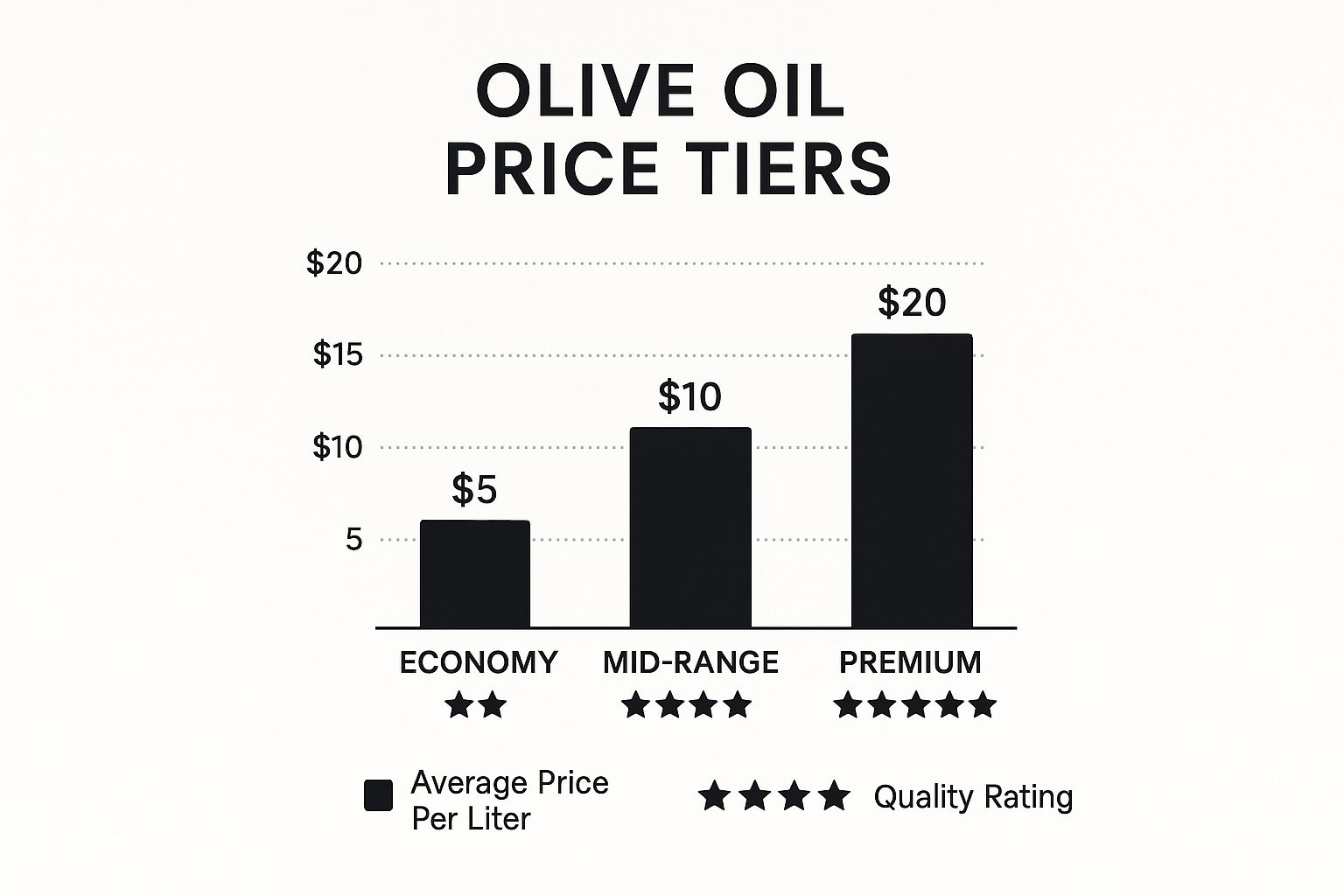
As you can see, while the premium oils score highest, those mid-range options offer outstanding quality for their price. They represent the sweet spot for most home cooks.
Top Budget-Friendly Olive Oils Compared
To make your decision even easier, here's a quick look at how our top picks stack up. This table breaks down their flavor profiles and best uses, so you can grab the right bottle for the right job.
| Brand | Flavor Profile | Best For | Price Range |
|---|---|---|---|
| California Olive Ranch Global Blend | Mild, buttery, and smooth | Sautéing, roasting, everyday vinaigrettes | $$ |
| Kirkland Signature Organic | Fruity with a distinct peppery finish | Salad dressings, dipping, finishing dishes | $ |
| Bertolli Originale | Well-rounded, classic, and consistently mild | General cooking, sauces, marinades | $$ |
Ultimately, the best choice comes down to your personal taste and how you plan to use it. For an all-rounder, California Olive Ranch is tough to beat. For finishing dishes with a bit more punch, Kirkland delivers incredible value.
Bertolli Extra Virgin Olive Oil Originale
A classic for a reason, Bertolli's Originale blend has been a supermarket fixture for decades. It's crafted for absolute consistency, offering a smooth, well-rounded flavor that works beautifully in just about any dish imaginable.
It's a reliable, everyday oil that brings a touch of the Mediterranean to your cooking without any drama. If you just need one bottle in your pantry for general use, this is a solid, widely available choice you can always count on.
Smart Strategies for Finding Olive Oil Bargains
It's one thing to find a cheap bottle of olive oil. It's another thing entirely to find one that's a genuinely good value. Getting the best bang for your buck requires a bit of insider knowledge—the kind that elevates you from a regular grocery shopper into a savvy bargain hunter who knows how to get maximum flavor for every dollar spent.
The real secret isn't just waiting for a sale sticker. It's knowing where to look and what to look for. Your local supermarket is a fine starting point, but the best deals are often hiding in plain sight. Big-box stores, for instance, use their colossal purchasing power to secure great oils at prices smaller shops simply can't match.
Think Beyond the Glass Bottle
One of the simplest ways to save is to rethink the packaging. Glass bottles are the standard, but buying your go-to everyday olive oil in a large tin can dramatically cut your cost per ounce.
A 3-liter tin might feel like a huge commitment, but it almost always costs less than buying three separate 1-liter bottles. Over time, those savings are substantial. Plus, this strategy comes with a bonus: the tin perfectly protects the oil from its greatest enemy, light. Just pour what you need for the week into a smaller, dark glass bottle for your countertop and keep the tin sealed in a cool, dark pantry.
If you're looking to stretch your food budget even further, applying these kinds of smart shopping tactics to your overall healthy meal planning on a budget can make a huge difference.
Uncovering Hidden Gems and Market Trends
Here’s another pro tip: do not overlook high-quality private label or store brands. It's easy to dismiss them, but these oils are often made by the exact same respected producers who sell their own branded oils for a much higher price. You're essentially getting the same quality juice without paying extra for the fancy label.
The global olive oil market is booming, which is fantastic news for consumers. It was valued at around USD 13.05 billion in 2024 and is projected to grow to USD 18.85 billion by 2032. All that competition means producers are working harder than ever to offer quality at a good price, making it easier to find the best inexpensive olive oil. You can see more details on this growing market on Fortune Business Insights.
Knowing the retail landscape is a huge advantage. Our guide on where to buy good olive oil breaks down the pros and cons of different places to shop, from online specialty stores to your neighborhood market, so you can zero in on the best sources for value right where you live.
Common Questions About Budget Olive Oil
Even after you've learned to spot a great deal, a few nagging questions can remain. It's natural to feel a bit skeptical when you find a fantastic, inexpensive olive oil that seems too good to be true. Let’s eliminate those final doubts with some straight answers, so you can use your budget-friendly find with total confidence.
Can I Really Cook With Inexpensive Extra Virgin Olive Oil?
Yes. A thousand times, yes. This is one of the most stubborn and profitable myths out there. For years, marketing has tried to convince us that Extra Virgin Olive Oil is only for drizzling and that you need a refined “light” oil for cooking. That is simply false.
Most quality extra virgin olive oils have a smoke point between 375°F and 400°F. That is more than high enough for everyday sautéing, roasting, and pan-frying. Not only is it perfectly safe, but cooking with a good, inexpensive EVOO infuses your food with far more flavor and health benefits than a flavorless, highly processed oil ever could.
What's the Real Difference Between a Ten- and Thirty-Dollar Bottle?
The biggest differences usually boil down to three things: complexity, scale, and story. Think of it like the difference between a simple, delicious table wine and a rare vintage from a single, legendary vineyard. Both are wonderful, but they serve different purposes.
A $30 bottle often comes from a small, single estate that might use a rare olive varietal. The result is an artisanal oil with a complex, nuanced flavor—the kind of oil you want to savor raw as a finishing touch.
A $10 bottle is typically produced on a much larger scale, often blending oils to create a consistently pleasant but less intricate taste. It offers phenomenal value for daily cooking, dressings, and marinades where those subtle, high-end notes aren't the star of the show.
With the expensive bottle, you're paying for craftsmanship and rarity. With the inexpensive one, you're getting reliable quality that's perfect for all-purpose use.
How Should I Store My Olive Oil To Make It Last?
Proper storage is the single most important thing you can do to protect your investment—no matter what you paid. The three sworn enemies of olive oil are heat, light, and air. They are on a relentless mission to turn your delicious oil rancid.
Here is your battle plan:
- Keep it cool: Store your oil in a dark place away from any heat, like a pantry or cupboard. Never, ever leave it on the counter next to your stove.
- Keep it dark: Always buy oil in a dark glass bottle or an opaque tin. If you buy a large tin, decant a smaller amount into a dark bottle for daily use. This minimizes air exposure for the bulk of your oil.
- Keep it sealed: Twist that cap on tightly after every single use. Oxygen is a primary cause of spoilage.
Following these simple rules will keep your oil fresh and flavorful for as long as possible. If you're ever worried about its longevity, check out our full guide on how long olive oil lasts and what signs to look for to ensure you're always using it at its peak.
Is "Light" Olive Oil a Healthier Option?
No. This is perhaps the most misleading term in the entire grocery aisle. The word “light” refers only to the oil’s flavor and color—it has nothing to do with calories or health benefits. All olive oils, from extra virgin to refined, contain the exact same number of calories.
"Light" olive oil is a highly refined product that has been stripped of its color, aroma, and, most importantly, the very antioxidants and polyphenols that make olive oil so good for you. You are always, without exception, better off choosing the best inexpensive "Extra Virgin" olive oil you can find. It’s the real deal, packed with all the flavor and goodness you’re looking for.
At Learn Olive Oil, we believe that everyone deserves to enjoy the incredible taste and health benefits of high-quality olive oil, no matter their budget. Our mission is to give you the knowledge and confidence to choose the perfect bottle for your kitchen. Explore our expert guides and start your journey into the world of this liquid gold today.
https://learnoliveoil.com
 Learn Olive Oil
Leave a comment