At its heart, the real difference between canola oil and olive oil is a tale of two philosophies. It’s a story of source, flavor, and purpose. One is a silent workhorse, born of modern science, engineered for the searing heat of your frying pan. The other is liquid history, pressed from ancient fruit, a flavorful artist meant to be tasted, not just used.
The choice you make isn't just about cooking. It's about what you need from that bottle. Are you looking for a quiet, reliable partner for a deep-fry, or are you seeking a bold, flavorful finishing touch that makes a simple dish sing?
Choosing Your Champion in the Kitchen
Stepping into the cooking oil aisle can feel like walking into a culinary battleground. In one corner, canola oil—the affordable, unassuming powerhouse you’ll find in nearly every restaurant kitchen on earth. In the other, olive oil—the celebrated “liquid gold” of the Mediterranean, haloed by tales of heart health and artisanal flavor.
But here’s a secret the experts know: this isn’t a fight for one true champion. It’s about understanding the unique genius of each and unleashing its power at the right moment.
This guide will slice through the confusion. It’s a no-nonsense, real-world look at what makes each oil tick. My goal is simple: to arm you with the confidence to walk down that aisle, grab exactly the right bottle for the job, and know, without a doubt, why you’ve made the perfect choice. This kind of deep-dive clarity is invaluable, much like guides that help food lovers by exploring the differences between various cuisines like Chinese and Japanese food.
A Quick Glance at the Contenders
Before we dive deep, let’s get the lay of the land. Think of this as the tale of the tape—the crucial stats that define these two kitchen heavyweights.
| Feature | Canola Oil | Olive Oil (Extra Virgin) |
|---|---|---|
| Source | Seeds of the rapeseed plant | Pressed from fresh olives |
| Flavor Profile | Neutral, light, almost tasteless | Varies from fruity and peppery to buttery |
| Best For | Frying, baking, high-heat searing | Dressings, finishing, light sautéing |
| Smoke Point | High (around 400°F / 204°C) | Lower (around 375°F / 191°C) |
| Key Nutrient | Good source of omega-3s | Rich in monounsaturated fats & antioxidants |
If you remember only one thing, let it be this: Canola oil is a utility player, engineered for heat and invisibility. Extra virgin olive oil is a finishing artist, designed to be the star.
Grasping this fundamental truth is the secret to mastering both. And remember, not all olive oil is created equal. The difference between a refined, pale olive oil and a grassy, peppery extra virgin is a chasm. You can explore this vast landscape in our guide to the different types of olive oil.
Now, let's pull back the curtain on how they're made, what they truly offer your body, and where each one belongs in your kitchen.
The Surprising Origins of Two Kitchen Staples
Every bottle of oil on your shelf has a story. A story that begins not in a factory, but in a field. And once you hear it, the real difference between canola oil and olive oil becomes blindingly clear. These kitchen staples don't just come from different plants; they emerge from entirely different worlds, shaped by history, technology, and tradition.
One story begins in the sun-drenched, ancient groves of the Mediterranean—a tale of patience, heritage, and the earth itself. The other unfolds on the vast, modern farms of North America—a narrative of scientific innovation and relentless efficiency. These profoundly different journeys from plant to pantry are the key to everything else—from their flavor and price to their true purpose in your kitchen.
Olive Oil: Ancient Roots and Terroir
Olive oil's story is practically as old as civilization itself. For thousands of years, olive trees have dug their roots into the rocky soils of places like Greece, Italy, and Spain. The oil made here isn't just a commodity; it's a cultural artifact, deeply connected to the land, or terroir.
This sacred bond means an olive oil from Tuscany will taste completely different from one harvested in Andalusia. The specific climate, soil, and even the timing of the harvest all leave their indelible fingerprints on the final product. That's why a high-quality extra virgin olive oil has such a complex, vibrant flavor profile—you’re literally tasting a place in time.
The process is almost deceptively simple, a ritual honed over centuries:
- Harvesting: Olives are plucked from the trees, often by hand, at the single perfect moment of ripeness.
- Pressing: The fruit is crushed, usually within hours of being picked, to capture its peak freshness and flavor. This is a purely mechanical act—no scorching heat, no chemical shortcuts.
- Separation: The resulting paste is spun in a centrifuge to separate the pure, liquid gold from the water and fruit solids.
This straightforward, low-intervention method preserves the natural antioxidants and polyphenols that give olive oil its celebrated health benefits and that signature peppery finish. The entire goal is to bottle the very essence of the olive in its purest form. For a deeper dive into this rich history, you can explore the fascinating origins of olive oil and its journey through time.
Canola Oil: A Modern Invention
Canola oil, on the other hand, is a triumph of 20th-century ingenuity. Its story doesn't begin in ancient groves but in Canadian laboratories during the 1970s. Scientists were tasked with a challenge: to tame the rapeseed plant, which naturally produced an oil high in erucic acid—a compound not ideal for human consumption.
Through traditional plant breeding, they developed a new variety of rapeseed with dramatically lower levels of this acid. They named it "canola," a portmanteau of "Canadian oil, low acid." This wasn't a discovery; it was an invention, engineered from the ground up for specific traits like a neutral flavor and a high tolerance for heat.
Canola oil was engineered to be a blank canvas. Its success lies not in what it does, but in what it doesn't do—it doesn't add flavor, it doesn't burn easily, and it doesn't carry the premium cost of a terroir-driven product.
The production process reflects this ruthless focus on efficiency. It's a highly refined system designed to create a consistent, stable, and affordable product—which is precisely why it has become a global workhorse for frying, baking, and large-scale food manufacturing.
A Head-to-Head Nutritional Showdown
Strip away the labels and the marketing, and you'll find the soul of an oil in its nutritional panel. This is where the true difference between canola oil and olive oil is written in the language of molecules—not as a simple "good vs. bad" contest, but as a tale of two entirely different chemical blueprints. To truly understand them, you must look beyond mere calories and into the very heart of the fats themselves.
On the surface, they appear similar. Both are plant-based, cholesterol-free, and pack around 120 calories per tablespoon. But that's where the casual comparison ends. The profound distinction lies in their fatty acid profiles and the unique micronutrients each carries.
The World of Fats: Monounsaturated, Polyunsaturated, and Saturated
Think of fatty acids as the building blocks of an oil. Their specific mix dictates how an oil behaves both in your body and on your stove.
Extra virgin olive oil is a veritable temple to monounsaturated fats, with the celebrated oleic acid making up a staggering 73% of its profile. This is the fat that has earned the Mediterranean diet its golden reputation for supporting heart health.
Canola oil holds its own with a respectable 63% monounsaturated fat content, making it another solid choice for heart-conscious cooking. Where it veers onto a different path is in its other fat components.
You'll find a much higher concentration of polyunsaturated fats in canola oil (28%) compared to olive oil (around 11%). This category includes both omega-6 and omega-3 fatty acids, essential for everything from brain function to reducing inflammation. In fact, canola oil’s primary nutritional claim to fame is its balanced 2:1 ratio of omega-6 to omega-3.
Nutritional Snapshot: Canola Oil vs. Olive Oil per Tablespoon
To truly see the difference, a side-by-side comparison is essential. This table breaks down the key nutritional facts for a standard one-tablespoon serving.
| Nutrient | Canola Oil | Olive Oil (Extra Virgin) |
|---|---|---|
| Calories | 124 | 120 |
| Total Fat | 14 g | 14 g |
| Monounsaturated Fat | 8.9 g | 10.2 g |
| Polyunsaturated Fat | 3.9 g | 1.4 g |
| Saturated Fat | 1 g | 1.9 g |
| Vitamin E | 16% DV | 13% DV |
| Vitamin K | 10% DV | 11% DV |
As you can see, while total calories and fat are nearly identical, the type of fat varies dramatically. Olive oil is the undisputed king of monounsaturated fats, while canola oil delivers a bigger dose of polyunsaturated fats.
The Antioxidant Powerhouse: Extra Virgin Olive Oil
Here is where extra virgin olive oil truly leaves its competitor behind. It's more than just fat; it's a living source of polyphenols. These are potent antioxidants that act like a personal bodyguard for your body's cells, defending them against the damage of free radicals.
This astonishing antioxidant profile is the secret weapon behind many of extra virgin olive oil’s most powerful health claims. These compounds deliver anti-inflammatory properties and are responsible for that classic peppery kick you taste in a truly great oil.
Refined oils like standard canola, on the other hand, are stripped of these delicate compounds. The high-heat processing and chemical solvents used in their production obliterate them. While canola oil does offer some Vitamin E (another antioxidant), it simply lacks the raw, unrefined power of a high-quality extra virgin olive oil. If you want to dive deeper, you can explore the complete olive oil nutrition facts to see just how unique its properties are.
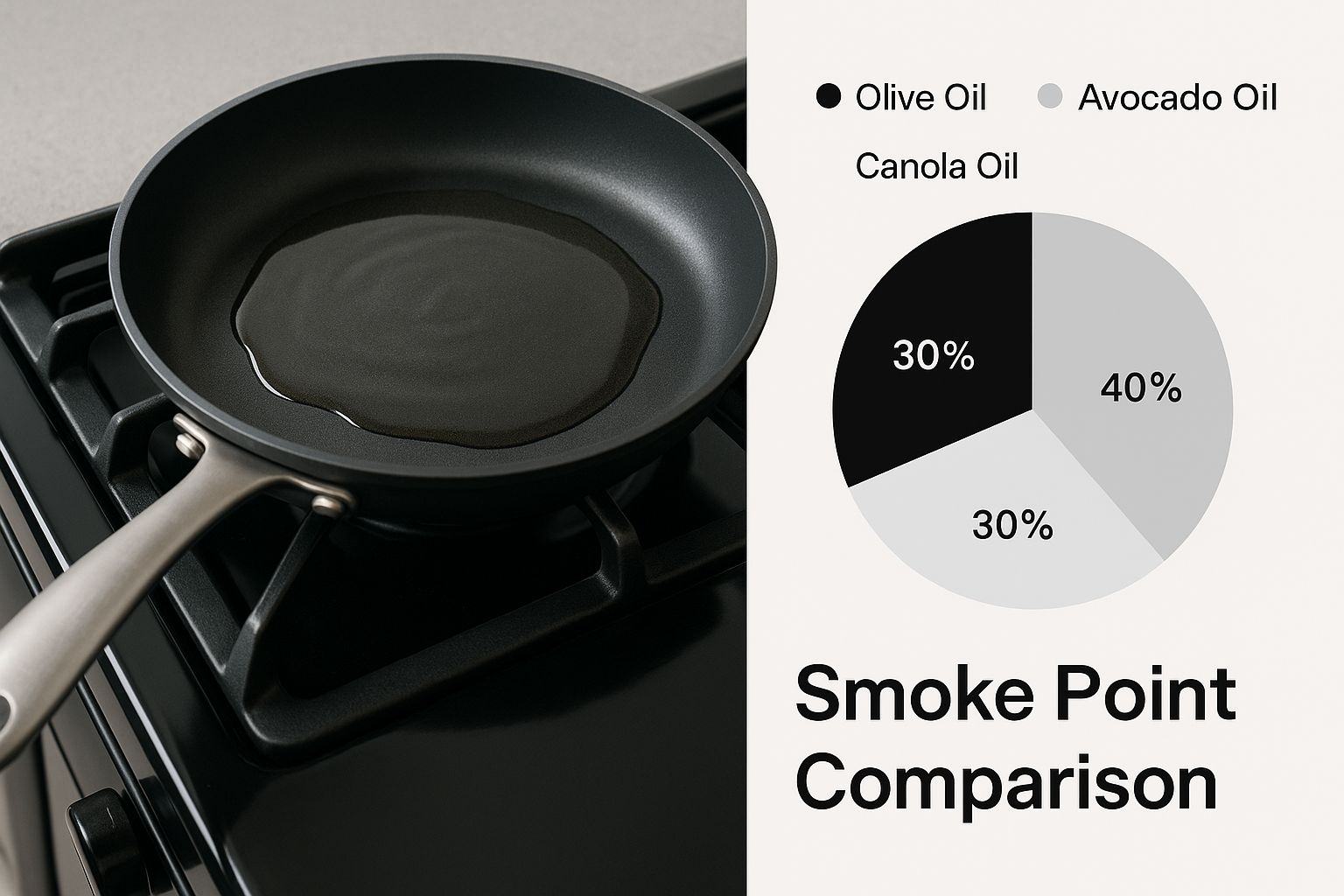
This visual guide shows how these nutritional differences directly impact how you should use them in the kitchen, especially when it comes to heat.
Vitamins and Minerals: The Final Tally
When we look at vitamins, both oils bring something to the table. They are both excellent sources of Vitamin E and Vitamin K, fat-soluble vitamins crucial for skin health and proper blood clotting.
Here’s a quick breakdown of their vitamin content per tablespoon:
- Vitamin E: Canola oil provides about 16% of your Daily Value (DV), with olive oil close behind at 13%.
- Vitamin K: Both are solid sources here, too. Canola delivers 10% of the DV, and olive oil offers 11%.
Ultimately, this nutritional showdown reveals not a single winner, but two specialists. Extra virgin olive oil’s strength is its unparalleled monounsaturated fat and polyphenol content, making it the perfect choice for raw applications or low-heat cooking where those precious benefits can be preserved. Canola oil offers a different kind of utility with its balanced fatty acid profile, making it a versatile, workhorse oil for everyday cooking.
Choosing the Right Oil for Every Dish
This is where theory meets the fire. Because using the wrong oil can instantly sabotage a dish, turning a perfectly crisp piece of chicken into a greasy tragedy or making a delicate vinaigrette taste bitter and strange. The true difference between canola oil and olive oil isn't just an academic curiosity; it's a practical choice that dictates the final texture, flavor, and success of your food.
Forget one-size-fits-all rules. To cook with authority, you need a playbook, not a rigid set of instructions. This means understanding specific culinary situations and knowing with certainty which oil will be a quiet supporter and which one must be the star of the show.
Canola Oil: The High-Heat Workhorse
When the heat is on, canola oil is your undisputed champion. Its power flows from two key attributes: a completely neutral flavor and a high smoke point, which sits at a robust 400°F (204°C). That stability is precisely what you need for cooking methods that demand intense, unforgiving heat.
Think of it as the ultimate utility player in your kitchen arsenal. It excels in tasks where you want the food’s own flavor to take center stage, without a single whisper of interference from the cooking fat.
- Deep-Frying: That high smoke point is your guarantee that fried chicken or French fries will cook to a flawless golden brown. The oil won't break down, preventing those nasty off-flavors and harmful compounds.
- Searing: To forge that beautiful, deeply browned crust on a steak or scallop, you need a screaming-hot pan. Canola oil can take the heat without filling your kitchen with smoke.
- Baking: Its utter neutrality makes it the secret weapon in cakes, muffins, and brownies. It provides essential moisture without ever competing with the vanilla, chocolate, or fruit.
Canola oil is the invisible force in your kitchen. Its job is to facilitate perfect cooking—crisping, browning, and baking—while remaining completely in the background. It delivers results without demanding the spotlight.
This profound reliability is why it’s the bedrock of professional kitchens and the go-to for any home cook who values consistency. When the recipe calls for high heat, canola oil provides a safety net, ensuring your food cooks evenly and cleanly, every single time. Its versatility is crucial, and for certain dishes, like choosing oil for pizza, the right oil makes all the difference.
Olive Oil: The Flavorful Finisher
Extra virgin olive oil, on the other hand, is all about flavor. It’s not meant to be a silent partner; it’s an ingredient, chosen specifically for the distinct peppery, grassy, or fruity character it contributes to a dish. Its more delicate soul means it is best suited for gentle cooking or, even better, no cooking at all.
Using a beautiful, expensive extra virgin olive oil for deep-frying is more than a waste of money—it's a culinary crime. The intense heat murders its complex flavors and vaporizes its beneficial polyphenols. You must save it for moments where its taste can be truly savored.
Here is where extra virgin olive oil reigns supreme:
- Vinaigrettes and Dressings: This is olive oil's natural habitat. Its robust flavor is the perfect foundation for a classic salad dressing, emulsifying with vinegar or lemon juice to create a rich, satisfying cloak for fresh greens.
- Finishing and Drizzling: A final, generous swirl of good olive oil over a finished soup, a plate of pasta, or a piece of grilled fish adds a layer of fragrant complexity that awakens the entire dish.
- Gentle Sautéing: For coaxing the sweetness from garlic, onions, or delicate vegetables over low to medium heat, olive oil is magnificent. It infuses the ingredients with its characteristic flavor without ever approaching a dangerous temperature.
Understanding the olive oil smoke point is the secret to using it wisely, preserving both its health benefits and its incredible taste. Think of it as a final benediction—an enhancement that breathes life into a dish right before it reaches the table. Your pantry isn't complete without both.
Understanding Production, Global Scale, and Cost
Have you ever stood in the grocery aisle and wondered why a bottle of good extra virgin olive oil costs five, ten, even twenty times more than a jug of canola oil? The answer goes far beyond clever marketing. It’s a story rooted in agriculture, mechanics, and two completely different economic philosophies.
This chasm in price is perhaps the most obvious difference between canola oil and olive oil, and it all begins in the dirt. One oil is the product of massive industrial efficiency, built for volume and affordability. The other is a product of tradition, patience, and often, back-breaking physical labor.
The Canola Economy of Scale
Canola oil is inexpensive because its production is colossal. This isn't just farming; it's an agricultural empire. The rapeseed plant is a tough, adaptable crop grown across millions of acres in places like Canada, China, and the United States, all with the help of highly mechanized farming.
Massive combines and automated systems handle everything from planting to harvesting. This relentless efficiency continues right into the processing plants. There, an industrial process of refining, bleaching, and deodorizing (RBD) wrings every last drop of oil from the seeds.
This entire operation is fine-tuned for a single, overriding goal: to create a consistent, stable, and incredibly inexpensive cooking oil for the global market. The math is simple—high volume plus high efficiency equals a low price tag for you.
This system is a marvel of modern food engineering, making canola the default choice for restaurants and anyone cooking on a budget. The focus is purely on yield, not on preserving delicate nuances of flavor or aroma.
The Artisan World of Olive Oil
The world of high-quality olive oil, by contrast, often feels more like a craft than an industry. Olive trees are fussy, demanding a specific Mediterranean climate to truly thrive. They often grow on ancient, terraced hillsides where you simply cannot operate large machinery.
This means the harvest is frequently done by hand—a slow, labor-intensive process requiring skilled workers who can judge the perfect moment of ripeness. And time is the enemy. Olives must be pressed within hours of being picked to stop them from oxidizing, which would ruin their flavor and destroy their precious polyphenols.
This hands-on, meticulous method is a world away from the automated canola process. The olive oil manufacturing process has more in common with fine winemaking, where every step is about protecting the integrity of the original ingredient.
The difference in sheer volume is staggering. Globally, farmers produce over ten times more rapeseed oil (canola's source) than olive oil. Recent figures put rapeseed oil production around 34.10 million metric tons, while olive oil is a mere 3.02 million metric tons. This enormous gap in supply is a major reason for the price difference you see at the store.
So when you buy canola oil, you're paying for agricultural efficiency. When you invest in a premium olive oil, you're investing in craftsmanship, climate, and a tradition where quality is the only thing that matters.
The Final Verdict: Which Oil Belongs in Your Pantry?
After breaking down their origins, nutritional secrets, and battlefield performance in the kitchen, we arrive at the final question. But here’s the truth: the real answer to the difference between canola oil and olive oil isn't about crowning one winner. The "better" oil is simply the right oil for the job. And no, that isn’t a cop-out—it’s the fundamental secret to a well-run, intelligent kitchen.
The question isn't which oil you should own, but when you should reach for each bottle. Think of it as building a culinary toolkit where every instrument has a specific, invaluable purpose.
The Case for Canola Oil: Your Kitchen Workhorse
For the everyday home cook who values practicality and reliability, canola oil is the clear champion for specific tasks. If you are doing any high-heat searing, deep-frying, or baking where a neutral flavor is non-negotiable, canola is the right tool. Its impressive stability and wallet-friendly price make it an indispensable utility player.
It's the silent partner that allows the pure flavor of your crispy fried chicken or delicate vanilla cake to shine. Its true value lies in its consistent, unobtrusive performance under the most intense pressure.
The Case for Olive Oil: Your Flavorful Artist
On the other hand, for the health-conscious foodie who views cooking as a creative act, a quality extra virgin olive oil is irreplaceable. When you want to add a peppery, fruity finish to a salad, build a zesty vinaigrette, or gently sauté garlic, nothing else even comes close. Its rich antioxidant profile and bold, assertive flavor are its greatest strengths.
Olive oil is an active ingredient, a final flourish that transforms a simple meal into something memorable. You choose it for what it adds to the dish, not for its ability to stay out of the way.
The smartest take is that a well-stocked kitchen doesn’t choose—it embraces both. You need the reliable workhorse and the flavorful artist. One is for function; the other is for flair.
The price tag drives this point home. The premium cost of extra virgin olive oil, which can range from USD 3,000 to 5,500 per metric ton in specialty markets, is a direct reflection of its labor-intensive production and nuanced quality. Canola oil, thanks to large-scale mechanized farming, remains one of the most affordable oils on the planet. That price gap isn't arbitrary; it reflects their completely different journeys from field to bottle. You can find more vegetable oil market dynamics on coherentmarketinsights.com.
So, stop thinking of it as a competition. See them as partners. Canola oil has your back for the hot, demanding jobs, while extra virgin olive oil is there to add that final, perfect touch of flavor and elegance.
Common Questions About Canola and Olive Oil
Even with all the details, a few stubborn questions always seem to surface in the cooking oil aisle. Let’s tackle these head-on and clear up the confusion for good, so you can feel confident about what you’re bringing into your kitchen.
Is Canola Oil Unhealthy Because It's So Processed?
It’s true that most canola oil is refined, but that doesn't automatically make it a villain. The refining process is precisely what gives it a neutral flavor and makes it stable enough for high-heat cooking. It remains a fantastic source of unsaturated fats, particularly the monounsaturated kind.
The main concern you hear about involves the chemical solvents sometimes used for extraction. If that's something that worries you, there’s an easy solution—just look for cold-pressed or expeller-pressed on the label. Those methods extract the oil mechanically, skipping the chemicals entirely. For everyday frying and searing, however, regular canola oil is a perfectly safe and effective option.
Can I Just Use Extra Virgin Olive Oil for Everything?
This is one of the most common—and costly—mistakes a home cook can make. The short answer is an emphatic no. Your beautiful bottle of extra virgin olive oil has a relatively low smoke point, around 375°F (190°C), and is brimming with delicate, peppery flavors and health-giving polyphenols.
When you blast extra virgin olive oil with high heat, you're not just ruining its amazing taste. You are incinerating the very antioxidants that make it so good for you and potentially creating harmful compounds in the process.
Save that liquid gold for where it can truly shine—in salad dressings, as a final drizzle over pasta or soup, or for dipping a crust of good bread. For any task that requires serious heat, reach for a more suitable oil.
So, Which Oil Is Really Better for My Heart?
This is the big one, isn't it? The truth is, both oils are excellent for your heart because they are packed with unsaturated fats. This isn't a battle of "good" versus "bad."
That said, extra virgin olive oil often gets the edge from nutrition experts for two key reasons:
- Monounsaturated Fats: It is phenomenally high in oleic acid, a fatty acid with a rock-solid reputation for supporting cardiovascular health.
- Antioxidant Power: The polyphenols in EVOO are potent anti-inflammatories that are fantastic for your entire cardiovascular system.
But don't dismiss canola oil. It also boasts a great monounsaturated fat profile and offers a healthy balance of omega-3 and omega-6 fatty acids. The smartest approach isn't an either/or dilemma; it's about incorporating a variety of healthy fats into your diet. Both of these oils have an important place in a heart-healthy kitchen.
At Learn Olive Oil, we believe that knowing the story behind your oil turns cooking from a routine into an art. Dive into the incredible world of premium olive oil and find a bottle that speaks to you. Start your journey at https://learnoliveoil.com.

 Learn Olive Oil

Leave a comment