Stand in any grocery aisle, and you’ll face a wall of olive oil bottles, each whispering promises of quality and flavor. But behind the fancy labels and rustic charm lies a simple truth most people never discover. The vast differences in olive oil types aren't a matter of marketing magic; they come down to two cold, hard facts: how the oil was made and its final acidity.
Imagine this: Extra Virgin Olive Oil is like fresh-squeezed juice, pulled directly from the fruit—pure, unadulterated, and bursting with life. Now, picture the oils labeled ‘Pure’ or ‘Light.’ These have been put through an industrial refining process, a sort of flavor-stripping boot camp that leaves them neutral, colorless, and a world away from their vibrant origins.
Your Quick Guide to Olive Oil Differences
Let's cut through the noise. The real story of olive oil is written in the press, not in the marketing department. Understanding the chasm between Extra Virgin, Virgin, and Refined oils is the secret to unlocking which one will make your salad dressing sing and which one belongs in a hot frying pan.
Everything—from the oil's peppery bite to its smoke point—is a direct consequence of how it was extracted and treated. This chart lays out the unvarnished truth, giving you a clear-cut guide to grabbing the right bottle for the right job, every single time.
Olive Oil At-a-Glance: Your Quick Comparison Chart
Here’s the simple breakdown that will demystify the main categories you'll find on the shelf.
| Olive Oil Type | Extraction Method | Flavor Profile | Best For |
|---|---|---|---|
| Extra Virgin | Cold-Pressed (Mechanical) | Robust, fruity, peppery, can be bitter | Dipping, dressings, finishing dishes, light sautéing |
| Virgin | Cold-Pressed (Mechanical) | Milder than EVOO, slight taste defects | General cooking, sautéing, roasting |
| Refined/Pure | Heat/Chemical Processing | Neutral, very mild, almost flavorless | High-heat frying, baking, when you don't want to taste the oil |
This table gives you the essentials, but never forget that within each category—especially Extra Virgin—lies a universe of flavor, from buttery and smooth to intensely grassy and pungent, waiting to be discovered.
The Journey That Defines Every Bottle
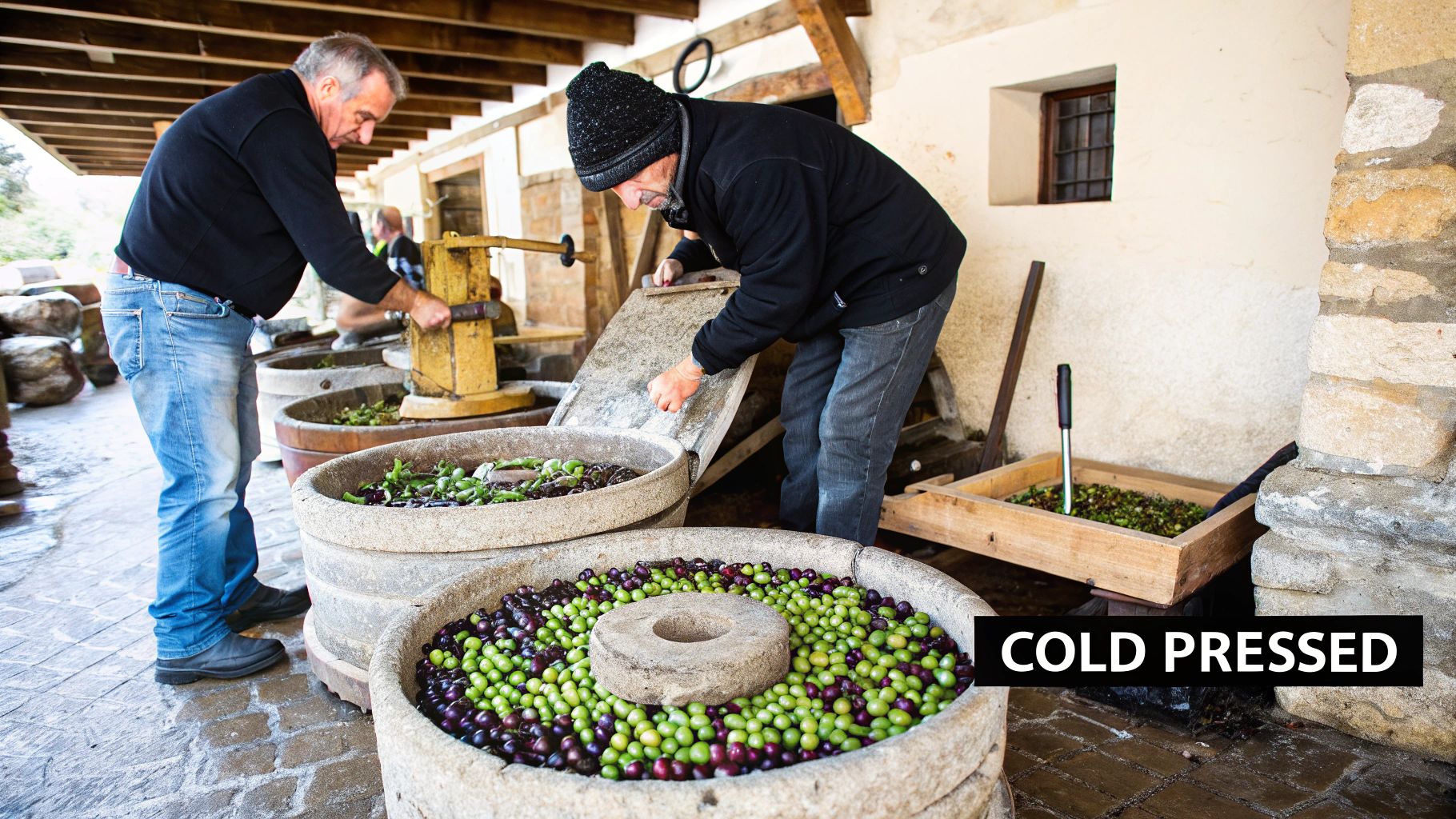
The real story of olive oil is forged long before it hits a shelf. It begins in the olive grove, where a journey from fruit to oil dictates every drop of its flavor, aroma, and health-giving power. This process is what creates the vast gulf between a peppery, antioxidant-rich Extra Virgin and a stripped-down, everyday cooking oil.
The world's finest oils, Extra Virgin, are born from a beautifully simple, purely mechanical process. Olives are picked, crushed, and pressed—without a hint of heat or chemicals. This gentle persuasion is what preserves the vibrant, complex flavors and the potent health compounds that make true EVOO a liquid treasure.
Lesser oils, however, walk a different path. Some are extracted with heat, while others endure an intense refinement with solvents to create a neutral, stable oil built for high-heat cooking. Understanding this core difference in types of olive oil is the key that unlocks why each bottle has its own distinct destiny in your kitchen. For a deeper look, you can explore the intricate making of olive oil in our detailed guide.
The Defining Factor: Acidity
Beyond how it’s made, a single number reveals nearly everything you need to know about an oil's quality: its free acidity level. This isn't about how sour the oil tastes—it's a precise chemical measure of the oil's integrity, its resistance to decay.
A lower acidity level is a direct signal of healthier fruit and a faster, more meticulous pressing. It's the most reliable chemical fingerprint of an oil's true quality.
Olive oil grades are officially classified based on their extraction method and this crucial acidity level.
- To earn the coveted Extra Virgin label, an oil must be mechanically pressed and have a free acidity below 0.8%.
- Virgin olive oil is made the same way but is allowed a higher acidity of up to 2% and may have minor sensory flaws.
- Refined oils are chemically treated to strip away flaws, leaving them colorless and flavorless. They are then blended with a bit of virgin oil to give them some semblance of character.
Flavor and Performance: A Side-by-Side Showdown
The real test of any olive oil isn’t what the label promises; it’s what happens in the pan and on your palate. This is where the grades truly prove their worth, influencing everything from the sizzle of a sauté to the final flourish on a finished dish. One oil can make your ingredients sing, while another just gets lost in the noise.
A magnificent Extra Virgin Olive Oil is a true showstopper. Its flavor profile is a complex symphony—think fruity, grassy, or even intensely peppery. It's an ingredient, a bold statement meant to shine. This is why it’s so perfect for finishing a grilled steak or dressing a simple salad where its character is the star. But that same boldness would trample the delicate flavors of baked goods or subtle sauces.
On the other end of the spectrum, oils labeled simply as 'Light' or 'Pure' are the quiet, dependable workhorses of the kitchen. They've been refined, stripped of any strong personality. This neutrality makes them perfect for baking, where you need fat for moisture without altering the taste of your cake, or for high-heat frying where you don't want the oil's flavor to steal the show.
The Smoke Point Myth, Debunked
There's a persistent myth that you can't cook with EVOO because of its smoke point—the temperature where oil breaks down and smokes. That's simply not the whole story. While it's probably not your best bet for deep-frying a Thanksgiving turkey, a quality EVOO has a smoke point between 350°F and 410°F. This makes it more than capable for most everyday cooking, including sautéing and roasting.
Refined oils do boast a higher smoke point, often hitting around 465°F, which gives them a clear edge for high-heat searing or deep-frying. The trick isn’t to fear cooking with EVOO; it’s to match the oil's stability to your cooking method.
Acidity and Flavor Go Hand in Hand
An oil's acidity level is a direct measure of its quality, and it has a profound impact on both stability and flavor. This chart breaks down the strict chemical standards that define the main olive oil grades.
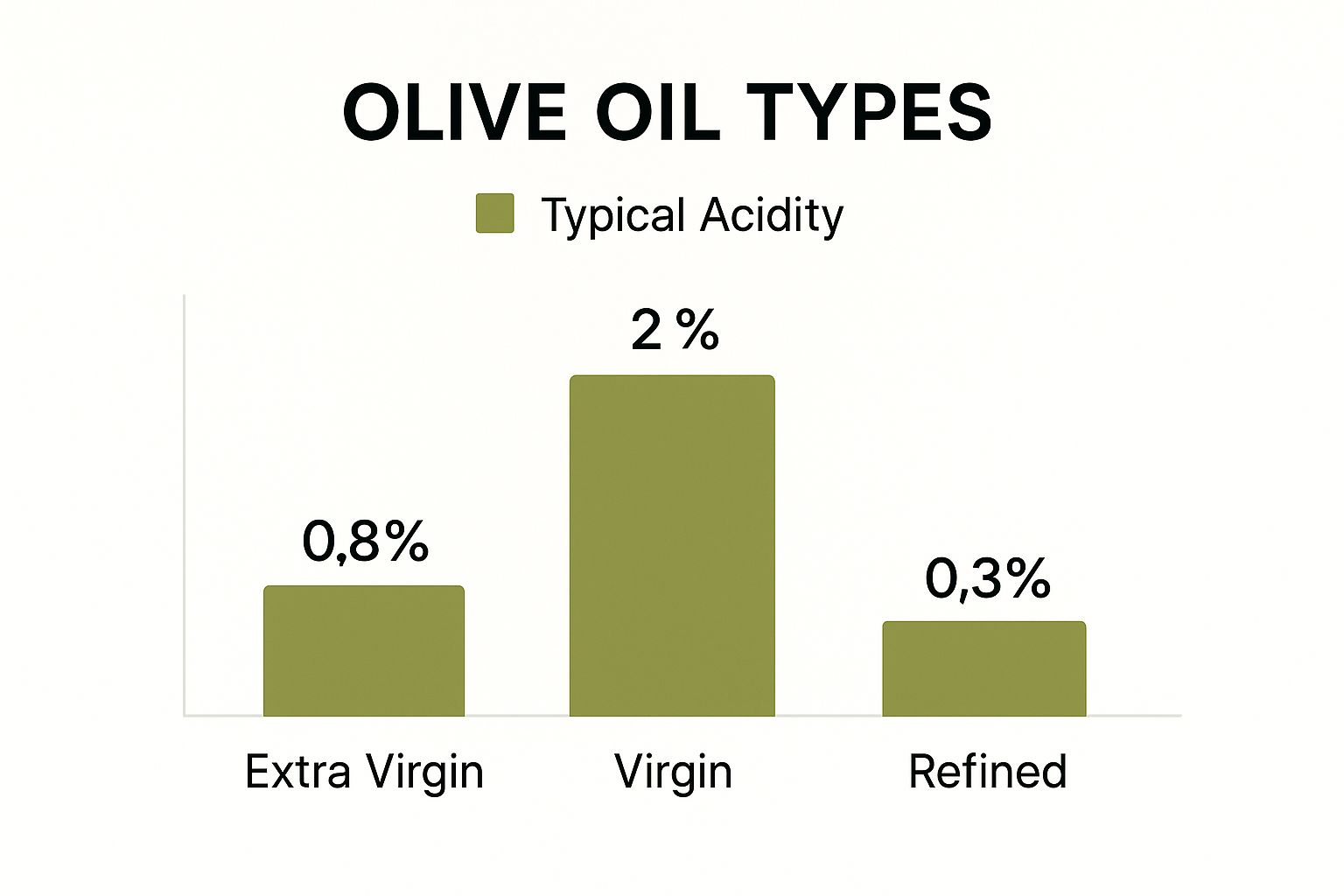
As the infographic clearly shows, Extra Virgin Olive Oil is legally bound to have a free acidity below 0.8%. This low number is the direct result of minimal processing and superior fruit, which in turn preserves its bold flavor and life-enhancing compounds. To truly appreciate these differences, you must learn how to taste olive oil properly, paying close attention to its unique aroma and sensory notes.
Key Insight: The lower the acidity, the higher the quality and the richer the sensory experience. This isn't just a number—it's a direct reflection of the health of the olives and the care taken during production, which you can taste in every single drop.
To make it even clearer, let's see how these oils stack up in a practical, side-by-side comparison.
Olive Oil Performance Breakdown: Flavor, Smoke Point, and Health
| Olive Oil Type | Dominant Flavor Notes | Smoke Point (Approx.) | Key Health Attribute |
|---|---|---|---|
| Extra Virgin | Fruity, peppery, grassy, complex | 350°F – 410°F | Highest in antioxidants (polyphenols) |
| Virgin | Mild, slightly fruity, less intense | 390°F | Good polyphenol content, but less than EVOO |
| Pure / Olive Oil | Neutral, very mild hint of olive | 410°F – 450°F | Contains some monounsaturated fats |
| Light | Completely neutral, no olive flavor | 465°F | Primarily a source of monounsaturated fat |
Ultimately, the best oil is the one that fits the job. A high-quality EVOO is your weapon for flavor, while refined oils are your tool for high-heat applications where neutrality is non-negotiable.
Decoding Labels Like Pure, Light, and Pomace
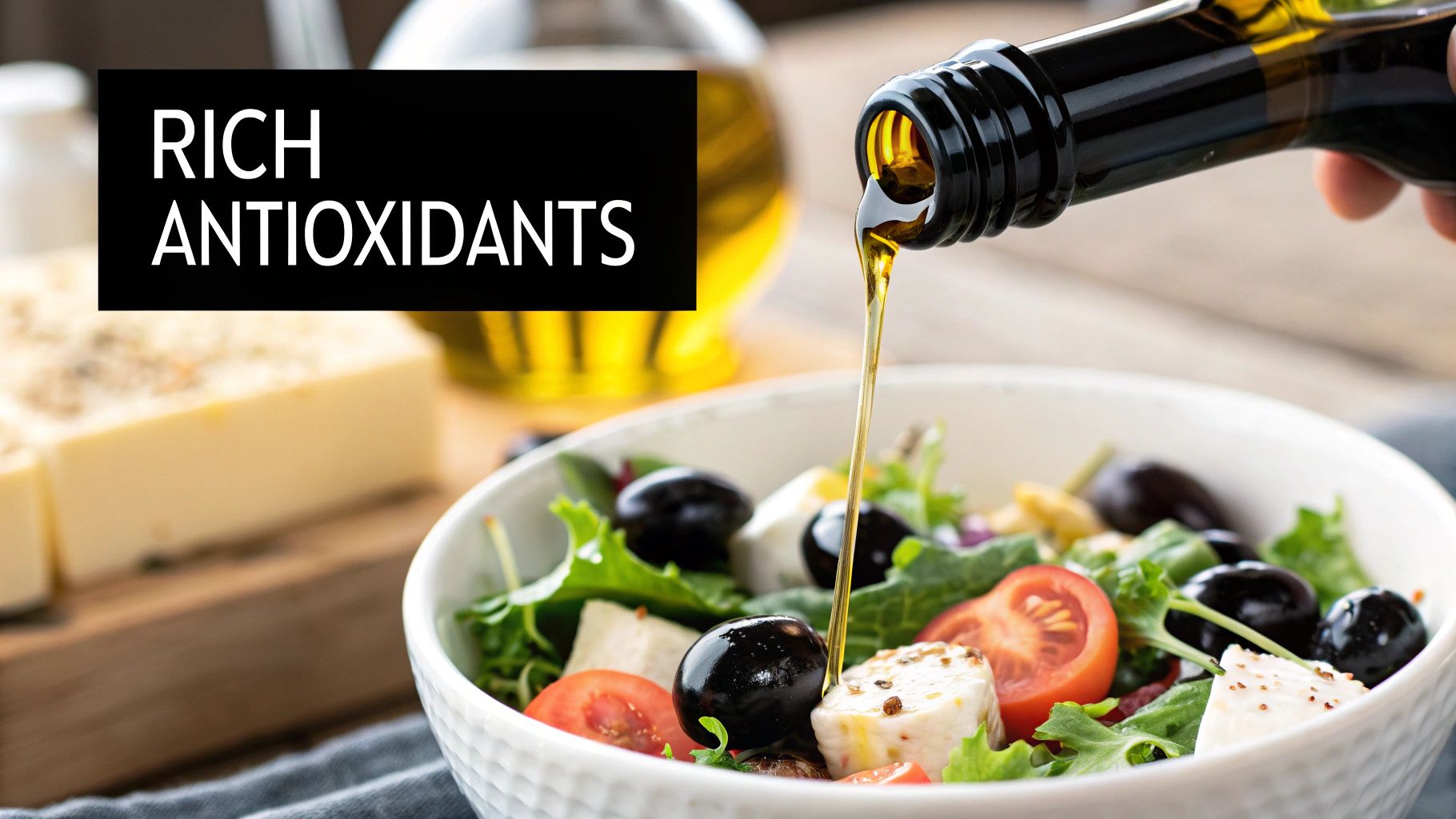
Once you move past Extra Virgin and Virgin, the grocery aisle becomes a minefield of confusing terms. Labels shouting 'Pure,' 'Light,' or 'Pomace' often create more questions than they answer, but each one is a code that describes a specific type of oil with a specific job in the kitchen.
These aren't just empty marketing words; they signal real differences in how the oil was processed and, more importantly, how it will behave for you. Cracking this code is the final step to mastering the differences in types of olive oil and grabbing the right bottle every time.
The Truth Behind "Pure" and "Light" Olive Oil
Let's clear this up right now: the names are designed to mislead you. A bottle labeled 'Pure Olive Oil' isn't "purer" in any meaningful way. It’s actually a blend, composed mostly of refined olive oil with just enough virgin or extra virgin olive oil mixed back in to add a whisper of flavor and color.
Likewise, 'Light' olive oil has absolutely nothing to do with calories or fat. That term refers only to its lighter, more neutral flavor and pale color. This quality makes it a great, unobtrusive choice for baking, delicate sauces, or high-heat frying where you don't want the taste of olives crashing the party.
The term 'Light' is one of the most powerful deceptions in the olive oil aisle. It describes the oil's flavor profile and color, not its caloric value. All olive oils have virtually the same number of calories per serving.
What Is Olive Pomace Oil?
So what happens after olives are pressed for the good stuff? A dry pulp of skin, pits, and flesh remains. This material, called pomace, still has a tiny amount of oil trapped inside. Olive Pomace Oil is what you get when that pulp is treated with industrial solvents and heat to extract every last drop—a process that is the polar opposite of the simple mechanical pressing of EVOO.
After extraction, the pomace oil is refined and then blended with a bit of virgin olive oil to make it palatable. Because of this intense processing, it's considered the lowest grade and is really best for industrial applications or high-heat cooking where flavor is irrelevant. Digging into the specifics of olive oil labeling will give you a full picture of the regulations behind each term.
How Global Terroir Shapes Your Olive Oil
Just as a vineyard’s soil and climate give wine its soul, the land where an olive tree puts down roots fundamentally shapes the oil it produces. This concept, known as terroir, is why an oil from the rocky hills of Greece tastes worlds apart from one grown in the sun-drenched groves of Spain. It’s the secret ingredient you can’t bottle, but you can absolutely taste.
The story of olive oil is deeply rooted in Mediterranean tradition. Spain is the world's production goliath, churning out a staggering 665,709 tonnes annually, much of it from the robust Picual olives in its Andalucía region. Not far behind, Italy and Greece each contribute their own iconic oils, shaped by distinct regional climates and ancient cultivation methods passed down through generations.
From Peppery Spanish to Delicate Greek
These regional differences create a fascinating spectrum of flavors, and knowing them can elevate your cooking from merely good to truly memorable.
-
Spain: Spanish oils, particularly from the Picual olive, are often bold, peppery, and assertive. They bring a distinct spicy kick that’s perfect for drizzling over a hearty stew or grilled steak.
-
Italy: The flavor profiles here are wildly diverse, changing dramatically from north to south. You'll find everything from the grassy, artichoke notes of Tuscany to the milder, sweeter oils of Sicily. Our guide to olive oils from Italy dives deep into this rich variety.
-
Greece: Renowned for delicate and fruity oils, especially from the famous Koroneiki olive. A great Greek EVOO is your secret weapon for light vinaigrettes or as a finishing touch on delicate fish.
Knowing where an oil comes from is like having a flavor roadmap. It connects your kitchen to a specific piece of land, helping you choose an oil that brings an authentic taste of place to whatever you're making.
Matching the Right Oil to Every Dish
Choosing the right olive oil isn't about finding one single, perfect bottle. The real secret, as any seasoned cook knows, lies in matching the oil’s personality to the task at hand. Think of it like a toolbox—you wouldn't use a screwdriver to hammer a nail.
A magnificent extra virgin olive oil is a finishing touch, not just another cooking fat. Those bold, peppery flavors are meant to be the star, elevating everything from a simple vinaigrette to a piece of grilled fish. To waste its complex character in a scorching hot pan is a culinary crime.
On the flip side, when you're searing a steak or frying chicken, a refined or ‘Light’ olive oil is your best ally. Its high smoke point and neutral flavor let your ingredients shine without interference.
Your Culinary Blueprint
Building a smart olive oil arsenal is about knowing when to splurge and when to save. You don't need a pricey finishing oil for everyday sautéing, and you certainly don't want a flavorless, refined oil drizzled over fresh mozzarella.
-
For Finishing and Dipping: An assertive, high-quality Extra Virgin Olive Oil is non-negotiable. Its robust flavor is an ingredient in its own right.
-
For Sautéing and Roasting: A good quality, everyday Virgin or a milder Extra Virgin works beautifully here, lending flavor that complements, rather than overpowers, the dish.
-
For Frying and Baking: A Refined or ‘Light’ olive oil is the most practical choice. You get the high smoke point you need and a neutral taste that won't sabotage your recipe.
The most common mistake is using one type of oil for everything. Stocking your pantry with two or three kinds is the key to getting the best flavor and performance for your money, every single time.
This growing appreciation for culinary detail is catching on. In fact, the global demand for olive oil is expected to jump from $20.3 billion in 2025 to over $30.6 billion by 2032. This surge is largely driven by home cooks who understand both its health benefits and its incredible versatility. To dive deeper, you can learn more about the different types of olive oil for cooking and master their unique applications.
Your Top Olive Oil Questions, Answered
Even after you've mastered the basics, a few stubborn questions always seem to surface. Let’s tackle those lingering curiosities head-on so you can choose, store, and cook with olive oil like you’ve been doing it your entire life.
Getting these details right is what separates those who just use olive oil from those who truly understand it.
Can You Substitute Extra Virgin Olive Oil in Baking?
Absolutely, but it’s a decision you must make with intention. A delicate, buttery EVOO can bring a beautiful, subtle complexity to cakes and muffins. A big, peppery, robust oil, however, could easily hijack your dessert and take it somewhere you never wanted to go.
If you just need a straightforward substitute for something like vegetable oil, a ‘Light’ olive oil is the safer, more neutral-tasting bet.
Does the Color of Olive Oil Mean It's Higher Quality?
This is one of the biggest myths in the food world. An oil's color—whether a vibrant, grassy green or a pale, liquid gold—reveals only the olive variety and its ripeness at harvest. It has absolutely nothing to do with quality.
A deep green hue often means the olives were picked early and are high in chlorophyll; a golden color might come from riper fruit. Both can be equally exceptional.
Here's an industry secret: professional tasters use special cobalt blue glasses for evaluations. This completely masks the oil's color, forcing them to rely only on what truly matters—aroma and flavor—to judge its quality.
What's the Best Way to Store Olive Oil to Keep It Fresh?
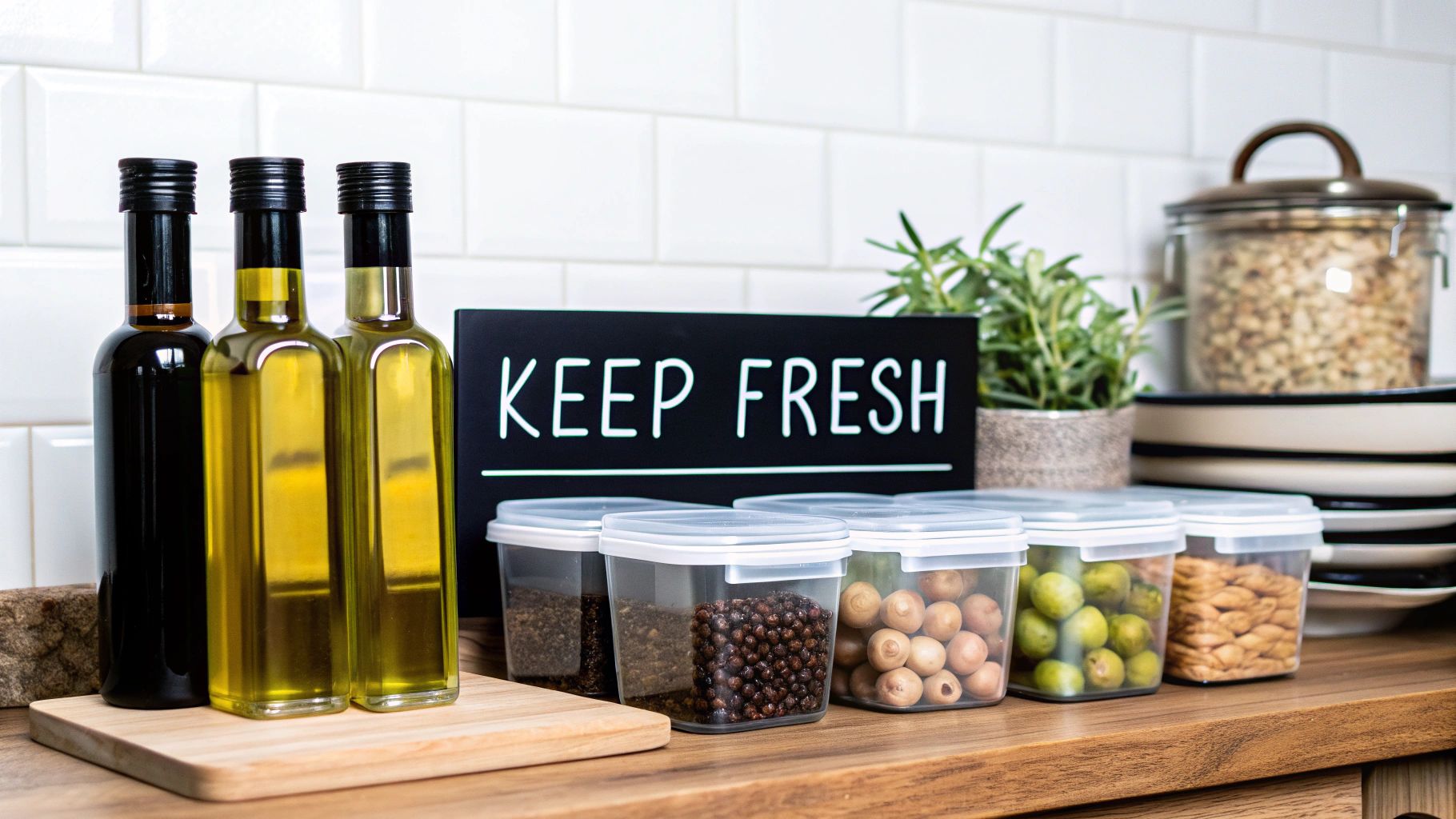
Remember olive oil's three mortal enemies: heat, light, and air. To protect your oil from breaking down and turning rancid, follow these simple commandments:
- Find a cool, dark home for it. A pantry or kitchen cabinet is perfect. Keep it far away from the stove and out of direct sunlight.
- Always put the cap back on tightly. Oxygen is the enemy of freshness.
- Buy oil in dark glass bottles or tins. Clear glass is a giant red flag, as it offers zero protection from light damage.
Proper storage is the single most important thing you can do to preserve the fresh flavors and health benefits you paid for.
At Learn Olive Oil, we believe that knowing these details can completely change the way you cook. Our guides are here to make you the expert in your own kitchen. Discover the World of Premium Olive Oil and taste the difference for yourself.

 Learn Olive Oil
Leave a comment