The real difference between one bottle of olive oil and the next boils down to a single, critical factor: processing. Imagine Extra Virgin Olive Oil as pure, unadulterated juice, cold-pressed directly from fresh olives. Every other type you see on the shelf undergoes more steps—steps that invariably strip away its flavor, color, and health-giving properties.
Grasp this one distinction, and you hold the secret to choosing the perfect oil for your kitchen, every single time.
Understanding the Olive Oil Spectrum
Walking down the grocery aisle feels like a test. You’re bombarded with labels like Extra Virgin, Virgin, Pure, and Light. What do they all mean? This isn’t just clever marketing; each label tells a story about the oil’s journey from the tree to the bottle.
And this story isn't just about taste. The production method directly impacts the oil's chemical makeup, its acidity, and the concentration of its powerful plant compounds. The International Olive Council (IOC) enforces strict parameters, primarily classifying oils into extra virgin, virgin, and refined categories.
To earn the coveted Extra Virgin title, an oil must possess a free acidity below a mere 0.8% and be utterly free of sensory defects. This is the highest quality standard in the world. Period. You can learn more about how these classifications are determined and what they mean for your health and your cooking.
This chart reveals at a glance the acidity levels and flavor profiles you can expect from the main types of olive oil.
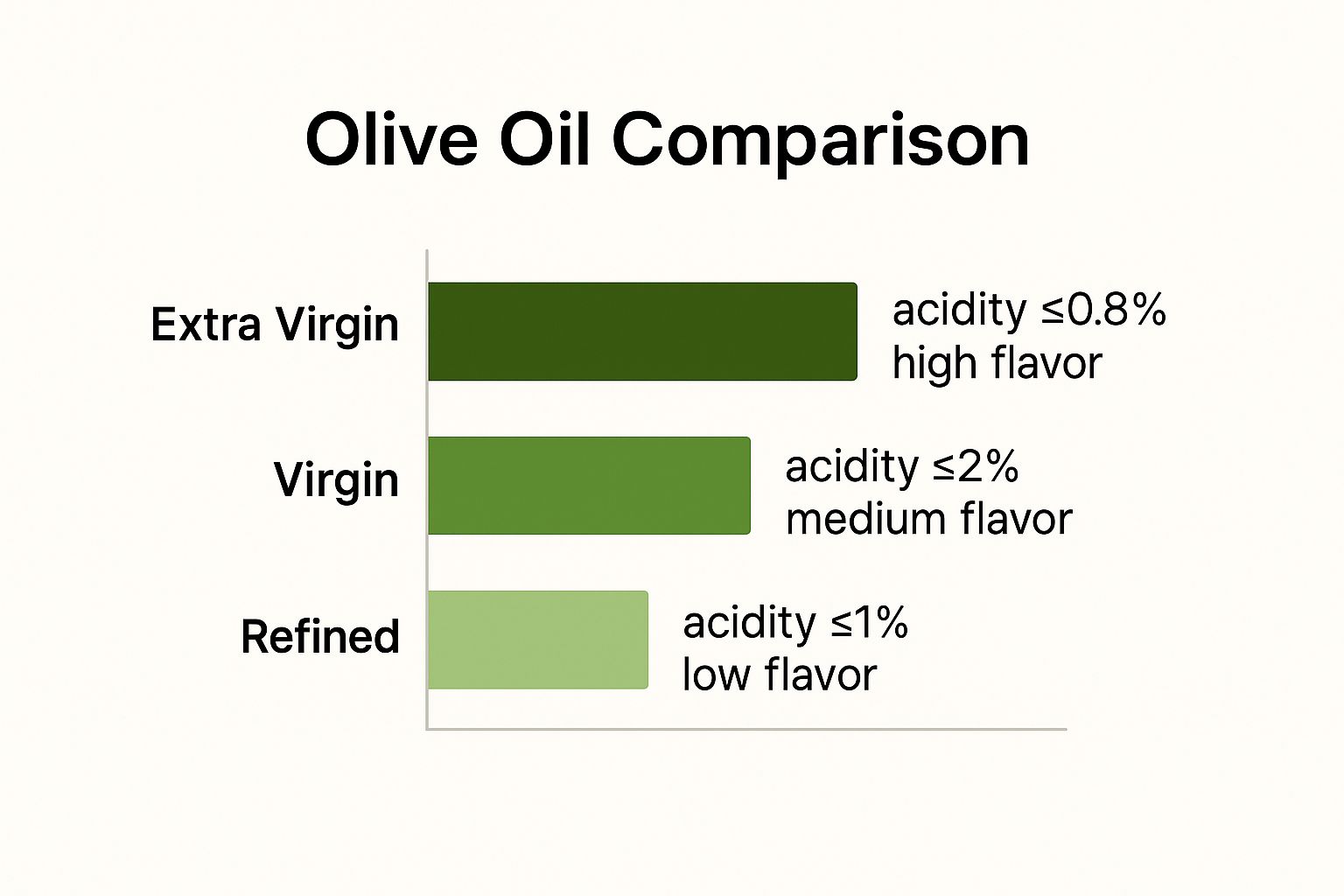
As you can see, the more an oil is processed, the more its flavor and health-promoting qualities are diminished.
The core takeaway is simple but powerful: Less processing equals more flavor and more health benefits. Extra Virgin Olive Oil is the least processed, making it the most vibrant and nutrient-dense option available.
Olive Oil Types at a Glance
For a more detailed breakdown, this table offers a clear comparison of the defining characteristics of each major olive oil category you'll encounter.
| Attribute | Extra Virgin Olive Oil (EVOO) | Virgin Olive Oil | Refined Olive Oil |
|---|---|---|---|
| Production Method | Cold-pressed, no chemicals or heat | Cold-pressed, no chemicals or heat | Treated with heat and chemicals |
| Flavor Profile | Robust, peppery, grassy, fruity | Milder, less pronounced flavor | Neutral, very little to no flavor |
| Acidity Level | Less than 0.8% | Less than 2.0% | Up to 1.0% (after refining) |
| Heat Tolerance | Medium to medium-high | Medium | High |
This at-a-glance view makes it easy to see how a simple difference in production creates a cascade of changes in flavor, quality, and how you should use the oil in your cooking.
The Craft Behind Extra Virgin Olive Oil
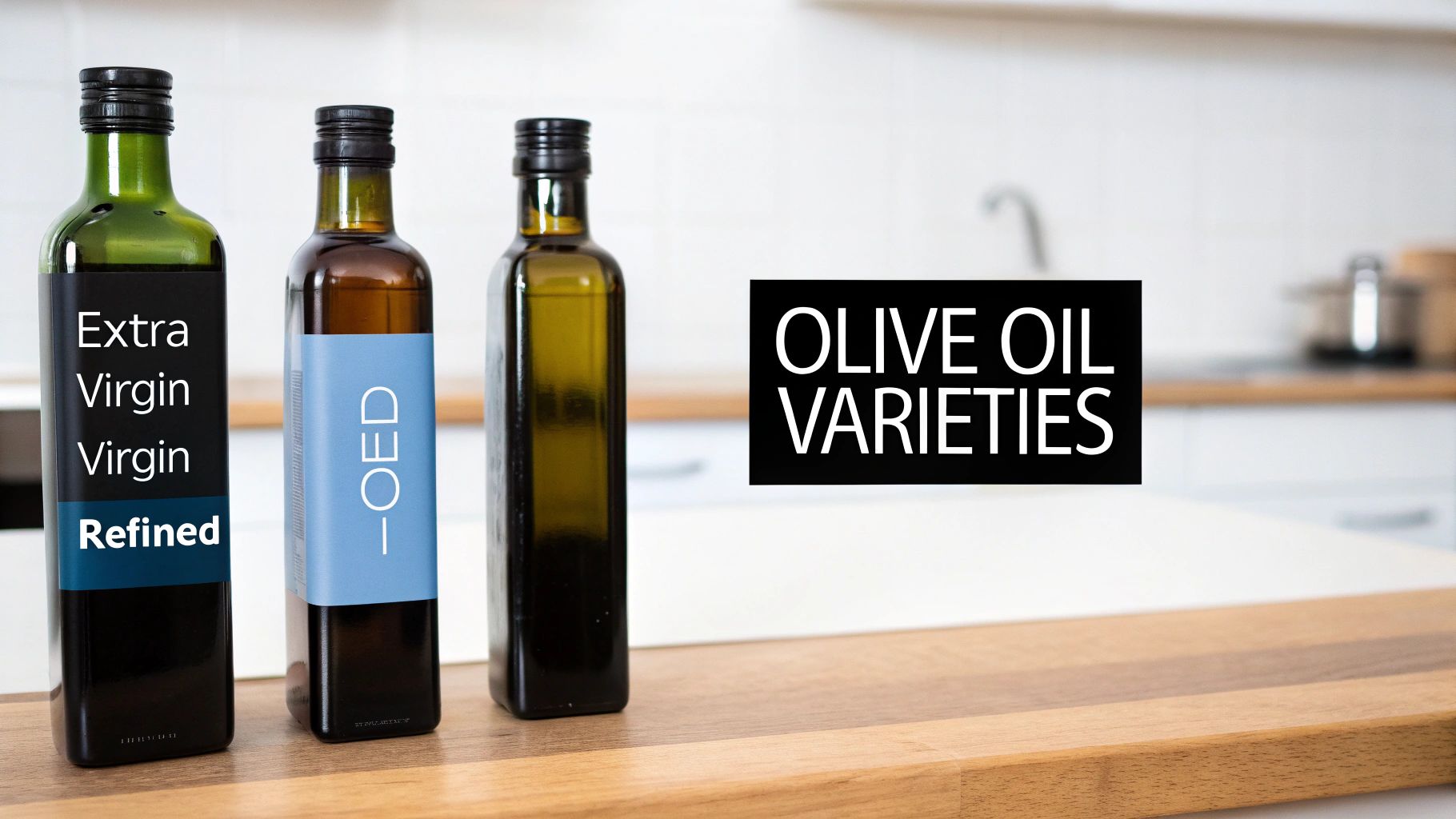
To truly grasp the difference between olive oils, you must first appreciate the craft behind the undisputed king: Extra Virgin Olive Oil (EVOO). This isn't just another bottle in your pantry. At its best, it is pure, unadulterated fruit juice—a direct reflection of the olive itself.
The entire process is a race against time. It begins with perfectly ripe olives, harvested and rushed to the mill within hours. This speed is non-negotiable; it prevents the fruit from oxidizing and developing the off-flavors that would disqualify the final product. At the mill, the olives are crushed into a paste and pressed without any heat or chemicals.
This method, known as "cold-pressing," is what makes EVOO so special. It is a purely mechanical process, designed to protect the delicate compounds that give the oil its incredible flavor and renowned health benefits. What emerges is a vibrant, living oil, bursting with natural antioxidants.
The Science of Purity
So, what separates a genuine EVOO from an imposter? It all comes down to incredibly strict, measurable standards. To earn the prestigious "extra virgin" title, an oil must pass two make-or-break tests: a detailed chemical analysis and a sensory evaluation by a panel of certified tasters.
The most critical chemical marker is its free fatty acidity, which absolutely must be below 0.8%. A low acidity level is a clear sign that the olives were healthy and the milling process was fast and flawless. If it's any higher, the oil simply cannot be called "extra virgin," which gets to the true meaning of extra virgin olive oil and its demanding definition.
An oil can have perfect chemistry, but if it fails the taste test—exhibiting defects like a musty or rancid flavor—it is immediately disqualified from the Extra Virgin category. It must be perfect in both science and sensation.
This two-part verification ensures that the oil in your bottle isn't just chemically pure but also delivers the fresh, flawless taste you expect from a high-quality product.
A Symphony of Flavors
The world of EVOO is every bit as complex and diverse as the world of fine wine. The flavor you experience is a direct result of several key factors, each one leaving its unique fingerprint on the oil's character.
- Olive Varietal: Just as a Cabernet grape creates a totally different wine than a Pinot Noir, olive varieties like the Spanish Arbequina, Italian Coratina, or Greek Koroneiki produce oils with distinct personalities. Some are soft and buttery, while others are intensely grassy and pungent.
- Harvest Time: When the olives are picked makes a huge difference. Early-harvest green olives yield a robust, peppery oil that’s packed with antioxidants. Olives picked later, once they've ripened to a dark purple, produce a much milder, smoother, and more buttery oil.
- Terroir: The unique combination of soil, climate, and geography—the grove's terroir—imparts subtle but unmistakable notes into the final oil.
This beautiful interplay of nature and skilled craftsmanship is what elevates EVOO from a simple cooking fat to a true culinary cornerstone. It’s the finishing touch that can define a dish, a drizzle that adds layers of complexity, and a flavor that tells the story of where it came from.
Decoding Everyday Virgin and Refined Oils
So, what happens when an olive doesn't quite make the cut for Extra Virgin status? That’s where the story of our everyday cooking oils begins. These are the workhorses you’ll find in most pantries—oils that balance quality, cost, and everyday practicality.
The first step down from the top is Virgin Olive Oil. Just like its "extra" cousin, it's produced mechanically without chemicals or heat. The difference is that it comes from olives that might have had a few minor issues—perhaps they sat a bit too long before pressing or had some small imperfections.
This results in an oil with some minor, but noticeable, sensory flaws. Its free acidity is also higher, landing between 0.8% and 2.0%. It doesn't have the vibrant, peppery kick of a great EVOO, but it still offers a pleasant, mild olive flavor, making it a solid choice for everyday cooking.
The World of Refined Oils
Now, if an olive oil has significant defects in its flavor, aroma, or acidity, it's not thrown away. Instead, it heads for an industrial refining process. This is where the lines between different olive oils become incredibly clear.
Using a combination of heat, chemicals, and intense filtration, processors essentially scrub the oil clean of all its flaws. The catch? This aggressive process also strips away everything that makes olive oil special: its color, its unique aroma, those healthy polyphenols, and every last trace of olive flavor. What’s left is a completely neutral, almost colorless oil with a very high smoke point.
Refined olive oil is a blank slate. The very process that removes its imperfections also strips away its personality, turning a character-rich fruit juice into a functional, heat-tolerant cooking fat.
Understanding "Pure" and "Light" Labels
This is where grocery store labels can get confusing. You’ve probably seen bottles labeled "Pure Olive Oil" or "Light Olive Oil." These names are a bit misleading. "Light" has nothing to do with calories—all oils are the same in that regard. It refers to the light flavor and color.
These products are made almost entirely from refined olive oil. To give them just a hint of olive character and meet labeling laws, producers blend in a small amount of Virgin or Extra Virgin Olive Oil, often just 5-15% of the total volume.
The result is an affordable, all-purpose oil. You get a high smoke point that’s great for searing and frying, but you lose out on the complex flavors and powerful health benefits that unrefined oils deliver. To get a better handle on these common but often misunderstood terms, you can explore our guide that answers the question, what is pure olive oil and how it fits into your kitchen. This knowledge helps you see the clear trade-offs between processing, price, and culinary function.
The Global Forces Shaping Your Olive Oil
The bottle of olive oil in your pantry is much more than a simple cooking ingredient. It's the final chapter in a huge, interconnected global story, and the difference in olive oil types you see on the shelf is a direct result of events unfolding thousands of miles away in the groves of Spain, Italy, and Greece.
This liquid gold is a product of agriculture, climate, and economics, all woven together. For instance, a severe drought in the Mediterranean can devastate harvest yields. This creates a ripple effect, tightening supply and pushing prices up on the international market. Suddenly, your go-to robust EVOO is harder to find and costs more—all because of weather patterns on the other side of the world.
These forces working behind the label ultimately decide which oils even reach your local grocery store. The path from a sun-drenched grove to your dinner plate is a complex dance of supply chains, trade policies, and agricultural realities.
The Heavyweights of Production
The olive oil world is dominated by a handful of major players whose fortunes can change with every single harvest. For the 2024/25 season, the European Union is on track to produce about 1.99 million tons, which is nearly 59% of the entire world's output. Spain is the undisputed giant in this arena, responsible for roughly 38% of the global supply all on its own.
But these numbers are anything but stable. While Spain and Portugal recently enjoyed production boosts of 51% and 21%, Italy saw its output drop by a staggering 27%. These dramatic shifts have an immediate impact on the availability and price of specific olive oil grades coming from those countries.
What this means for you is simple but profound: the price and availability of a delicate Italian EVOO versus a bold Spanish one are not just matters of brand preference, but of large-scale agricultural success or failure.
These powerful global dynamics are essential to understanding the real difference in olive oil types. The intricate web of international production shows just how much each bottle's story is shaped by its journey. To get a better sense of how geography shapes flavor, you might enjoy our guide to olive oil origins and the unique traits of each growing region. Learning the backstory of your oil adds a whole new layer of appreciation for this ancient and vital food.
Matching The Right Oil To Your Cooking
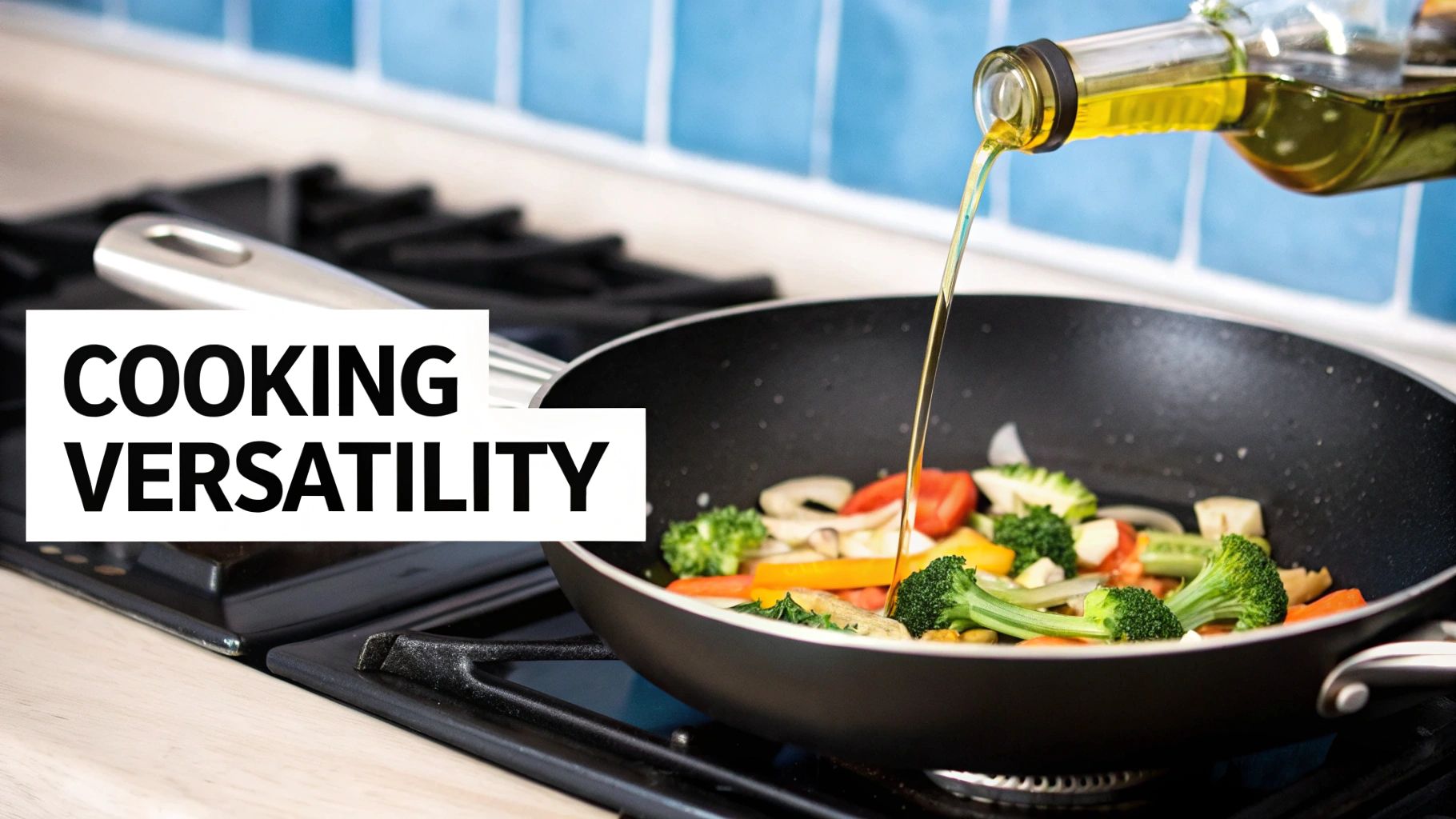
This is where all that knowledge pays off—when the oil hits the pan. Understanding the difference in olive oil types is one thing, but knowing which bottle to grab for which dish is what separates a good cook from a great one. It's a delicate dance between flavor, function, and heat.
The biggest mistake I see people make is treating all olive oil the same. You wouldn't use a delicate finishing salt to cure a steak, would you? The principle is identical. A bold, peppery Extra Virgin Olive Oil can completely overwhelm a piece of flaky fish, while a neutral refined oil adds nothing but grease to a salad.
Choosing correctly elevates your ingredients. Choosing poorly can ruin them.
For Finishing And Raw Applications
If you want to add a final, vibrant burst of flavor, nothing beats a high-quality Extra Virgin Olive Oil. This isn't just a cooking fat; it's a condiment, every bit as essential as a good finishing salt or freshly ground pepper.
Here's where it shines:
- Drizzling over finished dishes: A generous swirl over roasted vegetables, a perfectly grilled steak, or a hearty soup just before serving introduces an incredible fragrant, peppery kick.
- Creating vibrant vinaigrettes: The robust, fruity notes of a good EVOO are the soul of a classic salad dressing.
- Dipping fresh bread: Honestly, this is the purest way to appreciate a great oil. A piece of crusty bread is all you need to taste its complex character.
The delicate compounds that give EVOO its amazing taste and health benefits are fragile. High heat obliterates them. Using it raw keeps its integrity intact and ensures you get the biggest flavor impact from every single drop.
Think of Extra Virgin Olive Oil as a raw ingredient. Its job is to add flavor, not just to facilitate cooking. Heat is its enemy, and its bold personality should always be the star of the show.
For Everyday Sautéing And Roasting
For your daily cooking—sautéing onions and garlic, roasting chicken and potatoes—you need a reliable workhorse. This is the perfect job for a good Virgin Olive Oil or what's often labeled as "Pure" olive oil. These oils have a much milder olive flavor that complements food without overpowering it.
They strike a fantastic balance between cost and performance. You still get a hint of that classic olive taste but without the premium price of a top-shelf finishing EVOO. Their smoke points are also more than high enough for the medium-heat cooking most of us do every day.
For High-Heat Cooking
When you turn the heat way up for searing, stir-frying, or deep-frying, stability is what matters most. This is where Refined Olive Oil (often sold as "Light" olive oil) truly proves its worth. The refining process removes the very compounds that burn at lower temperatures, giving it a high smoke point that can handle the heat without smoking up your entire kitchen.
This is your go-to oil for:
- Searing: You need high, stable heat to get that perfect crust on a steak or piece of fish.
- Frying: Its neutral flavor won't make your french fries taste like olives.
- Baking: It works beautifully in cakes or muffins when you need a neutral-tasting oil.
The trade-off, of course, is a loss of flavor and nutrients. But for high-heat cooking, safety and stability must come first. To really get into the weeds, you can explore the science behind the olive oil smoking point to see exactly how each type handles the pressure. And to keep your chosen oil fresh and ready in the kitchen, a beautiful and functional elegant olive oil bottle makes all the difference.
Best Culinary Uses By Olive Oil Type
To make it even simpler, here’s a quick-reference table that matches the right oil to the right task.
| Culinary Use | Recommended Oil Type | Reasoning (Flavor, Smoke Point) |
|---|---|---|
| Salad Dressings & Dips | Extra Virgin | Best flavor, most nutrients. No heat involved. |
| Finishing & Drizzling | Extra Virgin | Adds a bold, peppery flavor as a final touch. |
| Sautéing & Roasting | Virgin or Pure | Good flavor, medium smoke point for everyday cooking. |
| Baking | Refined (Light) | Neutral flavor won't interfere with baked goods. |
| Searing & Frying | Refined (Light) | High smoke point prevents burning and smoking. |
Think of this table not as a set of rigid rules, but as a guide to help you get the most out of both your ingredients and your olive oil. Happy cooking.
Common Questions (and Expert Answers) About Olive Oil
Even with a solid grasp of the different olive oil grades, some practical questions always pop up. It’s one thing to read about them, but it's another to be standing in the grocery aisle, wondering which bottle is right for tonight's dinner.
Let’s clear up a few of the most common points of confusion. Getting these details right can be the difference between a good meal and a great one, ensuring you get the best flavor, health benefits, and value out of every bottle.
So, Can You Actually Fry with Extra Virgin Olive Oil?
The short answer: Yes, absolutely. But it comes with a major catch.
A good quality EVOO has a smoke point somewhere between 375-410°F (190-210°C). That’s surprisingly high and more than enough for everyday pan-frying. The real issue isn't safety; it's flavor and cost. Blasting your expensive, peppery EVOO with high heat will destroy its beautiful, complex flavors and wipe out many of the healthy polyphenols you paid a premium for.
For deep-frying, you’re much better off reaching for a refined olive oil. It’s more stable and way more economical. Save the good stuff—your EVOO—for sautéing over medium heat or, even better, for drizzling over a finished dish where its flavor can be the star.
What Does "Light" Olive Oil Mean, Anyway?
This is easily one of the most misleading labels in the entire oil aisle. "Light" or "extra light" has nothing to do with calories or fat. Zero. All olive oils have the exact same amount of fat and calories.
The term "light" refers only to the oil's flavor and color.
Expert Insight: "Light" olive oil is a highly refined product, processed specifically to have a neutral taste and a pale color. This makes it a great choice for baking or high-heat cooking where you don't want any olive flavor interfering with your ingredients.
What's the Best Way to Store Olive Oil?
To keep your olive oil from going bad, you must protect it from its three biggest enemies: heat, light, and air.
Always store it in a cool, dark place like a pantry or cupboard—never on the counter next to your hot stove. And make sure you twist that cap on tight after every use. Oxygen is the primary culprit behind rancidity.
The best bottles are made of dark green glass or opaque tin, as they do a much better job of blocking out damaging UV light than clear glass. Honestly, proper storage is the single most important thing you can do to preserve your oil's freshness and taste.
Is Cloudy Olive Oil a Bad Thing?
Probably not. In fact, cloudiness can sometimes be a good sign. It often means the oil is unfiltered, leaving behind tiny, harmless bits of the olive fruit that can contribute to a richer flavor.
Your oil can also get cloudy if it gets too cold (like in a chilly pantry). Just let it sit at room temperature for a bit, and it should clear right up.
The real test is the smell test. If your oil smells musty, waxy, or reminds you of old crayons, it has gone rancid. Trust your nose, not just your eyes.
 Learn Olive Oil
Leave a comment