Let’s be honest. The best extra virgin olive oil for your kitchen isn’t some mythical, one-size-fits-all elixir. It’s a tool. For everyday sautéing and roasting, it’s a beautifully balanced, fruity workhorse. For finishing a perfectly seared steak or a hearty stew, it’s a bold, peppery exclamation point. The secret is knowing which tool to reach for.
Your Guide to Finding the Perfect Olive Oil
Walking down the olive oil aisle is designed to confuse you. It’s a wall of green and gold bottles, each whispering promises of artisanal quality from some sun-drenched grove. The prices swing wildly, from suspiciously cheap to shockingly expensive. How, in all that noise, do you find the real thing?
The mission isn't just to buy another bottle of oil. It’s to discover a secret weapon that will fundamentally elevate your cooking. But first, we must kill a stubborn myth that holds countless kitchens hostage: the lie that you can’t cook with good extra virgin olive oil.
Beyond the Drizzle
Here’s a truth that can change the way you cook forever: the right EVOO isn't just for finishing. It’s a dynamic, active ingredient that unlocks richer, more complex flavors in almost anything you make. Imagine the sharp, peppery kick it gives to simple sautéed greens, or the delicate, fruity note it lends to a batch of muffins. This is how you create big flavor without complicated recipes or breaking the bank.
This guide is your roadmap. We're going to uncover how to find that perfect bottle—one that fits your taste, your cooking style, and your budget. And there’s never been a better time to learn. The global market for high-quality olive oil is exploding, currently valued at around USD 19.4 billion and poised to grow as more people discover the truth. You can learn more about the global olive oil market trends and see for yourself how consumer tastes are evolving.
Think of it this way: Just as a chef chooses a specific knife for a specific task, a home cook can choose a specific olive oil to achieve a specific flavor. It’s about moving from a one-size-fits-all approach to intentional, flavor-driven cooking.
We'll decode the secrets hiding on the label, shatter the myths about cooking with heat, and show you how to pair different oils with the food you love to cook. By the time we're done, you'll approach that wall of bottles not with hesitation, but with the quiet confidence of an expert.
How to Decode the Olive OIl Label
Think of an olive oil label as a sales pitch, not a confession. It’s designed to conjure images of sun-drenched Italian hillsides and ancient groves. But behind that rustic charm lies a code. If you truly want to find the best extra virgin olive oil for your kitchen, learning to crack that code is the single most important skill you can possess.
First, you must learn to ignore the marketing fluff. Terms like “first cold press” are ghosts from a bygone era. Modern olive oil extraction uses centrifuges, not ancient stone presses. By definition, all true extra virgin olive oil comes from the first mechanical extraction without heat. That phrase is now just noise on the label, designed to sound impressive to the uninformed.
Instead, train your eyes to hunt for the two details that reveal everything you truly need to know: the harvest date and the country of origin.
The Two Most Important Clues
The harvest date is your only real guarantee of freshness. Unlike a fine wine, olive oil is a fruit juice. It does not get better with age; it starts degrading the moment it's made. An oil bottled last month could easily be from olives harvested two years ago, meaning its vibrant flavors and powerful antioxidants have long since vanished. Always look for a harvest date within the last year—the more recent, the better.
Next, get specific about the origin. A vague label like "Product of Italy" is a red flag. It often means olives from Spain or Tunisia were shipped in and simply bottled in Italy—a common trick that sacrifices quality for lower costs. You’re looking for specifics.
An authentic, high-quality olive oil isn't shy about its roots. It proudly states its farm, region, and the specific olive varieties used because the producers know that’s where the real value is.
This is where seals of authenticity become your secret weapon. They slice through the marketing spin and offer an ironclad guarantee that the oil is what it claims to be. When in doubt, look for these certifications:
- PDO (Protected Designation of Origin): This is the gold standard. It guarantees every single step of the process—growing, harvesting, and pressing—happened in one specific geographical region under strict rules.
- PGI (Protected Geographical Indication): This is another powerful seal. It certifies that at least one phase of production occurred in the designated region, still ensuring a high degree of traceability.
- Third-Party Seals: Keep an eye out for seals from independent groups like the California Olive Oil Council (COOC) or the Extra Virgin Alliance (EVA). These organizations often enforce even stricter chemical and sensory standards than international requirements.
Olive Oil Label Cheat Sheet
To make this dead simple, here’s a quick reference guide for your next trip to the store.
| Term or Symbol | What It Really Means | Why It Matters for Cooking |
|---|---|---|
| Harvest Date | The month and year the olives were picked and pressed. | This is the only true indicator of freshness. A recent date means more flavor and more health benefits for your dishes. |
| "Product of…" | Can be dangerously misleading. May only indicate the country of bottling, not where the olives were grown. | Look for a specific estate or region name for superior quality control and a more distinct flavor profile. |
| "First Cold Press" | An outdated marketing term. All EVOO is from the first mechanical extraction without heat. | It’s essentially meaningless today. Do not let it influence your purchase. |
| PDO Seal | Protected Designation of Origin. Guarantees 100% of production occurred in a specific, named region. | The highest assurance of authenticity and quality. The oil's flavor will be characteristic of its origin. |
| PGI Seal | Protected Geographical Indication. At least one stage of production happened in the named region. | A very good sign of quality and traceability, though slightly less strict than PDO. |
| Dark Glass Bottle | The producer is actively protecting the oil from light, which causes it to degrade faster. | A producer who cares about packaging likely cares about the quality of the oil inside. It will stay fresh longer in your pantry. |
By focusing on these tangible facts—harvest date and verified origin—you become immune to clever marketing. You stop buying a story and start buying a superior product that’s fresh, authentic, and ready to make your food shine.
Debunking the Smoke Point Myth
For years, a single, persistent myth has held home cooks hostage. You’ve heard it whispered over sizzling pans and declared in cooking forums: “You can’t cook with good olive oil; its smoke point is too low.” It’s time to demolish this piece of kitchen dogma with a dose of science, because this lie is costing your food incredible flavor.
The smoke point is simply the temperature where an oil stops shimmering and starts to smoke, a signal that it's beginning to break down. But the generic numbers you find online are fatally misleading because they treat all EVOOs as if they're identical. They are not.
The truth is, a high-quality extra virgin olive oil’s stability isn't just about a number; it's about its chemical makeup. Its secret weapon? Polyphenols. These powerful antioxidants—the very same compounds that give great olive oil its peppery finish and health benefits—also act as molecular bodyguards, fiercely protecting the oil from the ravages of heat.
The Power of Freshness and Quality
A cheap, old, or refined oil has been stripped of these protective compounds, so it breaks down fast. But a fresh, high-quality EVOO is brimming with them. This is precisely why a genuine extra virgin olive oil can have a smoke point anywhere from 375°F to over 410°F (190-210°C), making it a surprisingly robust and versatile partner for your stove.
The smoke point isn't a fixed law but a dynamic quality directly tied to the oil's purity and freshness. A higher polyphenol count means a more resilient oil, capable of handling far more heat than most home cooking ever requires.
This revelation changes everything. Finding the best extra virgin olive oil for cooking is less about a single temperature and more about choosing an authentic, fresh product. The very qualities that make it taste so amazing—those vibrant, peppery notes—are the same ones that help it stand up to heat. For a deeper dive, you can read more about the science behind the olive oil smoking point and see why quality matters so much.
So what does this actually mean for your cooking?
- Sautéing Vegetables: Go for it. Most sautéing happens between 300-350°F, well below the smoke point of a good EVOO.
- Roasting in the Oven: Perfectly safe. Roasting is typically done around 400°F, a temperature a quality oil can easily handle.
- Pan-Frying: Absolutely. You can confidently fry chicken cutlets or sear a piece of fish without a moment's worry about ruining your oil or your dinner.
It's time to forget the myth. Stop saving your best oil for drizzling and give it the place it deserves right next to your stove. You can cook with confidence, knowing its quality isn't just for show—it's for performance.
Matching Flavor Profiles to Your Cooking
Asking for the “best extra virgin olive oil for cooking” is like asking for the best wine to have with dinner. The only intelligent response is, “Best for what?” A bold, tannic Cabernet that’s brilliant with a grilled steak would utterly obliterate a delicate piece of sole.
The exact same logic applies to olive oil. The real magic isn’t finding one single, perfect bottle. It’s understanding which oil will make the specific dish you're cooking absolutely sing.
Not all EVOOs taste the same, and that is a spectacular gift for any cook. This diversity is your secret weapon. Once you grasp the basic flavor families, you'll stop seeing olive oil as just another cooking fat and start treating it like the strategic, flavor-building ingredient it is. The goal is to move from guesswork to making intuitive, delicious choices every single time.
The Three Core Flavor Styles
Most extra virgin olive oils can be grouped into one of three main categories. These styles are shaped by the type of olive (the varietal), its ripeness at harvest, and the unique terroir of the region where it was grown. Think of them as your primary colors for painting with flavor.
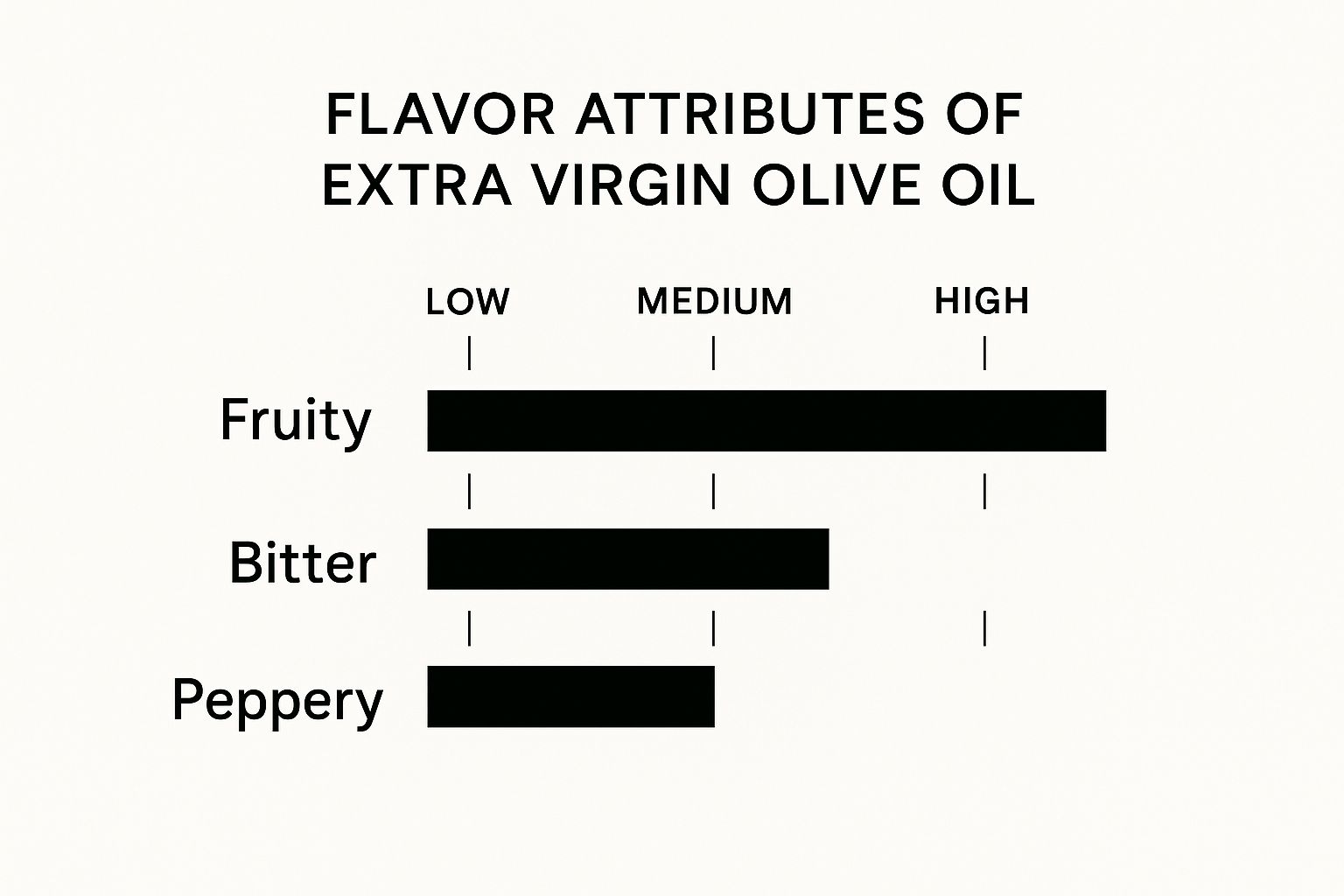
The interplay between fruity, bitter, and peppery notes is what gives an oil its character. This balance dictates whether an EVOO is delicate, medium, or robust, and it’s your ultimate guide for how to use it in your kitchen.
Let's break down how to pair each style with your food:
-
Delicate & Buttery: These are your smooth, mellow oils. They whisper rather than shout, often with soft notes of ripe apple, almond, or a creamy, butter-like finish. Made from olives like Arbequina or a late-harvest Picual, they are perfect for more gentle cooking. Think baking a lemon olive oil cake, whisking up a homemade mayonnaise, or lightly dressing a mild white fish.
-
Medium & Fruity: This is your everyday, all-around champion. Versatile and well-balanced, these oils typically have notes of green fruit and fresh-cut grass, ending with a pleasant, slightly bitter tickle in the back of your throat. Varietals like Koroneiki are classic examples. They truly shine when roasting vegetables, making vinaigrettes, or as a flavorful base for sauces and stews.
-
Robust & Peppery: These are the bold ones, the statement-makers. They’re known for a powerful peppery kick and a distinct bitterness, which comes from a high concentration of healthy polyphenols. Look for oils made from Coratina or early-harvest Picual olives. They are absolutely magnificent for finishing a grilled steak, drizzling over a hearty bean soup, or standing up to the challenge of bitter greens like arugula.
For a deeper dive into the options, you can check out our guide on the different types of olive oil for cooking.
The global supply of these amazing oils is constantly shifting. After a tough season, Spain—the world’s top producer—was recently projected to boost its output by an incredible 48% to 1.26 million tons. This kind of recovery is great news for all of us, as it helps stabilize prices and ensures a wider variety of these flavor profiles make it to our local shelves.
Ultimately, your own palate is the final judge. A robust oil might be too much for your mashed potatoes, or it could be the exact jolt they need to come alive. The key is to taste your oil on its own first. Take a small sip. Think about its personality—then imagine how it will play with the other ingredients in your dish.
Pairing EVOO Flavor Profiles with Cooking Methods
To make it even simpler, here's a quick guide to help you match the right oil to the right job. Think of this as a cheat sheet for getting the most flavor out of both your olive oil and your food.
| Flavor Profile | Common Olive Varietals | Best For Cooking | Avoid For |
|---|---|---|---|
| Delicate & Buttery | Arbequina, Leccino | Baking, emulsions (mayo), light sautéing, finishing mild fish | Searing steak, deep frying, pairing with bold, spicy flavors |
| Medium & Fruity | Koroneiki, Hojiblanca | Roasting vegetables, everyday sautéing, vinaigrettes, pesto, sauces | Delicate baked goods where its flavor might be too prominent |
| Robust & Peppery | Coratina, Picual (early harvest) | Finishing grilled meats, drizzling on soups & stews, pairing with bitter greens | Frying delicate eggs, making mayonnaise (can be too bitter) |
Using this table will get you started, but don't be afraid to experiment. Sometimes the most unexpected pairings turn out to be the most delicious.
Embracing this variety is what turns cooking from a simple task into a creative art. If you're just starting, grab a good, balanced medium oil, then add a robust one to your collection. Before you know it, you’ll be pairing them like a seasoned pro.
Protecting Your Olive Oil Investment
Bringing home a brilliant bottle of EVOO is only the first step. The real work of preserving that incredible flavor happens right in your kitchen, long after you’ve left the store.
Think of fresh, high-quality olive oil as a living ingredient. It’s delicate, and its peak freshness is a race against a ticking clock. To get the most from your investment, you must protect it from its three mortal enemies: light, heat, and air.
These aren't just casual suggestions; they are the absolute laws for keeping every drop of flavor and every antioxidant you paid for. Each one is a silent thief, slowly stealing the very essence of the oil.
This is exactly why any producer who takes pride in their product will use dark glass or an opaque tin. That dark bottle isn't just for show—it’s armor. It is your first and most obvious clue that you're buying from someone who cares. That clear glass bottle of golden-colored oil on the supermarket shelf? That’s an immediate red flag. Walk right on by.
Finding a Safe Spot in Your Kitchen
The second enemy, heat, is a quiet killer of flavor. It may seem convenient to keep your olive oil right next to the stove, but that’s likely the worst place in your entire kitchen for it. The constant, gentle warmth slowly degrades the oil, turning its bright, peppery notes into something flat and dull before it ever sees a pan.
Your oil needs a cool, dark home. A pantry or a closed cupboard, far away from the oven and out of direct sunlight, is its perfect sanctuary.
Finally, you must defend it from the air. Oxygen is the final saboteur, causing the oil to go rancid through a process called oxidation.
It's a simple habit to build: every single time you use your oil, screw the cap back on tightly. Don't just leave it sitting open on the counter while you finish cooking. That repeated exposure, day after day, is more than enough to ruin even the finest EVOO. For a deeper dive, check out our complete guide on proper olive oil storage techniques.
So, how can you tell if an oil has turned? Your nose knows best.
A fresh EVOO should smell vibrant—grassy, fruity, peppery, and alive. Rancid oil, on the other hand, has a very distinct and unpleasant smell. Think old crayons, putty, or stale nuts. If you get even a whiff of that, its cooking days are over.
Follow these simple rules, and you'll ensure the last pour from the bottle is just as spectacular as the first.
Your Step-By-Step Buying Guide
Alright, you have the knowledge. You can spot the myths and read a label like a seasoned expert. But all that theory gets put to the test in the grocery store aisle. This is where you put it all into practice with a simple, repeatable process for choosing the best extra virgin olive oil every single time.
The goal isn't to find one perfect bottle to use for the rest of your life. It's about building the confidence to walk up to that wall of options, survey it with the discerning eye of a chef, and select the right tool for the job.
Your Supermarket Checklist
For a moment, forget the brand names and the pretty labels. Your mission is to look for three critical details before any bottle even thinks about entering your cart. This checklist is your secret weapon, whether you're in a fancy specialty shop or your local supermarket.
1. Inspect the Container First
Before you even touch the bottle, just look at it. Is the glass dark? Is it in an opaque tin? Good. That’s your first and fastest clue that the producer actually cares about protecting their oil from light. If you see a clear glass bottle, it's an instant disqualification. Just walk away.
2. Hunt for the Harvest Date
Next, find the harvest date on the label. This is non-negotiable. Don't get it confused with the "best by" date, which can be almost meaningless. You need to know when the olives were actually picked and pressed, because freshness is the entire game. Aim for a date within the last 12-18 months to get the best flavor and the most health benefits.
3. Verify the Origin
Look for specifics. Does the label proudly declare a single country? Even better, a specific region or a single estate? A PDO or PGI seal is a gold star, your guarantee of its origin. Be deeply suspicious of vague phrases like "bottled in Italy" or "product of the Mediterranean," which are often code for a blend of average, untraceable oils. You can also https://learnoliveoil.com/how-to-choose-olive-oil.
A great bottle of olive oil tells you its story right on the label. It’s proud of where it came from and when it was made. If a label is hiding those details, it’s usually for a reason.
The demand for the real deal is exploding. To give you an idea, recent Italian extra virgin olive oil exports hit a staggering 108,671 tons in just four months—that's a 26% jump from the year before. People all over the world are waking up to what genuine quality tastes like.
This simple, three-step check cuts through all the marketing fluff and gets right to what matters. It’s a solid framework that helps you make a confident choice, ensuring the bottle you bring home is a true partner for your kitchen.
Common Questions About Cooking with Olive Oil
You've got the basics down, but a few questions always linger. Let's tackle them head-on. These are the details that separate a good cook from a great one, giving you that final measure of confidence to really unleash your skills in the kitchen.
It's time to clear up any remaining confusion and make sure the most important points are crystal clear.
Can I Really Fry with Extra Virgin Olive Oil?
Yes, absolutely. This is likely the biggest and most damaging myth in the olive oil world. A fresh, high-quality extra virgin olive oil has a smoke point somewhere between 375-410°F (190-210°C). That’s comfortably above the typical temperature for pan-frying, which hovers around 350°F.
But it’s not just about the numbers. What truly matters is the oil's stability. EVOO is packed with polyphenols—the same powerful antioxidants behind its health benefits—which act as a natural defense, protecting the oil from breaking down under heat. Just remember, this only applies to fresh, quality EVOO, not that old, dusty bottle you found in the back of your cupboard.
What Does "First Cold Press" Actually Mean?
Honestly, today, it means almost nothing. It’s a marketing term that has survived from a bygone era. Modern producers use centrifuges, not giant stone presses. The only important word in that phrase is "cold," which means the oil was extracted at a temperature below 80.6°F (27°C).
This gentle, low-heat process is what keeps all the delicate flavors and nutrients intact. By definition, any true extra virgin olive oil must come from the first mechanical extraction under these cool conditions. So, seeing "first cold press" on a modern label is redundant.
Think of it this way: "First Cold Press" doesn't mean an oil is superior anymore. It’s the minimum entry requirement for an oil to even be considered extra virgin. A great producer is more likely to tell you the harvest date and olive variety instead.
Is Greener Olive Oil Better Than Golden Oil?
Not at all. The color tells you about the flavor profile, not the quality. An oil’s hue is simply a clue about how ripe the olives were when they were harvested.
- Green Oils: Usually made from less ripe olives, these tend to be more robust, grassy, and peppery.
- Golden Oils: These typically come from riper olives, giving them a milder, buttery, and more mellow taste.
Both can be fantastic. When choosing an olive oil, let the dish you're making be your guide. Are you dressing a peppery arugula salad or gently poaching a piece of fish? That's what should guide your color choice. To learn more, you can explore the incredible olive oil health benefits tied to these amazing plant compounds.
How Do I Know if My Olive Oil Is Rancid?
Trust your nose and your palate—they will never lie to you. Rancid oil has a distinct, unpleasant smell, a lot like stale walnuts, old crayons, or even putty. It’s a flat, musty aroma that couldn't be more different from the fresh, vibrant scent of good EVOO.
If you taste it, it’s just as bad. It will feel greasy in your mouth and have a stale, lifeless flavor, completely missing that peppery kick you get from a fresh oil. If it smells or tastes off, it has gone bad. It has lost its flavor, and its health benefits are long gone, too.
At Learn Olive Oil, we believe that knowing these details is what turns cooking from a chore into a creative joy. With this knowledge, you're ready to dive into a whole new world of flavor.

 Learn Olive Oil
Leave a comment