Ever witnessed that fleeting moment when the oil in your pan stops its gentle shimmering and a faint, ghostly wisp of smoke appears? That’s the smoke point. It’s more than just a sign of heat; it’s a critical message from your oil, a warning that it’s beginning to break down. This isn’t about just getting the pan hot enough; it’s about protecting the flavor of your food and safeguarding the very goodness you paid for.
For a quality extra virgin olive oil, this crucial point usually falls somewhere between 356–419°F (180–215°C). Lighter, more refined olive oils, as you'll soon discover, can often handle a bit more fire.
What Happens When Your Olive Oil Starts Smoking
We’ve all been there. You turn your back on the stove for a single moment, and suddenly, your pan is breathing smoke. Is it a signal of a perfectly hot pan, ready for action? Or have you just sabotaged your dinner before the first ingredient has even touched the heat?
That visible, bluish smoke is a blaring alarm. It announces that the oil has hit its smoke point and its fats and nutrients are in the process of degrading. At this stage, two terrible things happen. First, the oil develops a harsh, acrid flavor that will mercilessly transfer to whatever you're cooking. Second, the beneficial compounds like antioxidants and polyphenols—the very elements that make olive oil a nutritional powerhouse—are being obliterated by the intense heat.
The Science in the Pan
Think of it this way: the free fatty acids in olive oil are like volatile, unstable characters. In a high-quality, masterfully crafted olive oil, there are precious few of them. They are bound tightly within the oil's molecular structure.
Heat, however, introduces chaos. As the temperature climbs, these free fatty acids are the first to break loose and vaporize, creating that tell-tale smoke. The more free fatty acids an oil contains from the start, the sooner it will surrender to the heat and begin to smoke.
The smoke point isn’t one precise number. It's the beginning of a temperature range where an oil produces a continuous, visible stream of smoke. Pushing past this point doesn't just burn the oil; it annihilates the flavor and health benefits you sought in the first place.
Why Not All Olive Oils Are Created Equal
This is precisely why different grades of olive oil perform like entirely different ingredients in the pan. A true extra virgin olive oil is unrefined, a pure essence packed with natural compounds. This purity means it has a slightly lower smoke point than its more processed cousins. A refined or "light" olive oil, by contrast, has been processed specifically to strip out those volatile free fatty acids, giving it a more neutral profile and a higher tolerance for heat.
So, how hot is too hot? Research reveals that most extra virgin olive oils have a smoke point between 180–215°C (356–419°F). A higher-quality, fresher EVOO with low free acidity will naturally command the higher end of that range. In stark contrast, refined olive oil can typically withstand heat up to 230°C (446°F). You can read more about these findings on olive oil composition.
Understanding the difference between a gentle, confident shimmer and a plume of acrid smoke is the secret. The heat that creates a satisfying sizzle is your greatest ally. The heat that generates smoke is a sign you've pushed too far. Knowing the burning point of olive oil is the first step to unlocking its true potential in your kitchen.
To make things simpler, here’s a quick breakdown of which olive oil to grab for different cooking tasks.
Quick Guide to Olive Oil Smoke Points and Best Uses
This table summarizes the typical smoke point ranges and the best culinary applications for each grade of olive oil.
| Olive Oil Grade | Typical Smoke Point Range (°F / °C) | Best Culinary Use |
|---|---|---|
| Extra Virgin | 356–419°F / 180–215°C | Sautéing, pan-frying, roasting, finishing, dressings |
| Virgin | ~390°F / ~199°C | Sautéing, baking |
| Refined ("Light") | ~446°F / ~230°C | High-heat searing, deep-frying, grilling |
| Olive Oil (Blend) | ~410°F / ~210°C | General-purpose cooking, roasting, baking |
Remember, these are general guidelines. The exact smoke point of your oil can vary based on its age, quality, and how it was produced. A fresher, higher-quality EVOO will always perform better.
Why Not All Olive Oils Handle Heat the Same Way
Ever stood in the grocery aisle, paralyzed by a wall of olive oils? You’ve got extra virgin, virgin, refined, and “light” options, each one making a silent promise. But then you get them home, and they act like completely different beasts in the pan. One sizzles with perfect control, while another sends up angry plumes of smoke at the exact same temperature.
What gives? The secret isn’t just marketing jargon—it's woven into the oil’s entire journey from the olive grove to your kitchen. An oil's smoke point isn't some arbitrary number. It's a direct consequence of its purity, its processing, and its overall chemical stability. The more an oil is manipulated and refined, the more its personality—and its ability to take the heat—is altered.
It All Starts With How It’s Made
The story begins with the extraction. Extra Virgin Olive Oil (EVOO) is the crown jewel, the purest expression you can find. Imagine it as fresh-squeezed olive juice, crafted by simply crushing the fruit without any chemicals or intense heat. This gentle method is brilliant for preserving those magnificent, peppery flavors and all the healthful goodness inside, but it also leaves behind microscopic bits of the olive fruit itself.
In a salad dressing, those particles are harmless. In a hot pan, however, they ignite. And they do it fast. This is a key reason why a cloudy, unfiltered EVOO might have a lower smoke point than a crystal-clear, filtered one. Filtering simply removes those combustible solids, giving the oil more fortitude over the flame.
Refined olive oils, often labeled simply "olive oil" or "light olive oil," endure a much more aggressive production. They're treated with heat and other agents to strip out impurities, neutralize assertive flavors, and remove color. This process also eliminates many of the healthy polyphenols, but it makes the oil incredibly stable under high heat.
It's a bit like comparing wood. An unfiltered EVOO is like a piece of raw, natural timber—it’s full of character but catches fire easily. A refined oil is more like kiln-dried lumber—it's uniform, predictable, and far more resistant to burning.
The image below shows that critical moment when a healthy oil turns into a smoking, degrading one that will ruin your food.
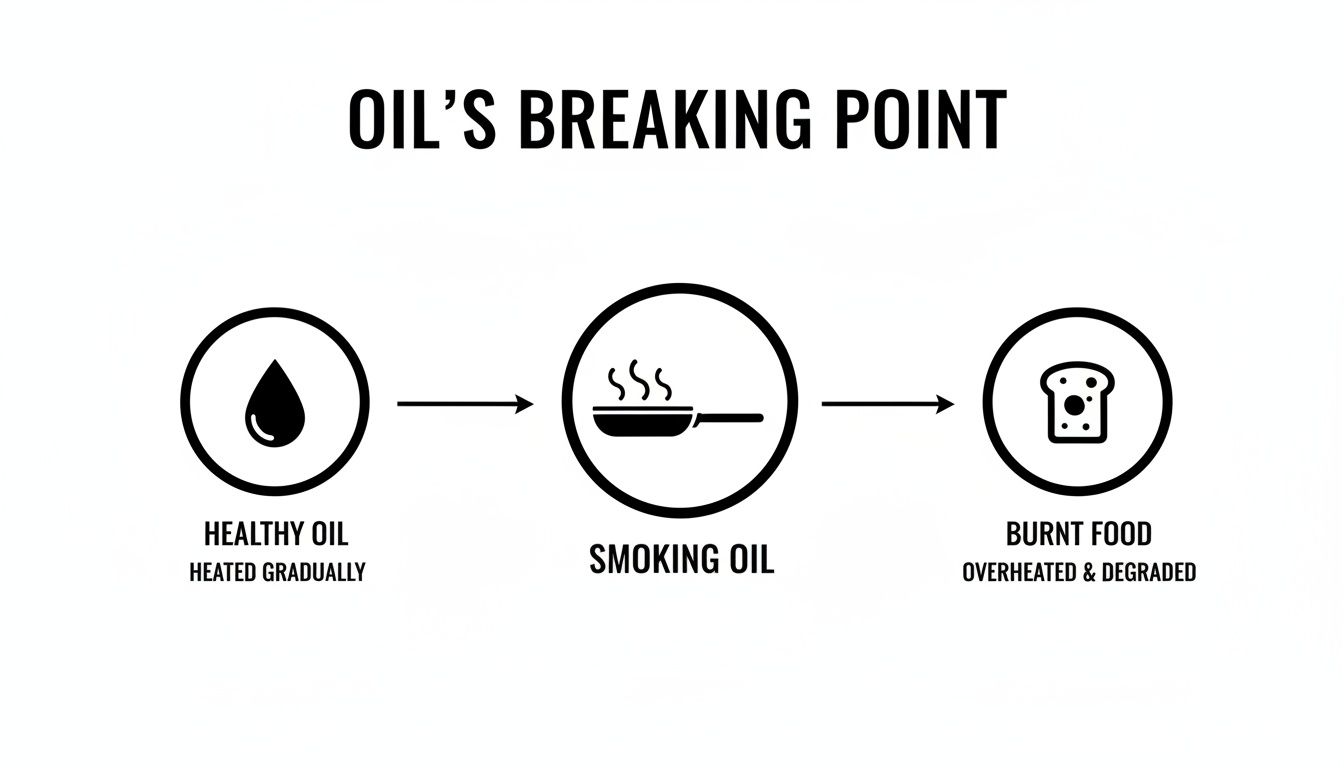
That smoke is your final warning. It means the oil is breaking down, creating bitter flavors and destroying its beneficial compounds.
The Real Smoking Gun: Free Fatty Acids
If you want to get to the very heart of what dictates an oil’s smoke point, it all comes down to one critical factor: its Free Fatty Acid (FFA) level.
In a superior oil, the fatty acids are neatly bundled into stable molecules. But things like bruised fruit, long delays between harvest and pressing, or simply poor storage can cause these molecules to fracture. When they do, they release "free" fatty acids.
These lone fatty acids are dangerously volatile and begin to smoke at much lower temperatures. Therefore, the more FFA an oil contains, the faster it will start smoking in your pan. A low FFA level is the undisputed hallmark of a quality oil that can stand up to the heat.
To see how the different grades are defined by their processing and FFA levels, take a look at the table below.
Comparing Olive Oil Grades From Production to Pan
This chart breaks down the key differences between the major types of olive oil you'll find on the shelf.
| Attribute | Extra Virgin Olive Oil (EVOO) | Virgin Olive Oil | Refined Olive Oil |
|---|---|---|---|
| Production Method | Mechanical extraction only, no chemicals or high heat. Cold-pressed. | Mechanical extraction only, but may have minor flavor defects. | Made from lower-quality oils treated with heat and chemicals. |
| Free Fatty Acid (FFA) | Must be below 0.8%. Premium oils are often 0.1-0.3%. | Higher FFA levels allowed, up to 2.0%. | FFA is stripped out during refining, often below 0.3%. |
| Flavor Profile | Robust, fruity, peppery, and complex. A "finishing" oil. | Milder than EVOO, but still has a distinct olive taste. | Neutral, very little flavor or aroma. A "working" oil. |
| Smoke Point | 350-410°F (177-210°C). Varies with quality and filtration. | Around 390°F (199°C). Lower than EVOO due to higher FFA. | 425-465°F (218-240°C). The highest due to refinement. |
As you can see, the journey from olive to oil has a profound impact on its behavior in your kitchen.
Ultimately, an oil's chemical profile tells its entire story. Once you understand what olive oil is made of on a deeper level, you can predict its performance with astonishing accuracy. For high-heat cooking, an oil with a verifiably low FFA is always your winning ticket.
Busting the Biggest Myths About Cooking With Olive Oil
For years, a single piece of culinary dogma has been repeated so often it feels like gospel: you must never, ever cook with extra virgin olive oil. The warning is always the same—it has a low smoke point, it will burn instantly, and it will poison your food with harmful compounds.
This idea isn't just wrong; it's a colossal disservice to home cooks everywhere. It’s a myth that has robbed kitchens of spectacular flavor and health benefits, all born from a fundamental misunderstanding of what a quality olive oil can truly accomplish. The truth is, a good extra virgin olive oil is a remarkably stable and versatile cooking fat, not merely a finishing drizzle.
The fear comes from lumping all EVOOs into one clumsy category, treating a premium, low-acidity oil the same as a cheap, poorly made one. But as we've already discovered, quality is the single most important factor in how an oil performs under fire.
Myth 1: The Smoke Point Is Dangerously Low
This is the big one—the cornerstone of the entire anti-cooking-with-EVOO argument. And it’s built on a foundation of seriously outdated information. While EVOO generally has a lower smoke point than hyper-refined oils like canola, its smoke point is far from "low."
A high-quality extra virgin olive oil, especially one with a very low Free Fatty Acid (FFA) level (often below 0.3%), can boast a smoke point soaring as high as 410°F (210°C). That’s more than enough heat for almost everything you do in a home kitchen.
Let's put that into perspective:
- Sautéing and Pan-Frying: This is typically done between 320-375°F (160-190°C).
- Oven Roasting: Most recipes call for temperatures between 350-400°F (175-205°C).
As you can see, a well-made EVOO can easily handle these temperatures without breaking a sweat—or in this case, without breaking down into smoke.
Myth 2: Heating EVOO Creates Harmful Compounds
This myth usually follows right on the heels of the first. The theory is that heating EVOO past its smoke point renders it "toxic." Here’s the reality: any oil heated past its smoke point will begin to degrade and create undesirable compounds. Olive oil is no exception to this rule.
What makes extra virgin olive oil special, however, is its secret weapon: a powerful army of antioxidants and polyphenols. These natural compounds do more than just provide health benefits; they actively shield the oil from oxidative damage when it's heated.
Studies have repeatedly shown that EVOO is one of the most stable cooking oils available. Its rich antioxidant content helps it resist thermal breakdown far better than many common seed oils, which can oxidize and produce harmful byproducts even if their smoke points are technically higher.
This means that even when you cook with EVOO, it retains more of its healthy properties and produces fewer harmful compounds than many of its refined competitors. If you're just diving into this topic, you can explore other common misconceptions about olive oil to get the full picture.
Myth 3: You Should Only Use Refined Oils for High Heat
Sure, refined or "light" olive oils have a higher smoke point, but that doesn't automatically make them a superior choice for cooking. The very refining process that raises the smoke point also strips the oil of its flavor, its aroma, and—most importantly—those protective polyphenols. You're left with a bland, neutral fat.
When you choose a high-quality EVOO for sautéing, you’re not just getting a stable cooking medium. You're actively infusing your food with complex, delicious flavors. That peppery bite and grassy aroma can elevate a simple dish of pan-seared vegetables or chicken from mundane to magnificent.
Ultimately, cooking with extra virgin olive oil isn't about ignoring its limits. It’s about understanding its true capabilities. Armed with a quality bottle and a basic knowledge of cooking temperatures, you can confidently use EVOO for nearly all of your daily cooking and unlock a world of flavor you might have been told was forbidden.
Matching the Right Olive Oil to Your Cooking Method
The secret to an unforgettable meal often has less to do with a complicated recipe and more to do with using the right tool for the job. It's the exact same story with olive oil. Once you grasp how an olive oil's smoke point really works, you can stop following rigid rules and start making smarter, more intuitive decisions in the kitchen.
This isn't about memorizing charts. It’s about developing a feel for which oil will not only withstand the heat but will actually make your food taste extraordinary. From the gentle warmth of poaching to the roaring sizzle of a perfect sear, choosing the right olive oil is a game-changer.
Sautéing, Roasting, and Everyday Cooking
For the vast majority of your daily cooking—sautéing garlic, roasting vegetables, or pan-frying chicken—a high-quality extra virgin olive oil is your most trusted companion. These methods typically operate between 320°F and 400°F (160-205°C), a temperature range a good EVOO handles with grace.
The real magic here is the flavor. Sautéing aromatics in a peppery EVOO doesn't just soften them; it builds a deep, delicious foundation that a neutral oil simply cannot replicate. Roasting potatoes or Brussels sprouts? The olive oil becomes a star ingredient, not just a non-stick coating.
Think of it this way: your goal is a confident sizzle, not a kitchen filled with acrid smoke. A quality EVOO brings its antioxidant power to the pan, making it a surprisingly stable and flavorful partner for your everyday meals.
High-Heat Searing and Frying
Alright, let's turn up the heat. When you need that deep, gorgeous crust on a steak or that perfectly crisp skin on fried chicken, you're pushing the temperature well past 400°F (205°C). This is where a delicate EVOO can begin to falter.
It’s time for a refined or "light" olive oil to step into the spotlight.
These oils are processed specifically to remove the free fatty acids and other compounds that cause smoking at lower temperatures. With a much higher smoke point, often around 446°F (230°C), they are built for high-intensity cooking.
- Searing Meats: Lets you achieve that perfect Maillard reaction without the oil burning and turning your food bitter.
- Shallow-Frying: Gives you the high, steady heat needed for a crispy coating on things like fish fillets or schnitzel.
- Stir-Frying: You can cook fast and hot, keeping vegetables crisp and vibrant without smoking out your kitchen.
Using a refined olive oil for these jobs is a strategic move. You get the clean, high-heat performance you need, and you don’t squander the beautiful, complex flavors of your premium extra virgin oil where the intense heat would destroy them anyway. To really nail these techniques, take a look at our guide to the best olive oils for cooking.
Finishing, Drizzling, and Raw Applications
This is where olive oil truly sings—when it's used raw. Grab your best bottle, the one you paid a little extra for, the one that smells of fresh-cut grass or green almonds.
In these moments, the smoke point is utterly irrelevant. The oil has one job and one job only: to deliver pure, unadulterated flavor.
A bold, peppery EVOO drizzled over a finished steak, a delicate and fruity one whipped into a vinaigrette, or a smooth, buttery oil pooled on top of a warm soup—this is how you elevate a good dish into an unforgettable one.
When to Use Your Best EVOO:
- Salad Dressings: The oil is the star, and all its subtle notes will come through.
- Dipping for Bread: There's nothing for the oil to hide behind. Its quality is the entire experience.
- Finishing Soups or Pastas: A final swirl just before serving adds a burst of fresh aroma and flavor.
- Drizzling on Vegetables or Meats: It acts as a bright, vibrant counterpoint that elevates the cooked flavors.
By matching the oil to the task, you stop worrying about limitations and start seeing a world of possibilities. You ensure every drop of oil in your pantry is used to its full potential, helping you create incredible food, day in and day out.
How to Protect Your Olive Oil From Its Three Enemies
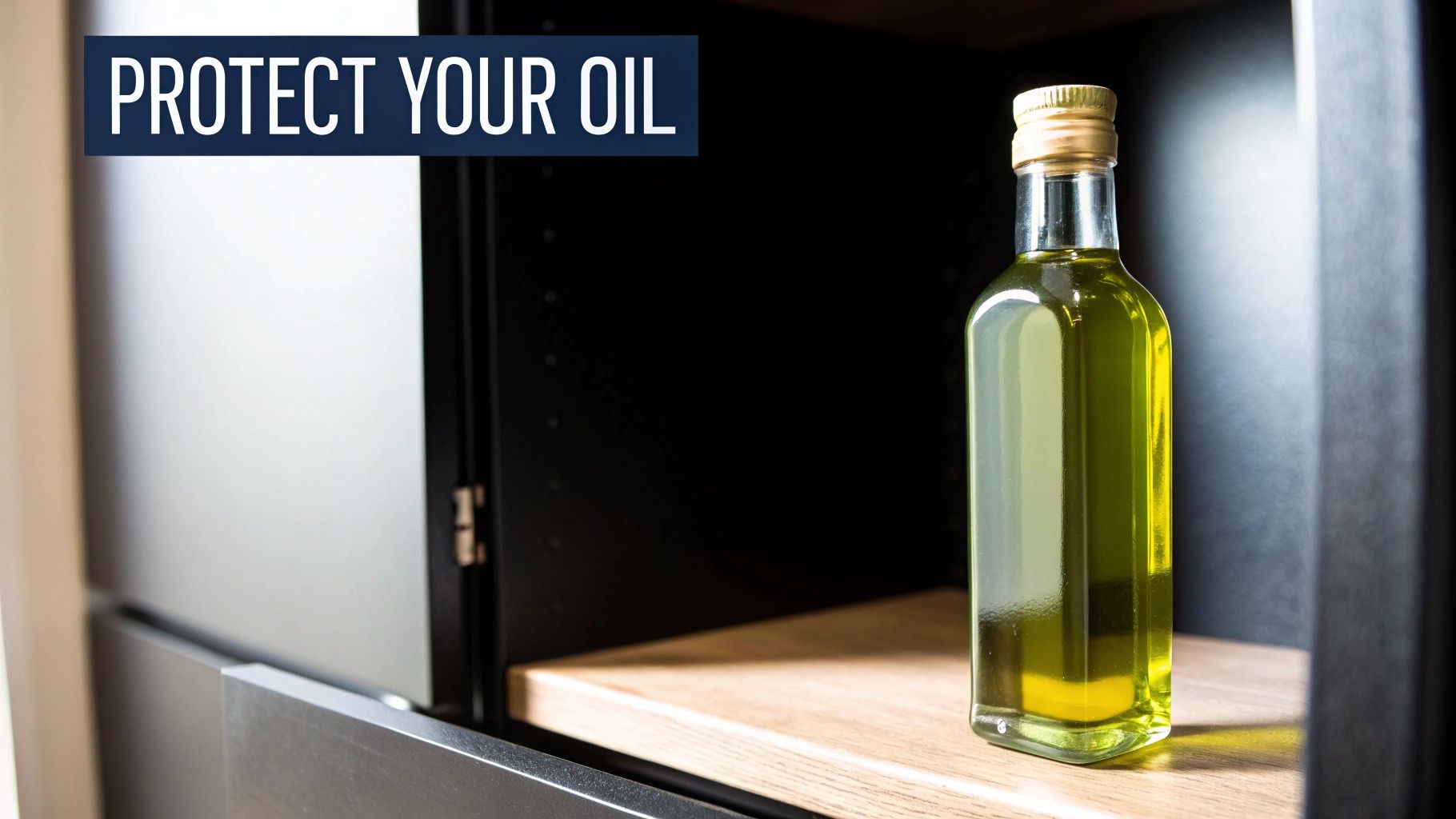
That beautiful bottle of extra virgin olive oil sitting on your counter is locked in a constant, silent battle. It has three sworn enemies working around the clock to rob it of its flavor, its health benefits, and its heat stability: light, heat, and air.
An olive oil's smoke point isn't a number set in stone. Think of it more like the oil’s vitality. Every time it's exposed to one of these enemies, its internal structure begins to degrade, the free fatty acids multiply, and its smoke point plummets. That convenient spot right next to your stove might seem like a good idea, but the daily warmth is slowly destroying the very qualities you paid for.
Protecting your oil isn't just a culinary best practice; it's smart economics. With the world's largest olive oil producers seeing crop yields drop by around 7% in recent years, quality oil has become an even more precious commodity. Storing your oil correctly protects that investment and ensures every dollar you spend actually makes it into the pan.
Defending Against the Elements
You must treat your olive oil like a fine wine, not like a jug of generic vegetable oil. The strategy is simple, but it’s absolutely critical if you want to preserve its integrity and maintain a stable smoke point.
The first enemy, light, is why you almost always see premium oils sold in dark, opaque bottles. A clear glass bottle might look pretty, but it’s an open invitation for light to initiate oxidation—the very process that turns fresh, vibrant oil into something stale and rancid.
The Best Defense: A Cool, Dark Place
Your best line of defense is a simple one: store your oil in a cool, dark place. A kitchen cabinet or pantry, far away from the oven and any sunny windows, is the perfect fortress. This one habit shields it from both heat and light.
Here are the non-negotiable rules for preserving your oil:
- Avoid the Stove: The ambient heat from your cooktop is a constant, low-grade assault on the oil's stability.
- Keep it Out of the Light: Never store olive oil on a windowsill or an open shelf that gets direct sun.
- Seal it Tight: Oxygen is the third enemy. Always screw the cap back on tightly right after you use it to keep air out.
Your pantry is more than just storage; it’s a vault for your liquid gold. Protecting your oil from these three enemies is the single most effective way to ensure the smoke point and flavor you expect are there when you need them.
Following these simple steps guarantees that the last drop from the bottle is nearly as fresh and heat-stable as the first. For a more detailed breakdown, check out our complete guide on proper olive oil storage. It’s the key to making sure your investment in quality oil pays off in every single dish.
Answering Your Questions About Olive Oil's Smoke Point
Even when you feel you've mastered the basics, new questions always emerge right when you're standing over a hot stove. It's in these "what if" moments that having clear, confident answers separates a good cook from a great one. Here, we tackle the most common curiosities about olive oil's smoke point, arming you with practical kitchen wisdom.
Let’s get into the questions every home cook eventually asks.
Can I Deep Fry With Olive Oil?
You absolutely can—but you must choose your weapon wisely. It would be a culinary crime to pour a bottle of beautiful, expensive extra virgin olive oil into a deep fryer. Not only would its complex, delicate flavors be completely vaporized by the intense heat, but its lower smoke point simply isn't engineered for the task.
A refined or "light" olive oil, on the other hand, is a fantastic choice for deep-frying. With a high smoke point hovering around 446°F (230°C), it provides the stable, consistent heat you need for that perfect golden, crispy crust without any risk of burning. The refining process also strips away most of the flavor, so it won't overpower the food you're frying. It’s a smart, economical choice that delivers the high-heat performance you need without sacrificing your premium finishing oil.
What Does a Burnt Olive Oil Smell Mean?
That sharp, acrid, and truly awful smell is a blaring alarm bell from your pan. It’s the unmistakable scent of failure, telling you the oil has rocketed past its smoke point and is now chemically decomposing. At this point, the oil isn't just smoking; it's breaking down at a molecular level.
This breakdown creates bitter, off-putting flavors that will contaminate everything in the pan, ruining your dish beyond all hope. It also signifies that the healthy fats and beneficial polyphenols have been destroyed. The only thing to do is stop, immediately.
Pushing forward is a mistake you only make once. The acrid flavor is impossible to mask. Your best and only move is to carefully and safely discard the hot oil, wipe the pan completely clean, and start over with fresh oil at a more controlled temperature.
Learning to recognize that smell is a crucial skill. It teaches you the limits of your oil and your heat source, turning a potential disaster into an invaluable lesson in temperature control.
Does Filtering Olive Oil Change Its Smoke Point?
Yes, it does—and this is one of those subtle details that can seriously improve your cooking. Filtering is what separates a clear, stable oil from a cloudy, more volatile one. Unfiltered olive oil contains tiny, suspended particles of the olive fruit itself.
While these microscopic solids contribute to a robust, rustic flavor, they are also the very first things to burn when you apply heat. They scorch at a much lower temperature than the oil itself, which effectively drags down the overall smoke point of the unfiltered oil and makes it smoke far too early.
This means a clear, filtered extra virgin olive oil will almost always have a higher and more consistent smoke point than its unfiltered cousin. It's why filtered EVOO is often a more reliable and versatile choice for sautéing and pan-frying. Save that beautiful, cloudy, unfiltered oil for what it does best: finishing dishes where its bold, raw flavor can truly shine without ever seeing the heat of a pan.
How Do I Know if My Olive Oil Is High Quality?
Figuring out if an olive oil is high-quality starts long before you even twist the cap. You have to become a bit of a detective, hunting for clues that reveal the oil's true character and how it will perform in your kitchen.
Start with the bottle and the label. A serious producer will almost always use dark, opaque glass or a tin to shield the oil from light—its number one enemy.
Next, scan the label for these key signs:
- Harvest Date: This is the single most important piece of information. Olive oil is a fruit juice; it's best when it's fresh. Look for a recent harvest date, ideally within the last year. Be wary of bottles that only show a "best by" date, which can be terribly misleading.
- Origin and Certifications: A specific region of origin (like "Tuscany, Italy" or "Crete, Greece") is a great sign. Official certifications like PDO (Protected Designation of Origin) or PGI (Protected Geographical Indication) are even better, as they indicate strict quality control and authenticity.
- Low Free Fatty Acid (FFA) Level: While it's not always listed, a low FFA is the ultimate mark of a well-made, stable oil. Premium oils often boast an FFA below 0.3%, which directly correlates to a higher, more stable smoke point.
Finally, trust your own senses. Once opened, a great olive oil should smell fresh and vibrant—think grassy, peppery, or fruity. If it smells waxy, stale, or like crayons, it has gone rancid, and its smoke point will be shot. High-quality oil is an investment, and these clues help ensure you're getting what you pay for.
At Learn Olive Oil, we believe that understanding the nuances of olive oil transforms cooking from a daily chore into a delicious art form. By exploring the world of premium oils, you can elevate every meal you create. Discover expert insights, tasting techniques, and trusted producers to guide your journey.
Start exploring today at https://learnoliveoil.com and unlock the true potential of this liquid gold.


Leave a comment