Picture this: a perfect, golden-brown sear on a salmon fillet. Potatoes roasted to a shattering crisp. That moment of kitchen alchemy hinges on one crucial secret: knowing the thermal limit of your cooking oil. For olive oil, this limit is the heating point—what most of us call the smoke point. It’s that precise temperature where the oil in your pan stops shimmering and begins sending up wisps of smoke, a clear signal it’s starting to break down.
What Is An Oil's Heating Point?
Think of an oil's heating point not as a strict rule, but as its performance threshold. It's the moment the oil cries, "That's enough heat!" Push it past this point, and it sends up literal smoke signals—a desperate warning that its precious fats and flavorful compounds are degrading.
This breakdown is more than a smelly inconvenience; it's a culinary tragedy in the making. The beautiful, nuanced flavors of your olive oil are scorched into a bitter, acrid mess. Worse, some of its healthy fats can transform into potentially harmful compounds. Staying below this thermal boundary is the key to unlocking spectacular flavor and reaping all the nutritional benefits from your oil.
Debunking The Low Heat Myth
There's a persistent kitchen myth that all olive oil is too delicate for anything hotter than a gentle drizzle. This is simply not true. The reality is, the heating point for olive oil can vary wildly, depending on one thing: its quality.
A high-quality extra virgin olive oil (EVOO), for instance, is far more resilient than you’ve been led to believe. It is naturally stable enough for most home cooking, thanks to its powerful chemical makeup. This stability is born from its high concentration of monounsaturated fats—specifically oleic acid, which makes up a staggering 70-80% of its composition. This type of fat is a fortress against heat and oxidation compared to oils high in flimsy polyunsaturated fats. You can dive deeper into this at https://learnoliveoil.com/olive-oil-heat-point.
The smoke point is the temperature at which an oil begins to produce a continuous stream of bluish smoke. It's a clear indicator that the oil is no longer stable and its quality is rapidly declining.
Here’s the surprising part: a premium EVOO has a smoke point that can range anywhere from 180°C to 215°C (356°F to 419°F). The best oils, those with the fewest impurities and lowest acidity, will sit confidently at the higher end of that range. This makes them perfectly safe for sautéing, roasting, and even shallow frying.
Once you understand what your olive oil can truly handle, you can stop cooking with fear. It’s not about avoiding the heat; it's about choosing the right oil for the battle.
Why Not All Olive Oils Are Created Equal
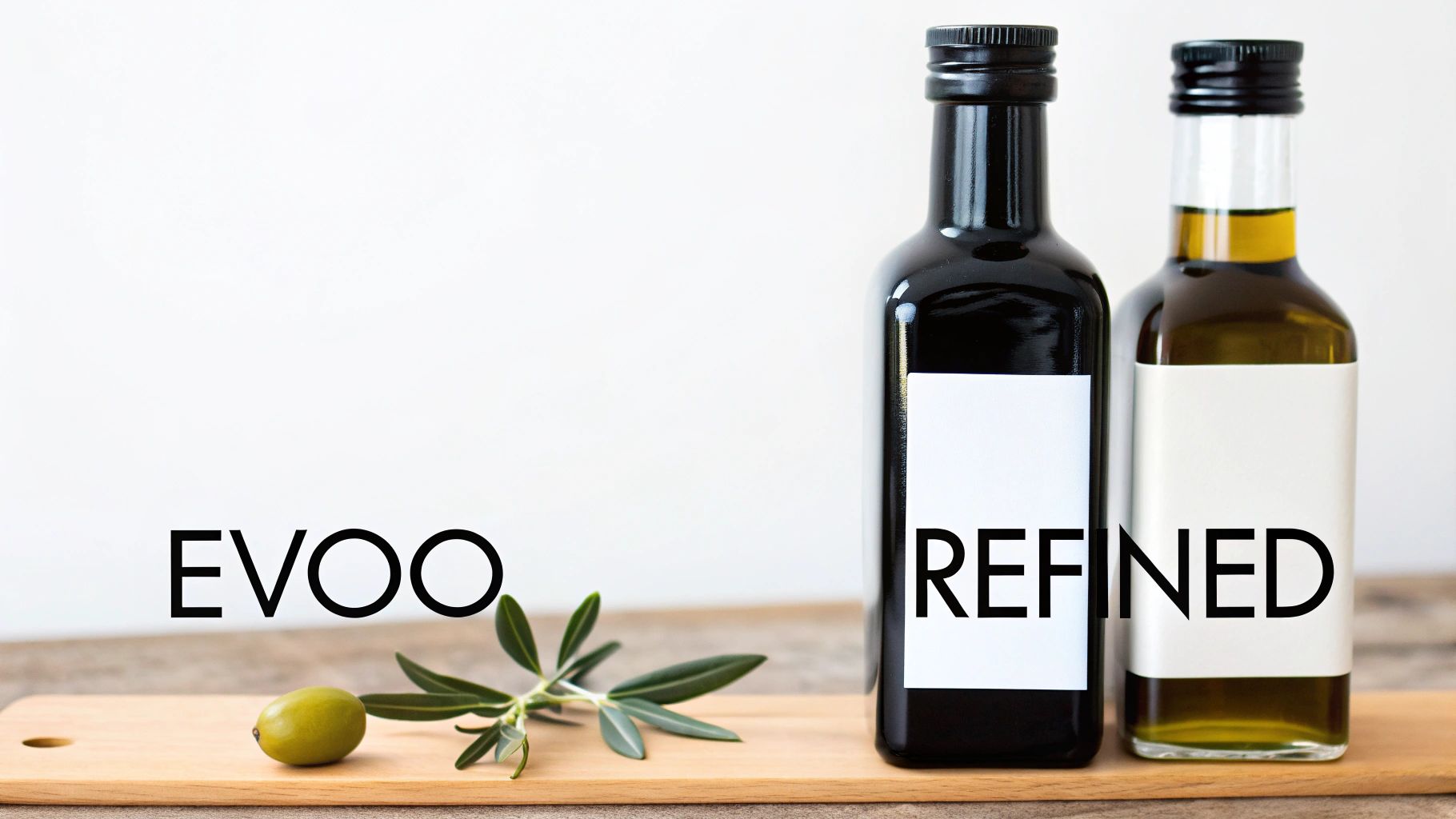
Walk into any serious cook's kitchen, and you’ll discover a fundamental truth: not all olive oils are meant for the same task. The humble olive gives us two radically different products: the assertive, peppery Extra Virgin Olive Oil (EVOO) and its quieter, more versatile cousin, refined olive oil.
The real difference lies in how they journey from the tree to your bottle. One is a raw, unadulterated expression of the fruit, bursting with character. The other is deliberately engineered for high-performance under fire. Knowing which one to grab is the secret to getting the most out of every single dish.
The Tale Of Extra Virgin Olive Oil
Think of Extra Virgin Olive Oil as freshly squeezed olive juice. It's extracted using only mechanical methods—no high heat or chemicals allowed. This gentle, cold-press process is all about preserving the olive's natural soul.
The result is an oil overflowing with personality. It’s packed with polyphenols, potent antioxidants that deliver that characteristic spicy kick and a host of health benefits. But this raw purity has its limits in the kitchen.
Because EVOO isn't heavily processed, it holds onto more natural compounds and free fatty acids. These are the very things that create its incredible flavor, but they are also the first to surrender and smoke when the heat is on. It's like raw, unfiltered honey; its complexity makes it amazing, but you wouldn’t use it to make hard candy over a raging flame.
The Path Of Refined Olive Oil
Refined olive oil starts its life as virgin olive oil but then embarks on a completely different journey. It’s put through a rigorous purification process of filtering, neutralizing, and deodorizing. This isn't about making it "worse"; it's a deliberate transformation to forge a totally different kind of cooking fat.
This industrial-scale refinement strips away the very things that give EVOO its lower heating point—the free fatty acids, tiny olive particles, and volatile flavor compounds. By removing these sensitive elements, the oil becomes incredibly stable, and its smoke point soars.
It's the same principle behind turning butter into ghee. You remove the milk solids (which burn easily), leaving behind pure fat that can handle much higher temperatures. The process results in a clean, neutral-tasting oil built for high-heat combat.
Refined olive oil is the unsung hero of the high-temperature kitchen. Its purification process elevates its smoke point, making it a surprisingly robust and reliable choice for tasks that would make more delicate oils smoke and burn.
This stability makes it a true kitchen workhorse. In fact, refined olive oil can reach an impressive smoke point of 465°F (242°C), making it a spectacular choice for deep-frying or getting a hard sear on a steak. This fact alone shatters the myth that olive oil can't compete with other high-heat oils like canola (around 400°F) or peanut oil (around 450°F).
You can learn more about the differences between these olive oils and see just how much the refinement process changes the final product. Ultimately, this exceptional heat tolerance makes refined olive oil an invaluable, if often overlooked, tool for any home cook.
The Unseen Factors That Control The Sizzle
So, what really decides when an oil surrenders under heat and starts sending smoke signals? It’s not something you'll find written on the front of the bottle. The answer is etched in the oil's molecular makeup—a story told by its purity, its age, and a few microscopic characters that run the show in your pan.
To truly grasp what's happening, you need to meet the main villain behind a low smoke point: Free Fatty Acids, or FFAs.
Picture a perfectly stable, well-structured liquid. Now, imagine a swarm of tiny, restless troublemakers darting through it, just waiting for a chance to break free and burn at the slightest provocation. That's a good way to picture FFAs. They're fatty acids that have broken off from their main structure, and the more of them you have, the faster your oil will break down when you turn up the heat.
The Quality Connection: Free Fatty Acids
Here is where you can draw a sharp line between a superb olive oil and a mediocre one. A low FFA level is the secret weapon of any high-quality Extra Virgin Olive Oil. In fact, to even earn the "extra virgin" title, an oil must have an FFA level below 0.8%. That’s not just an arbitrary number; it's a guarantee of purity and stability.
Compare that to lower-grade virgin olive oils, which can have FFA levels all the way up to 2.0%. It may not sound like a huge difference, but in the heat of the kitchen, it's massive. That higher concentration of volatile "troublemakers" means the oil will start smoking at a much lower temperature, potentially ruining your dish before you even get a proper sear.
An oil with a low FFA count is like a well-disciplined army—stable and resilient under pressure. An oil with high FFAs is more like a chaotic mob, ready to break ranks and burn at the first sign of heat.
Recent studies confirm this, showing a direct link between high FFA levels and lower heat tolerance. In short, as the FFA percentage climbs, the smoke point plummets. This research proves that high-quality EVOO with less than 0.8% FFA can confidently handle temperatures between 191-215°C (375-420°F). Meanwhile, oils with higher acidity struggle to remain stable even around 180°C (355°F).
Age And The Enemies Of Oil
But it’s not just about the FFAs an oil is born with. Its life story—and its constant battle against three mortal enemies—also dictates its performance on the stove. These enemies are:
- Oxygen: Every time you open that bottle, air rushes in. Oxygen triggers a process called oxidation, which not only creates stale, off-flavors but also gradually increases the free fatty acid content.
- Light: Those clear bottles may look pretty on the shelf, but UV light is a death sentence for olive oil. It accelerates the breakdown of the oil's healthy fats and antioxidants, weakening its structure and lowering its smoke point.
- Heat: Storing your oil next to the stove is one of the worst things you can do. Even the gentle, ambient heat from cooking encourages the chemical reactions that degrade the oil's quality, slowly chipping away at its ability to stand up to the heat in your pan.
The Hidden Remnants Of The Fruit
Finally, there’s one more subtle factor: filtration. Have you ever seen those cloudy, unfiltered olive oils? They contain microscopic particles of the olive fruit itself. While some people enjoy that rustic character, those tiny solids are far more delicate than the oil around them.
When you heat an unfiltered oil, these little fruit particles will burn long before the oil itself reaches its true smoke point. This creates smoke and imparts a bitter, acrid taste, effectively sabotaging the oil's performance. A well-filtered, clear oil has had these potential burn-points removed, giving you a cleaner flavor and a more reliable, higher heating point.
By understanding these unseen forces—from the oil's chemical makeup to how you store the bottle—you're no longer just using olive oil. You're beginning to think like a connoisseur, able to predict how your oil will behave before a single drop even hits the pan. To get a better grasp of olive oil's components, you might be interested in our guide on what olive oil is made of.
The High Cost Of Overheating Your Olive Oil
That first wisp of smoke curling up from your pan isn't just a sign that it's hot. It's a distress signal from your olive oil. Pushing your oil past its smoke point is a costly mistake that hits you on two fronts: it ruins the flavor of your food and destroys the very health benefits you paid for.
The first casualty is always taste. Imagine the delicate, grassy notes and peppery finish of a beautiful Extra Virgin Olive Oil. Those are the very first things to be incinerated when the oil gets too hot. What you're left with is a bitter, acrid flavor that can easily sabotage an entire dish, turning a great meal into a smoky, disappointing memory.
When Flavor Turns Foul
This isn't just a subtle change in taste—it's a total molecular collapse. The complex, aromatic compounds that make high-quality olive oil so special are incredibly fragile. Once you push past the oil's heating point, these molecules are violently torn apart.
The result is a burnt, foul taste that no amount of salt or spice can mask. That gorgeous piece of fish you were searing now just tastes like scorched oil. Those vibrant vegetables you were roasting are now tainted with a harsh, almost chemical bitterness. It's an expensive mistake, not just in the wasted oil, but in the ruin of a perfectly good meal.
When olive oil begins to smoke, its molecular structure is breaking down. This process, known as thermal decomposition, not only destroys its flavor but also begins to create harmful by-products that you don't want in your food.
This destructive process is exactly why managing your heat is non-negotiable. When you respect the oil's limits, you ensure it enhances your food rather than overpowering it with burnt, unpleasant notes.
The Nutritional Price Tag
The deeper cost of overheating your olive oil is the price you pay silently, in nutrition. The very compounds that make olive oil "liquid gold"—its powerful polyphenols and antioxidants—are extremely sensitive to high temperatures.
These are the components that deliver the celebrated health benefits, from fighting inflammation to protecting your body. As the oil starts to smoke, these valuable nutrients are rapidly degraded and destroyed, literally vanishing into thin air before your food ever hits the plate.
Beyond losing the good stuff, you start creating bad stuff. The healthy monounsaturated fats that make olive oil so stable can begin to oxidize when pushed past their smoke point. This oxidation process creates harmful free radicals—the very molecules you were trying to fight in the first place.
- Polyphenol Destruction: That peppery kick you taste in a good EVOO? That's the calling card of healthy polyphenols. When the oil smokes, that flavor vanishes because the polyphenols have been obliterated.
- Formation of Harmful Compounds: Research has shown that when oils are heated past their smoke point, they can form polar compounds and other by-products that are best to avoid.
- Loss of Vitamins: Olive oil is a source of fat-soluble vitamins like Vitamin E and K, which are also damaged and degraded by extreme heat.
This isn't meant to scare you away from cooking with olive oil. It is a plea to protect the integrity of your ingredients. Understanding this thermal boundary is crucial. Remember that old or poorly stored oil can also go bad, and you can learn more about how to spot it in our guide to the rancidity of olive oil. By keeping your heat in check, you ensure every meal you cook is a true celebration of both exceptional flavor and vibrant health.
Matching Your Oil To Your Cooking Method
All this talk of smoke points and fatty acids is interesting, but it means nothing until you put it to work. Let’s get practical. This is where you transform the science of the olive oil heating point into consistently delicious food. Nailing this is the final step to cooking with unshakable confidence.
The trick is simple: pair the right oil with the right task. Think of it like a partnership. For a beautiful steak you plan to pan-sear at 375°F (190°C), a robust Extra Virgin Olive Oil is your trusted ally. At that temperature, the oil is happy, and its bold, peppery notes will amplify the rich flavor of the meat.
But if you're deep-frying calamari at 400°F (204°C), that same EVOO would be a disaster. This is where a refined olive oil steps into the spotlight. Its much higher smoke point allows it to handle that intense heat without breaking down, delivering perfectly golden calamari instead of a smoky, bitter mess. For some specific high-heat jobs, like seasoning cast iron, it's essential to use a high-smoke-point oil that can create a tough, non-stick layer.
Reading The Signs In The Pan
Here’s the good news: you don’t need a fancy thermometer to know when your oil is ready. Your eyes are the only tool you need. The real secret is learning to read the oil's visual cues—the subtle language it speaks just before it hits that perfect cooking temperature.
When you first pour oil into a cold pan, it’s thick and sluggish. As it heats, you’ll see it start to thin out and move more freely. The moment you are waiting for is the shimmer. You’ll see faint, wavy lines ripple across the oil's surface. That shimmer is your green light, signaling the pan is perfectly preheated and ready for your food. It's the sweet spot, long before the oil even thinks about smoking.
This simple flowchart lays out the choice you face every time you heat oil in a pan.
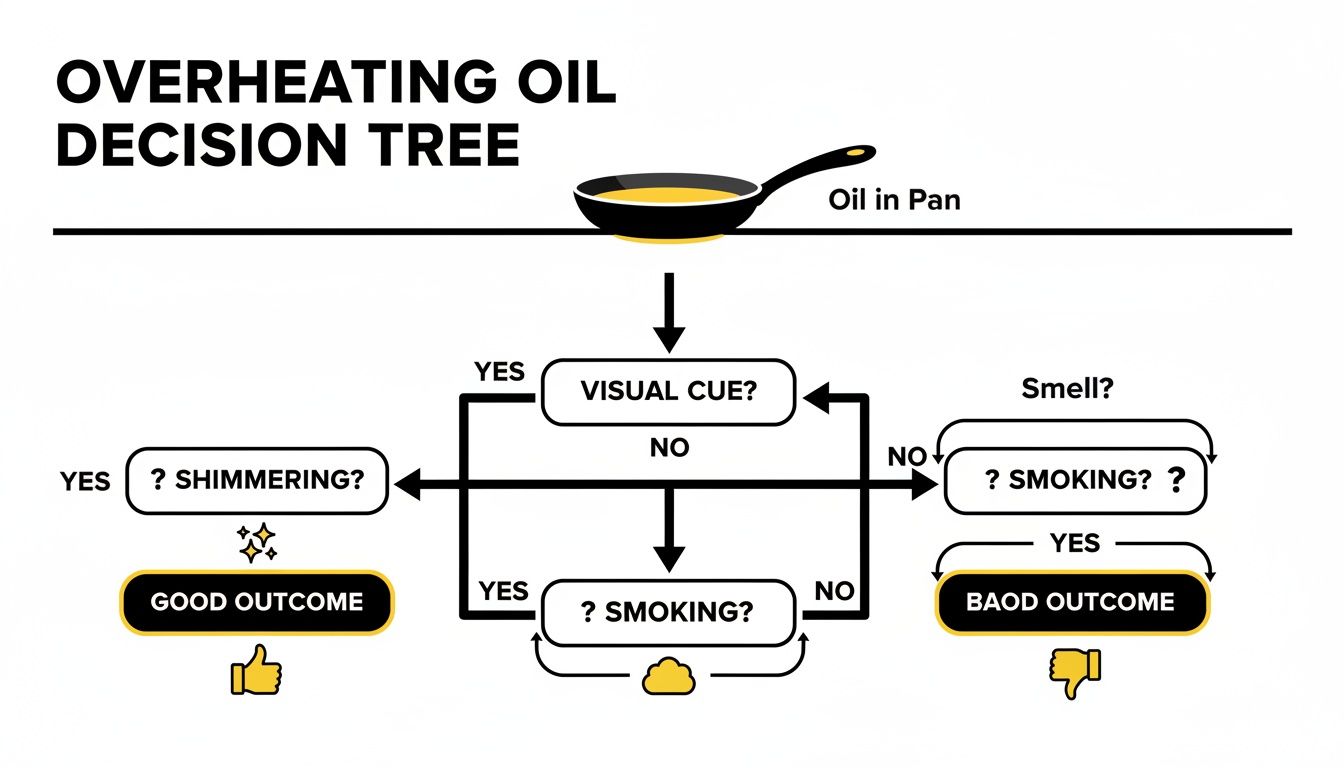
The takeaway couldn't be clearer: a shimmering oil means you’re in the cooking zone. A smoking oil means you’ve gone too far, and it’s time to stop, cool down, and start over.
Your Olive Oil Cooking Cheat Sheet
To make things even easier, here is a straightforward guide. Use this table to match the right olive oil to whatever you're cooking to guarantee you get the best flavor and performance, every single time. Getting this down is a game-changer, and you can always dig deeper into the types of olive oil for cooking to build on what you learn here.
| Cooking Method | Ideal Temperature Range (°C / °F) | Recommended Olive Oil Type | Example Dishes |
|---|---|---|---|
| Sautéing & Pan-Searing | 160-190°C / 320-375°F | High-Quality Extra Virgin | Sautéed vegetables, seared fish, chicken cutlets |
| Roasting | 190-220°C / 375-425°F | Extra Virgin or Refined Olive Oil | Roasted potatoes, chicken, Brussels sprouts |
| Frying (Shallow/Deep) | 180-205°C / 355-400°F | Refined Olive Oil or "Light" Olive Oil | Fried chicken, french fries, crispy artichokes |
| Finishing & Drizzling | No Heat | High-Quality Extra Virgin | Drizzled on soups, salads, bread, hummus |
| Baking | 175-200°C / 350-400°F | Refined or Mild Extra Virgin | Cakes, focaccia, muffins |
By following these simple pairings, you can stop worrying about smoke points and start focusing on what truly matters: creating incredible meals. This is how you master the essential partnership between heat and oil.
How to Protect Your Liquid Gold
That beautiful bottle of extra virgin olive oil is an investment in your kitchen, but its quality is more fragile than you might imagine. The olive oil heating point isn't set in stone; it begins to degrade the moment the oil is exposed to its three mortal enemies: heat, light, and oxygen. Protecting your liquid gold is simple, but it demands your care.
Think of a high-quality EVOO like a fine wine. You would never leave an expensive bottle of wine sitting on a sunny windowsill next to the stove, would you? The same logic applies here. Every encounter with those three enemies chips away at the oil's integrity, breaking down the very compounds that deliver its incredible flavor, health benefits, and stable heating point.
The Three Enemies of Olive Oil
The secret to preserving your olive oil lies in your pantry. A good defense starts the moment you bring that bottle home by shielding it from the elements.
Heat: Keeping your olive oil next to the stove may seem convenient, but it’s a death sentence for its quality. Even low, consistent heat from your stovetop or oven accelerates oxidation, aging the oil prematurely and lowering its smoke point. Find a home for it in a cool, dark cupboard, far from any appliances.
Light: Those clear glass bottles look lovely, but they offer zero protection. UV rays kickstart a process called photo-oxidation, which rapidly destroys the delicate fats and beneficial polyphenols. This is why the best producers insist on dark glass bottles or opaque tins—they are essentially sunscreen for your oil.
Oxygen: The clock starts ticking the second you break the seal. Oxygen immediately begins to react with the fats, which is what eventually causes that stale, rancid taste. Make it a habit to tighten the cap securely after every single pour. Don't give air any more time with your oil than is absolutely necessary.
A good rule of thumb? Treat your olive oil like a vampire. It loves cool, dark places and hates light and air. Proper storage is the single most important thing you can do to preserve its flavor and performance in the pan.
Smart Buying for Maximum Freshness
The best way to guarantee your oil is always at its peak is to rethink how you buy it. It’s tempting to grab that giant, economy-sized jug, but unless you're running a pizzeria, it's a terrible idea. Oil degrades from the moment it’s opened, and a huge bottle will almost certainly go rancid before you can finish it.
Instead, buy smaller quantities that you can realistically use within a month or two. This ensures the last drop is just as vibrant, flavorful, and heat-stable as the first.
And if you ever open a bottle and notice it smells waxy, like crayons or old walnuts, that’s the unmistakable smell of rancidity. Trust your nose, toss it, and open a fresh one. Your food will thank you.
Your Top Olive Oil & Heat Questions, Answered
Even with all the science laid out, a few common questions always seem to surface when it comes to cooking with olive oil. Let's tackle them head-on, so you can get back to the kitchen with complete confidence.
Can I Really Fry With Extra Virgin Olive Oil?
Yes, you absolutely can. This is perhaps the biggest and most stubborn myth out there, so let's set the record straight once and for all. A good quality extra virgin olive oil has a heating point somewhere between 356-419°F (180-215°C).
That range is comfortably above the temperature needed for most home cooking, including pan-frying, which typically sits around 350°F (177°C). EVOO is packed with stable monounsaturated fats, making it far more durable under heat than you’ve been led to believe. It’s a fantastic choice for sautéing, searing, and even shallow frying, all while adding a tremendous boost of flavor to your food.
Does Filtering Olive Oil Increase Its Smoke Point?
It absolutely does, and the effect is dramatic. Unfiltered oils contain tiny, suspended particles of the olive fruit itself. Think of them as microscopic leftovers from the pressing process.
These little solids are much more fragile than the oil itself and will begin to burn at very low temperatures. When they do, you'll see smoke and get a bitter, unpleasant taste long before the oil has actually reached its limit.
By filtering the oil, producers remove these particles that are so quick to burn. The result is a cleaner, more stable oil with a much higher heating point. This is why a crystal-clear, high-quality EVOO will often outperform a cloudy, unfiltered one when the heat is on.
What Should I Do If My Olive Oil Starts Smoking?
If you see smoke, it's a clear signal you've pushed the oil past its heating point. At this stage, the oil is breaking down, destroying its delicate flavor and healthy compounds while creating by-products you don't want in your food.
The only correct move is to immediately and carefully take the pan off the heat. Let it cool down completely, then dispose of the oil.
Do not try to salvage the food. That burnt, acrid taste has already seeped into everything in the pan. Your best bet is to wipe it clean and start over with fresh oil, keeping a closer eye on the temperature to stay safely below that smoking threshold. Your taste buds will thank you.
Ready to explore the world of premium olive oil? At Learn Olive Oil, we provide expert insights, tasting guides, and recommendations to help you discover the perfect bottle for every dish. Start your journey and elevate your cooking at https://learnoliveoil.com.
 Learn Olive Oil
Leave a comment