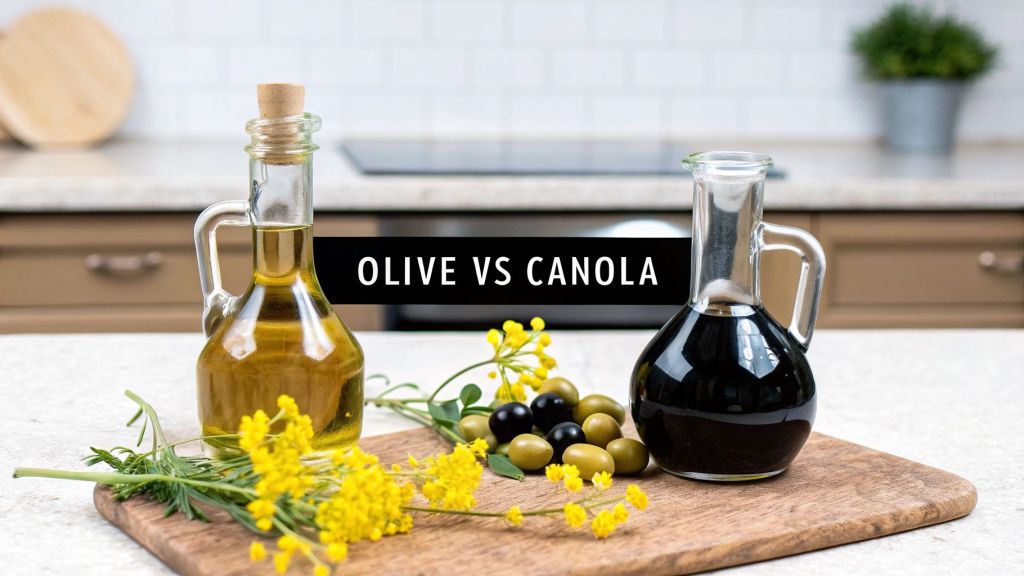
Walk down any supermarket aisle and you'll face a decision that quietly shapes every meal you cook. Olive oil or canola oil? On the surface, it seems trivial. But I'm here to tell you it's one of the most critical choices you can make for your health.
Here’s the simple, unvarnished truth most food marketers hope you never realize: Extra virgin olive oil is a natural fruit juice. It is pressed directly from whole olives, capturing a symphony of antioxidants and a flavor that has graced healthy tables for millennia. In the other corner, you have canola oil, a product of intense industrial chemistry. It’s wrenched from rapeseed using chemical solvents, high heat, and bleaching agents until it’s a pale, lifeless, and neutral liquid.
A Choice That Defines Your Kitchen
Think about that for a moment. One is a food. The other is a factory product. In one hand, you hold the liquid gold of the Mediterranean, the celebrated heart of a diet proven to extend life. In the other, a bottle born from a process that systematically strips away every trace of its natural origin.
This isn't merely about taste. It’s a profound choice between a whole, vibrant fruit oil bursting with life-giving compounds and a heavily refined seed oil engineered for shelf-life and profit. We’re about to cut through the fog of misleading health claims and give you the unshakeable facts in the olive oil vs. canola showdown.
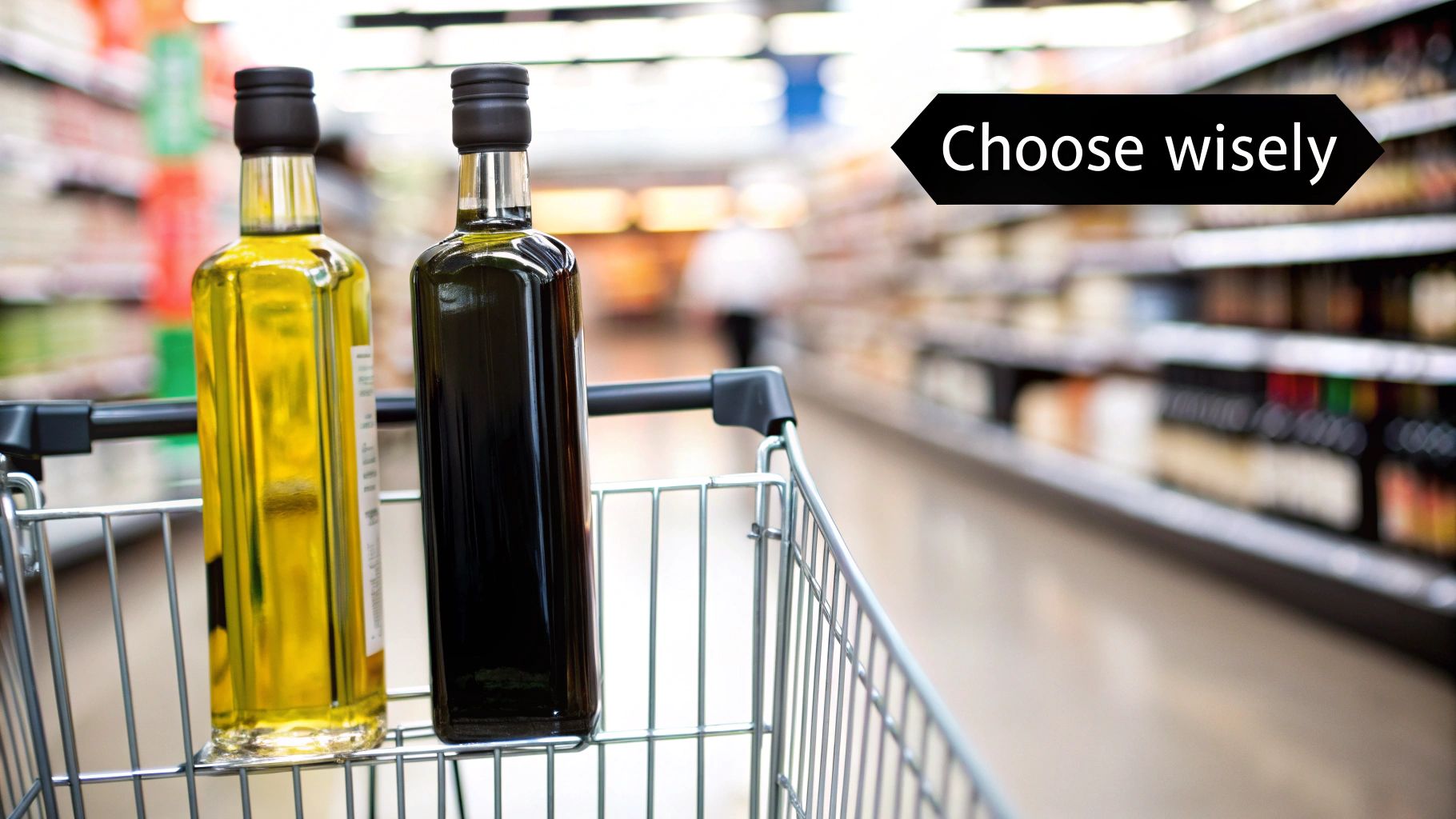
A Tale of Two Oils
Let’s lay the cards on the table. This simple comparison will reveal more than an hour of reading food labels ever could.
| Feature | Extra Virgin Olive Oil | Canola Oil |
|---|---|---|
| Source | Ancient fruit (olives) | Genetically modified rapeseed plant |
| Processing | Cold-pressed, unrefined | Solvent extraction, bleached, deodorized |
| Flavor Profile | Fruity, peppery, complex | Neutral, bland, flavorless |
| Key Compound | Oleocanthal (anti-inflammatory) | Mostly omega-6 fatty acids |
| Primary Use | Flavor enhancer, cooking, finishing | High-heat cooking, industrial frying |
Your choice of oil is as fundamental as the pots and pans in your kitchen. Having the right kitchen and cooking essentials is critical, but the ingredients you use are what truly nourish you.
The question isn't just "Which oil is better?" The real question is: "Do I want to cook with a whole, natural food or an industrially manufactured fat?" Once you see how they're made, the answer becomes startlingly clear.
We will dismantle the myths about nutrition, heat stability, and flavor. For instance, the lie that olive oil can't handle heat is easily debunked by any reputable cooking oil smoke points chart, which shows it’s ideal for most home cooking. This is about empowering you to make a conscious choice, not just an accidental purchase.
From Ancient Groves to Industrial Labs
To truly grasp the chasm between olive oil and canola oil, you must travel to their origins. One story begins on sun-drenched, ancient hillsides. The other starts inside a massive, sterile processing plant. Their beginnings aren't just different—they represent two opposing philosophies of food.
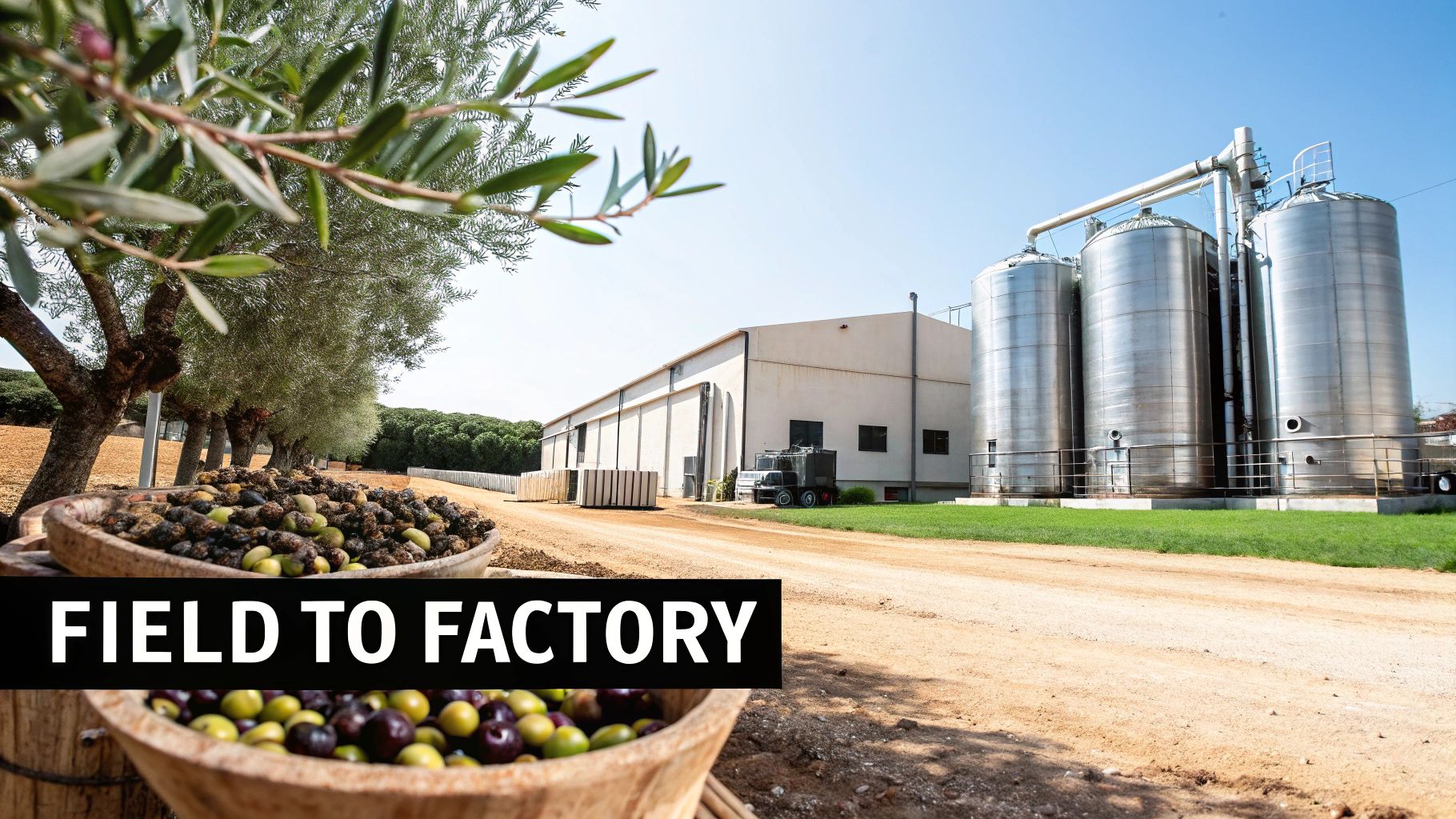
First, imagine a centuries-old olive grove. The air is warm, the soil has been nurtured for generations, and the gnarled trees are a living legacy. Here, creating extra virgin olive oil is not an act of invention; it is an act of preservation. A craft guided by nature.
The Sacred Tradition of Olive Oil
The process is breathtakingly simple. Olives are harvested, often by hand, and rushed to a mill to prevent even a hint of oxidation. They are washed, then crushed—pits and all—into a thick, fragrant paste. This paste is gently churned, coaxing the tiny oil droplets to join together.
Finally, the pure oil is separated from the fruit solids and water, usually with a centrifuge. What emerges is pure, unadulterated liquid gold. No high heat. No chemical baths. Just the raw, vibrant soul of the olive, teeming with the polyphenols that give it its legendary character. To see this ancient craft in detail, explore our guide on how olive oil is extracted.
This minimalist approach is precisely why it sings with flavor and overflows with health benefits. It is a whole food, a direct link from the earth to your table.
In truth, high-quality extra virgin olive oil is less a manufactured product and more a harvested treasure. It’s a snapshot of a place and time, captured in a bottle.
The Industrial Reality of Canola Oil
Now, step into a different world entirely: the factory where canola oil is born. The journey begins not with a luscious fruit, but with the tiny black seeds of the rapeseed plant—a crop specifically bred to reduce its naturally occurring toxic erucic acid.
These seeds guard their oil jealously. Extracting it requires an aggressive, multi-stage industrial assault that bears no resemblance to the simple pressing of olives.
Witness the transformation:
- Seed Crushing: Rapeseeds are pulverized and heated to rupture their cell walls.
- Solvent Bath: The remaining seed mash is washed with a petroleum-based solvent, typically hexane, to force out the very last drop of oil.
- Refining: The crude oil undergoes a battery of high-heat and chemical washes to remove gums, waxes, and free fatty acids.
- Bleaching: It’s then filtered through acid-activated clays to strip away all natural color, leaving it with that familiar pale, anemic hue.
- Deodorizing: Finally, the oil is steam-distilled under a vacuum at blistering temperatures to obliterate any and all odors left from its chemical ordeal.
The final product is odorless, tasteless, and colorless—a uniform commodity engineered for an unnaturally long shelf life. Every shred of its natural character and any potent nutrients have been systematically annihilated.
Consider the contrast. On one side, the sun-drenched groves of Andalusia, where Spain alone produces over 1.4 million tons of olive oil. On the other, the industrial reality that over 90% of North American rapeseed is genetically modified. This fact alone should give pause to anyone committed to eating clean, natural foods.
This profound difference in origin—agricultural craft versus industrial chemistry—is the fundamental truth in the olive oil vs. canola debate. It is the secret that explains everything else we are about to uncover.
The Health Showdown: A Nutritional Knockout
When you choose a cooking oil, you’re not just greasing a pan. You are making a decision that will either build up or break down your health. On the surface, olive oil and canola oil have similar calorie counts. But that’s where the comparison ends and the deception begins.
This isn’t about calories. It’s about the quality of the fat and, critically, the presence—or total absence—of powerful, disease-fighting micronutrients. What you are about to discover is the hidden reason why one oil promotes vitality, while the other is little more than empty calories.
The Foundation: Monounsaturated Fats
Both oils are primarily made of monounsaturated fat, rightly celebrated for supporting heart health. But even here, the similarities are deceiving.
Extra virgin olive oil is dominated by a specific monounsaturated fat called oleic acid, which can constitute up to 83% of its profile. This isn't just any fat. Oleic acid is a proven powerhouse known for powerfully reducing inflammation and even showing positive effects on genes linked to cancer. It is the engine driving the legendary health benefits of the Mediterranean diet.
Canola oil also contains oleic acid, around 60%. But it’s what’s missing—and what was destroyed during its creation—that separates the contender from the champion.
The Antioxidant Powerhouse vs. The Nutritional Void
Here, the fight becomes a first-round knockout. As a pure, unrefined fruit juice, extra virgin olive oil is overflowing with bioactive compounds and antioxidants that are utterly obliterated during canola oil’s violent production.
Canola oil's refining process is a scorched-earth campaign against nutrition. High heat, chemical solvents, and bleaching agents strip away every last vitamin and polyphenol, leaving behind a dead, empty fat designed for profit, not for your health.
In stark contrast, a high-quality extra virgin olive oil is a living food. It contains over 30 different phenolic compounds, potent antioxidants that form a shield around your body, protecting your cells from the daily onslaught of free radicals.
- Oleocanthal: This miracle compound has anti-inflammatory effects so similar to ibuprofen you can often feel it as a peppery tickle in your throat—the signature of a truly robust olive oil.
- Hydroxytyrosol: One of nature’s most powerful antioxidants, it is critical for protecting LDL (bad) cholesterol from oxidation, a key trigger for heart disease.
- Vitamin E and Vitamin K: Olive oil is a rich source of these essential fat-soluble vitamins, which support everything from skin health to bone strength.
To grasp the protective power packed into every spoonful, simply review the nutrition facts for extra virgin olive oil. Canola oil, stripped bare by industry, offers a nutritional zero in this arena.
The Hidden Danger of the Omega-6 to Omega-3 Ratio
One of canola oil's biggest marketing lies centers on its omega-3 content. Yes, it contains ALA, a plant-based omega-3. But that’s not the whole story. The real issue is the delicate balance between omega-6 and omega-3 fatty acids.
Most experts agree the ideal ratio is close to 1:1 or 2:1 (omega-6 to omega-3). Canola oil’s ratio is around 2:1, which looks good on paper. But here’s the catch: the modern diet is already drowning in pro-inflammatory omega-6 fats from processed foods. Adding more, even with some omega-3s, is like trying to put out a fire with a squirt gun.
Worse still, the brutal heat used to refine canola oil can damage those fragile omega-3s, potentially twisting them into toxic trans fats and erasing any benefit. Olive oil, with its extremely low levels of these unstable fats, presents no such danger. Its stability and potent anti-inflammatory compounds make it the clear, reliable choice.
Nutritional Comparison: The Unmistakable Truth
Let the numbers speak for themselves. This table compares one tablespoon of extra virgin olive oil to one tablespoon of refined canola oil. The difference is not subtle; it is absolute.
| Nutrient or Compound | Extra Virgin Olive Oil | Refined Canola Oil |
|---|---|---|
| Primary Fat Type | Monounsaturated (Oleic Acid) | Monounsaturated (Oleic Acid) |
| Polyphenols | High (30+ types) | Negligible to None |
| Vitamin E | ~1.9 mg (13% DV) | ~1.9 mg (13% DV) |
| Vitamin K | ~8.1 mcg (7% DV) | ~9.6 mcg (8% DV) |
| Anti-Inflammatory | High (Oleocanthal) | None |
| Omega-6 to 3 Ratio | ~10:1 (but low PUFA overall) | ~2:1 (but damaged by heat) |
The evidence is overwhelming. When you choose extra virgin olive oil, you are arming your body with an arsenal of protective compounds that actively fight inflammation and cellular decay. When you choose canola, you are consuming a highly processed, nutritionally barren fat with hidden risks lurking behind its "heart-healthy" facade.
Debunking the Smoke Point Myth: The Most Dangerous Lie in Cooking
For years, a simple, dangerous myth has dominated the conversation about cooking oils: Canola has a high smoke point, making it great for cooking. Olive oil has a low one, so it’s only for salads.
This is a profound misunderstanding of science, and it’s time to expose the truth. A high-quality extra virgin olive oil isn't just safe for cooking—it is, in fact, the superior and more stable choice.
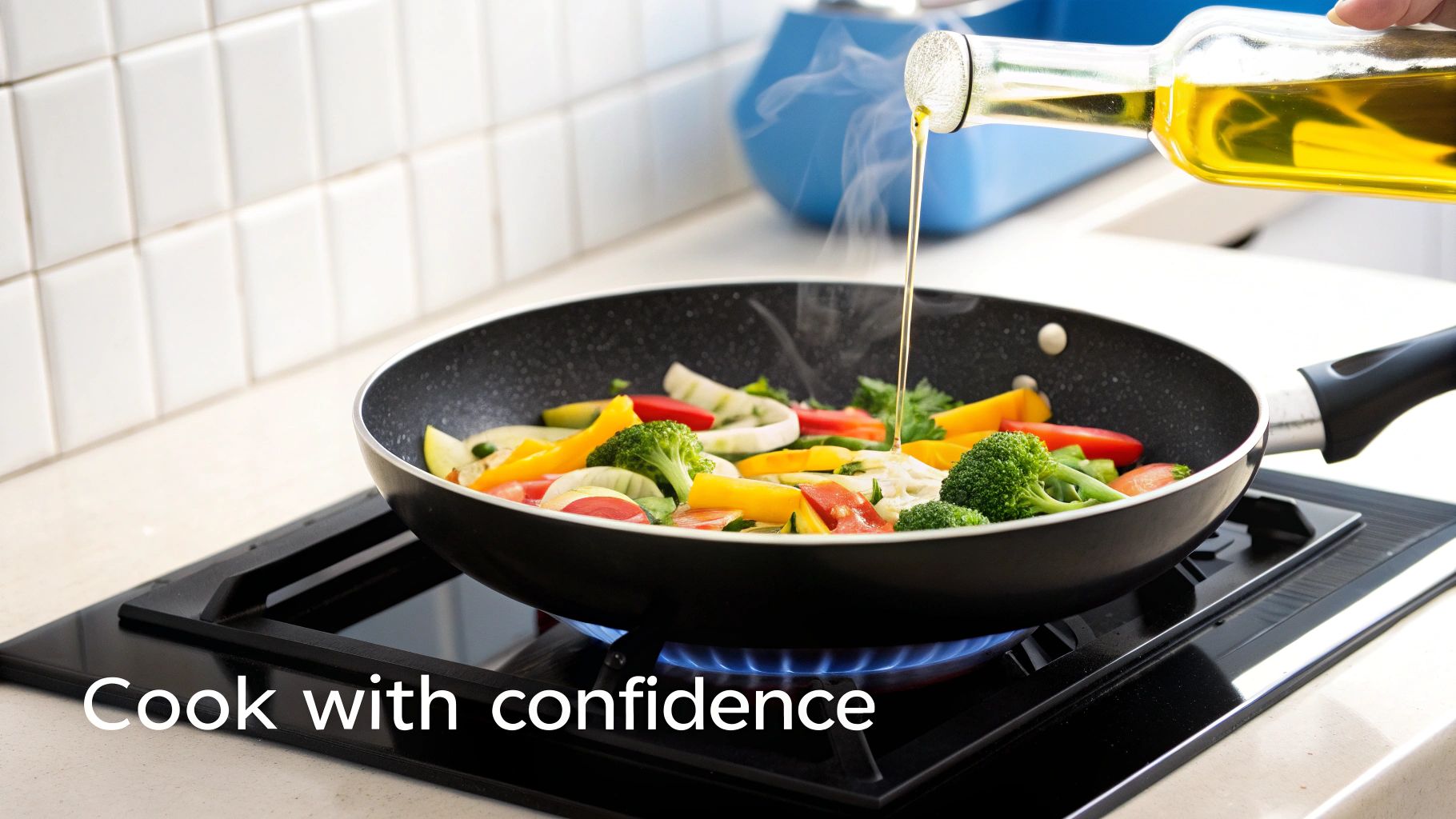
The smoke point is not the most important measure of an oil’s stability. What truly matters is an oil's ability to resist oxidative damage when heated. And on that crucial battleground, extra virgin olive oil is the undisputed champion.
Why Antioxidants Are the Secret Weapon
An oil's smoke point is just an alarm bell, telling you when it’s physically breaking down and smoking. But the real danger—the creation of harmful compounds through oxidation—begins long before you see any smoke.
This is where the two oils reveal their true natures. Canola oil is a naked fat. The refining process has stripped it of every natural compound that could have protected it from heat. It is left defenseless.
Extra virgin olive oil, however, arrives with its own elite bodyguard service. It is packed with stable monounsaturated fats and a powerful army of antioxidants, including polyphenols and vitamin E. These compounds are cellular heroes, sacrificing themselves to shield the fats from breaking down under heat.
The smoke point is a distraction. The true test of a cooking oil is its resistance to oxidative degradation. In study after study, high-quality extra virgin olive oil, rich in antioxidants, proves more stable than refined seed oils with higher smoke points.
This means that even though a chart might list canola oil with a higher smoke point, it begins to degrade and form toxic byproducts at lower temperatures than a robust extra virgin olive oil. The antioxidants in EVOO actively prevent this breakdown, keeping the oil stable and your food safe.
Real-World Cooking: What the Numbers Mean for You
Let’s bring this into your kitchen. The smoke point of a quality extra virgin olive oil is between 375°F and 410°F (190°C to 210°C). This range is more than high enough for virtually every home cooking application.
- Sautéing and Stir-Frying: Most sautéing occurs around 320°F (160°C). A good olive oil thrives at this temperature, enriching your food with flavor and health-boosting polyphenols.
- Roasting: Roasting vegetables or chicken at 350°F to 400°F (175°C to 205°C) is the sweet spot for olive oil, guaranteeing delicious, perfectly browned results.
- Pan-Frying: Even when pan-frying fish or chicken, the oil temperature rarely exceeds 350°F (175°C). Olive oil is not only safe but adds a depth of flavor that a bland oil like canola can never replicate.
If you crave the scientific proof, you can learn more about the surprising durability and smoke point of EVOO in our comprehensive guide. It confirms what savvy cooks have known for centuries: the fears are completely unfounded.
Is There Ever a Place for Canola Oil?
The use cases for a highly refined oil like canola are vanishingly small. The main one is deep-frying, where oil is held at a high temperature for extended periods. Even then, many cultures traditionally deep-fry in olive oil. But for cost reasons, some may opt for a high-heat oil.
For the other 99% of your cooking—sautéing, roasting, and pan-searing—extra virgin olive oil is not only safe, but profoundly healthier and immeasurably more flavorful. The smoke point myth has tragically steered millions toward processed, lifeless oils. By understanding the protective power of antioxidants, you can cook with the confidence that EVOO is your best and most trusted fat for nearly every meal.
Flavor, Authenticity, and the Real Meaning of “Value”
Have you ever wondered why world-class chefs treat olive oil as a precious ingredient, yet view canola oil as nothing more than a functional, invisible commodity? The answer cuts to the very soul of cooking: flavor, authenticity, and the true definition of value.
One oil brings a story to your plate; the other is an industrial product designed to be forgotten. This is not about being a food snob. It's for anyone who believes that food should be more than mere fuel. A great extra virgin olive oil can elevate the simplest dish into something transcendent.
The Symphony of Flavors in Olive Oil
A high-quality extra virgin olive oil is not a single note; it is a complex chord of flavors that tells the story of its home—the olive variety, the soil, the climate, the moment of harvest. The diversity is astonishing.
- Robust and Peppery: Imagine oils from Tuscany or early-harvest Spanish Picual. They greet you with a bold, grassy nose and finish with a peppery kick in your throat—the unmistakable sign of healthy oleocanthal.
- Mild and Buttery: Oils from late-harvest olives are often more delicate and smooth, with notes of ripe fruit or almond. They are perfect for baking or when you desire a gentle, rich undertone.
- Fruity and Herbaceous: Many oils fall in between, with bright notes of green apple, tomato leaf, or fresh herbs that make salads and roasted vegetables come alive.
This is the secret behind the magic of Mediterranean cooking. The rich character of the oil in classic pasta dishes is not just a cooking medium; it is a primary ingredient.
Canola Oil: Engineered for Emptiness
Canola oil, by contrast, is engineered for neutrality. Its entire industrial journey—from solvent baths to bleaching and deodorizing—is designed to systematically erase any trace of flavor, aroma, or personality.
This engineered blandness is sold as a feature, a "clean" taste. But in reality, it is a flavor vacuum. It is a tacit admission that the oil itself offers nothing of value to the food. It is the culinary equivalent of a blank wall.
Olive oil adds life, complexity, and soul to your food. Canola oil adds only fat. This is the difference between an agricultural treasure and an industrial commodity.
Choosing canola oil is a conscious decision to miss an opportunity to build another layer of deliciousness into your meal.
How to Spot a True Treasure and Avoid Fakes
The world of olive oil, sadly, is rife with imposters. The market is flooded with low-quality oils and fraudulent blends masquerading as "extra virgin." To ensure you get the real thing, you must become a savvy consumer.
Here is what to look for on the bottle:
- A Harvest Date: Freshness is paramount. Look for a specific date, like "Harvested October 2023," and choose the most recent one. An expiration date alone is not enough.
- Dark Glass or Tin: Light is the enemy of good oil. A quality product is always shielded from light, which causes rapid degradation. Never buy olive oil in a clear bottle.
- Specific Origin: Vague labels like "Product of Italy" are red flags. Look for a specific estate, region, or an official seal like PDO (Protected Designation of Origin).
Thinking About Value Beyond the Price Tag
Finally, let's address the cost. Yes, canola oil is almost always cheaper than authentic extra virgin olive oil. But does that truly make it a better value?
Consider what your money buys. With canola, you purchase a flavorless, highly processed fat. With a quality EVOO, you purchase a potent source of anti-inflammatory compounds, a wealth of antioxidants, and an ingredient that delivers profound pleasure and flavor. The conversation about extra virgin olive oil prices often misses this crucial point.
True value is not price per ounce; it is the health and flavor delivered in every drop. Seen through that lens, a bottle of real olive oil isn't an expense. It's an investment in your health and the joy of eating delicious, life-giving food.
The Final Verdict: Making the Right Choice for Your Kitchen
After dissecting the science, the history, and the performance of these oils, what is the final word? This is more than just choosing a product; it’s about embracing a philosophy of food.
The olive oil versus canola oil debate is a choice between two worlds: one is a traditional, minimally processed fruit oil, the other a modern, highly refined seed oil. One has been a pillar of healthy diets for thousands of years. The other was engineered for industrial applications, designed to be cheap, neutral, and devoid of character.
This flowchart simplifies the decision based on what matters most in your kitchen.
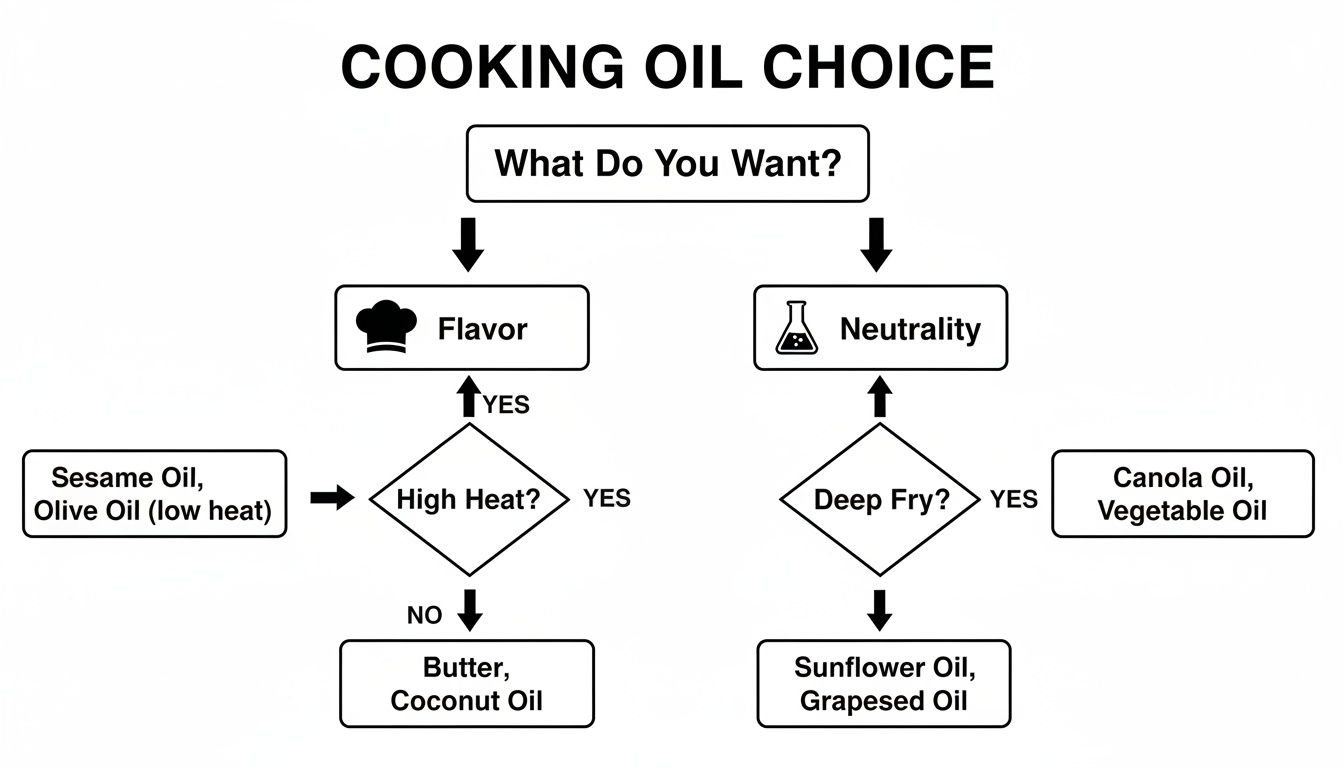
As the chart makes clear, if your goals are health and flavor, all roads lead to olive oil. Canola oil’s only virtue is its neutrality—a quality more valuable in a factory than in a home where every ingredient should contribute to the final masterpiece.
Why Extra Virgin Olive Oil Should Be Your Everything Oil
Let's translate this into a simple, powerful kitchen strategy. The overwhelming evidence declares that high-quality extra virgin olive oil should be the primary fat in your kitchen. It is the complete package: heart-healthy fats, potent anti-inflammatory polyphenols, and a flavor that elevates everything it touches.
- For finishing and dressings: A vibrant, flavorful EVOO is non-negotiable here. It is the soul of a great salad or soup.
- For everyday cooking: A quality EVOO is your workhorse for sautéing vegetables, roasting meats, and pan-searing fish. It is stable, it protects your food with its antioxidants, and it adds a layer of flavor that canola oil simply cannot.
Where does this leave canola oil? Given its industrial origins and nutritional emptiness, it’s difficult to justify a place for it in a health-conscious home. Its only potential use is for deep-frying, a cooking method best reserved for rare occasions.
Your pantry is the foundation of your health. Stocking it with real, whole-food ingredients is one of the most powerful choices you can make. The first, simplest step is to replace industrial seed oils with authentic extra virgin olive oil.
Ultimately, your choice of cooking oil reflects your approach to food. Do you want an ingredient that actively builds health and flavor? Or just a cheap, neutral fat? For your health, your palate, and the pure joy of cooking, a good extra virgin olive oil is the undisputed champion.
Got Questions? We’ve Got Answers.
Even after a deep dive into the olive oil vs. canola oil debate, a few questions tend to pop up. Let's tackle them head-on, so you can feel completely confident about what you're bringing into your kitchen.
Can I Really Cook With Extra Virgin Olive Oil on High Heat?
Yes, you absolutely can. This is one of the most persistent myths out there. A good quality extra virgin olive oil has a smoke point between 375–410°F (190–210°C), which is more than enough for everyday cooking like sautéing and pan-frying.
What makes it so stable? It’s packed with monounsaturated fats and powerful antioxidants. These compounds act as a natural defense against heat, protecting the oil from breaking down. So, despite what you may have heard, science actually shows it’s one of the most stable oils you can cook with.
The smoke point isn't the whole story. What really matters is an oil's oxidative stability—its ability to resist breaking down under heat. Thanks to its rich polyphenol content, extra virgin olive oil holds up exceptionally well, often outperforming refined oils that have been stripped of these protective compounds.
Is Canola Oil Healthy Because It Has Omega-3s?
It's a little more complicated than that. While canola oil does contain ALA, a plant-based omega-3, the way it's made is a major issue. The high-heat, chemical-heavy refining process can damage these fragile fats, potentially destroying their benefits and creating harmful compounds instead.
Plus, canola oil's very high ratio of omega-6 fatty acids can throw your body's inflammatory balance out of whack. When you compare that to the proven anti-inflammatory power of the polyphenols and stable fats in extra virgin olive oil, the choice becomes much clearer. You get more reliable health benefits without the baggage of industrial processing.
How Do I Know I'm Buying Good Olive Oil?
Walking down the oil aisle can be confusing, but you can learn to spot the real deal. A few clues on the bottle will point you toward a genuinely high-quality product.
- Always Choose "Extra Virgin": This is the top grade, meaning the oil is unrefined and made from pure, cold-pressed olives.
- Find the Harvest Date: Freshness is everything. Look for a recent harvest date—it’s a much more reliable sign of quality than a far-off expiration date.
- Grab a Dark Bottle: Light is olive oil’s worst enemy. A dark glass bottle or a tin protects the oil’s delicate flavors and nutrients from degrading.
- Look for Seals and Certifications: A PDO (Protected Designation of Origin) seal guarantees the oil comes from a specific region and meets its rigorous quality standards.
At Learn Olive Oil, we believe that understanding your ingredients is the key to unlocking better health and unforgettable food. We provide the expert insights you need to choose, taste, and cook with the world's finest olive oils. Discover the World of Premium Olive Oil and transform your relationship with food forever.
 Learn Olive Oil
Leave a comment