You're standing in the cooking oil aisle, a battlefield of bottles. On one side, the golden promise of olive oil. On the other, the crystal-clear neutrality of canola. You just want to make the right choice for your family's health.
Let me end the suspense right now: For your long-term, vibrant health, extra virgin olive oil isn't just a better choice—it's in a different league entirely.
The Great Oil Debate: An Immediate Verdict
The reason for this decisive victory isn't something you can spot on the nutrition label alone. The real story—the one that truly matters—is hidden in the journey each oil takes from the plant to your pantry.
One is gently pressed from a fruit, a process so simple it has remained unchanged for millennia, preserving a treasure trove of powerful natural compounds. The other is a modern marvel of industrial chemistry, born from high heat, harsh solvents, and a multi-stage refining process that strips it of its natural soul.
Throughout this guide, we'll unpack the science behind this verdict. By the end, your next trip to the grocery store will feel less like a quiz and more like a victory lap.
A First Look at the Numbers
At first glance, the nutrition facts for these two oils can be deceivingly similar. This is where the confusion starts. Olive oil's true superiority lies in a rich profile of antioxidants and heart-protective compounds that aren’t required on a standard label, especially in extra virgin varieties.
Both oils pack about 124 calories and 14 grams of fat per tablespoon. But their fat composition isn't identical. Olive oil is made up of about 73% monounsaturated fats, while canola oil contains 64%. The real game-changer is what’s beyond the fats: extra virgin olive oil is loaded with vitamin E and potent anti-inflammatory polyphenols. For a more detailed breakdown, this Healthline article about olive and canola oil offers a good overview.
To truly grasp the difference, a side-by-side comparison is essential.
Canola vs Olive Oil At a Glance
Here’s a quick summary of the most critical differences between a high-quality extra virgin olive oil and standard refined canola oil.
| Attribute | Extra Virgin Olive Oil | Refined Canola Oil |
|---|---|---|
| Source | Olives (a fruit) | Rapeseed (a seed crop) |
| Processing | Cold-pressed, minimal heat, no chemicals | High heat, chemical solvents, bleached |
| Antioxidants | Very high (rich in polyphenols) | Very low (destroyed during refining) |
| Primary Fat | Monounsaturated (Oleic Acid) | Monounsaturated (Oleic Acid) |
| Flavor Profile | Robust, peppery, fruity | Neutral, bland |
| Best For | Dressings, finishing, sautéing, roasting | High-heat frying, neutral baking |
This table reveals the hidden story: while both oils are high in monounsaturated fats, their source, processing, and resulting antioxidant content are worlds apart. These are the differences that truly matter for your health and your cooking.
From Plant to Pantry: The Hidden Story of Processing
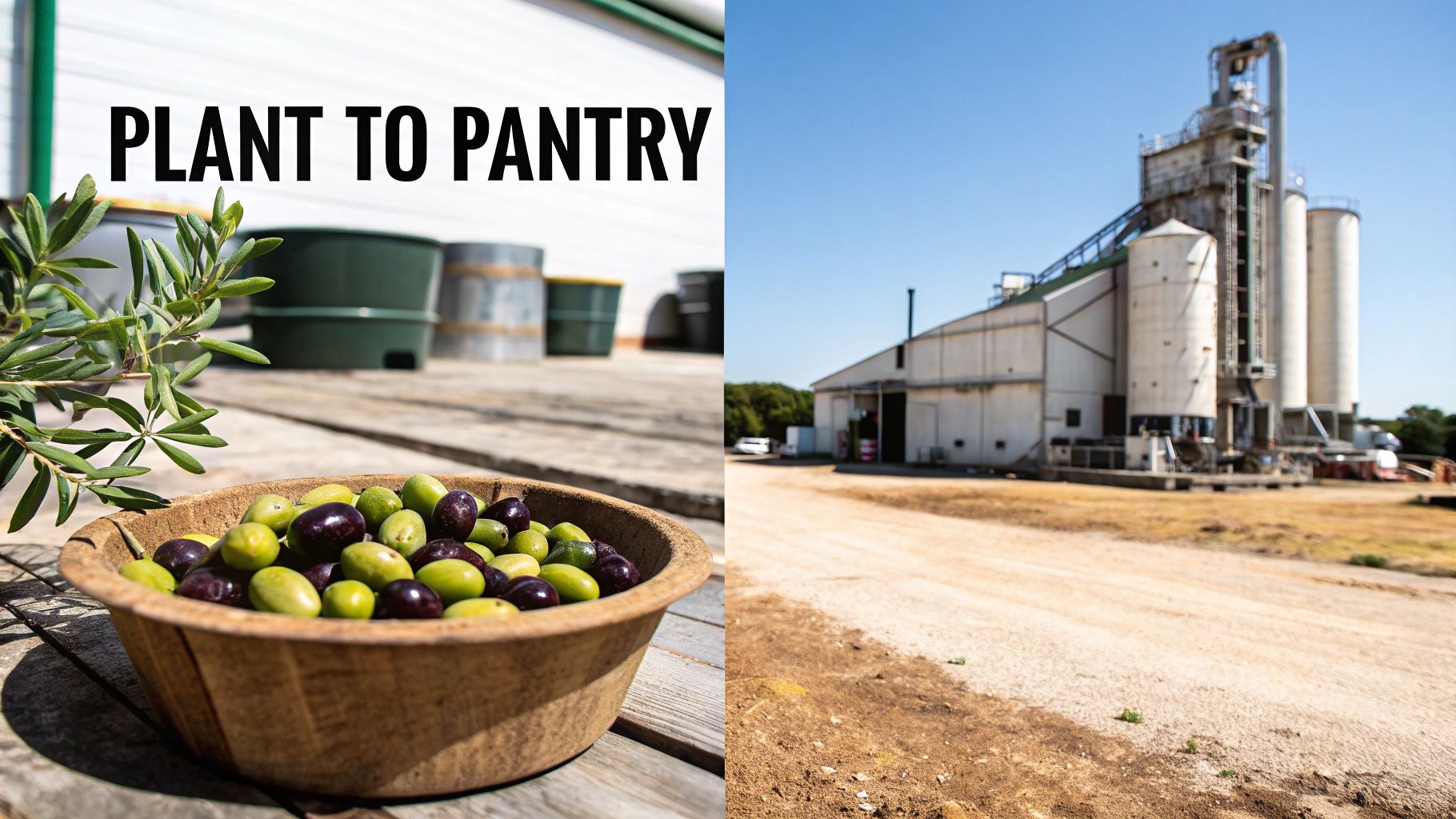
The true story of any cooking oil isn't found on the nutrition label; it's forged in its journey from the field to your kitchen. This journey—the processing—is where olive oil and canola oil diverge onto two completely different paths. One path is a gentle country lane; the other is a harsh industrial highway.
Picture an olive grove under a Mediterranean sun. The fruit is picked and simply pressed to release its liquid gold. It’s a pure, mechanical process. Now, contrast that with an industrial facility where rapeseed is blasted with heat, bathed in chemical solvents, and subjected to a multi-stage refining process. This difference is everything. It determines whether an oil retains its natural life force or has it stripped away.
The Gentle Journey of Olive Oil
The finest olive oil, extra virgin, is nothing less than fresh-squeezed fruit juice. The entire goal of its production is to preserve the pristine, natural character of the olive.
The process is refreshingly simple:
- Harvesting and Cleaning: Olives are gathered and washed, freeing them of leaves and dirt.
- Crushing: The entire olive—pit and all—is ground into a thick, fragrant paste.
- Malaxation: This paste is slowly mixed, allowing tiny oil droplets to coalesce into larger ones.
- Extraction: The oil is then spun from the solids and water in a centrifuge. No chemicals. No extreme heat.
This method, often called "cold-pressing," is designed to be gentle for a reason. By avoiding high temperatures and chemical solvents, the oil fiercely holds onto its full spectrum of delicate polyphenols, vitamins, and the aromatic compounds that give it that peppery, vibrant flavor. These are the very things that deliver its legendary health benefits.
If you're curious about the details, you can learn more about how olive oil is made and see why these traditional methods matter so much for quality.
The Industrial Ordeal of Canola Oil
Canola oil’s path from rapeseed to bottle is a far more brutal affair. The system is engineered for maximum yield and shelf life, often at the direct expense of nutritional value.
It begins by crushing and heating the seeds to high temperatures. To wring out every last drop of oil, the remaining seed mash is washed with a chemical solvent—usually hexane, a petroleum byproduct. While the hexane is later boiled off, government regulations permit trace amounts to remain in the final product.
But the ordeal has just begun. The resulting crude oil is dark, bitter, and completely unpalatable. It must be aggressively refined:
- Degumming: Acids are used to remove sticky, gummy materials.
- Bleaching: The oil is filtered through industrial clays to strip away its natural color.
- Deodorizing: It's then blasted with high-temperature steam (often over 400°F / 204°C) to remove any offensive odors and tastes.
This intense, high-heat gantlet doesn't just produce a neutral-tasting, pale yellow oil. It decimates the fragile omega-3 fatty acids, can create small amounts of unhealthy trans fats, and utterly obliterates nearly all the beneficial compounds like vitamin E and polyphenols that were in the original rapeseed. What’s left is a highly processed product that bears little resemblance to its natural source.
Decoding the Fat Profile: It's More Than Just "Good Fats"
At first glance, the nutritional labels for canola and olive oil look remarkably similar. Both are praised for their high levels of monounsaturated fats—the "good" fats we're all told to eat more of. But if you dig just a little deeper, the story gets much more interesting. The real differences are hidden in the molecular details.
Extra virgin olive oil's star player is oleic acid, a powerhouse monounsaturated fat that makes up a whopping 55-83% of its composition. What's so great about oleic acid? It's incredibly stable, which means it holds up well against heat and light. Think of it as the oil's natural armor. You can get a full breakdown of what olive oil is made of in our detailed guide, but for now, just remember that this stability is a huge plus.
Canola oil also has a lot of monounsaturated fat, but it contains a much higher percentage of delicate polyunsaturated fats (PUFAs)—about 28% compared to olive oil's 11%. This includes a good amount of omega-3s, which sounds great on paper. The catch? These PUFAs are fragile. They're easily damaged during the high-heat refining process canola oil goes through, potentially turning a health benefit into a health risk.
A Surprising Twist in the Cholesterol Story
This is where the conversation takes an unexpected turn, often fueled by confusing headlines. Science sometimes throws us a curveball, and the debate over canola and olive oil is a perfect example.
A major 2022 meta-analysis reviewing 13 clinical trials with over 1,000 adults came back with a shocking result. It found that canola oil actually lowered "bad" LDL cholesterol more effectively than olive oil. The numbers showed canola dropped LDL by an average of -6.13 mg/dL and total cholesterol by -8.92 mg/dL in a direct comparison.
That's not a small number. For context, heart health experts estimate that a 6 mg/dL drop in LDL can lower heart attack risk by 5-10%. So, does this make canola oil the clear winner for heart health? Not so fast.
Why LDL Is Only One Piece of the Puzzle
Fixating on a single biomarker like LDL cholesterol is like judging a car by its paint job while ignoring the engine. It's a dangerously incomplete picture. True cardiovascular health is far more complex, and this is where that one statistic can be incredibly misleading.
While lowering LDL is certainly a good thing, it's just one factor among many. Here’s what that number fails to capture:
- Particle Quality and Oxidation: It's not just how much LDL you have, but what kind you have. The real trouble comes from small, dense LDL particles that have become oxidized (damaged). These are the ones that actually build up in your arteries. The powerful antioxidants in extra virgin olive oil are fantastic at preventing this oxidation—a benefit you won't get from highly refined canola oil.
- Inflammation: We now know that chronic inflammation is a major root cause of heart disease. The unique polyphenols in high-quality olive oil are potent anti-inflammatory agents. Canola oil is stripped of these compounds during processing.
- Blood Pressure and Vessel Health: Studies consistently show that olive oil helps lower blood pressure and improves the function of the endothelium (the delicate lining of your blood vessels). These are critical factors for a healthy heart that go far beyond a simple cholesterol test.
The takeaway is this: while canola oil may give you a slight edge on one specific lab value, extra virgin olive oil offers a holistic, multi-pronged approach to protecting your heart. It gets to the root causes of cardiovascular disease—oxidation and inflammation—instead of just treating one symptom. That’s the critical difference that makes olive oil the superior choice for long-term heart health.
The Power of Polyphenols: Olive Oil's Secret Weapon
If this debate were just about fatty acid profiles, it might be a close race. But it isn't. There’s a hidden world of microscopic powerhouses in a bottle of good olive oil that you'll never see on the nutrition facts panel.
This is where the comparison stops being close. Beyond fats and calories, a quiet battle against cellular damage is constantly being waged inside your body. The heroes in this fight are antioxidants, and this is where extra virgin olive oil holds a profound, undeniable advantage.
An Army of Antioxidants in Every Drop
Let’s talk about polyphenols. Think of these potent plant compounds as your body's personal security detail, neutralizing rogue molecules called free radicals that drive aging and disease. Because of its harsh industrial refining, canola oil is a ghost town—it's been stripped of virtually all these precious compounds.
Extra virgin olive oil, on the other hand, is teeming with them. A good bottle contains over 30 different types of polyphenols, each with a specific mission.
- Oleocanthal: Famous for its anti-inflammatory effects, this compound works in a way that’s strikingly similar to ibuprofen. It's what causes that peppery, slightly burning sensation you feel in the back of your throat with a high-quality oil.
- Hydroxytyrosol: Considered one of nature's most powerful antioxidants, it helps protect your blood vessels from the oxidative damage that can lead to heart disease.
- Oleuropein: Abundant in fresh olives and unrefined oil, this polyphenol delivers both antioxidant and anti-inflammatory benefits, contributing to the oil’s characteristically bitter notes.
These compounds do more than just make the oil taste interesting. They are the very essence of its health-promoting power, actively working to shield your heart, brain, and cells from daily stress.
This isn't just some minor nutritional detail; it is the central, decisive difference. The absence of these compounds in refined canola oil is a critical liability, leaving it without the protective shield that makes extra virgin olive oil so uniquely beneficial.
The Proof Is in the Science
This isn't just theory. The PREDIMED trial, one of the most important nutrition studies ever conducted, put this idea to the ultimate test. This landmark study followed thousands of people at high risk for heart disease for nearly five years.
One group was assigned a Mediterranean diet supplemented with extra virgin olive oil. The results were stunning. This group saw a 30% reduction in their risk of having a heart attack or stroke compared to those on a standard low-fat diet. This incredible benefit wasn't just from the monounsaturated fats; it was the whole package—the healthy fats working in concert with a powerful symphony of polyphenols.
This powerful effect highlights why choosing an oil is about more than just avoiding "bad" fats. It’s about actively choosing an oil that delivers "good" things. Refined canola oil, stripped of its natural protectors, simply can't compete on this front. It lacks the biological machinery to offer this level of defense.
From the Grove to Your Cells
The polyphenol content of olive oil is directly tied to its quality. Everything from the olive variety to the harvest time and extraction method determines how rich the final product will be. A fresh, early-harvest, cold-pressed extra virgin olive oil will always have the highest concentration of these beneficial compounds. You can explore our guide to understand what makes a genuine high-polyphenol olive oil stand out.
Ultimately, when you choose extra virgin olive oil, you aren’t just choosing a cooking fat. You're choosing a functional food packed with natural, disease-fighting compounds preserved through careful, minimal processing. Canola oil is simply an isolated fat—a source of calories stripped of its natural soul. That is the secret weapon that makes olive oil the clear winner.
Which Oil Can Stand the Heat in Your Kitchen?
Let's dismantle one of the most stubborn myths in the food world: the idea that you can't cook with extra virgin olive oil. We've all heard it—its smoke point is too low, it'll burn, it'll turn toxic. It’s time to extinguish that myth with the cool, hard light of science.
The truth is, smoke point is a deeply misleading measure of an oil's stability. It began as a marketing term and somehow became kitchen gospel, but it tells you very little about what's actually happening to the oil on a molecular level when you heat it.
The Real Enemy in a Hot Pan
The real threat in your pan isn't a wisp of smoke; it's oxidative damage. When oil breaks down under heat, it oxidizes, creating harmful compounds. So the real question isn't "When does it smoke?" but rather, "How well does it resist breaking down into something I don't want to eat?"
This is where the oil's chemical structure is king. As we've established, extra virgin olive oil is packed with stable monounsaturated fats. Picture these fat molecules as sturdy, well-built structures that are incredibly resilient to heat. Canola oil, on the other hand, has a much higher percentage of fragile polyunsaturated fats, which are far more delicate and prone to shattering under the stress of heat.
But that’s only half the story. High-quality olive oil brings its own protection to the party. Its powerful army of polyphenols acts like a natural shield, sacrificing themselves to protect the fat molecules from heat damage. This double-layer of defense—stable fats plus antioxidant protectors—makes extra virgin olive oil surprisingly tough in the kitchen.
What Science Says About Cooking with Olive Oil
You don’t have to take my word for it; the lab evidence is crystal clear. When scientists heat different oils and measure the toxic byproducts that form, a clear winner emerges time and again.
A 2019 EU-funded trial on frying stability delivered a powerful verdict. After being heated to 190°C (375°F) for six hours, extra virgin olive oil generated 40-60% fewer harmful polar compounds and aldehydes—nasty byproducts linked to serious health issues—than canola oil. This superior performance is a direct result of olive oil's 73% monounsaturated fat content resisting oxidation far better than canola’s more fragile fats. You can dive deeper into these findings on heat stability and cooking oils to see the data for yourself.
This means that even at high temperatures perfect for sautéing, pan-frying, and even deep-frying, a good extra virgin olive oil is not only safe but often the healthier choice. It stays more stable and produces fewer dangerous compounds than the very oils often marketed specifically for high-heat cooking.
For a comprehensive look at how various oils perform under heat, our cooking oil smoke points chart helps put these numbers into a practical kitchen context.
Practical Cooking Guide: When to Use Which Oil
So, how does all this science translate to your actual kitchen? Choosing the right oil for the job is simple once you know what to look for. This guide breaks down the best choice for common cooking scenarios based on both health and performance.
Practical Cooking Guide When to Use Which Oil
| Culinary Task | Healthiest Choice | Why It Works Best |
|---|---|---|
| Sautéing & Roasting (Medium-High Heat) | Extra Virgin Olive Oil | Its monounsaturated fats and polyphenols provide excellent stability, resisting oxidation and creating fewer harmful byproducts than canola oil. |
| Pan-Frying Chicken or Fish | Extra Virgin Olive Oil | Provides superior heat stability, protecting both the food and the oil itself from breaking down into toxic compounds. |
| Salad Dressings & Finishing | Extra Virgin Olive Oil | Delivers a payload of flavor and anti-inflammatory polyphenols that are completely lost in refined oils like canola. |
| High-Heat Deep Frying (Occasional) | Extra Virgin Olive Oil | While not a daily health practice, its stability makes it a surprisingly better option than canola for resisting degradation during prolonged heat exposure. |
Ultimately, for nearly every home cooking application, extra virgin olive oil proves to be the more stable, healthier, and more flavorful option. Its natural composition is simply better equipped to handle the heat.
Your Practical Guide to Choosing and Using Oils
All the data in the world doesn't mean much if you can't put it to use in your own kitchen. So, let's translate the science into a simple, practical framework for how to think about these oils day-to-day. After all, knowing the "what" is only half the battle; the "how" and "when" are just as important.
When you get down to it, the choice between canola and olive oil is surprisingly clear-cut. Is there a time for canola oil? Yes, but it's a very specific one: when you're baking something and need a completely neutral flavor where even a mild olive oil would be noticeable.
For just about everything else, from drizzling on a salad to searing a steak, a good extra virgin olive oil is the undisputed champion for both flavor and health.
This decision tree cuts through the noise and shows just how versatile a high-quality olive oil really is.
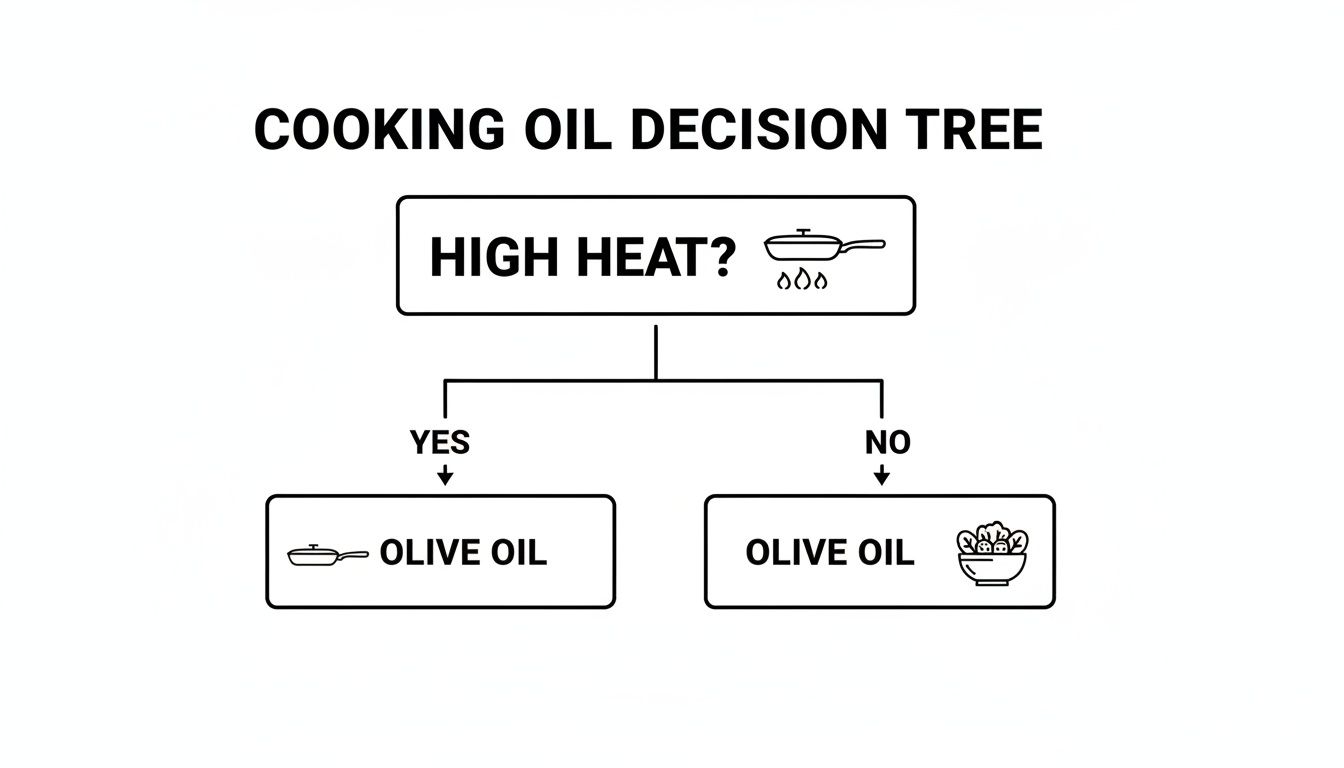
The main point is simple: whether you're cooking with high heat or no heat at all, a great olive oil is almost always the more stable and health-promoting choice.
How to Buy Great Olive Oil Like an Expert
The real challenge isn't deciding if you should use olive oil, but figuring out how to buy a good one. The grocery store shelves are a minefield of low-quality bottles and misleading labels. A little bit of knowledge here goes a long, long way.
Here’s what to look for when you're shopping:
- Insist on "Extra Virgin": This is the top grade. It means the oil was extracted mechanically, without solvents or high heat, which keeps all those powerful polyphenols intact. If a bottle just says "olive oil," "pure," or "light," you're looking at a refined product that's been stripped of its best qualities.
- Find the Harvest Date: Olives are a fruit, and olive oil is essentially a fresh-pressed juice. It doesn't get better with age. A good producer will proudly display the harvest date on the bottle. Always grab the one from the most recent season.
- Check the Packaging: Light is one of the biggest enemies of olive oil, causing it to go rancid quickly. A producer who cares about their product will bottle it in dark, opaque glass or a tin to protect it from light damage.
Here's the most important thing to remember: true extra virgin olive oil is a fresh, perishable product. You should think of it more like fresh produce than a shelf-stable pantry item. Buying a quality oil is the only way to guarantee you're getting the antioxidant and anti-inflammatory power you're paying for.
Learning to read the labels is a game-changer. To really become a pro, you can dive deeper with this guide on how to buy olive oil that will make you a much more confident shopper.
And if you're exploring other healthy fats, this complete guide to butter substitutes in cooking and baking is a great resource. Making smart, informed choices is the first step to building a kitchen stocked with ingredients that genuinely support your well-being.
Frequently Asked Questions
It's easy to get lost in the sea of cooking oils. Let's clear up some of the most common questions that pop up when you're trying to choose between canola and olive oil in the grocery store.
Can I Use Extra Virgin Olive Oil for High-Heat Cooking?
Yes, you absolutely can. The idea that you can't cook with extra virgin olive oil is probably one of the most persistent myths in the food world. The truth is, its stability isn't just about its smoke point—it comes from its high concentration of tough-as-nails monounsaturated fats and a powerful army of protective antioxidants.
In fact, research has demonstrated that high-quality olive oil generates fewer harmful compounds when heated compared to oils full of more delicate polyunsaturated fats, like canola. This makes it a fantastic and healthy option for everything from sautéing and roasting to light pan-frying.
Is Canola Oil a Healthier Choice for My Heart Because It Lowers LDL Cholesterol More?
This is a perfect example of how one single data point can obscure the bigger picture. While it's true some studies suggest canola oil might lower LDL ("bad") cholesterol a bit more than olive oil, that's only one piece of the massive puzzle that is heart health.
Genuine cardiovascular wellness isn't just about hitting a target on a lab report. It's about tamping down inflammation, preventing cholesterol particles from oxidizing (which is what makes them truly dangerous), and keeping your blood vessels flexible and healthy.
Extra virgin olive oil shines in all of these critical areas thanks to its wealth of polyphenols—something that refined canola oil is completely missing. It provides a more holistic, protective approach for your cardiovascular system, making it the clear winner for long-term heart health.
What’s the Real Difference Between “Light” Olive Oil and Extra Virgin Olive Oil?
The difference is night and day, and it all boils down to how they're made. Extra virgin olive oil is essentially fresh, cold-pressed fruit juice from olives. It's unrefined, which means it keeps all its natural flavor, aroma, and powerful antioxidants.
On the flip side, "light" or "pure" olive oil is a highly refined product. It’s been treated with heat and chemical solvents to strip away its natural color and taste. Unfortunately, this process also wipes out almost all of its beneficial polyphenols, leaving you with an oil that, while made from olives, lacks the very compounds that make extra virgin olive oil a nutritional powerhouse.
If Canola Oil Comes from a Plant, Why Is It Considered Unhealthy?
The problem isn't the plant it comes from; it's the industrial journey it takes to get into the bottle. Canola oil starts as rapeseed, but it goes through an intense refining process that includes high heat, chemical solvents like hexane, bleaching, and deodorizing.
This harsh treatment destroys nearly all its natural vitamins and antioxidants. Worse, it can damage the fragile omega-3 fats and even create trace amounts of unhealthy trans fats. The end result is a highly processed product that's a world away from its natural plant source.
At Learn Olive Oil, we're convinced that knowing the story behind your oil empowers you to make healthier decisions. We offer expert insights to help you confidently explore the world of high-quality olive oil. Discover the World of Premium Olive Oil and take your cooking and your health to the next level.
 Learn Olive Oil
Leave a comment