Let me reveal a secret most home cooks never discover.
It’s the key that unlocks the stunning, soul-satisfying flavor hidden inside that bottle of extra virgin olive oil sitting in your pantry. And it’s shockingly simple.
The secret isn’t a complex technique or an expensive gadget. It’s a powerful mental shift: you must learn the crucial difference between cooking with olive oil and finishing with it. Once you grasp this single concept, you’ll transform a simple ingredient into your kitchen’s most potent secret weapon.
The One Simple Secret to Using EVOO Like a Culinary Master
Most people relegate their extra virgin olive oil (EVOO) to a lonely existence, used only for the occasional salad dressing. This is a tragedy. They’re missing out on a universe of flavor. This liquid gold is far more than just another cooking fat—it's a gateway to deeper, richer flavors, a powerhouse of health benefits, and a surprisingly versatile culinary tool.
The real trick—the one that separates amateur cooks from seasoned chefs—is to think of your olive oil in two distinct ways: one oil for building a foundation of flavor over heat, and another for delivering that final, breathtaking flourish of aroma and taste.
One is for the gentle work of building a savory base. The other is for that final, dramatic anointment—the peppery, aromatic exclamation point on a finished dish.
This simple mental flowchart can help you decide when to reach for your EVOO for cooking versus when to use it raw.
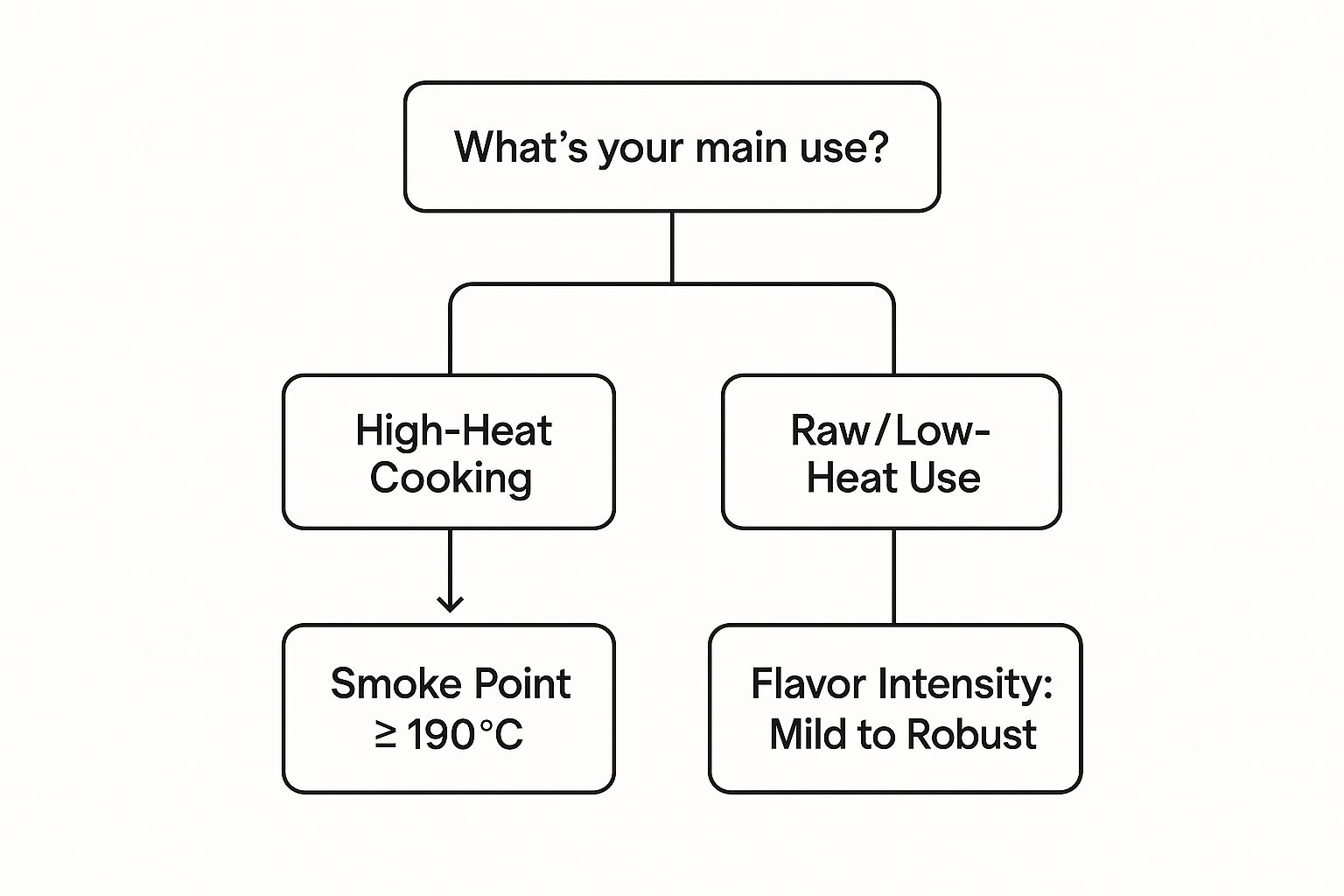
As the image reveals, your choice boils down to a single question: are you applying heat, or are you using the oil straight from the bottle? That decision then guides you to the right oil based on its smoke point or its flavor intensity.
Why This Secret is More Important Now Than Ever Before
Mastering this distinction is no longer just a "nice-to-have" skill. The global market for extra virgin olive oil was valued at a staggering $19.4 billion and is projected to explode. The world is waking up to its power. EVOO is rapidly shifting from a niche item to an everyday essential, used for everything from sautéing vegetables to drizzling over ice cream. To see the full scope of this trend, you can explore the full market report.
If you remember nothing else, remember this: Save your most robust, expensive, and intensely flavorful oils for finishing. Use a quality, everyday EVOO for general cooking. You wouldn’t use a 20-year-old Bordeaux to make sangria, would you? The same logic applies here. Don't waste the sublime, delicate notes of a premium oil on high heat where they will simply vanish into thin air.
This mindset ensures you extract every ounce of value and taste from every bottle you buy.
To help you commit this to memory, here is a quick guide to help you decide on the fly.
EVOO Quick Guide: Cooking vs. Finishing
This table is your simple reference for choosing the right application for your extra virgin olive oil, whether you're heating it up or using it raw.
| Application Type | Best Use Case | Why It Works |
|---|---|---|
| Cooking | Sautéing, roasting, baking, light frying | Milder, everyday EVOOs add subtle flavor and have a high enough smoke point for most home cooking. |
| Finishing | Drizzling over pasta, steak, soup, salads, bread | Robust, high-quality EVOOs are used raw to preserve their complex, peppery, and fruity notes. |
Thinking this way—matching the oil to the mission—will have you cooking with the confidence of a seasoned chef.
- For finishing: A bold, peppery, high-phenolic oil is your star player for drizzling over a finished steak or a hearty bowl of soup.
- For cooking: A milder, more affordable "workhorse" EVOO is what you need for sautéing your garlic and onions.
Make this one simple shift in your approach, and you will immediately start getting more from your olive oil.
How to Choose a Truly Great Olive Oil
Stepping into the olive oil aisle can feel like navigating a minefield. You're confronted by a towering wall of bottles, all screaming for your attention with beautiful labels and alluring descriptions. So, how do you cut through the noise and separate the genuine liquid gold from the imposters?
The real secret isn't about the price tag or the elegance of the bottle; it’s about learning to read the label like a detective hunting for clues. A truly great olive oil is not just a cooking fat—it's a fresh, living agricultural product, bursting with its own unique personality. The difference in taste between a bold, peppery oil from Tuscany and a delicate, buttery one from Spain is as stark as night and day. Knowing which one to choose is the first step in learning how to use extra virgin olive oil to utterly transform your cooking.
Look for These Telltale Signs of Quality
To unearth an exceptional bottle, you must ignore the seductive marketing on the front. Flip the bottle over. The real story—the truth—is on the back.
Here are the critical clues I never fail to look for:
- A Harvest Date: This is, without a doubt, the single most important piece of information on the bottle. Olive oil is a fruit juice. It's best when it’s fresh. I relentlessly seek out a bottle from the most recent harvest and will immediately reject any that only offers a vague "best by" date.
- Dark Glass or Tin: Quality EVOO is fragile. Its greatest enemy is light, which mercilessly degrades its flavor and health-giving properties. Any producer who truly cares about their oil will bottle it in dark green or brown glass, or an opaque tin. A clear glass bottle is a massive red flag.
- Seals of Approval: Look for official certifications like PDO (Protected Designation of Origin) or PGI (Protected Geographical Indication). These are not mere marketing fluff; they are your guarantee that the olives were grown and pressed in a specific region according to strict, time-honored standards.
The most expensive bottle on the shelf is not always the best, but I can almost guarantee the cheapest one is a poor choice. Crafting true extra virgin olive oil is a labor-intensive art, and the price reflects that devotion. Spending a few extra dollars is what separates an oil that merely coats your pan from one that truly brings your dish to life.
The great news for all of us is that high-quality EVOO is becoming more accessible. The EU is expecting a recovery in production, which has helped bring prices down from recent highs. This means top-tier oils are more affordable for everyday use, not just for special occasions.
Ultimately, finding the right oil starts with knowing what to look for before you even twist the cap. For an even deeper dive, our guide on how to choose olive oil breaks it down even further.
Mastering Heat: The Truth About Cooking with EVOO
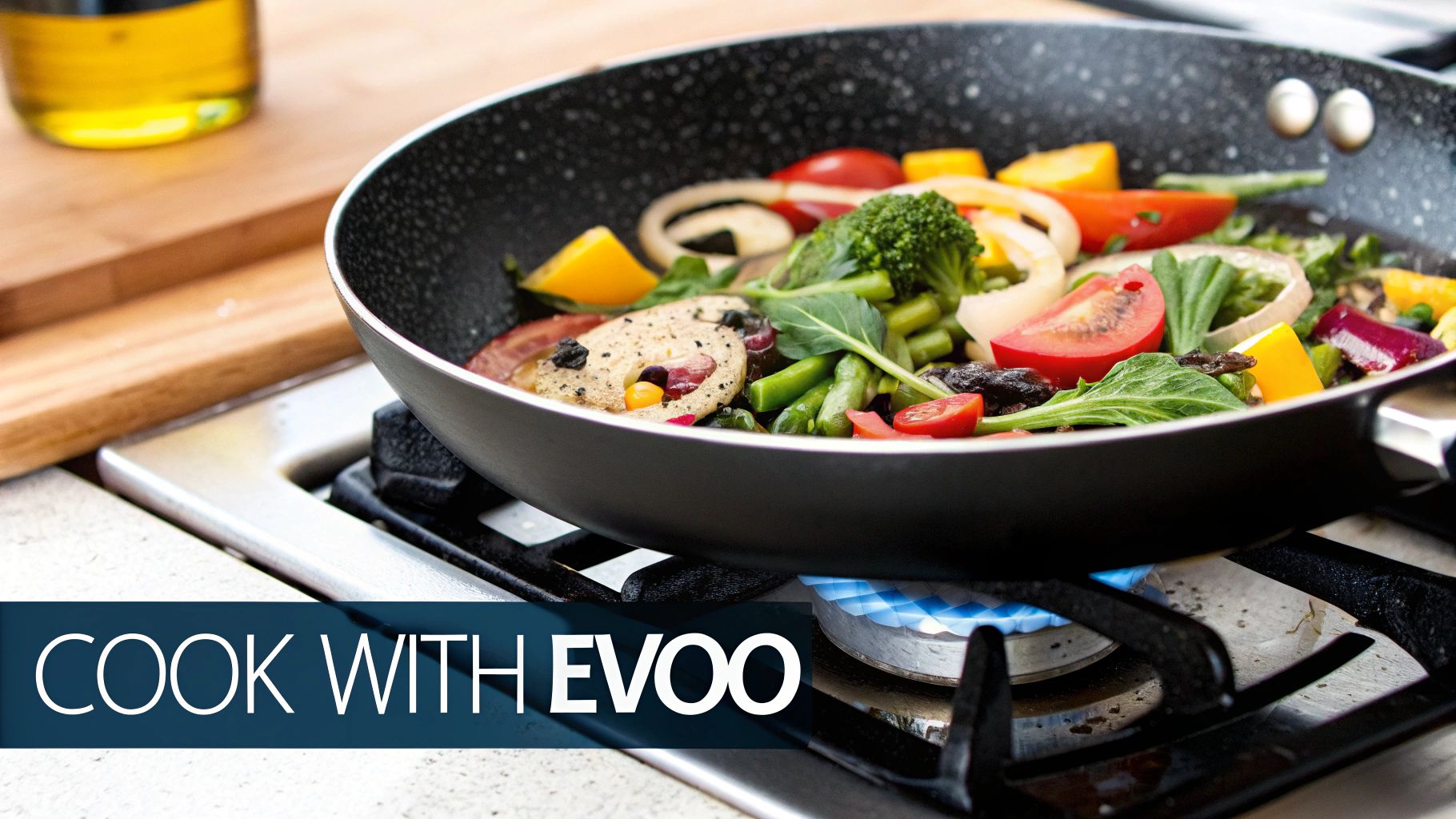
Let us now shatter one of the most persistent and damaging myths in the culinary world: you absolutely can, and should, cook with extra virgin olive oil. Far too many people, paralyzed by fear, hoard their best bottles for drizzling, terrified that a hot pan will destroy them. The truth? You're missing out on a universe of flavor.
Think about the alchemy that occurs when you gently sauté garlic in a good EVOO. The oil doesn't just cook the garlic; it infuses it, building a fragrant, fruity foundation that a bland, neutral oil could never hope to replicate. The secret isn't to avoid heat, but to master it.
The term that has caused all this confusion is the smoke point. This is not some rigid, unforgiving cliff edge. It is simply the temperature where an oil begins to break down and produce visible smoke. For a quality extra virgin olive oil, that point is much, much higher than you've been led to believe.
Understanding EVOO and Heat
A good EVOO generally has a smoke point around 190–210°C (375–410°F). This temperature range is more than high enough for the vast majority of your daily cooking. While deep frying isn't a common use for premium EVOO in Mediterranean cultures—mostly to preserve its potent antioxidants—it’s perfectly safe for most other methods.
Modern advice often emphasizes using EVOO raw to get the full benefit of its anti-inflammatory phenolic compounds. But don’t let that scare you away from the stovetop.
Key Takeaway: You are not trying to push your oil to its absolute limit. The goal is to cook within a safe and effective temperature range, which for most stovetop cooking falls well below the smoke point of good EVOO.
If you're interested in the hard science, you can get a more detailed breakdown by reading about the olive oil smoking point. It truly demystifies what’s happening in your pan.
Once you get comfortable using heat, you'll unlock a whole new dimension in your cooking. Here’s how to put it into practice:
- Sautéing: This is where EVOO sings. A medium flame is perfect for softening onions, garlic, or other aromatics, infusing them with a beautiful, complex flavor that becomes the very soul of your dish.
- Roasting: Go ahead and toss your vegetables in EVOO before they hit the oven. Roasting at temperatures up to 200°C (400°F) is completely fine. The oil helps everything caramelize to perfection without a wisp of smoke.
- Pan-Frying: A classic Mediterranean technique is to pan-fry a piece of fish or a chicken cutlet in EVOO over medium heat. It creates a wonderfully crisp crust and imparts a distinct richness.
Stop treating your EVOO like a fragile artifact and start using it as the versatile, flavorful workhorse it was born to be.
The Final Flourish: Using EVOO as a Finishing Oil
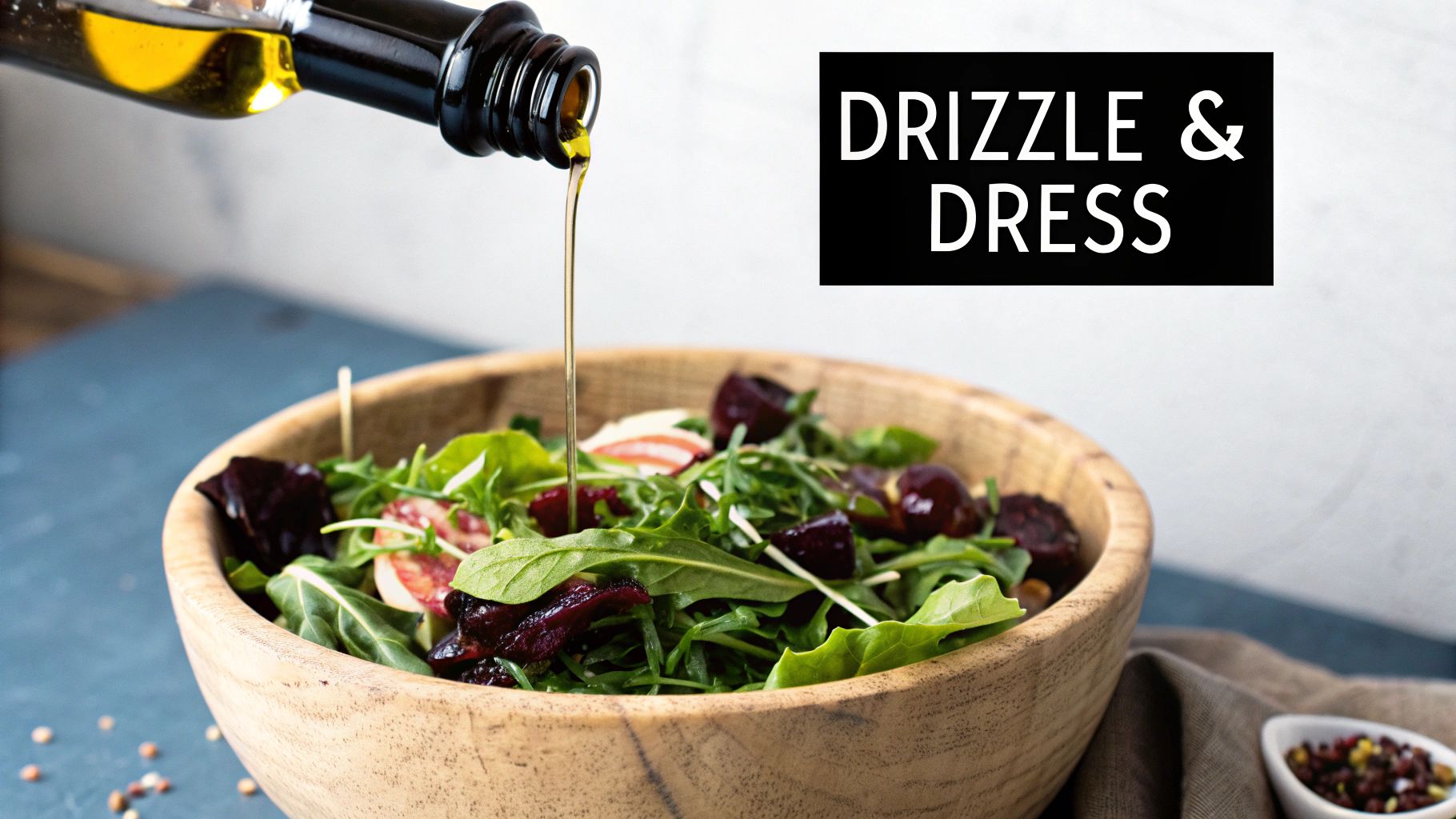
Here, my friend, is where the true, breathtaking magic of a great olive oil is unleashed. While cooking with a workhorse EVOO lays a beautiful foundation of flavor, it is the final act—the anointment with a high-quality finishing oil—that elevates a dish from merely good to truly unforgettable.
It’s the simplest way to jolt a dish to life, adding a shock of bright, peppery flavor and an intoxicating aroma that awakens every ingredient it touches. A generous drizzle right before serving is the secret that separates humble home cooking from restaurant-quality cuisine. It's the difference between a simple bowl of bean soup and one that tastes complex, layered, and deeply, profoundly satisfying. This is how to use extra virgin olive oil to make people stop and ask for your secret.
The Art of the Drizzle
Think of your finishing oil not as a cooking fat, but as a liquid condiment of the highest order. Its sole purpose is to add character at the very end. The moment the heat is off is your cue. A final cascade over grilled fish, a generous swirl into a bowl of hot pasta, or a simple pour over freshly steamed vegetables adds a layer of richness that butter can only dream of.
The most profound, impactful way to experience a phenomenal extra virgin olive oil is raw, as a final touch. Its delicate, volatile flavor compounds—the very source of its peppery kick and grassy notes—are perfectly preserved, delivering a sensory punch that cooking heat would silence. This is its highest and most noble calling.
Even something as mundane as stovetop popcorn is utterly transformed. Instead of melted butter, try popping your kernels in a quality EVOO and drizzling a bit more over them while they're still hot. The oil clings to each piece, delivering a pure, savory flavor that’s intensely addictive.
Pairing Flavors Like a Pro
Matching your oil's intensity to your dish is the final, crucial piece of the puzzle. Just as you would pair a wine with food, you must consider how the oil's unique character will dance with the other ingredients.
-
Robust & Peppery Oils: These are your power hitters. Their assertive, spicy notes are a magnificent partner for bold dishes that can stand up to their flavor. Drizzle them with abandon over a thick, grilled steak, a hearty lentil soup, or bitter greens like radicchio and arugula.
-
Delicate & Fruity Oils: These milder, often buttery or nutty oils are perfect for enhancing, not overpowering. Use them to grace delicate poached fish, fresh mozzarella with tomatoes, or even something as surprising as a scoop of vanilla ice cream with a tiny sprinkle of sea salt.
Mastering this final step is what makes a dish truly sing. And while many people start with salads, understanding these broader applications is key. For more ideas on that classic use, check out our guide on finding the perfect olive oil for salad dressing.
Beyond the Kitchen: Unexpected Uses for EVOO
A spectacular bottle of extra virgin olive oil doesn't have to live its entire life chained to your pantry. Its remarkable natural properties make it a surprisingly powerful yet gentle tool all around your home, especially if you want to rely less on harsh chemicals.
The very same compounds that make EVOO a nutritional superstar give it this incredible versatility. Think about it—many of these uses have been passed down for generations, long before we had a specialized product for every conceivable task. Its rich concentration of vitamins and antioxidants, for instance, makes it a phenomenal natural moisturizer.
Here's a key tip: for these non-food uses, there is no need to break out your most expensive, peppery finishing oil. A good, solid, everyday extra virgin olive oil will perform these tasks beautifully, delivering all its wonderful properties without breaking the bank.
This is all about getting the absolute most out of one high-quality, natural product.
Simple Uses Around the Home
Beyond your skin, EVOO can be a true friend to many household items, particularly anything made of wood. Just a small amount of oil can breathe new life into dull, tired-looking surfaces.
Here are a few of my favorite, time-tested uses:
-
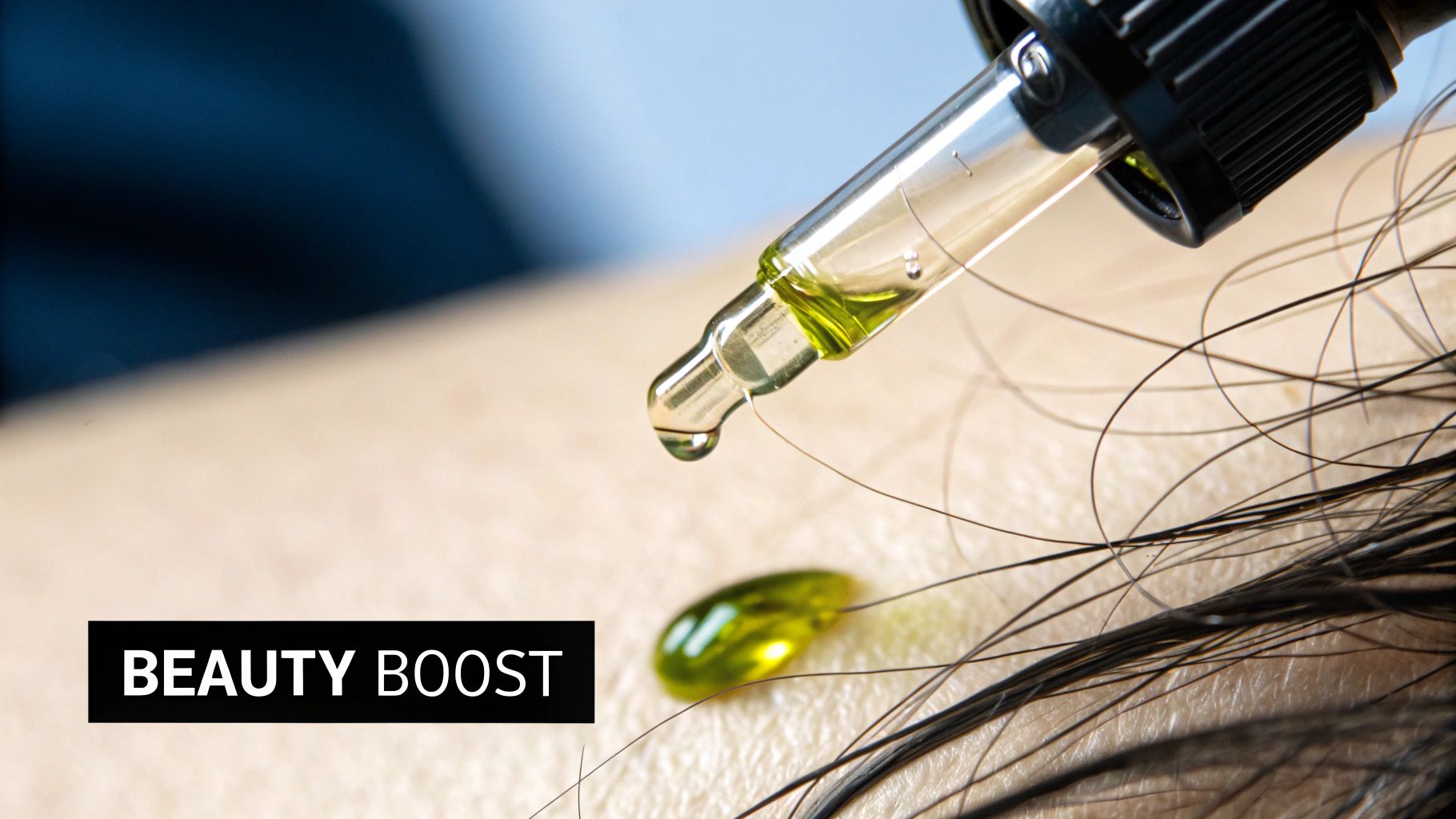
Natural Moisturizer: A true classic. Apply a small amount to damp skin right after a shower to lock in moisture. It often works better than expensive commercial lotions, leaving your skin feeling supple and amazing. It is simple, pure, and incredibly effective.
-
Gentle Makeup Remover: A few drops on a cotton pad will melt away even the most stubborn waterproof mascara. It gets the job done without any harsh chemicals and leaves your skin feeling soft and nourished, not stripped and dry.
-
Wood Conditioner: Do you have a wooden cutting board or salad bowl that looks a bit sad and thirsty? Rub a thin layer of EVOO into it. This simple act nourishes the wood, helps prevent it from cracking, and brings back that beautiful, natural sheen.
Adopting these little tricks is about more than just finding clever uses for an ingredient; it’s about appreciating the full spectrum of extra virgin olive oil benefits in every part of your life. It’s a real testament to the power of a single, natural product.
Your Top EVOO Questions, Answered
Once you begin to explore the incredible world of extra virgin olive oil, a few questions inevitably surface. This is perfectly normal. When you realize just how versatile this ingredient can be, you naturally want to ensure you're using it to its full potential.
Let's finally put to rest some of the most persistent myths and common points of confusion. My goal is to move you beyond merely following rules and help you understand the why behind them. Once you grasp the simple science, you’ll wield your EVOO with confidence, making decisions based on skill, not on guesswork.
Can I Really Fry with Extra Virgin Olive Oil?
This is the big one, and the answer is an emphatic YES. This is probably the most widespread and damaging myth about olive oil. A good quality extra virgin olive oil has a smoke point between 190–210°C (375–410°F). This is more than high enough for the temperatures you would use for everyday sautéing and pan-frying in your home kitchen.
The secret is simply to manage your heat, which is a fundamental skill for any kind of cooking. You are not trying to get the pan screaming hot to the point of smoking. For a beautiful piece of fish or a chicken cutlet, medium-high heat is all you need. The EVOO will not only give your food a fantastic, crispy texture but will also impart a subtle, fruity complexity that a neutral oil simply cannot deliver.
What's the Best Way to Store Olive Oil so It Stays Fresh?
I want you to imagine three assassins are constantly trying to destroy your olive oil: Oxygen, Light, and Heat. They are the culprits that degrade its amazing flavor and obliterate its powerful health benefits. Proper storage isn’t just a casual suggestion; it is an absolute necessity if you want to protect your investment.
The single best thing you can do is treat your olive oil like a fine red wine. Store it in a cool, dark place away from the stove, like a pantry or a cabinet. Shielding it from the daily rollercoaster of temperature fluctuations will make a massive difference in how long its glorious flavor lasts.
And you must be ruthless about sealing the cap tightly after every single use. Once that seal is broken, the clock starts ticking. For peak flavor, I always recommend using an open bottle within a few months. It's also critical to recognize when oil has gone bad. Our guide on how to tell if olive oil is rancid will show you exactly what to look for, so you never have to serve a dish tainted with off-flavors.
Does "Light" Olive Oil Mean Fewer Calories?
Absolutely not. This is a clever and deceptive piece of marketing that has confused consumers for decades. When a label says "light" olive oil, it refers to a lighter flavor and color—not a lower calorie or fat content. All oils, regardless of type, have the exact same number of calories per serving.
"Light" olive oil is a heavily refined product. The industrial refining process strips away the bold taste, the characteristic green-gold hue, and, crucially, the very polyphenols and antioxidants that make extra virgin olive oil a nutritional powerhouse. What you are left with is a bland, characterless, neutral oil that has been robbed of all the qualities that make EVOO so remarkable in the first place.
At Learn Olive Oil, we believe that truly understanding your ingredients is the foundation of great cooking. Explore our guides to unlock a world of flavor. Start your journey at https://learnoliveoil.com and discover a deeper appreciation for this liquid gold.
 Learn Olive Oil
Leave a comment