You know the look. Your cat steps into the litter box, circles once, squats, strains, and leaves behind almost nothing. Then comes the second trip. Then the third. By that point, many owners are doing what you may be doing right now. Searching fast, hoping there’s a safe answer sitting in the kitchen.
That’s why olive oil for cats constipation keeps coming up.
It isn’t nonsense. Olive oil can help in the right situation. But it’s also the kind of remedy that gets people into trouble when they use it too late, use too much, or use it for the wrong problem. A mildly constipated cat is one thing. A cat with pain, vomiting, or a blockage is another.
The difference matters.
I like olive oil because it’s familiar, accessible, and, when used correctly, it can offer short-term relief for a cat dealing with hard, dry stool. I dislike how casually some advice treats it. This is not a cure-all. It is not something to syringe into a cat’s mouth. It is not what you reach for when your cat is clearly sick.
Used wisely, it’s a tool. Used blindly, it becomes a distraction from the underlying issue.
That Worrisome Trip to the Litter Box
A constipated cat rarely announces the problem in a dramatic way. More often, it starts with small clues. Extra time in the litter box. A dry little stool. A cat that comes out looking annoyed, then goes back in an hour later.
That’s enough to rattle any good owner.
Constipation sits in an uncomfortable gray zone. It might be a minor, short-lived slowdown. Or it might be the first visible sign that something is wrong and getting worse. That uncertainty is what sends people reaching for a pantry remedy.
Olive oil has earned that reputation for a reason. It has a legitimate place in home care for mild constipation. But before you touch the bottle, take a sober look at the setup around your cat.
Start with the obvious
Sometimes the problem isn’t only inside the cat. It’s around the cat.
A box that smells bad, feels cramped, or gets ignored for too long can make some cats hold stool longer than they should. That gives the stool more time to dry out. If your cat has been fussy about the box lately, it’s worth brushing up on maintaining a clean litter box before assuming the answer is medicinal.
What this article is really about
This isn’t a cheerleading piece for home remedies. It’s a decision guide.
You need to know three things:
- When olive oil makes sense: mild, recent constipation with no signs of broader illness
- When it doesn’t: persistent, painful, or repeated problems
- What often works better: fixing hydration and diet so the problem stops coming back
A remedy that helps once can still be the wrong plan if your cat keeps needing it.
That’s the heart of it. The goal isn’t to make your cat pass one stool tonight. The goal is to know whether tonight is a small problem or the start of a bigger one.
How Olive Oil Helps a Constipated Cat
Olive oil does one job reasonably well. It coats and softens dry stool so it can pass with less friction.
That can help if the problem is simple. A cat ate a little less wet food, got mildly dehydrated, or produced one dry, hard stool and is still acting normal otherwise. In that narrow situation, olive oil may make the next bowel movement easier.

What it does well
Used short term, olive oil can be a practical lubricant.
- Softens dry stool: This is the main benefit.
- Reduces friction in the colon: Stool may pass with less straining.
- Works best for mild, recent constipation: It is a short trial, not an ongoing strategy.
That last point matters. In my experience, olive oil is most defensible when the stool is dry, the constipation is recent, and the cat is still bright, comfortable, and eating.
What it does not do
Olive oil does not correct the reasons cats become constipated in the first place. It does not rehydrate the body. It does not add fiber. It does not improve gut motility in a meaningful way. It does not fix pain, stress, obesity, arthritis, megacolon, or repeated hairball problems.
That is why so many pantry-remedy articles miss the mark. They focus on whether olive oil can help stool move once. The better question is why the stool became hard and stalled.
Olive oil can reduce friction. It cannot solve the underlying cause.
If you want background on the digestive effects of olive oil more broadly, this overview of olive oil for digestion is useful context. Cats still require far tighter limits than people do.
When olive oil is the wrong tool
This is the part that protects cats.
Do not rely on olive oil if your cat is vomiting, hiding, crying in the litter box, refusing food, has a swollen belly, or keeps returning to the box with little or nothing produced. Do not use it as a repeat fix for a cat that gets constipated often. Those cases call for a diagnosis, not more oil.
Veterinary guidance from VCA Animal Hospitals on constipation in cats makes that distinction clear. Mild constipation can sometimes be managed conservatively, but recurrent or severe constipation can point to dehydration, obstruction, pain, neurologic disease, or megacolon.
The trade-off
Olive oil is easy to reach for because it is already in the kitchen. The trade-off is that it can make a problem look handled when the important part is still untouched.
For many cats, the better fix is more moisture in the diet, a vet-approved fiber plan, better hairball control, weight reduction, or prescription treatment if the colon is struggling to move stool normally. Olive oil belongs in that bigger toolkit, and near the front only for mild, short-lived cases.
Use it with clear limits. If those limits are exceeded, stop experimenting.
The Exact Protocol for Using Olive Oil Safely
A small dose is the only safe way to try this.
If your cat still seems bright, is eating, and has only mild constipation, olive oil can be used as a short, conservative trial. The goal is to soften stool enough to help it pass. The goal is not to keep adding oil until something happens.

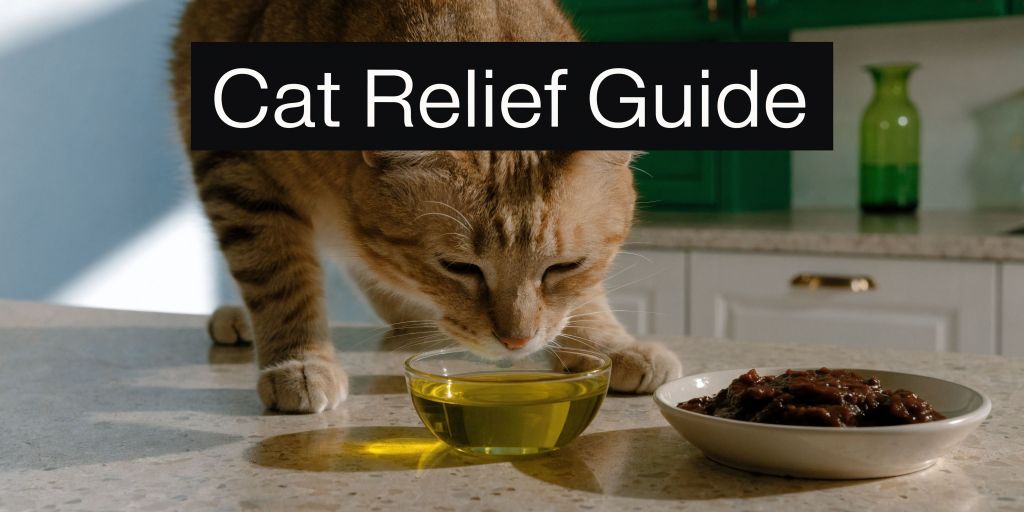
Use only plain extra virgin olive oil
Choose plain extra virgin olive oil with no added flavorings or botanicals. Skip garlic, citrus, chili, truffle, and herb-infused oils. Cats are sensitive to added ingredients, and this is not the time to experiment with a fancy bottle.
Fresh oil is better than old oil from the back of the cupboard. Rancid oil can upset the stomach and makes food less appealing.
Mix it into wet food
Mix the measured amount into a small portion of wet food your cat already tolerates well. Wet food matters here because moisture does more of the work than oil does.
Do not syringe olive oil into your cat’s mouth. Oil can be inhaled into the lungs, which creates a serious aspiration risk. Do not pour it over dry kibble and call that treatment. A dry meal still leaves you short on hydration.
The dose
Keep the amount modest.
A practical at-home range is ¼ teaspoon for a small or average cat, and up to ½ teaspoon for a large adult cat, mixed into food. Offer it once, then reassess over the next day. If you choose to repeat it, keep the trial brief and limited to 24 to 48 hours total. Beyond that, stop treating at home and call your veterinarian.
That cautious approach lines up with veterinary home-care advice that short trials of mild remedies should stay short, and ongoing constipation needs a medical workup. Cornell Feline Health Center’s guidance on constipation in cats reflects that bigger picture.
| Cat's Weight | Recommended Dose |
|---|---|
| Small cat | ¼ teaspoon mixed into wet food |
| Average adult cat | ¼ teaspoon mixed into wet food |
| Large adult cat | ¼ to ½ teaspoon mixed into wet food |
I keep the table conservative on purpose. More oil does not mean better results. It usually means loose stool, food refusal, or a greasy mess in the litter box.
A simple routine that keeps risk low
- Start with a wet meal: Use food your cat already eats willingly.
- Measure the oil: Use a measuring spoon, not a free pour.
- Mix it well: Oily pockets make many cats reject the meal.
- Watch for results: You want easier stool passage, normal appetite, and no vomiting.
- Stop early if side effects show up: Diarrhea, nausea, or refusal to eat means the trial is over.
For general portion awareness with oil, this guide on how much olive oil per day is considered reasonable gives useful context. Cats need far less, and the margin for error is smaller.
What not to improvise
Home treatment gets risky fast when owners keep stacking remedies.
- Do not keep redosing for days: Repeated constipation needs diagnosis, not another teaspoon.
- Do not mix olive oil with butter, coconut oil, mineral oil, or random hairball products unless your vet told you to: Combining slicking agents can backfire.
- Do not use flavored or infused oils: Added ingredients create avoidable hazards.
- Do not make it a routine topper: A cat that needs ongoing help usually does better with hydration, a vet-directed laxative, diet change, or treatment for the actual cause.
Used carefully, olive oil is a limited tool. Respect the limits, and it stays safer.
Red Flags That Demand a Vet Visit Immediately
The mistake I see most often is delay.
Owners spend too long asking whether they should try one more home remedy, one more meal topper, one more wait-and-see night. A constipated cat who is mildly uncomfortable may be fine with watchful care. A cat who is sick, painful, or blocked needs a veterinarian, not pantry medicine.

Stop treating at home if you see these signs
Use this as a hard line, not a suggestion.
Call the vet now if your cat is vomiting, lethargic, refusing food, crying in the litter box, straining repeatedly with little or no result, or still not passing stool after the short home-care window.
Those signs push the problem out of the “maybe mild” category.
Why the line matters
Constipation isn’t always just constipation.
A cat may have severe stool retention. A blockage. Pain that makes squatting difficult. A separate issue that looks similar from your side of the litter box. If the cat is hunched, unhappy, and deteriorating, olive oil won’t rescue the situation. It can waste time while the cat gets sicker.
That’s especially important if your cat seems withdrawn or unusually quiet. Cats don’t always broadcast distress.
For a broad overview of possible digestive downsides from overusing oil, this page on olive oil side effects gives context. In cats, the bigger danger is often not the oil itself. It’s treating a serious problem as if it were simple.
One more reason not to guess
Urinary trouble can sometimes look like bowel trouble to an owner watching from across the room. A cat may strain in the box and produce very little, and the assumption becomes constipation. If the issue is urinary, delay gets dangerous fast.
That’s why symptom clusters matter more than internet confidence.
A short visual explanation can help you think more clearly about what you’re seeing at home:
The right mindset
Home care is for a bright, stable cat with a mild problem. Veterinary care is for a cat who looks unwell, painful, or stuck.
If you’re debating whether your cat looks “bad enough,” that hesitation is often your answer.
Beyond the Bottle Better Long-Term Solutions
Here’s the contrarian truth. Olive oil gets too much credit because it’s easy.
It’s in the kitchen. It feels natural. It can help quickly. That combination makes it seductive. But for a cat with repeated constipation, the better question isn’t “What can I add today?” It’s “Why does this keep happening?”
Veterinarians point to inadequate hydration from dry food diets as a root cause in up to 70% of feline constipation cases, and switching to a high-protein, wet food diet often resolves the issue without laxatives that can mask the underlying problem, according to Hoji Real’s safety guide on olive oil for cats.

Hydration first
If a cat lives on dry food and drinks modestly, hard stool is not a mystery.
Wet food often does more for long-term comfort than any spoonful of oil ever will. It addresses the environment inside the gut, not just the stalled moment. That’s why I’d rather improve moisture intake than build a routine around lubricants.
If you’re evaluating foods with digestion in mind, a practical roundup like this guide to the best cat food for digestion can help you compare options in a more useful way than asking which oil to use.
Pumpkin has a different job
Olive oil lubricates. Pumpkin works differently.
Plain pumpkin puree adds fiber and can help create better stool texture for some cats. That makes it a more thoughtful option when the issue is recurring stool quality rather than one dry episode. It won’t be right for every cat, and cats can be fussy about taste, but it’s often closer to a root-cause approach than oil.
If olive oil is the slick shortcut, pumpkin is the stool-structure tool.
Probiotics deserve attention
Gut health is rarely glamorous, but it matters.
A cat with recurring digestive irregularity may benefit from a veterinarian-guided probiotic plan. That’s not as dramatic as “give this tonight and watch what happens,” which is exactly why it gets overlooked. Better bowel patterns often come from steadier internal conditions, not stronger rescue tactics.
For readers interested in the broader digestive logic behind fats and inflammation, this overview of olive oil for gut health is worth reading. In cats, though, olive oil should remain the supporting player, not the star.
The professional’s hierarchy
When a cat keeps getting constipated, this is the order I trust most:
- Improve moisture intake: Wet food is the workhorse.
- Review the full diet: Protein quality and digestibility matter.
- Consider fiber thoughtfully: Plain pumpkin can help some cats.
- Use probiotics with purpose: Best discussed with your vet.
- Reserve olive oil for short-term relief: Helpful, but not foundational.
What usually fails
Quick fixes fail when owners use them instead of asking harder questions.
Repeated oil dosing. Waiting too long. Assuming hairballs are the whole story. Treating a chronic pattern as a series of isolated incidents. That’s how a manageable issue turns into a recurring one.
Olive oil belongs in the toolkit. It does not belong on the throne.
Using Kitchen Remedies with Wisdom
Good home care isn’t about acting like a veterinarian. It’s about knowing where your role begins and where it ends.
Olive oil for cats constipation can be useful when the case is mild, recent, and uncomplicated. Used correctly, in a small measured amount mixed with food, it may help a cat pass hard, dry stool. Used carelessly, it can muddy the picture, delay proper treatment, or create a new mess.
That’s the larger lesson.
The best owners aren’t the ones who know the most tricks. They’re the ones who can tell the difference between a short-term aid and a real solution. In this case, real solutions usually live in hydration, diet quality, observation, and timely veterinary care.
If you want a broader look at how olive oil is commonly discussed as a digestive aid, this page on olive oil for constipation offers context. For cats, the responsible version is narrower and more disciplined.
Trust the simple hierarchy. Mild problem, cautious help. Persistent problem, deeper fix. Sick cat, vet now.
Frequently Asked Questions
Does olive oil help with hairballs too
Sometimes, but I wouldn’t treat it as a reliable hairball strategy.
It may help a little by making passage easier, but that’s not the same as solving why the hairballs keep forming or why stool consistency is poor. If hairballs and constipation are recurring together, grooming, hydration, and diet usually deserve more attention than another dose of oil.
Can I use vegetable oil instead
Plain extra virgin olive oil is the standard choice when people use this remedy.
I would not improvise with random oils from the pantry. The more you drift away from plain, simple, measured olive oil mixed into food, the less predictable the result becomes.
Is olive oil safe for kittens
Kittens are not the place for casual home experiments.
They can get into trouble faster, and constipation in a kitten can have different causes than in a healthy adult cat. If a kitten is straining, not eating, or acting off, call a veterinarian instead of testing a kitchen remedy.
What about senior cats
Senior cats deserve extra caution.
Older cats are more likely to have medical issues behind constipation, including problems that need diagnosis instead of lubrication. If an older cat has a pattern of constipation, think less about repeat oil use and more about getting a veterinary workup.
Can diabetic cats use olive oil for constipation
Olive oil is not a glucose-management tool.
If a diabetic cat becomes constipated, the safer mindset is to look at the whole diet and the cat’s medical status, not to assume oil solves anything beyond temporary stool passage. Recurrent constipation in a diabetic cat needs professional oversight.
What if my cat has pancreatitis or a sensitive stomach
Use extra caution and ask your veterinarian first.
Olive oil is fat. A cat with a history of fat-sensitive digestive trouble is not the right candidate for casual at-home dosing. In these cats, even a well-meant remedy can complicate the picture.
How long should I wait before getting help
Not long.
If the problem doesn’t resolve quickly after a brief, careful attempt at home care, or if your cat seems unwell at any point, stop and call your vet. Repeated straining, pain, or a worsening overall condition changes the equation.
Learn Olive Oil is a trusted place to deepen your understanding of premium olive oil, from quality and sourcing to responsible health-related use. If you want clear, practical guidance that respects both the product and the context, visit Learn Olive Oil .
 Learn Olive Oil
Leave a comment