In the great olive oil vs. coconut oil showdown, you’ve been told there's a simple answer. There isn't. The "best" choice is a secret hidden not on the label, but in your specific intentions—for your health and in your kitchen. If you prize your heart health and crave everyday versatility, a high-quality extra virgin olive oil is an undisputed titan, armed with decades of scientific proof. Yet, coconut oil holds its own unique power, especially when the stove gets searing hot or when your vegan baking demands a certain magic.
The Oil Debate: A Decision You Make Every Day
You're standing in the grocery aisle, a familiar battleground. The bottle of olive oil, shimmering with golden-green promise, vies for your attention against the snow-white allure of coconut oil. Their labels scream health claims, but beneath the marketing noise lies a more fascinating, nuanced story. This isn't about crowning a single champion. It’s about arming you with the knowledge to choose the right tool for the right job, every single time.
Ultimately, the choice between these two pantry titans boils down to a few critical factors: their secret fatty acid formulas, how they stand up under fire, and the nutritional arsenal they bring to your body. Each possesses a distinct culinary personality and triggers a completely different cascade of events inside you.
A Tale of Two Fats
At the very core of this debate lies their fatty acid profiles. Extra virgin olive oil is a treasure trove of monounsaturated fats, with its star player, oleic acid. This is the very fat that has earned the Mediterranean diet worldwide acclaim, celebrated for its astonishing ability to help vanquish "bad" LDL cholesterol while protecting "good" HDL cholesterol.
Coconut oil, in stark contrast, is built almost entirely from saturated fat, a truth that has placed it at the epicenter of fierce nutritional controversy. While its advocates sing the praises of its unique medium-chain triglycerides (MCTS), the world's leading health organizations continue to issue clear warnings: limit your intake of saturated fat to shield your heart from harm.
This visual breakdown reveals just how profoundly different their internal makeup is.
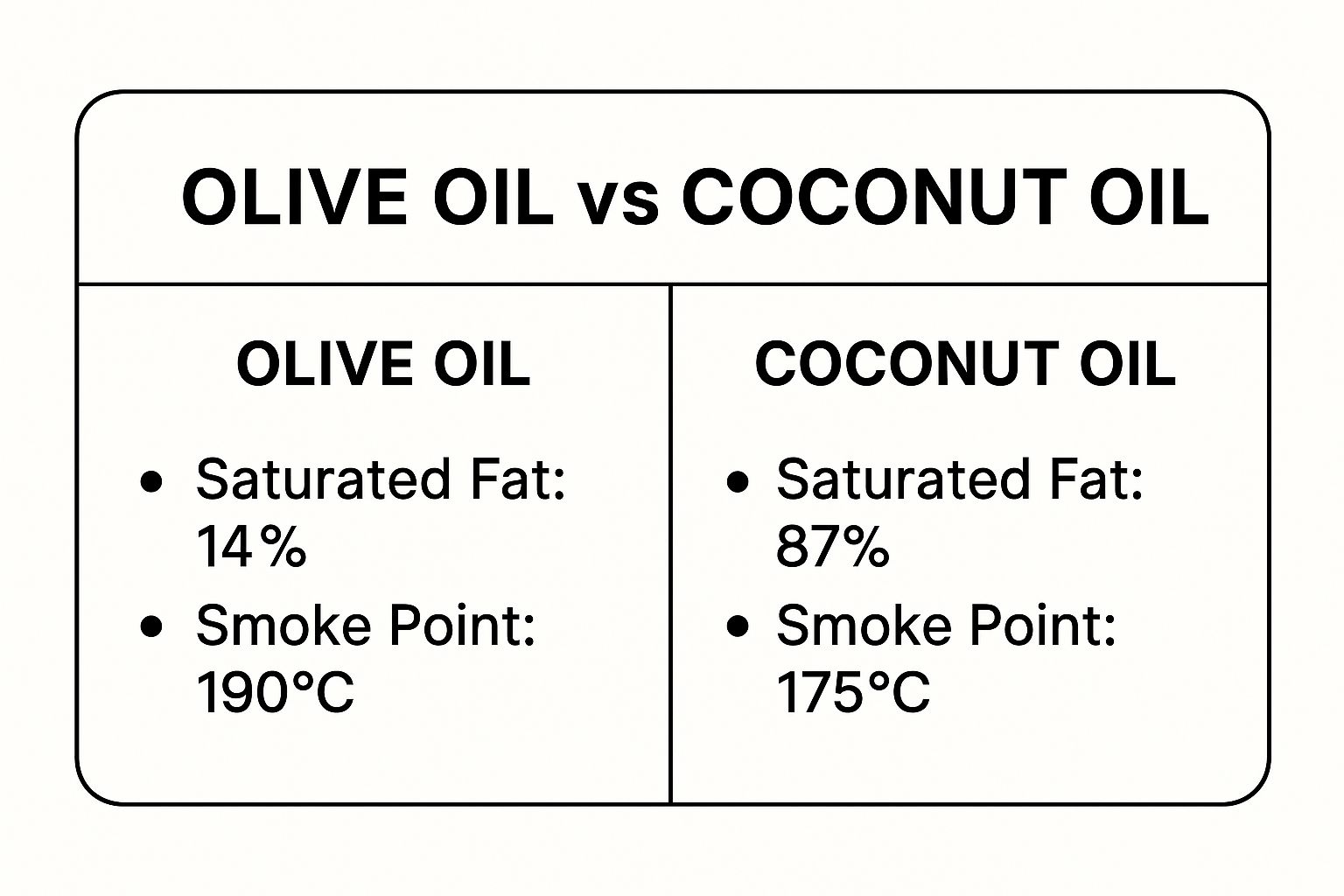
As you can see, the chasm in saturated fat levels is immense. But here’s a surprise: a high-quality olive oil boasts a more versatile smoke point than most people believe, making it a reliable ally for much more than a simple drizzle.
To arm you for a quick decision, here is a side-by-side dossier on each oil.
Olive Oil vs Coconut Oil: A Quick Comparison
| Attribute | Olive Oil | Coconut Oil |
|---|---|---|
| Primary Fat Type | Monounsaturated (oleic acid) | Saturated (lauric acid) |
| Heart Health | Widely considered beneficial | Controversial; may raise LDL cholesterol |
| Flavor Profile | Grassy, peppery, or fruity | Nutty, sweet, distinctly tropical |
| Best For | Salad dressings, finishing dishes, sautéing | High-heat cooking, baking, specific cuisines |
This table delivers the facts at a glance, but the real secret to mastery lies in intelligent application.
The key to unlocking their power isn't about picking a side, but understanding their roles. Think of extra virgin olive oil as your trusted, everyday workhorse for spectacular flavor and robust health, and coconut oil as a highly specialized tool for very specific culinary missions.
In the end, the right oil is the one that perfectly matches your cooking method and serves your health goals. If you're ready to delve deeper into the fascinating world of "liquid gold," you can discover the different types of olive oil and learn how to select the perfect bottle for your kitchen.
Decoding The Nutritional Labels of Each Oil
If you truly want to settle the olive oil vs coconut oil debate for yourself, you must look past the flashy marketing and listen to the science. That nutrition label isn't a boring grid of numbers; it's a secret blueprint revealing exactly how an oil will behave inside your body. It’s where the real story—and the crucial differences—are written in black and white.
Let's dissect the nutritional profile of each, but we'll go deeper than the tired "good fat vs. bad fat" cliché. This is where you'll uncover the distinctions that truly matter for your health.
The Foundation of Fat: A Tale of Two Profiles
The most staggering difference between these two oils is their fatty acid composition. Think of these fats as the oil's fundamental building blocks—the very essence that defines its character and its impact on your health.
-
Olive Oil's Powerhouse: Extra virgin olive oil is forged from a foundation of monounsaturated fats, with the undisputed champion being oleic acid. This is the fat that gives the Mediterranean diet its heart-healthy halo, and for good reason. It is renowned for helping to lower "bad" LDL cholesterol while leaving "good" HDL cholesterol untouched.
-
Coconut Oil's Controversy: Coconut oil, on the other hand, is a saturated fat titan. It's composed of roughly 80-90% saturated fat, the very reason it remains solid at room temperature. This single fact is the source of nearly all the controversy and debate that swirls around it.
Both oils register at around 120 calories per tablespoon, but here's the crucial secret: the type of fat those calories come from is what truly matters. Your body processes monounsaturated and saturated fats in profoundly different ways.
This distinction is the first, and most vital, piece of the puzzle. It sets the stage for everything that follows.
Beyond the Fats: Antioxidants and Special Compounds
But the story doesn't end with fat. High-quality, unrefined oils contain a hidden treasure of other beneficial compounds, many of which are obliterated during industrial processing. This is where the nutritional battle gets truly compelling.
Extra virgin olive oil is teeming with powerful antioxidants, especially polyphenols like oleocanthal and tyrosol. These compounds act like tiny bodyguards for your cells, defending them against the oxidative stress and inflammation that lie at the root of so many chronic diseases. Have you ever noticed that peppery kick in a truly great EVOO? That's oleocanthal, a natural anti-inflammatory, announcing its presence.
Coconut oil brings its own unique compound to the fight: lauric acid. This specific type of saturated fat, a medium-chain triglyceride (MCT), constitutes about 49% of the oil's fat content. Proponents will tell you that the body metabolizes MCTs differently, fast-tracking them to the liver for a quick surge of energy. It is vital to know, however, that lauric acid often behaves more like a long-chain fatty acid in the body, and its true effect on cholesterol remains a hot topic of scientific debate.
Understanding the Labels for a Smarter Choice
Making an intelligent decision in the grocery aisle means seeing past the seductive front label. To truly know what you're buying, you must learn the language of the nutrition panel. When you choose the best olive oil, you should hunt for key phrases like "extra virgin" and "cold-pressed," as these are hallmarks of higher quality and preserved nutrients.
Beyond just the oils themselves, becoming fluent in other food labels, like understanding what non-GMO means, will transform you into a more empowered shopper. These details paint a complete picture of a product's odyssey from the farm to your kitchen.
So, when you’re decoding those labels, just remember this simple breakdown:
- Olive Oil: Think monounsaturated fats, potent polyphenols, and proven anti-inflammatory power.
- Coconut Oil: Think saturated fats, lauric acid, and a unique MCT profile that generates both fascination and caution.
Each nutritional label tells a story. Once you understand it, you hold the power to choose the oil that truly serves your health and your cooking.
The Health Verdict: What The Research Reveals

It’s dangerously easy to get swept away by wellness trends and clever marketing. But when it comes to the stark choice between olive oil and coconut oil, the only verdict that matters comes from science. One of these oils is the undisputed hero of one of the most rigorously studied diets on Earth; the other is a tropical darling whose health claims have often galloped far ahead of the evidence.
Let’s cut straight to the facts. It's time to separate popular opinion from proven research to see what each oil truly means for your health in the long run.
Olive Oil and the Power of the Mediterranean Diet
For decades, scientists have been captivated by the extraordinary health and longevity of people in the Mediterranean. Their secret weapon? Extra virgin olive oil, a true liquid gold that forms the very bedrock of their diet. The evidence supporting it isn't based on a few flimsy studies—it is robust, consistent, and frankly, overwhelming.
The magic is found in olive oil's high concentration of monounsaturated fats, especially oleic acid. This "good fat" has proven itself, time and again, to be a powerful champion for heart health.
A massive, unassailable body of research links regular extra virgin olive oil consumption to lower "bad" LDL cholesterol, reduced blood pressure, and a significantly lower risk of heart disease. It's not a miracle cure, but it is one of the most effective dietary tools we possess for protecting our hearts.
But the benefits don't stop there. The unique polyphenols in EVOO, such as oleocanthal, act as potent natural anti-inflammatory compounds. They help extinguish the low-grade, chronic inflammation that smolders beneath so many modern diseases. To learn more, discover our detailed guide on the proven health benefits of olive oil.
The Coconut Oil Controversy: A Sober Look at the Science
Coconut oil stormed onto the health scene armed with audacious promises—to rev up your metabolism, sharpen your brain, and even melt away fat. When we place these claims under the unforgiving lens of the scientific microscope, however, the picture becomes alarmingly murky. The primary point of contention is its composition: coconut oil is roughly 80-90% saturated fat.
Supporters frequently argue that its main saturated fat, lauric acid, behaves differently in the body. Yet, nearly every major health organization on the planet recommends limiting saturated fat. While studies do confirm coconut oil raises "good" HDL cholesterol, they also show it significantly raises "bad" LDL cholesterol—the very particle that contributes to dangerous plaque buildup in your arteries.
This dual effect on cholesterol is the crux of the debate. While it might be less damaging than other saturated fats, the scientific consensus simply does not support the notion that it is "heart-healthy" in the same way olive oil is. As for the weight loss and brain health claims? Those are mostly built on small studies, often using pure MCT oil (a refined derivative), not the coconut oil you actually buy in a jar.
The Bottom Line: What the Evidence Tells Us
When you pit olive oil against coconut oil based on credible, long-term health research, the conclusion is brutally clear.
- For Heart Health: Olive oil is the decisive winner. Its monounsaturated fats and polyphenols offer proven, powerful cardiovascular protection.
- For Fighting Inflammation: The anti-inflammatory compounds in extra virgin olive oil are well-documented. Coconut oil’s impact, in contrast, is neutral at best.
- For Overall Health: The Mediterranean diet, with olive oil at its core, is consistently linked to a longer, healthier life with lower rates of chronic disease.
Olive oil's reputation as a health powerhouse is backed by its global presence. Though a specialty product compared to giants like palm oil, its worldwide production has remained strong, with recent figures showing around 3 million metric tons produced in the 2023/24 cycle, celebrated for its high monounsaturated fat content.
Choosing The Right Oil For Your Kitchen
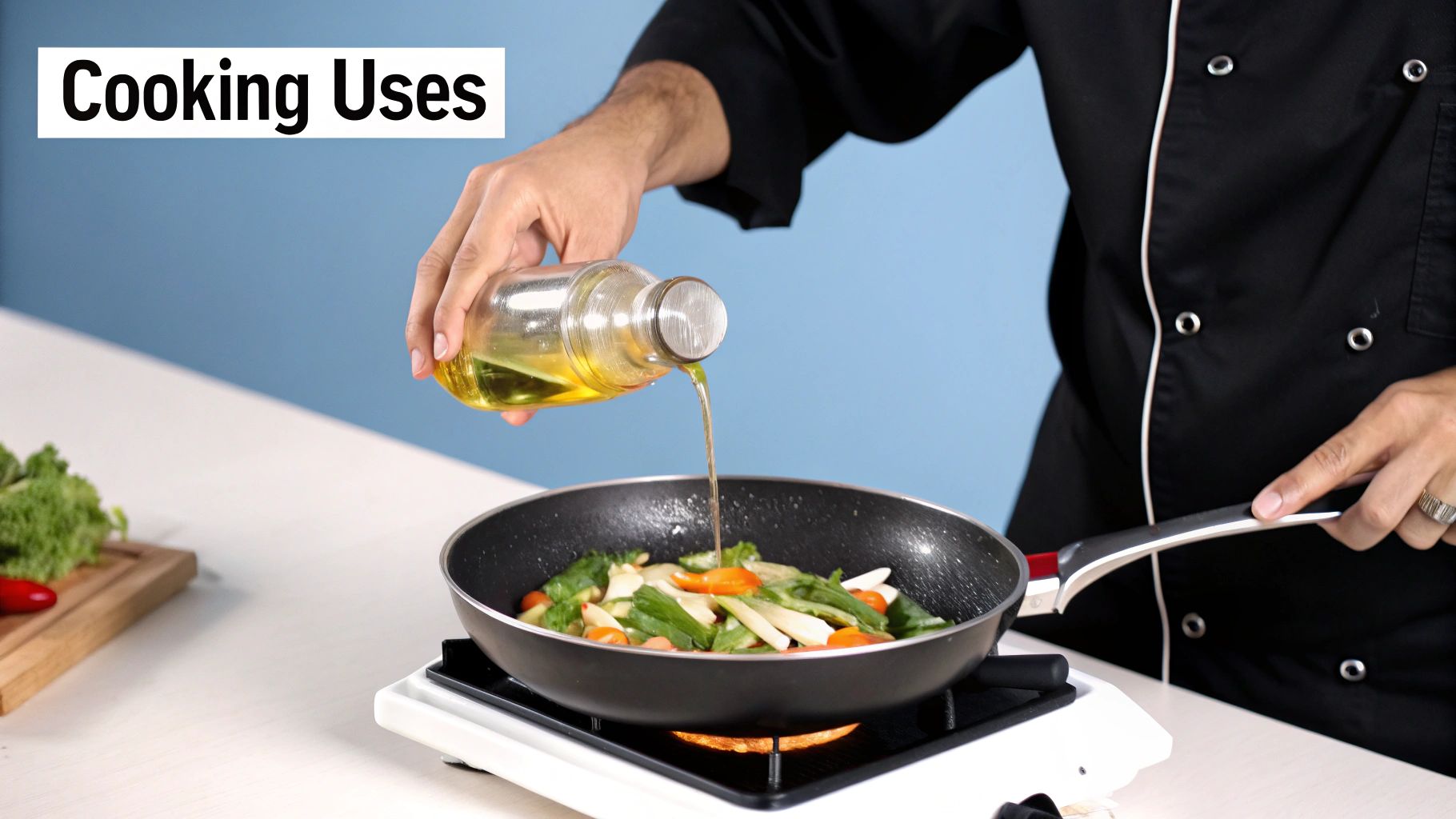
Any seasoned cook will tell you the real test of an oil isn't on a nutrition label or in a lab report. It’s in the sizzle of a hot pan, the silken blend of a vinaigrette, or the perfect crumb of a baked good. This is where theory is forged into practice, and knowing the distinct personalities of olive oil and coconut oil will elevate your cooking from merely good to truly great.
The olive oil vs coconut oil debate in the kitchen isn’t about choosing a single winner. It’s about instinctively knowing which bottle to reach for. This simple skill makes all the difference, amplifying flavors, safeguarding nutrients, and delivering the exact texture you crave.
The Finishing Touch and Low-Heat Master: Extra Virgin Olive Oil
Think of a premium extra virgin olive oil (EVOO) less as a cooking fat and more as a powerful finishing condiment. Its true value is locked in its vibrant, complex flavor—which can be grassy, peppery, or fruity—and its precious cargo of delicate polyphenols. Blasting this liquid gold with intense heat is like using a sledgehammer to crack a nut; you destroy all its delicate nuance.
The bold, fresh taste of EVOO is born to be the star of the show.
- Salad Dressings: It is the very soul of a classic vinaigrette, emulsifying with vinegar to forge a flavor foundation.
- Finishing Drizzles: A swift pour over roasted vegetables, grilled fish, or a bowl of soup just before serving unleashes an incredible burst of freshness.
- Dipping and Spreading: Nothing rivals a great EVOO served simply with crusty bread, where its unique character can be truly savored.
For actual cooking, command EVOO to gentle heat. It is perfect for a light sauté of garlic and onions or for wilting spinach. Its smoke point hovers around 375°F (191°C), more than sufficient for these tasks, preserving both its magnificent taste and its health-giving properties.
The Versatile Workhorse: Refined Olive Oil
So what happens when you crave olive oil's heart-healthy fats but need to crank up the heat? That's when refined olive oil—often labeled simply "olive oil" or "light olive oil"—steps into the ring. This version has been processed to strip away the delicate compounds that give EVOO its low smoke point and assertive flavor, rendering it a neutral and stable workhorse for the kitchen.
With a much higher smoke point of up to 465°F (240°C), it's a superb choice for everyday cooking like roasting, pan-searing chicken, or stir-frying vegetables without imparting any strong flavor. To master its use, it helps to explore the different types of olive oil for cooking to find what works for you.
The High-Heat Hero and Vegan Baker's Secret: Coconut Oil
Now, let's turn to coconut oil. It is a completely different beast. Where EVOO is peppery and nuanced, virgin coconut oil brings an unmistakable tropical sweetness and nutty flavor to everything it touches. This makes it a formidable, if specific, tool in your culinary arsenal.
Its high percentage of saturated fat gives it an impressive smoke point—around 400°F (204°C) for refined versions—making it a champion for high-heat cooking where you actively want that signature taste.
- Stir-Fries and Curries: It is a natural fit in Thai, Indian, and other South Asian cuisines, where it lends an authentic, aromatic flavor.
- Vegan Baking: Because it's solid at room temperature, it is a brilliant substitute for butter or shortening. It creates flaky pie crusts, tender scones, and rich, fudgy brownies by providing a structure that liquid oils simply cannot replicate.
- Pan-Frying: Perfect for getting tofu phenomenally crispy or searing plant-based burgers, where both its stability and flavor are major assets.
In the end, the goal isn't to crown one oil as the best, but to build an instinct for which one to use and when. For flavor-forward, low-heat cooking and finishing touches, EVOO is your undeniable go-to. When things get hot, reach for refined olive oil for neutrality or coconut oil for that tropical flair. A smart approach ensures every meal is cooked perfectly and tastes extraordinary.
The Journey From Grove And Palm To Your Pantry
That bottle of oil sitting in your pantry didn't just magically appear on the shelf. It’s the final destination on an epic journey that began in a field halfway across the world, a journey that navigated complex supply chains, economies, and ethical standards before it ever reached your kitchen. Knowing this story transforms you from a mere shopper into a conscious consumer, one who understands the global narrative sealed inside that glass or jar.
When it comes to olive oil and coconut oil, their paths from plant to pantry could not be more different. One story is steeped in ancient tradition and family legacy, while the other is a tale of massive industrial scale and tropical logistics.
The Olive Grove: A Tradition Centuries in the Making
Picture a gnarled, ancient olive tree, its roots dug deep into the rocky Mediterranean soil. This is where the story of olive oil begins—a craft woven into the fabric of history and often passed from one generation to the next. The world's most revered olive oils don't come from colossal corporate farms, but from small, family-owned groves scattered across the landscapes of Italy, Greece, and Spain.
This smaller, more intimate scale profoundly shapes the final product. It permits an incredible devotion to detail, from harvesting olives by hand to pressing them within hours to capture their peak flavor and nutritional power. To get a true sense of this journey, you can see what makes a premium Italian Extra Virgin Olive Oil from Apulia so special. This artisanal approach is precisely why authentic EVOO costs more; you're investing in heritage, quality, and a true agricultural art form.
The price and quality of your olive oil are directly linked to these traditional methods. When you see a "D.O.P." (Protected Designation of Origin) label, it's not just marketing jargon—it's a legal guarantee that your oil comes from a specific region and was crafted according to strict, time-honored rules.
The Coconut Palm: A Global Commodity
The story of coconut oil, in contrast, is one of industrial might and global economics. Produced primarily in the Philippines and Indonesia, coconut oil is a massive commodity, its supply and price swayed by everything from weather patterns to market speculation.
This industrial scale means the production methods are a world away from traditional olive oil. While small-batch, artisanal coconut oil does exist, the vast majority you find in stores originates from large plantations where maximizing efficiency is the supreme law.
The market for coconut oil is incredibly dynamic. Global production for the 2024/25 season is forecast to be around 3.65 million metric tons, a slight downturn from droughts caused by El Niño. Despite this, the market is projected to skyrocket from $6.93 billion in 2025 to over $13.37 billion by 2035, propelled by its explosive popularity in both food and cosmetics.
Ultimately, your choice in the olive oil vs coconut oil debate extends far beyond your kitchen. It’s a decision that connects you to different agricultural systems, economies, and ethical questions. Whether you reach for the peppery bite of a handcrafted olive oil or the subtle sweetness of coconut oil, knowing its origin story helps you choose a product that aligns not just with your recipe, but with your values.
If you're ready to put that knowledge to use, our guide on using olive oil for salad dressing is a perfect place to start.
Your Common Oil Questions Answered
When you're standing in the kitchen, confronted by a bottle of olive oil and a jar of coconut oil, a few critical questions always arise. Let's get straight to the answers, so you can feel confident you're making the right call for your meal.
We’ll tackle the most common points of confusion with practical advice you can use tonight.
Can I Substitute Olive Oil for Coconut Oil in Baking?
Technically, yes, but you must think twice before attempting a simple 1:1 swap. Making this substitution without understanding the consequences is a recipe for disaster. Olive oil has a distinct savory, sometimes peppery character that is an unwelcome intruder in most sweet treats like cakes or cookies.
Beyond flavor, the real issue is texture. Coconut oil is solid at room temperature and performs much like butter, helping to create the light, flaky, or tender crumbs we crave. Liquid olive oil simply cannot replicate this. It will yield a much denser, sometimes even greasy, result. It's fantastic in savory bakes like a rustic focaccia or some muffins, but for delicate desserts, it’s a gamble that almost never pays off.
Which Oil Is Better For High-Heat Frying?
When you need to sear a steak or get a stir-fry sizzling hot, refined coconut oil is your trusted ally. It boasts a smoke point around 400°F (204°C), meaning it remains stable and won't degrade into unhealthy compounds when the heat is on.
Extra virgin olive oil, on the other hand, was never built for that kind of intense fire. Its smoke point is lower, around 375°F (191°C), and high temperatures will swiftly destroy its delicate polyphenols and obliterate its nuanced flavor. If you are determined to use olive oil for higher-heat jobs, a "light" or refined variety is a better choice, as its smoke point is higher—just know that you are sacrificing all those celebrated EVOO health benefits.
Here's a critical distinction many people miss: 'Extra Virgin' is a legally regulated term for olive oil that guarantees a specific quality and cold-pressing process. For coconut oil, the term 'virgin' is purely a marketing word—it carries no official weight or regulated meaning.
Does Coconut Oil Really Help You Lose Weight?
This is perhaps one of the biggest myths in the wellness world, and the scientific evidence simply does not support it. The entire claim is built on the presence of medium-chain triglycerides (MCTs) in coconut oil, which your body can burn for quick energy.
A few very small, isolated studies using pure, concentrated MCT oil (not coconut oil from a jar) showed a minor, temporary increase in metabolism. However, no major human study has ever demonstrated that simply adding coconut oil to your diet leads to any significant or sustainable weight loss. At the end of the day, it's a fat, and a dense one at that, packing about 120 calories per tablespoon. Relying on it as a weight-loss tool is a dangerous misunderstanding that can easily backfire.
At Learn Olive Oil, we're passionate about showing how a little knowledge can completely change the way you cook and eat. Our goal is to clear up the confusion around high-quality olive oil, giving you the confidence to choose, taste, and use it like a pro.
Start your journey into the world of liquid gold by exploring our expert guides today.

 Learn Olive Oil
Leave a comment