You don't need a fancy lab to figure out if the olive oil in your pantry is the real deal. In fact, the most powerful tools you have are your own senses. The classic 'sip and smell' technique is what the pros use, and it's surprisingly easy to learn. It's all about tuning into the fruity, bitter, and peppery notes that signal a true Extra Virgin Olive Oil. Forget complicated chemistry for a moment—your palate is your best defense against rancid or fake oil.
Your Quick Guide to Spotting Fake Olive Oil
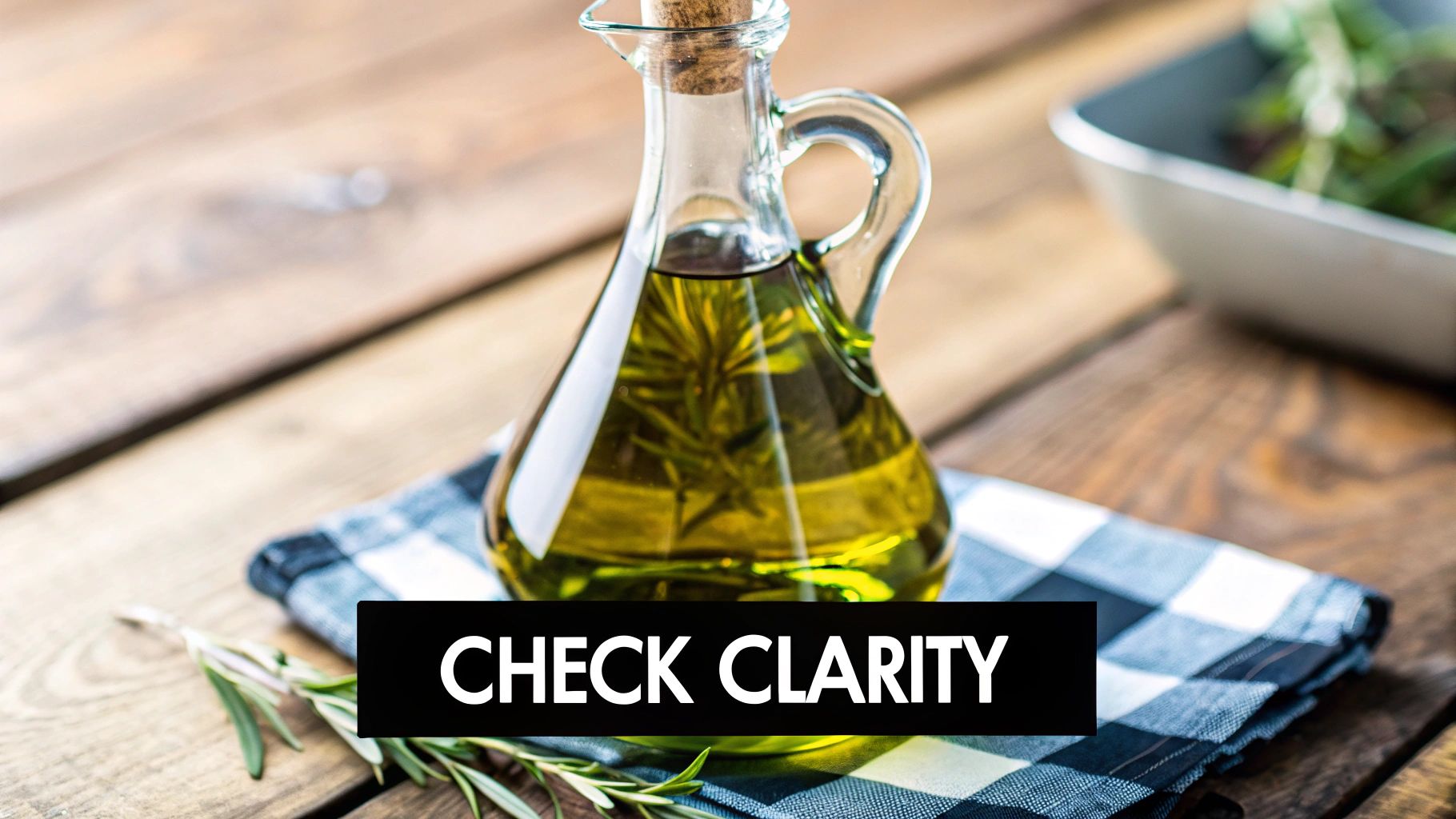
Before we get into the nitty-gritty, let's start with a simple roadmap. Think of this as your first step toward becoming a more discerning olive oil buyer. The goal here isn't to turn you into a certified taster overnight, but to give you the confidence to trust your own judgment and question what's in that bottle.
We’ll cover a few popular home methods, including the famous refrigerator test that always seems to pop up in online discussions. This guide will give you a quick overview of the most practical techniques you can try right now.
The Professional 'Sip and Smell' Method
From the tasting rooms in Tuscany to your kitchen counter, the gold standard for evaluating olive oil is sensory analysis. It sounds technical, but it just means using your nose and mouth to pick up on key characteristics. It’s less intimidating than you think.
A genuine Extra Virgin Olive Oil (EVOO) should have a trifecta of positive traits:
- Fruitiness: This is the aroma of fresh, healthy olives. Depending on the olive variety and harvest time, it might remind you of green grass, artichoke, tomato vine, or even almonds.
- Bitterness: A clean, pleasant bitter note on your tongue is actually a very good sign. It indicates the presence of fresh olives and antioxidants, not a defect.
- Pungency: This is that peppery or spicy kick you feel in the back of your throat a moment after you swallow. This sensation comes from powerful polyphenols and is a hallmark of a high-quality, fresh oil.
If you can learn to spot these three things, you're already way ahead of most consumers. An oil that tastes flat, greasy, or waxy, with none of these characteristics, is a major red flag.
Key Takeaway: That peppery cough at the back of your throat isn't a flaw—it's a feature! This sensation is caused by an antioxidant called oleocanthal, and it's one of the best indicators you have a fresh, authentic extra virgin olive oil.
The Refrigerator Test A Popular But Flawed Clue
You've probably heard this one before: put your olive oil in the refrigerator, and if it gets cloudy and solidifies, it's pure. While there's a grain of truth here, this method is far from reliable for testing olive oil quality at home.
It's true that monounsaturated fats, the main type in olive oil, tend to congeal when they get cold. The problem is, other refined oils can do the same, and some high-end EVOOs are "winterized" (chilled and filtered) to stay clear, so they won't solidify much at all.
Think of the fridge test as one small clue in a larger investigation, not the final verdict. We'll dig into the science and its limitations later on.
To give you a quick reference for your tasting experiments, here's a handy cheat sheet.
Home Olive Oil Test Cheat Sheet
This table summarizes the simple sensory and physical tests you can perform in your own kitchen to get a better sense of your olive oil's quality.
| Test Method | What to Look For | Indicates High Quality | Indicates Low Quality |
|---|---|---|---|
| Smell (Aroma) | Pour a small amount into a glass and warm it with your hands. Swirl and sniff. | Fresh, vibrant aromas like grass, fruit, tomato leaf, or artichoke. | Smells like crayons, stale nuts, vinegar, or nothing at all. |
| Taste (Flavor) | Take a small sip. Note the flavors on your tongue and the feeling in your throat. | A balance of fruitiness, bitterness on the tongue, and a peppery kick in the throat. | Tastes greasy, waxy, musty, metallic, or overly sour. |
| Refrigerator Test | Place a small amount of oil in the fridge for a few hours. | May become cloudy and thicken or solidify (but this is not a definitive test). | Remains perfectly clear and liquid (can be a red flag, but also inconclusive). |
| Lamp Test | Observe a small amount of oil in an oil lamp with a cotton wick. | Burns cleanly and steadily without producing much smoke. | Sputters, produces black smoke, or has trouble staying lit. |
Use these tests as a starting point. The more you practice, the more your senses will become attuned to the subtle differences between a superb oil and a subpar one. Remember, the goal is to build your confidence and enjoy the authentic flavors of real olive oil.
Using Your Senses to Find the Good Stuff
You don't need a white lab coat or a high-tech chemistry set to figure out if you've got a great olive oil. In fact, the most powerful tools you have are the ones you were born with. Professional olive oil tasters depend entirely on their senses, and for good reason—a well-trained palate can pick up on subtleties that machines simply can't.
Learning to trust your own senses is the key to becoming a confident judge of quality. It's less about being a connoisseur and more about getting to know your food. When you really pay attention, an olive oil tells you its whole life story, from how it was grown to how it was handled.
This image breaks down the very first thing a pro does: the smell test.
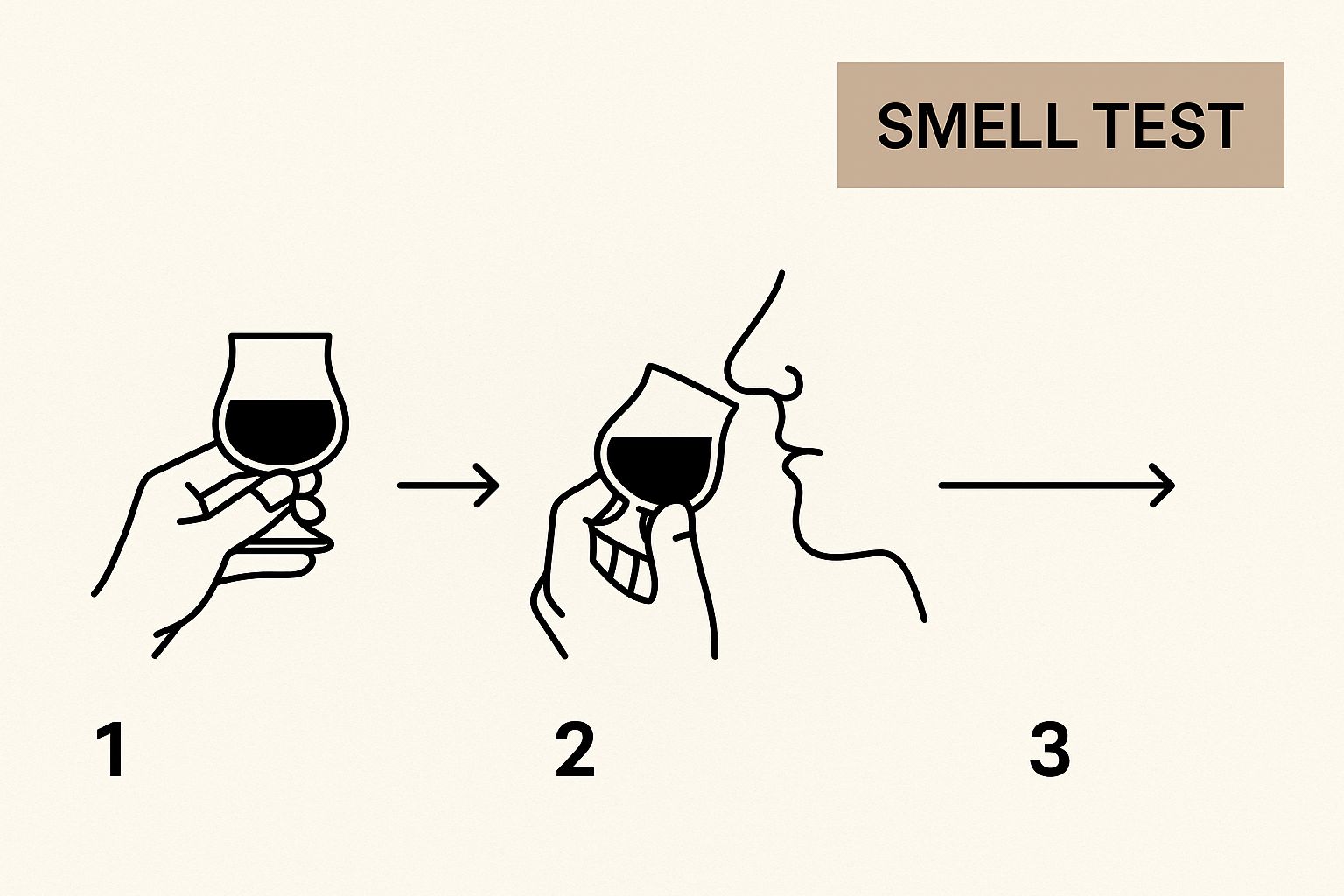
As you can see, warming the oil in your hands is crucial. This simple action releases all those fragrant compounds, giving you the first real clue about the oil's character.
How to Taste Like a Pro (It's All in the 'Slurp')
First things first, let's set you up for a proper tasting. Pour about a tablespoon of oil into a small, sturdy glass. A small wine glass is ideal, but even a clean shot glass will do the trick.
Cup the glass in one hand and place your other hand over the top. This traps the aromas inside, concentrating them so you can get a better read.
Now, gently swirl the glass for about 30 seconds. The warmth from your hand coaxes the oil to release its aromatic compounds. Once you're ready, bring the glass up to your nose, remove your hand, and take a good, deep inhale.
What do you smell? A legitimate Extra Virgin Olive Oil (EVOO) should smell fresh and clean. You're looking for vibrant, green scents like:
- Freshly mown grass
- Green banana or apple peel
- Artichoke or even tomato leaf
- A hint of fresh nuts, like almond
Next up is the taste, and this requires a special technique called the ‘slurp.’ Take a small sip of oil into your mouth—but hold off on swallowing. Purse your lips like you're about to whistle and suck a bit of air in sharply over the oil. It might feel a little funny, but this aerates the oil and spreads it across your entire palate, unlocking its full spectrum of flavors.
This is where you'll find the three hallmarks of a true EVOO: fruitiness, bitterness, and pungency. The presence and harmony of these three attributes are the ultimate signs of an authentic, high-quality oil.
What to Look For: The Three Positive Signs
A genuine EVOO is defined by three positive characteristics. Think of them as a team—they all need to show up.
The first is fruitiness, which you already started to evaluate when you sniffed the oil. This isn't about sweetness; it's the collection of fresh, plant-based aromas and flavors that come from healthy, perfectly ripe (or under-ripe) olives.
Next is bitterness. I know, "bitter" usually sounds like a bad thing, but in olive oil, it's a badge of honor. A clean, pleasant bitterness on the tongue is a dead giveaway that the oil was made from fresh olives and is packed with beneficial antioxidants. It should feel crisp, not acrid or unpleasant.
Finally, you're looking for pungency. This is that peppery, sometimes cough-inducing kick you feel in the back of your throat right after you swallow. That little sting is caused by oleocanthal, a powerful anti-inflammatory polyphenol that acts a lot like ibuprofen. If that kick is missing, it’s a big red flag that the oil is old, has been refined, or is just low-quality.
Red Flags: Spotting Common Flavor Defects
Just as you look for the good, you need to be able to spot the bad. If an oil has any "off" flavors, it means something went wrong—the olives were damaged, the oil was stored improperly, or it's simply gone bad.
Keep an eye (and a nose) out for these common flaws:
- Musty or Fusty: This is a swampy, fermented smell. It happens when olives sit in piles for too long before being milled.
- Rancid: By far the most common defect. It smells and tastes like old walnuts, stale crackers, or even a box of crayons.
- Vinegary: A sharp, sour taste that signals the olives have fermented without air.
- Metallic: A distinct taste of metal, which usually means the oil came into contact with reactive metal surfaces during processing or storage.
If you taste any of these, the oil is not extra virgin quality, no matter what the label claims. Your senses are your best guide, and when it comes to olive oil, they rarely lie.
The Refrigerator Test: Myth vs. Reality
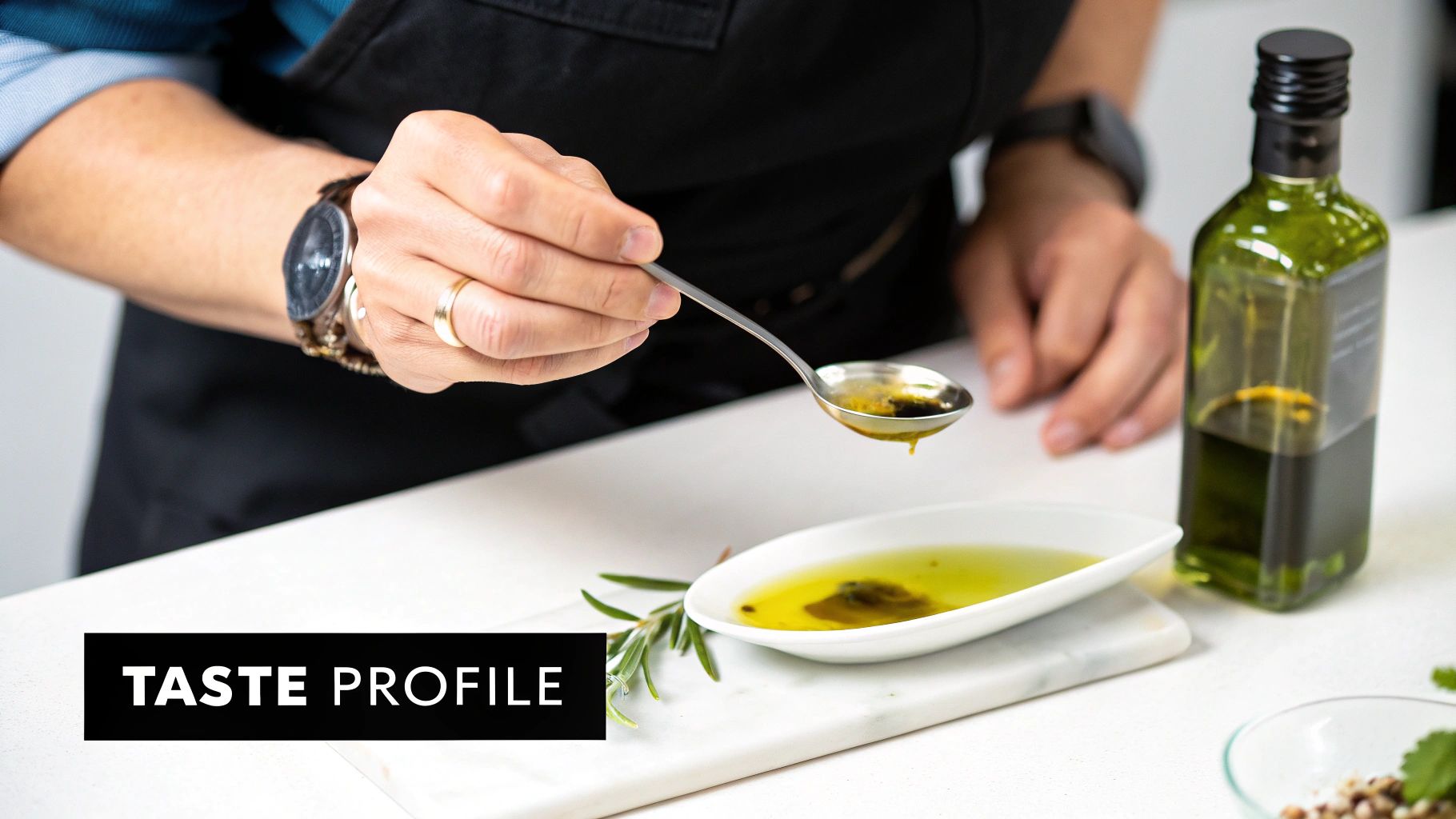
You’ve probably seen this one pop up on blogs or social media. The "fridge test" for olive oil has become a popular piece of kitchen wisdom. The idea is simple: stick your bottle of olive oil in the refrigerator, and if it gets cloudy and starts to solidify, it must be pure extra virgin olive oil.
This old wives' tale caught on because it’s based on a little bit of science. Extra virgin olive oil is packed with monounsaturated fats, which tend to solidify at colder temperatures compared to the polyunsaturated fats in many seed oils. So, when you chill a true EVOO, those fats can crystallize and make the oil look thick and cloudy.
But here’s the problem: relying on this test alone is a huge mistake. It’s nowhere near as reliable as people think.
Why Solidification Isn't a Guarantee
The truth is, the chemical makeup of oils is incredibly complex. Yes, a good EVOO will often get firm in the cold, but so will other, less desirable oils. For instance, a producer could mix in a cheap, high-oleic sunflower oil—which is also high in monounsaturated fats—and it would likely "pass" the fridge test with flying colors. You'd be left thinking you have a great product when you don't.
On the flip side, not every authentic extra virgin olive oil will turn solid. The specific temperature at which an oil congeals is determined by its unique fatty acid profile. This profile changes dramatically based on several factors:
- The type of olive: An Arbequina olive from Spain produces a very different oil than a Koroneiki from Greece.
- The time of harvest: Early-harvest oils have a different chemical structure than those made from late-season, fully ripe olives.
- The growing region: Climate and soil play a massive role in the oil's final characteristics.
Because of all this natural variety, some fantastic, top-shelf EVOOs might only get a little hazy in the fridge, while others turn into a solid block of green-gold butter. There's simply no single, universal standard.
The Reality Check: A well-known study from the University of California, Davis, found no reliable connection between what happened in the fridge and what lab tests revealed about an oil's quality. Plenty of genuine EVOOs "failed" the test, while some adulterated oils "passed."
The "Winterization" Wrinkle
There's another factor at play here: a process called winterization. Some producers intentionally chill their oil before bottling and then filter out the specific waxes that cause cloudiness. They do this purely for cosmetic reasons, so the oil stays perfectly clear when someone stores it in a chilly pantry or uses it to make a salad dressing that will live in the fridge.
This winterized oil is still a high-quality EVOO. But because it's been filtered this way, it won't solidify in your refrigerator. You could end up pouring a perfectly good, premium oil down the drain because you thought it failed the test.
So, Is the Fridge Test Useless?
Not entirely, but you have to use it with a huge grain of salt. It's one tiny clue in a much larger investigation.
Here’s how to think about it: if your oil sits in the fridge for a day and remains as clear and liquid as water, it might be a red flag. It’s a sign that you should definitely investigate further with your nose and taste buds. But if the oil does get cloudy or solid, that tells you very little. It’s not proof of purity.
At the end of the day, the most powerful tools you have for testing olive oil are your own senses. Your ability to smell fruitiness and taste that peppery bite on the back of your throat is what truly separates the good stuff from the bad. The fridge test is a fun experiment, but it's not the final verdict.
Gauging Freshness with Peroxide Value
While your senses are your most trusted tools for judging olive oil, some of the initial signs of decay are completely invisible. They’re chemical changes that happen long before you can taste or smell that something is off. This is where a key scientific metric comes into play: the peroxide value (PV).
Think of it as a chemical report card for the oil's freshness. The peroxide value measures the very first stage of oxidation—the process where oil reacts with oxygen. This reaction creates compounds called peroxides, which are the precursors to the rancid flavors we all want to avoid. A low PV means the oil is fresh and has been well-protected from its biggest enemies: air, light, and heat.
What the Official Numbers Mean
For an olive oil to earn the "extra virgin" label, it has to pass a series of strict chemical tests, and peroxide value is a crucial one. The International Olive Council (IOC) sets the legal limit at a maximum of 20 milliequivalents of active oxygen per kilogram (mEq O₂/kg). If an oil's PV is higher than 20, it’s officially considered oxidized and fails to qualify as EVOO. You can dive deeper into the science behind olive oil quality standards on olivamed.net.
But here’s the thing: for high-end producers, just squeaking by under that legal limit isn't nearly good enough. They strive for much, much lower numbers as a point of pride.
An Insider's Perspective: When you see a harvest date on the bottle, that's a great sign. It's an even better sign when the producer also lists the peroxide value at the time of bottling. An oil with a PV under 10 mEq O₂/kg is what I consider truly exceptional. It tells you the olives were healthy, processed quickly, and handled with incredible care, ensuring a longer, more flavorful life in your pantry.
This single number tells a big story about the oil's journey. A high peroxide value is often a red flag for issues like:
- Damaged fruit: Olives that were bruised or broken during harvest start oxidizing immediately.
- Processing delays: The longer the olives sit around between picking and pressing, the more time they have to degrade.
- Poor storage: Keeping finished oil in clear glass or a warm spot on the counter will send the PV soaring.
Can You Really Test This at Home?
Traditionally, measuring peroxide value required a full-blown laboratory. But things have changed. As more people get interested in the science behind their food, user-friendly testing kits have started to appear on the market. These kits are surprisingly effective for home use.
Typically, they work with chemical strips or reagents that change color based on the oil's PV. You might get a color chart, for instance, where a pale yellow means the oil is very fresh (low PV) and a dark brown means it’s highly oxidized (high PV). It won't give you the exact decimal point you'd get from a lab, but it provides a powerful piece of data that goes beyond what your senses can detect.
Knowing about peroxide value doesn't just help you pick a better bottle at the store. It helps you understand why proper storage—in a cool, dark cupboard, away from the stove—is so non-negotiable for keeping that beautiful oil in peak condition.
Decoding Acidity and Signs of Degradation
Beyond just freshness, there’s another crucial chemical marker that separates true extra virgin olive oil from the rest: its acidity level. Measured as Free Fatty Acid (FFA) content, this number gives you a direct look into the health of the olives at the very moment they were crushed. It tells a story of careful handling—or a story of neglect.
Think of it this way: healthy, whole olives are like tiny, perfect containers, protecting the precious oil inside. But if those olives get bruised during harvest, left sitting in a pile for too long, or become overripe on the tree, their cell walls start to break down. This damage releases enzymes that immediately go to work, breaking apart the oil’s triglycerides and creating what we call free fatty acids.
The Magic Number for EVOO
This is exactly why FFA is such a fundamental measure of quality. A higher FFA percentage is a dead giveaway that the olives were damaged or had already started to degrade before they ever made it to the mill. To even be legally called "extra virgin," an oil must have an FFA level of no more than 0.8%.
This isn't just some arbitrary rule; it directly impacts the oil's flavor and shelf life. Oils with higher acidity are much more prone to oxidation, meaning they'll go rancid far more quickly. The connection between low acidity and high quality is a worldwide standard. And yet, it's shocking to learn that some studies show up to 30% of commercial oils labeled as EVOO don't actually meet this basic requirement. You can dig deeper into these findings in published research on olive oil standards.
A Common Tasting Misconception
Now, it's really important to understand what "acidity" means here. We're not talking about the sour tang of lemon juice. The acidity measured in olive oil is completely imperceptible on your tongue. A lot of people mistakenly think that sharp, peppery kick you get in the back of your throat from a great oil is a sign of high acidity.
Key Insight: That pungent, cough-inducing sensation is actually a fantastic sign! It comes from healthy polyphenols like oleocanthal, not from free fatty acids. An oil with high acidity doesn't taste sharp; it usually just tastes flat, greasy, or otherwise defective.
Getting this distinction right is one of the biggest "a-ha!" moments when you're learning to taste olive oil. So don't fear that peppery finish—it's a hallmark of a fresh, antioxidant-rich oil.
Can You Test for Acidity at Home?
While getting a precise FFA measurement requires a professional lab, the options for at-home testing are getting better. You can now find simplified kits that use titration methods or special test strips to give you a rough idea of where your oil stands.
These kits aren't going to give you the exact 0.23% FFA reading you'd get from a lab report, but they are great for spotting major red flags. For instance, a home test can easily tell you if an oil is way over the 0.8% EVOO threshold, which can confirm your suspicions if it’s already failing your own taste and smell tests. Understanding what FFA means gives you another powerful tool for your kitchen investigations.
Common Questions About Olive Oil Testing
Once you start dipping your toes into the world of olive oil tasting, a few questions always seem to surface. It's completely normal. Getting these sorted out will make you a much more confident buyer and home cook. Let's walk through some of the things people often wonder about.
"What Does the Color Tell Me?"
This is probably the number one question I get. So many of us have been taught to believe that a deep, rich green olive oil is the gold standard, while a lighter, more golden one is somehow inferior.
Frankly, that's a myth.
The truth is, color tells you almost nothing about an olive oil's quality or flavor. A top-tier, authentic extra virgin olive oil can be anything from a vibrant green to a pale, shimmering gold.
The final color comes down to the variety of the olive and how ripe it was at harvest, not its quality. In fact, professional tasters use special blue glasses specifically to hide the oil's color so it won't sway their judgment. What you should be paying attention to is the aroma and, of course, the taste.
"Is a Spicy Kick a Bad Sign?"
I love this question because the answer surprises people. Not only is that peppery sensation at the back of your throat not a bad sign, it's one of the best indicators of a fresh, high-quality extra virgin olive oil.
That spicy "kick" is caused by powerful antioxidants called polyphenols. One in particular, oleocanthal, is famous for its natural anti-inflammatory properties. If an oil is completely smooth with no peppery finish, it’s a red flag—it could be old, overly refined, or simply a low-grade product. Learn to look for that cough-inducing spice. It’s the sign of a healthy, authentic oil.
"How Should I Store My Olive Oil?"
This is a big one. You can buy the best oil in the world, but if you store it incorrectly, you'll ruin it. Olive oil has three mortal enemies: oxygen, light, and heat.
To keep your oil fresh and flavorful, always store it in a cool, dark place. A kitchen pantry or cupboard is perfect, but keep it away from the stove and any sunny windows. And always, always make sure you screw the cap back on tightly. Limiting its exposure to air will preserve those delicate flavors you just learned how to spot.
Ready to put your new knowledge to the test? At Learn Olive Oil, we have a whole library of expert guides and recommendations to help you explore the world of premium olive oil. You can elevate your palate and your cooking by checking out our resources at https://learnoliveoil.com.

 Learn Olive Oil
Leave a comment