Unlocking the Secrets of Olive Oil
Choosing the right olive oil can dramatically impact flavor and health benefits. This guide clarifies the different types of olive oil, empowering you to make informed decisions in the kitchen and beyond. We'll explore eight varieties, from extra virgin olive oil (EVOO) to olive pomace oil, highlighting their unique properties and ideal uses. Learn the differences between virgin olive oil, pure olive oil, light olive oil, infused olive oil, organic olive oil, and Protected Designation of Origin (PDO) olive oil. Understanding these distinctions ensures you select the perfect olive oil for every culinary need.
1. Extra Virgin Olive Oil (EVOO)
When discussing different types of olive oil, Extra Virgin Olive Oil (EVOO) reigns supreme. It represents the highest quality and most expensive classification. Produced using solely physical methods, primarily cold-pressing, EVOO avoids any chemical treatments or excessive heat. This meticulous process ensures the oil retains its natural flavors and beneficial compounds. To qualify as EVOO, the oil must have an oleic acid content of less than 0.8% and pass stringent chemical tests and sensory evaluations by trained tasters, confirming its freedom from defects. This rigorous process guarantees a superior product with exceptional taste and health benefits.
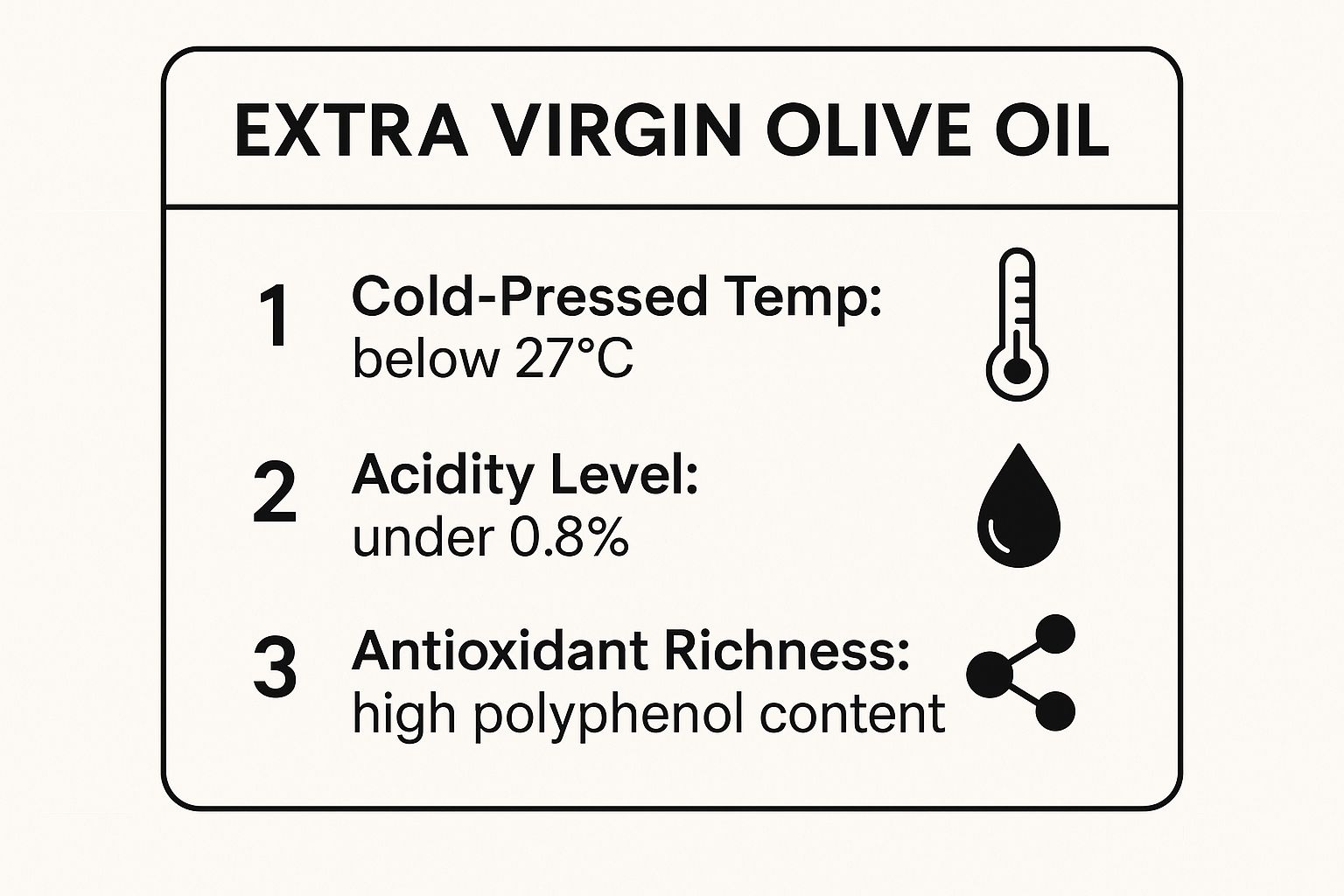
The infographic above provides a quick reference summarizing the key attributes of EVOO: its unrefined nature, low acidity, richness in antioxidants, and distinct flavor profile. This visual representation clearly highlights what sets EVOO apart from other types of olive oil.
EVOO is unrefined and cold-pressed at temperatures below 27°C (80°F), preserving its delicate flavors and maximizing its nutritional value. This low-temperature processing helps retain the oil's rich concentration of polyphenols, potent antioxidants linked to numerous health benefits. Among these beneficial compounds is oleocanthal, a natural anti-inflammatory agent. EVOO's flavor profile is robust and complex, varying based on the olive variety and region of origin. Its color can range from deep green to golden, reflecting the ripeness of the olives and specific production methods.
Features and Benefits of EVOO:
- Unrefined and Cold-Pressed: Ensures maximum nutrient retention and a pure, natural flavor.
- Low Acidity: A key indicator of quality, with EVOO having an acidity level of less than 0.8%.
- Rich in Antioxidants: Contains high levels of polyphenols and oleocanthal, offering potential health benefits.
- Robust Flavor Profile: Provides a complex and desirable taste, enhancing culinary creations.
Pros:
- Highest Nutritional Value: Offers the most concentrated source of antioxidants and vitamins among olive oil types.
- Superior Taste: Boasts complex flavor profiles that elevate dishes.
- Health Benefits: Associated with reduced inflammation and other health advantages.
- Medium-Heat Stability: Maintains its integrity when heated to medium temperatures, making it suitable for various cooking applications.
Cons:
- High Cost: The most expensive type of olive oil due to its production process and quality standards.
- Shorter Shelf Life: Typically lasts 12-18 months, requiring proper storage.
- Lower Smoke Point: Has a lower smoke point (375-405°F) compared to refined oils, limiting its use in high-heat cooking.
- Intense Flavor: The robust flavor may be overpowering for some dishes.
- Susceptibility to Fraud: Its premium status makes it a target for counterfeiting.
This video provides a visual guide to understanding EVOO's qualities and production.
Examples of EVOO:
- Frantoia EVOO (Sicily, Italy)
- California Olive Ranch EVOO (California, USA)
- Cobram Estate EVOO (Australia)
- Gaea Fresh EVOO (Greece)
Tips for Using and Storing EVOO:
- Store in a cool, dark place away from heat and light.
- Best used for finishing dishes, dressings, and low to medium-heat cooking.
- Look for harvest dates on bottles to ensure freshness.
- Purchase in dark glass bottles or tins to protect from light degradation.
- A peppery sensation at the back of the throat indicates high polyphenol content, a desirable characteristic of high-quality EVOO.
EVOO's unique characteristics and health benefits have been popularized by Mediterranean cultures, particularly Italy, Spain, and Greece, where it forms a cornerstone of their diets. Chefs like Jamie Oliver frequently champion its use, and brands like Bertolli, Colavita, and Filippo Berio have made it widely accessible. The International Olive Council (IOC) plays a crucial role in regulating and promoting the quality of olive oil, including EVOO, worldwide. When exploring the different types of olive oil, EVOO's exceptional quality and flavor make it a clear standout and a worthy investment for discerning consumers.
2. Virgin Olive Oil
When exploring different types of olive oil, Virgin Olive Oil stands as a strong contender, offering a balance of quality and affordability. Positioned just below Extra Virgin Olive Oil (EVOO) in the quality hierarchy, Virgin Olive Oil is a valuable player in the culinary world. It's made using the same mechanical extraction process as EVOO – crushing olives without the use of chemicals or excessive heat – ensuring a natural and wholesome product. This approach preserves many of the health benefits associated with olive oil, making it a smart choice for health-conscious consumers.
So, what differentiates Virgin Olive Oil from EVOO? The key lies in the slightly higher acidity levels (between 0.8% and 2.0%) and the potential presence of minor sensory defects. These subtle imperfections, perhaps a slightly less vibrant flavor or a hint of bitterness, prevent it from achieving the coveted extra virgin classification. However, don't let this deter you. Virgin Olive Oil still retains a good flavor and boasts a rich nutritional profile.
Features of Virgin Olive Oil:
- Unrefined and Cold-Pressed: Processed at temperatures below 27°C (80°F) to maintain quality.
- Acidity Level: Between 0.8% and 2.0%.
- Sensory Profile: May have slight defects not detectable in EVOO.
- Flavor: Good, but less intense and complex than EVOO.
- Color: Natural hues ranging from green to yellow.
Pros:
- Cost-Effective: A more budget-friendly option compared to EVOO.
- Nutrient-Rich: Good source of monounsaturated fats and antioxidants.
- Versatile Flavor: Its milder flavor profile complements a wide range of dishes without overpowering delicate ingredients.
- Chemical-Free Processing: Retains natural goodness.
- Medium Smoke Point: Suitable for most cooking methods, including sautéing and baking.
Cons:
- Lower Antioxidant Content: Contains fewer polyphenols and antioxidants compared to EVOO.
- Less Complex Flavor: Lacks the robust and nuanced flavor of EVOO.
- Limited Availability: Not as readily available in some retail markets as EVOO or refined olive oils.
- Potential for Mislabeling: Sometimes confused with or mislabeled as EVOO.
- Shorter Shelf Life: Typically has a shelf life of around 12 months.
Examples of Virgin Olive Oil:
- Partanna Virgin Olive Oil from Sicily
- Merula Virgin Olive Oil from Spain
- Many co-op produced virgin olive oils in Mediterranean countries
Tips for Using Virgin Olive Oil:
- Everyday Cooking: A great alternative to EVOO for daily use.
- Balancing Flavors: Ideal for recipes where a subtle olive oil flavor is desired, but EVOO might be too dominant.
- Proper Storage: Store in a cool, dark place away from heat and light.
- Freshness: Use within one year of purchase for optimal flavor and quality.
- Cooking Applications: Excellent for marinades, sautéing, and medium-heat cooking.
Virgin Olive Oil earns its place among the different types of olive oil due to its balance of quality, versatility, and value. While it may not reach the premium status of EVOO, it offers a healthy and flavorful option for a variety of culinary applications. By understanding its characteristics and proper usage, you can confidently incorporate Virgin Olive Oil into your cooking repertoire and enjoy its many benefits. It’s a testament to the fact that you don't always need the "best" to enjoy something good.
3. Pure Olive Oil
When exploring different types of olive oil, "Pure Olive Oil" often causes confusion. Don't let the name fool you; this type isn't "pure" in the sense of being unprocessed. Instead, Pure Olive Oil (sometimes simply labeled as 'Olive Oil') sits in the middle tier of olive oil quality, offering a compromise between price and some of the health benefits associated with olive oil. It's a blend of refined olive oil and virgin olive oil, making it a distinct choice among the different types of olive oil available.
This blend typically consists of 80-90% refined olive oil and 10-20% virgin olive oil. The refined component undergoes chemical processing to neutralize strong flavors, remove defects, and improve its color. This process, however, strips away many of the natural aromas, flavors, and beneficial compounds found in virgin olive oils. Adding back a small percentage of virgin olive oil helps restore some flavor, color, and nutritional value to the final product. This results in an oil with an acidity level of less than 1.0% and a lighter color than virgin olive oils.
Features of Pure Olive Oil:
- Blend of refined and virgin olive oil (typically 80-90% / 10-20%)
- Acidity level less than 1.0%
- Lighter color than virgin olive oils
- Mild olive flavor
- Higher smoke point (around 470°F/240°C) than virgin olive oils
Pros:
- More affordable: Compared to virgin and extra virgin olive oils, Pure Olive Oil is a budget-friendly option.
- Longer shelf life: Proper storage can extend its shelf life up to two years.
- Higher smoke point: Suitable for various cooking methods, including frying and sautéing, without the risk of burning or producing harmful compounds.
- Consistent, mild flavor: Won't overpower delicate dishes.
- Retains some nutritional benefits: While not as potent as virgin oils, it still offers some of the health benefits of olive oil.
Cons:
- Significantly reduced polyphenol and antioxidant content: The refining process removes many of these valuable compounds.
- Less distinctive flavor: Lacks the robust, fruity flavor of virgin olive oils.
- Misleading name: Can confuse consumers into thinking it's a completely unprocessed oil.
- Not ideal for flavor-forward applications: Not recommended for dressings, dips, or dishes where a prominent olive flavor is desired.
Examples of Pure Olive Oil:
- Bertolli Pure Olive Oil
- Goya Pure Olive Oil
- Pompeian Pure Olive Oil
Tips for Using Pure Olive Oil:
- High-heat cooking: Excellent for frying, sautéing, and other high-heat cooking methods.
- All-purpose cooking: A good choice when a neutral oil is needed and olive flavor isn't a priority.
- Economical option: Ideal for recipes requiring large quantities of oil.
- Avoid for flavor: Not recommended for dressings or dishes where a distinct olive flavor is desired.
- Other uses: Can be used for making homemade soaps and skincare products.
Why Pure Olive Oil Deserves Its Place on the List of Different Types of Olive Oil:
Pure Olive Oil fills a specific niche in the market. While it may not have the rich flavor profile and high antioxidant content of extra virgin olive oil, its affordability, higher smoke point, and mild flavor make it a practical choice for everyday cooking. Understanding the characteristics of different types of olive oil, including Pure Olive Oil, empowers consumers to make informed choices based on their culinary needs and budget. Pure Olive Oil was popularized by commercial brands looking for more affordable options, restaurants seeking cost-effective cooking oils, and ultimately, the International Olive Council's classification system.
4. Light Olive Oil
When exploring different types of olive oil, you'll likely encounter "Light" olive oil, a category that often causes confusion. It's important to understand that "light" in this context refers solely to the oil's color and flavor, not its calorie or fat content. Light olive oil is essentially refined olive oil that has undergone extensive processing, stripping away much of its natural color, aroma, and flavor. A small amount of virgin olive oil is typically added back in after refining. This earns its place on the list of different types of olive oil because it fills a specific niche for those seeking the functional benefits of olive oil without the distinctive taste.
Light olive oil is characterized by its highly refined nature, resulting in a minimal olive flavor and aroma. Its color ranges from a pale yellow to almost clear. One of its key features is its high smoke point of approximately 465-470°F (240-243°C), making it suitable for high-heat cooking methods. This type of olive oil has a neutral taste that doesn't impart a strong olive flavor to foods, which can be desirable in certain culinary applications.
Pros:
- High Smoke Point: One of the highest smoke points among olive oils, ideal for frying, searing, and other high-heat cooking methods.
- Neutral Flavor: Works well in baking and recipes where a pronounced olive taste is undesirable. Think cakes, cookies, and even mayonnaise or aioli.
- Longer Shelf Life: Compared to virgin olive oils, light olive oil has a longer shelf life, often up to two years.
- Affordability: Generally less expensive than virgin olive oils.
- Retains Some Benefits: While reduced, light olive oil still retains some of the basic benefits of oleic acid, a healthy monounsaturated fat.
Cons:
- Minimal Antioxidants: The refining process significantly reduces the levels of beneficial antioxidants and polyphenols.
- Limited Nutritional Value: Compared to virgin olive oils, it offers fewer nutritional benefits.
- Misleading Name: The "light" designation can mislead consumers into believing it's lower in calories or fat, which is not the case.
- Heavily Processed: Undergoes extensive processing, often involving chemical treatments.
- Lacks Characteristic Flavor: Missing the robust, fruity flavor that makes olive oil a prized ingredient in many dishes.
Examples: Common brands include Bertolli Light Tasting Olive Oil, Pompeian Light Taste Olive Oil, and Star Light Olive Oil.
Tips for Using Light Olive Oil:
- Baking: Ideal for cakes, cookies, and other desserts where a neutral oil is preferred.
- High-Heat Cooking: A good choice for frying, searing, and sautéing.
- Mayonnaise and Aioli: Perfect for these emulsions when olive flavor isn't desired.
- Seasoning Cast Iron: Its high smoke point makes it suitable for seasoning cast iron cookware.
- Storage: Store in a cool, dark place, even though it has better stability than virgin olive oils.
Light olive oil was popularized by American food companies marketing to consumers who wanted some perceived benefits of olive oil without the strong flavor. It also gained traction among baking enthusiasts looking for healthier oil alternatives and restaurants needing high-heat cooking oils with a longer shelf life. While it may not be the most flavorful or nutritionally rich option among different types of olive oil, light olive oil serves a practical purpose in specific cooking scenarios.
5. Olive Pomace Oil
Olive Pomace Oil represents the final stage in olive oil production. Unlike other types of olive oil derived directly from pressing olives, pomace oil is extracted from the leftover olive pulp, skins, and pits – the pomace – after the initial pressing for virgin oils. This remaining material still contains a small amount of oil, but it requires chemical solvents, typically hexane, to extract it. After extraction, the resulting oil undergoes heavy refining to remove impurities and neutralize odors, resulting in a neutral-tasting product. Finally, a small percentage (usually 5-10%) of virgin olive oil is blended back in to add some flavor. This process places olive pomace oil as the lowest grade of olive oil available commercially among different types of olive oil.
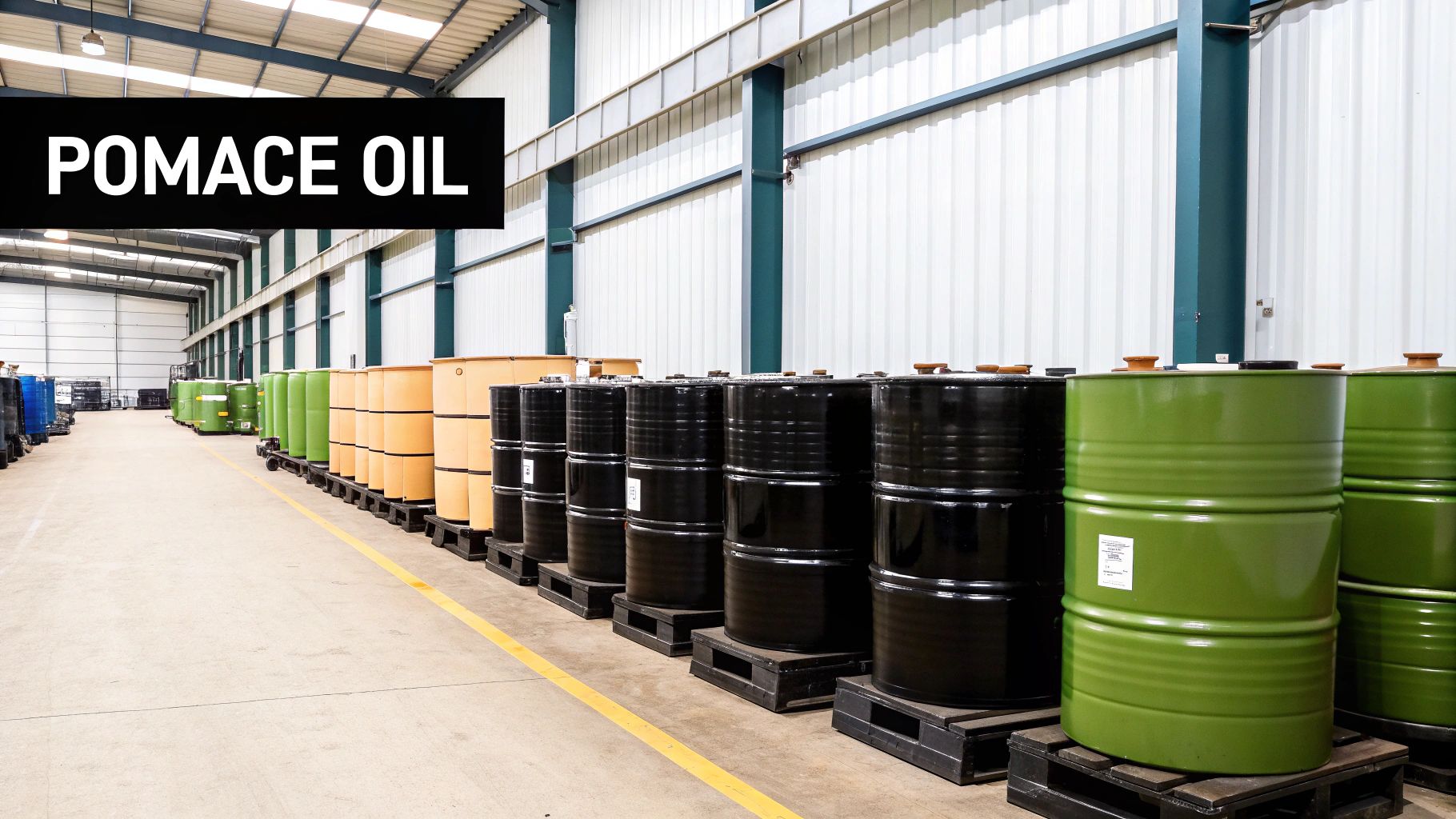
The defining feature of olive pomace oil is its extraction process. While other types of olive oil, like extra virgin and virgin, are produced solely through mechanical means, pomace oil necessitates chemical intervention. This process, although allowing for maximum oil extraction from the olive fruit, impacts the oil’s flavor and nutritional profile. The resulting oil has a pale yellow color, a high smoke point (around 460-470°F or 238-243°C), and a minimal olive flavor. Brands like Carbonell and Borges offer pomace olive oil, and it's frequently used in store brands and bulk commercial oils.
Olive pomace oil deserves a place on this list of different types of olive oil because it fulfills a specific niche: providing a cost-effective, high-heat cooking oil. It is particularly prevalent in the commercial food service industry and in food manufacturing where cost is a primary concern.
Pros:
- Most economical: It is significantly cheaper than other types of olive oil.
- High smoke point: Ideal for deep frying and other high-heat cooking methods.
- Long shelf life: Can last up to two years.
- Consistent performance: Its neutral flavor and consistent quality make it suitable for standardized cooking applications.
- Sustainable practice: Utilizes olive by-products that would otherwise be discarded.
Cons:
- Lowest quality: Offers minimal nutritional benefits compared to other types of olive oil.
- Chemical extraction: The use of hexane in the extraction process raises concerns for some consumers.
- Potential trace solvents: Although refined, the possibility of residual solvents remains.
- Historical safety concerns: The 1981 toxic oil syndrome incident in Spain, though linked to fraudulently labeled rapeseed oil and not pomace oil itself, created lasting apprehension about chemically extracted oils.
- Limited recognition: Some countries don't classify it as true olive oil.
Tips for Using Olive Pomace Oil:
- Best suited for commercial frying operations or industrial food production where large quantities of high-heat cooking oil are needed.
- Not recommended for salad dressings, dips, or other applications where the delicate flavor of olive oil is desired.
- Can be used for soap making and cosmetic applications.
- Store in a cool, dark place away from direct sunlight.
While olive pomace oil has its place, particularly for cost-conscious consumers and commercial applications, it's essential to understand its limitations. If you prioritize flavor and nutritional value, other types of olive oil like extra virgin or virgin olive oil are better choices. However, if your primary need is a high-heat cooking oil at an economical price, olive pomace oil fulfills that role effectively.
6. Infused Olive Oil
Infused olive oil stands out among the different types of olive oil as a flavorful and versatile option. It's created by imbuing extra virgin or virgin olive oil with the essence of various herbs, spices, fruits, or other natural flavorings. This process can be achieved through two primary methods: cold infusion and co-pressing. Cold infusion involves steeping the flavoring ingredients in the oil over time, allowing their flavors to slowly meld with the olive oil. Co-pressing, on the other hand, involves crushing the flavoring ingredients together with the olives during the oil extraction process, resulting in a more intense and integrated flavor. Infused oils add depth and complexity to dishes, offering a convenient way to impart distinctive flavors with minimal effort.
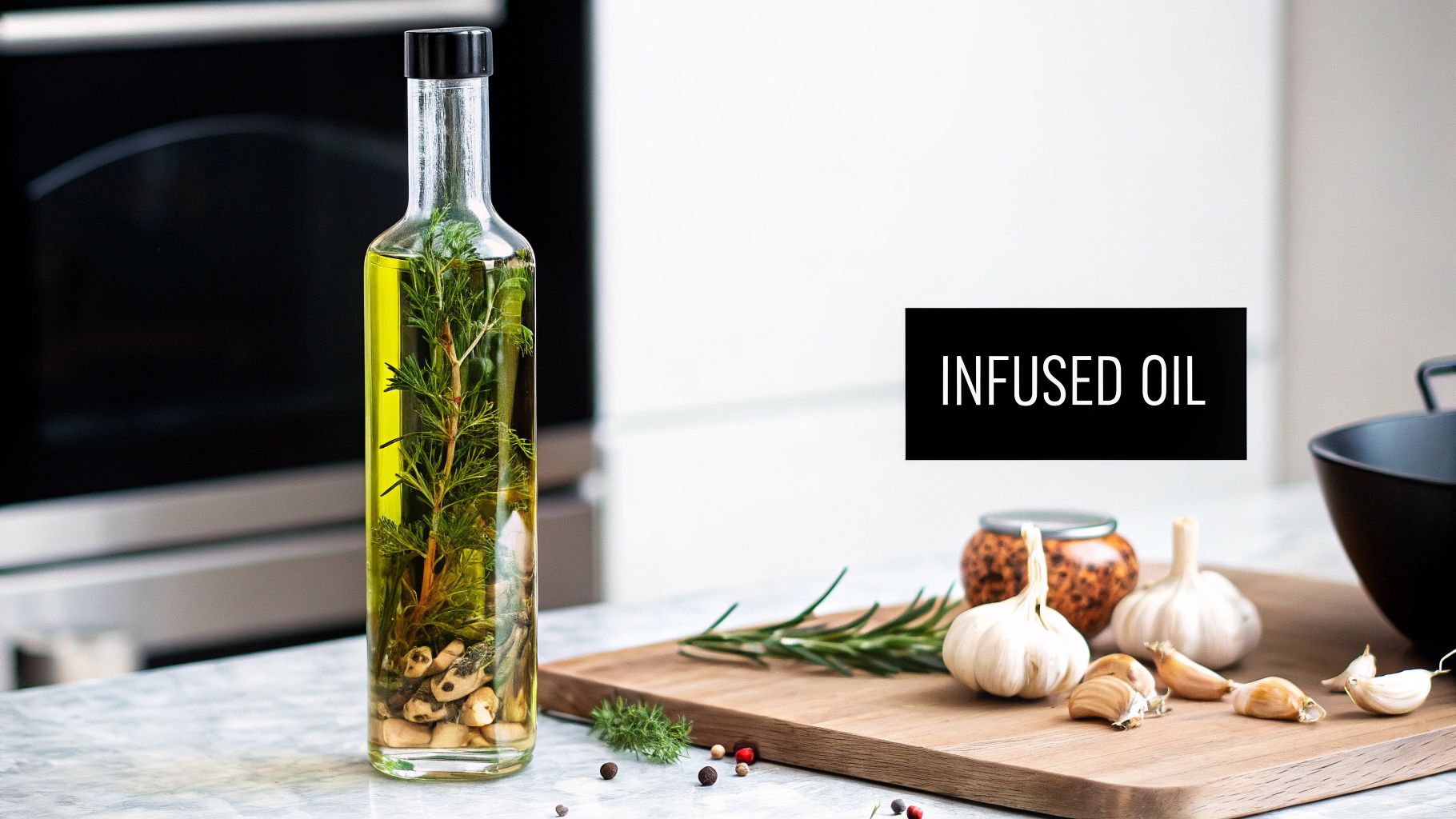
Infused olive oils typically use a base of high-quality virgin or extra virgin olive oil. The range of potential infusions is vast, encompassing popular choices like garlic, chili, lemon, basil, rosemary, and the luxurious truffle. These oils are readily available commercially, with brands like Williams-Sonoma, O&Co., TruffleHunter, and California Olive Ranch offering a diverse selection. Alternatively, infused olive oils can be crafted at home, allowing for personalized flavor combinations and control over the ingredients. The visual appeal of infused oils is often enhanced by the presence of visible herbs or ingredients suspended within the oil, adding an aesthetic touch to both the bottle and the finished dish. The intensity of the flavor varies depending on the infusion method, the specific ingredients used, and the duration of the infusion process.
Pros:
- Adds complex flavors to dishes without requiring extensive preparation.
- Creates distinctive finishing oils that can elevate simple dishes.
- Makes excellent and personalized homemade gifts.
- Allows for customization to suit individual taste preferences, enabling creative culinary expressions.
Cons:
- Generally has a shorter shelf life (3-6 months for homemade versions) compared to non-infused oils.
- Improper homemade preparation can present potential food safety concerns, particularly the risk of botulism if fresh ingredients are used incorrectly.
- The quality of commercially produced infused oils can vary significantly.
- Can be more expensive than regular olive oil.
Tips for Using and Making Infused Olive Oil:
- Use infused olive oils as finishing oils rather than cooking oils to preserve the delicate flavors, which can be damaged by high heat.
- For homemade infusions, prioritize dried herbs over fresh herbs to minimize the risk of botulism.
- Store infused olive oils in dark-colored bottles in the refrigerator to extend their shelf life and protect them from light and heat.
- Infused olive oils are excellent for bread dipping, drizzling over pasta, adding a finishing touch to soups, and enhancing salads.
- Consider creating custom blends of herbs and spices tailored to specific cuisines, such as Mediterranean herb blends or Asian-inspired spice infusions.
Infused olive oil deserves a prominent place on this list of different types of olive oil due to its versatility and ability to transform ordinary dishes into gourmet experiences. Its unique characteristics, combined with the ease of use and the wide array of available flavors, make it a valuable addition to any kitchen. The popularization of infused olive oils can be attributed to gourmet food shops like Williams-Sonoma and Dean & DeLuca, celebrity chefs like Ina Garten and Jamie Oliver, specialty olive oil retailers, and the growing farm-to-table movement that emphasizes artisanal food products.
7. Organic Olive Oil
When exploring different types of olive oil, organic olive oil stands out as a popular choice for health-conscious and environmentally aware consumers. This type of olive oil isn't defined by its grade (like extra virgin or virgin) but by how the olives are grown and processed. It represents a commitment to sustainable agriculture and minimizing exposure to synthetic chemicals.
Organic olive oil is produced from olives cultivated without the use of synthetic pesticides, herbicides, fertilizers, or genetically modified organisms (GMOs). The entire production process, from grove to bottle, must adhere to strict organic standards and be certified by authorized organizations. These organizations, such as the USDA Organic (US), EU Organic, or similar bodies, verify that producers meet stringent requirements for organic practices. This often involves natural pest control methods like introducing beneficial insects or using traditional and sustainable farming techniques.
Features and Benefits:
- Grown without synthetic inputs: No synthetic pesticides, herbicides, or fertilizers are used in the cultivation of the olives.
- Certified organic: Production is certified by recognized organizations ensuring adherence to organic standards.
- Sustainable practices: Often involves traditional or sustainable farming practices that promote soil health and biodiversity.
- Potentially fewer contaminants: May contain fewer residues of synthetic chemicals compared to conventional olive oils.
Pros:
- Reduced chemical exposure: Minimizes exposure to potentially harmful agricultural chemicals.
- Environmentally friendly: Supports more sustainable agricultural practices, protecting ecosystems and biodiversity.
- Supports smaller farms: Often produced by smaller farms employing artisanal approaches to olive cultivation.
- May be healthier: Potential for reduced contaminant levels can be a health benefit for consumers.
Cons:
- Higher cost: Significantly more expensive than conventional olive oils due to lower yields and increased production costs.
- Taste and quality not guaranteed: Organic certification focuses on farming practices, not necessarily taste or quality. An organic olive oil can still be poorly made.
- Potential for higher environmental footprint per bottle: Lower yields sometimes translate to a larger environmental footprint per bottle produced, a counterintuitive consequence.
- Limited availability: May be less readily available than conventional olive oils, depending on your location.
- Varying certification standards: Organic certification standards can vary between countries and regions, making comparisons complex.
Examples:
- Bragg Organic Extra Virgin Olive Oil
- California Olive Ranch Organic Extra Virgin Olive Oil
- Terra Delyssa Organic Extra Virgin Olive Oil from Tunisia
- Bionaturae Organic Extra Virgin Olive Oil from Italy
Tips for Choosing and Using Organic Olive Oil:
- Look for certification: Verify authenticity by checking for reputable organic certification symbols on the packaging.
- Check harvest date: Organic doesn't mean fresh. Always check the harvest date for optimal quality and flavor.
- Proper storage: Store away from light and heat to preserve the oil's quality and organic integrity.
- Use according to grade: Like other types of olive oil, use based on the grade (extra virgin for salads and dips, virgin or refined for cooking).
- Consider buying direct: Purchasing directly from organic producers can offer better quality assurance and traceability.
Organic olive oil deserves its place on the list of different types of olive oil because it offers a choice that aligns with the values of consumers prioritizing health, environmental sustainability, and supporting sustainable agricultural practices. While it comes at a premium, the benefits for personal well-being and the planet make it a compelling option within the diverse world of olive oil.
8. Protected Designation of Origin (PDO) Olive Oil
When exploring different types of olive oil, Protected Designation of Origin (PDO) olive oil stands out as a mark of superior quality and regional authenticity. PDO is a legally protected geographical indication granted by the European Union to agricultural products, including olive oil, that possess unique characteristics directly linked to their place of origin. This designation assures consumers that the oil has been produced, processed, and prepared within a specific geographical region using traditional methods, preserving both cultural heritage and distinct flavors. This makes PDO a significant consideration for discerning olive oil buyers.
How does the PDO system work? It establishes strict regulations regarding the entire production process, from the specific olive varieties permitted to the cultivation techniques employed. Factors like climate, soil conditions, and even the traditional knowledge passed down through generations contribute to the final product's distinctive characteristics. This rigorous adherence to regional specifications and time-honored practices is what sets PDO olive oil apart.
Features and Benefits of PDO Olive Oil:
- Guaranteed Authenticity and Traceability: PDO status ensures the oil's origin and production methods are verifiable, offering consumers confidence in its authenticity.
- Preservation of Traditional Practices: PDO supports local communities by encouraging the continuation of traditional farming and production methods.
- Distinctive Regional Characteristics: The unique terroir of each designated region imparts specific flavor profiles and qualities to the oil, reflecting the local environment.
- Higher Quality Standards: The stringent regulations governing PDO production often result in higher quality olive oils with exceptional flavor and aroma.
Pros and Cons:
| Pros | Cons |
|---|---|
| Guaranteed authenticity and traceability | Premium price point |
| Preservation of cultural heritage | Limited production volumes and availability |
| Typically higher quality | May be less known outside of Europe |
| Support for local economies | Regulations can sometimes restrict innovation |
| Protection against imitation and fraud | Similar non-EU systems use different terminology |
Examples of PDO Olive Oil:
- Kalamata PDO (Greece): Known for its robust flavor and fruity aroma, often with a slightly peppery finish.
- Siurana PDO (Catalonia, Spain): Characterized by its balanced flavor profile with hints of almond and green apple.
- Toscano IGP (Tuscany, Italy): (While technically an IGP – Protected Geographical Indication – which has slightly less stringent regulations than PDO, it still represents a geographically linked product.) Offers a delicate, fruity flavor with a slightly bitter note.
- Baena PDO (Andalusia, Spain): Recognized for its intense fruitiness and balanced bitterness.
- Terra di Bari PDO (Puglia, Italy): Often presents a fruity aroma with hints of almond and artichoke.
Tips for Choosing and Using PDO Olive Oil:
- Appreciate regional differences: Explore PDO oils from various regions to discover the diverse flavor profiles.
- Use as a finishing oil: Drizzle PDO oil over salads, soups, or grilled vegetables to enhance their flavor.
- Pair with regional cuisine: Combine PDO oils with dishes from their region of origin for an authentic culinary experience.
- Look for the PDO symbol: The red and yellow PDO symbol on the packaging guarantees authenticity.
Why PDO Olive Oil Deserves Its Place:
PDO olive oil represents the pinnacle of quality and regional expression in the world of olive oil. By protecting traditional methods and guaranteeing authenticity, PDO ensures that consumers can experience the true essence of a specific terroir. This focus on quality, traceability, and regional character elevates PDO olive oil above standard olive oils, justifying its premium price point and making it a worthy addition to any discerning olive oil enthusiast's pantry. This makes PDO olive oil a must-try when exploring the different types of olive oil available.
Comparison of 8 Olive Oil Types
| Olive Oil Variety | Implementation Complexity 🔄 | Resource Requirements ⚡ | Expected Outcomes 📊 | Ideal Use Cases 💡 | Key Advantages ⭐ |
|---|---|---|---|---|---|
| Extra Virgin Olive Oil (EVOO) | High – Requires cold-pressing, testing | High – Early harvest, skilled tasters | Superior flavor, high antioxidants, reduced inflammation | Finishing dishes, dressings, low to medium heat cooking | Highest nutritional value, complex flavor |
| Virgin Olive Oil | Medium – Mechanical processing only | Moderate – Cold-pressed olives | Good flavor, moderate antioxidants | Everyday cooking, medium-heat applications | Good nutrition at lower cost than EVOO |
| Pure Olive Oil | Medium – Blend of refined & virgin oil | Moderate – Refining and blending | Mild flavor, longer shelf life, higher smoke point | High-heat cooking, general-purpose cooking | Affordable, stable for frying and sautéing |
| Light Olive Oil | High – Extensive refining processes | Moderate – Chemical treatments | Neutral flavor, very high smoke point | Baking, high-heat frying, when neutral oil needed | High smoke point, neutral taste |
| Olive Pomace Oil | High – Solvent extraction and refining | Low – Uses olive by-products | Minimal flavor, longest shelf life | Industrial frying, bulk commercial use | Most economical, high heat tolerance |
| Infused Olive Oil | Variable – Base oil plus infusion methods | Moderate – Additional ingredients & flavoring | Complex, distinctive flavors | Finishing oils, drizzling, enhancing simple dishes | Customizable, gourmet flavor additions |
| Organic Olive Oil | High – Certified organic cultivation | High – Organic farming & certification | Cleaner production, environmentally sustainable | Health-conscious cooking, raw and cooked dishes | Reduced chemical exposure, supports sustainability |
| PDO Olive Oil | Very High – Region-specific, regulated | High – Strict regional & production controls | Distinctive regional flavor, guaranteed authenticity | Finishing, pairing with regional cuisine | Authenticity, cultural heritage, premium quality |
Choosing Your Perfect Olive Oil
From the robust flavors of extra virgin olive oil (EVOO) drizzled over a fresh salad to the subtle notes of light olive oil used in baking, understanding the different types of olive oil empowers you to make informed choices in the kitchen and beyond. We've explored eight key varieties, ranging from the familiar pure olive oil and versatile virgin olive oil to the specialized infused and PDO olive oils. Remembering the distinctions between these categories—considering factors like processing methods, acidity levels, and flavor profiles—allows you to select the best oil for every culinary creation. When choosing olive oil, consider the packaging's environmental impact as part of a health-conscious lifestyle. For sustainable packaging options, explore resources like Eco Friendly Takeout Containers: Sustainable Packaging Tips from MrTakeOutBags.com: eco-friendly takeout containers.
Mastering your understanding of different types of olive oil is more than just a culinary skill; it’s an investment in flavor, health, and mindful consumption. By selecting the right olive oil, you elevate the taste of your dishes, potentially benefit from the health-protective properties of high-quality EVOO, and support sustainable practices. Embrace the nuances of this liquid gold and discover the perfect olive oil to enhance your culinary journey.
Want to dive even deeper into the world of olive oil? Visit Learn Olive Oil to expand your knowledge about different types of olive oil, discover new recipes, and connect with a community of olive oil enthusiasts.

 Learn Olive Oil
Leave a comment